

Passing the #PMP Exam—Study Group Discussions (Chapter 2—Stakeholders)
1. Stakeholder definition
The concept of stakeholders consists of three parts in PMBOK® Guide:
| Stakeholder | Person or organization that is actively involved in the project, or whose interests may be positively or negatively affected by execution or completion of the project. A stakeholder may also exert influence over the project and its deliverables. |
The first idea in our discussion group of a “stakeholder” was the first part of the definition, someone or some organization actively involved in the project. But the guide goes into detail regarding the second part of the definition, showing that a stakeholder is one who may not necessarily be involved in the project, but whose interests may be affected by the project either positively or negatively. The third part is the reverse of the second, showing that it is not just who or what can be affected by the project, but who or what can affect the project (either positively or negatively).
A local environmental group could be considered a negative stakeholder for a new refinery project for example, because they could protest against the project and cause it to be shut down because the bad publicity is something upper management does not want. A government regulatory authority might also be a negative stakeholder if the new project is found not to conform to governmental regulations.
The key points to remember:
- stakeholders may be positive or negative,
- may be within the organization, outside of the organization but with a business relationship to it, or some organization in society that is somehow affected by the project
Now there is a diagram of all the stakeholders in the PMBOK® Guide page 24. The diagram was complete in that it listed all of the categories of stakeholders; however, it was a bit confusing because it lumped together all of the stakeholders that were external to the project itself, whether they were within the company or outside of it.
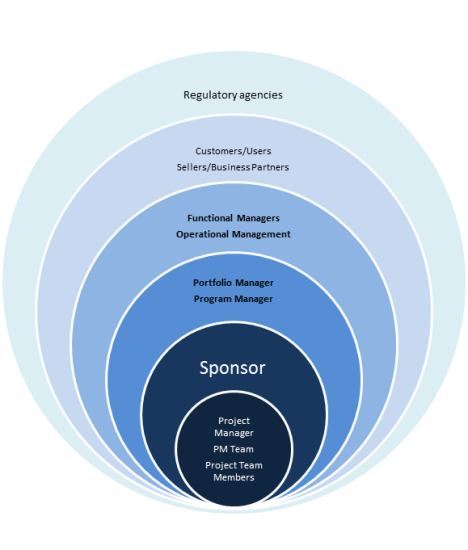
So here’s my attempt to make the categories a little bit more understandable. Here are the categories of stakeholders on a project, starting with the team working on the project itself and the circles of influence stronger (to match the font size) and then weaker as the relationship goes outward.
Fig. 1. Categories of Stakeholders on a Project
-
The innermost circle is that of the people actually working on the project, namely the Project Manager, the Project Management Team (the other members of the team that assist with the management of the project), and the Project Team members who actually do the work.
-
The second circle is that of the Sponsor, the person or group that provides the financial resources for the project and the one who champions the project within the organization when it is first conceived. The Sponsor acts as a spokesperson to higher levels of management within the organization, which is why I placed the Sponsor in the second circle.
-
The third circle contains those higher-level organizers of projects, such as the program manager, who manages related projects in a coordinated way, and a portfolio manager, who manages a collection of projects or programs which may not be related in content, but which all serve the business model of the organization at large. I put them in this circle because they monitor the performance of the project and can even terminate if the business case for the project no longer holds.
- The next circle is still within the organization, but rather than the three inner circles that deal with project work, this circle represents the interests of the ongoing operational work, with the functional managers in charge of areas such as human resources, finance, accounting, and procurement. Depending on the type of organization, project managers will have to negotiate with them to allow their staff with expertise that would assist the project to work on that project for its duration. The operations management people will have to be consulted during the course of the project, because the project when completed is often handed off to them on account of the fact that they take care of normal operations and will provide long term support for the result of the project.
- Now we get to the circle which is outside of the organization, but one in which there is a business relationship between the organization and that stakeholder, such as sellers/business partners (vendors and suppliers, for example) in the case of a B2B relationship, and customers/users in the case of a B2C relationship.
- The last circle consists of elements of society that may not have any formal relationship to the organization, but which may contain groups that are affected by the project or that can influence the project. The PMBOK® Guide labels this group generically as “Other Stakeholders”, but I have put an example of “Regulatory Agencies” as just one type of entity that could be considered a stakeholder. A non-governmental organization such as an environmental awareness group that is an NGO would also be an example of a stakeholder at this level.
These concentric circles, I believe, show a little more of the different kinds of stakeholders and why some of them have more influence than others. I found this diagram helpful for our group to gain awareness of the different types of stakeholders, and I hope that it is helpful for those studying for the PMP exam as well.
That concludes this series of blog posts on the 2nd chapter of the PMBOK® Guide on the Framework of Project Management. The 3rd chapter covers the processes of Project management, and I will cover this chapter in a series of blog posts next week.
Filed under: Uncategorized |
 4squareviews
Leave a comment