

1. Introduction—GAMES 1 and 2 (memorizing by knowledge area, process group)
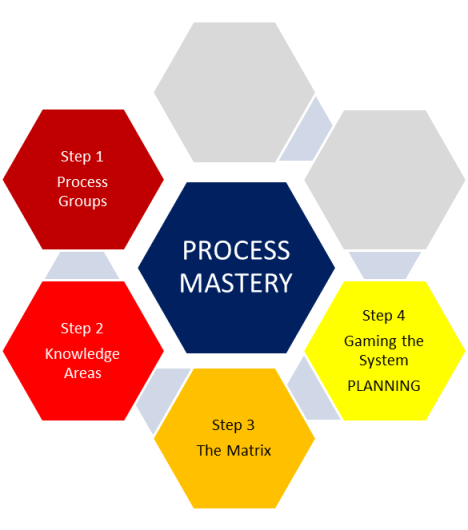
This series of posts on step 4 of mastering the processes refers to “gaming the system” in the sense of making flashcards with the various process names on one side and the details of those processes on the others. The goal is to be able to complete these two games. For details, see the post for 08/01 on the INITIATING PROCESS GROUP.
GAME 1.
Shuffle the flashcards and put the 42 processes in order by knowledge area. You need to be able to do this within 10 minutes or less.
GAME 2.
Shuffle the flashcards and put the 42 processes in order by process group. You need to be able to do this within 10 minutes or less.
2. Processes in the Planning Process Group
| Process Group |
Process Number |
Process Name |
Process Description |
| Planning | 4.2 | Develop Project Management Plan | Documents integration of all subsidiary plans (from all knowledge areas); project management plan is primary source on how to manage project across all PM process groups |
| Planning | 5.1 | Collect Requirements | Defining and documenting stakeholders’ needs to meet the project objectives. |
| Planning | 5.2 | Define Scope | Developing a detailed description of the project and product. |
| Planning | 5.3 | Create WBS | Subdivides project deliverables and project work into smaller, more manageable components. |
| Planning | 6.1 | Define Activities | Identifying actions to be performed to produce product deliverables. |
| Planning | 6.2 | Sequence Activities | Identifying and documenting relationships among the project activities. |
| Planning | 6.3 | Estimate Activity Resources | Estimating type and quantities of resources (human and material) required to perform each activity. |
| Planning | 6.4 | Estimate Activity Durations | Approximating the number of work periods needed to complete individual activities with estimated resources. |
| Planning | 6.5 | Develop Schedule | Analyzing activity sequences, durations, resources requirements, and schedule constraints to create product schedule. |
| Planning | 7.1 | Estimate Costs | Developing an approximation of the monetary resources needed to complete project activities. |
| Planning | 7.2 | Determine Budget | Sums up the estimated costs and add reserves to establish an authorized cost baseline. |
| Planning | 8.1 | Plan Quality | Identifying quality requirements and/or standards for the project and product; documenting how project will demonstrate compliance. |
| Planning | 9.1 | Develop Human Resources Plan | Identifying project roles and responsibilities; create staffing management plan. |
| Planning | 10.2 | Plan Communications | Determining the needs of project stakeholders for information and defining a communication approach. |
| Planning | 11.1 | Plan Risk Management | Defining how to conduct risk management activities for a project. |
| Planning | 11.2 | Identify Risks | Determining which risks may affect the project objectives and documenting their characteristics. |
| Planning | 11.3 | Perform Qualitative Risk Analysis | Prioritizing risks for further analysis by assessing likelihood & impact. |
| Planning | 11.4 | Perform Quantitative Risk Analysis | Numerically analyzing the effect of risks on project objectives. |
| Planning | 11.5 | Plan Risk Responses | Developing options and actions to enhance opportunities and reduce risk. |
| Planning | 12.1 | Plan Procurements | Project purchasing decisions, identifying potential sellers. |
4.2 Develop Project Management Plan
The Project Management or PM Plan is actually the “mother of all plans”, meaning it combines the individual plans that cover all of the other knowledge areas and integrates them together.
NOTE: All of the processes in the Executing and Monitoring & Controlling Process groups have the phrase “project management plan” in them, so it shows you how vital this process is.
5.1 Collect Requirements
What do the stakeholders require to meet the project objectives? In this process you take the high-level requirements from the project charter and produce a detailed list of requirements.
Main question answered by this process: What do you need to get the project done?
5.2 Define Scope
The purpose of this process is to create a project scope statement, which puts everybody on the “same page”. This project scope statement creates a detailed description of the deliverables of the project and the work required to create them. This is where the rubber meets the road, so to speak.
Main question answered by this process: How do you get the project done IN GENERAL?
5.3 Create WBS
The previous process of “Define Scope” gives the final address of the destination, but the “Create WBS” breaks things down like the GPS system in your car which can give you specific instructions like “turn left here”, “go straight 2.0 miles”, etc. that, if followed, will get you to your destination.
Main question answered by this process: How do you get the project done IN SPECIFIC STEPS?
6.1 Define Activities
Okay, in the last planning process for the previous knowledge area, 5.3 Create WBS, the process of work to produce deliverables was broken down to the level of the work package.
This process Define Activities takes it one more step, to the level of activities.
6.2 Sequence Activities
Okay, you have a WBS which is now broken down into activities. In what order to you do them? Do you have to do them all one after another (series relationship) or can you do some of them simultaneously (parallel relationship)? By the time you are done, you know WHAT needs to be done and in WHAT ORDER.
6.3 Estimate Activity Resources
But how long will the project take? To get that answer, you need to find out WHAT RESOURCES you have to do the project, both human and material resources. For example, this process will result in telling you that you have 5 staff members, each of whom can work only ½ day or 4 hours on the project.
6.4 Estimate Activity Durations
Let’s continue with the example from the previous paragraph. If the result of 6.2 Sequence Activities is that the project will take 100 man-hours from start to finish, and you have 8 staff members who work half-time on the project, you can tell that the project will take 100 man-hours / (5 staff members x 4 hours/day) or 5 days.
6.5 Develop Schedule
This is the finalization of the schedule, the end result of the process that started in 6.1 Define Activities. This becomes the schedule baseline of the project.
If you picture what these processes DO, then you can see how the order they are listed in is quite logical.
7.1 Estimate Costs
Costs are estimated by various methods that are based on past projects, on top-down or bottom-up estimates, or on averaging between pessimistic, neutral or optimistic assumptions. This gives you an estimate or ballpark figure of the project costs.
7.2 Determine Budget
Here, in a parallel to 6.5 Determine Schedule, once you have the work packages broken down into billable units of work called activities, you can now start adding them up to get the project baseline. Add the reserves for those risks which you’ve planned for (contingency reserves) and you get the cost baseline. Finally add the reserves for those risks which you’ve NOT planned for (management reserves) and you get the cost budget.
8.1 Plan Quality
The question being answered here is: what are the quality standards that will be used on the project?
9.1 Develop Human Resources Plan
The roles and responsibilities must be agreed upon beforehand, because if there is a problem, people need to know who to turn to for expert advice or for decisions to be made. The staffing plan allows the project manager to know who is available for how much time during the course of the project.
These two questions of “what role will team members play?” and “what team members are available?” are answered in the planning stage.
10.2 Plan Communications
Using the list of stakeholders and the analysis of their interests in the project, you can now plan on answering the 5 questions of information:
- who gets told,
- what information is given them,
- at what frequency (when)
- in what form, and
- by whom
For example, routine status reports may go to a group of stakeholders, whereas critical issues may only go to a subset of them.
11.1 Plan Risk Management
This process answers the question “how will we manage risk?” Risk categories are identified in preparation for when risks are identified in process 11.2, definitions of risk probability and impact are laid down in preparation for processes 11.3-11.5, and finally the way risks are tracked and reported on are hammered out in preparation for process 11.6.
11.2. Identify Risks
Risks are identified by the various groups of stakeholders using various information-gathering techniques and are organized and put in a risk register.
11.3 Perform Qualitative Risk Analysis
The risks are rated according to two variables, their probability and their impact. This gives a general idea of their severity.
11.4 Perform Quantitative Risk Analysis
This process focuses on quantifying the impact of a particular risk on a project. The aggregate of all risks is evaluated.
11.5 Plan Risk Responses
The risks identified in 11.2, qualified in 11.3 and quantified in 11.4 are now planned for both in terms of resources and/or activities needed to reduce their impact on the project objectives.
12.1 Plan Procurements
This is where the company decides for components, software or whatever intermediate steps are needed to produce the deliverables, whether the company will make them in-house or whether it will be more cost-effective to have them made by a subcontractor or seller.
If the decision is to make them in-house, then the rest of the procurement processes 12.2-12.4 are cancelled because there are no procurements. However, if the decision is to have some of them made by sellers, then the potential sellers are identified.
Memorizing them in order as members of the planning process group is particularly important, because many of the test questions describe a situation, and ask you what you are supposed to do next. This means you have to a) identify where you are in the process flow, i.e., which of the 42 processes I am in the midst of, and b) what is the next process down the line?
If you’ve memorized the processes according to knowledge area, memorizing the order WITHIN each knowledge area is not a problem, because you’ve already done that. Memorizing the transition BETWEEN the knowledge areas, however, is a matter of recognizing in the case of those with a longer list of processes when the endpoint of the planning process has been reached. Determine Schedule, Determine Budget, and Plan Risk Responses should be recognized from the list of processes above it as the point towards which the other processes were leading. If you read the descriptions of the processes above, this will make more logical sense.
The next post will cover the EXECUTING process group, for which there are only 8 processes.
Filed under: Uncategorized |
 4squareviews
Leave a comment