

This latest series of posts is covering the Integration Knowledge Area, which as you can guess from its title, works on processes that integrate all of the processes from all of the other knowledge areas.
Since I’ve covered the first Integration process, 4.1 Develop Project Charter, in the last few posts, I am now going to cover topics related to the second Integration process, 4.2 Develop Project Management Plan.
You don’t get too many brownie points for answering the question “What’s the output of the Develop Project Management Plan?” (If you answer anything other than “the Project Management Plan,” you need to do a lot more studying.) A most interesting question is, “what are the inputs of the Project Management Plan?” I know I’ve already covered inputs and outputs to all the processes in a separate series of posts, but the Project Management Plan is a guide to the project plan in the same way that the PMBOK® Guide is a guide to the field of knowledge related to project management. So I thought it would be worthwhile to do a post outlining the inputs, and going into some detail regarding some of these inputs.
A. Inputs to Project Management Plan–PMBOK® Guide Explanation
Formally, the PMBOK® Guide on p. 78 of the Fourth Edition lists the following as the inputs for the Project Management Plan:
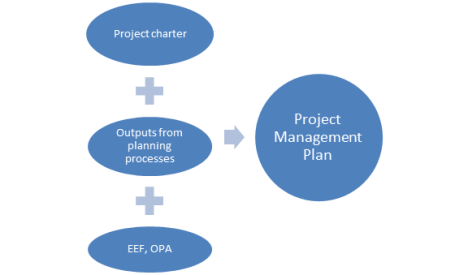
I found this a not very helpful list, for the following reasons:
a) The project charter is an output of the process 4.1 Develop Project Charter. It is an input to the process 5.2 Define Scope which has as its output the Project Scope Statement. In reality, it is the Project Scope Statement, and not the Project Charter, that is a more direct input into the Project Management Plan.
b) The input listed as “outputs from planning processes” is a little vague, because there are eight processes, one of each from the eight knowledge areas other than Integration, but there are four additional processes that are also required.
c) There is an additional set of inputs NOT listed above, and that is the performance baseline consisting of the scope, cost, and schedule baseline.
B. Inputs to Project Management—More Complete Explanation
However, on the very next page there is a diagram of the various inputs and outputs of the Project Management Plan and it is more accurate in terms of the inputs. This post is used to list these inputs in a more complete way consistent with that diagram.
|
Input Category |
Input Description |
|
| 1. | Project Management Processes | Which of the 42 processes are to be used? (you may not procurement processes if all components made in-house) |
| 2. | Performance Measurement Baseline | This consists of the following three baselines:
|
| 3. | Knowledge area management plans | These consist of plans from the 8 knowledge areas other than Integration
|
| 4. | Additional management plans (knowledge area they are associated with is in parentheses) |
|
| 5. | EEF | Project Management Information System |
| 6. | OPA | Corporate knowledge base for PM (including PMO), historical information (including lessons learned) |
C. Additional management plans—additional explanation
It is fairly obvious that the eight management plans listed under item 3 above come from the various knowledge areas listed. However, I feel a little more detail should be in order for those 4 additional management plans listed under item 4.
| Management Plan |
Explanation |
|
| 1. | Change management plan | This outlines the change control process:
|
| 2. | Configuration management plan | As opposed to changes in the project, the configuration controls changes to the product and the project documentation related to these product changes. |
| 3. | Requirements management plan | This links the various requirements to
|
| 4. | Process improvement plan | Improving processes used on the project during the course of the project. |
These are the elements of the Project Management Plan. In my opinion, it is the most integrative of ALL the 42 processes and that is why it is important to focus on all the inputs that go into it.
Filed under: Uncategorized |
 4squareviews
Leave a comment