

1. Three Thinking Processes
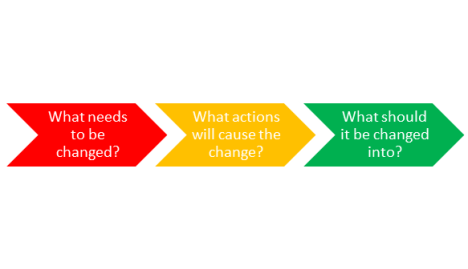
To remove constraints and increase throughput, the current state of the system needs to be analyzed, and the constraints identified. Then the undesirable effects or UDEs need to pinpointed, which is the answer to the question “what needs to be changed?”
Then a cause-and-effect analysis is done to find out those actions which, if taken, will result in the elimination of those UDEs. This is the answer to the question “what actions will cause the change?” Finally, the future state of the system without the constraints must be visualized, which is the answer to the question “what should it be changed into?”
2. Tools or “Trees” in Theory of Constraints
NOTE: In the terminology of the Theory of Constraints, UDEs stand for UnDesirable Effects. These three focusing questions are explored with the use of the following tools or “trees”.
|
Tool or “Tree” |
Explanation |
|
| 1. | Current Reality Tree |
Shows the current state, identifies UDEs and traces them back to root cause.
|
| 2. | Strategy and Tactics Tree | Implementation plan for changes to achieve the future state (replaces old Prerequisite Tree).
|
| 3. | Evaporating Cloud Tree | Identifies changes (aka “injections”) to system in order to eliminate UDEs; resolves conflicts between alternative approaches. |
| 4. | Future Reality Tree |
Shows result of changes designed to eliminate UDEs.
|
| 5. | Negative Branch Reservation | Identifies possible new UDEs caused by changes from current reality to future reality that eliminate the old UDEs. |
The result should be the elimination of the constraints or UDEs from the system.
The last post covers the way that the work flow is controlled in the Theory of Constraints, with the controlled pull system called Drum-Buffer-Rope for short.
Filed under: Uncategorized |
 4squareviews
Leave a comment