Labor Day as seen through The Time Machine


This post is dedicated to the blogger Driftglass, the head of the Science Fiction University segment on the Professional Left Podcast, which has re-kindled my love of science fiction.    

There are a lot of people writing about the history of Labor Day, including this excellent column by Paul Krugman called Love for Labor Lost.   http://www.nytimes.com/2013/09/02/opinion/krugman-love-for-labor-lost.html?_r=0

The purpose of this post is to look at Labor Day through the lens of science fiction, in particular, the movie The Time Machine based on the science fiction novella written by H. G. Wells in 1895.    I saw the 1960 version of the movie directed by George Pal on Friday evening, just because it was a movie that I hadn’t seen for a long time and wanted to watch again for nostalgia’s sake.

However, yesterday I reflected on the fact that it was Labor Day weekend and thought back on the movie I had seen earlier that weekend.    In the movie, the book’s protagonist, a British inventor, invents a time machine and uses it to explore the future.    He visits the year 802,701 A.D. , where he meets the Eloi, a society of child-like adults that live an idyllic existence without apparently having to do any work.    This first positive appraisal of the society is followed by the realization on the part of the protagonist that these people also do not seem to have any curiosity or any ambition.    But where does their clothing come from?   Where does their food come from?    They seem too unambitious to have produced it themselves …

Despite these questions about how their society functions, he decides to leave them in disgust at the degenerate state of mankind, when he finds that his time travel machine is missing.    It had apparently been dragged inside of a building whose facade resembled that of a Sphinx.     In trying to recover his time machine, he encounters a race of ape-like troglodytes called Morlocks.   The building he found is the entrance to an underground lair where the Morlocks live.    There he finds the machinery which apparently manufactures the clothing and produces the food upon which the Eloi depend.    What do the Morlocks get in return for this service to the Eloi.    There, he finds that the Eloi ARE the food upon which the Morlocks depend.    They exist not as enemies but in a symbiotic relationship, where one group depends on the other for its existence.

They both are descendants of the human race, where the middle class has disappeared, and the capitalist system we have now has devolved in a feudal system where there is only an upper class, an elite, and the working class.    These groups have then evolved, or devolved I should say, to the point where the two classes have become, in fact, two different species.

In this science fiction story, H. G. Wells posits the question through the lens of science fiction, “what are the ultimate consequences to a society when its middle class starts to disappear?”   It is a question that some modern movies of science fiction are exploring, in the October 2012 movie Cloud Atlas, which looks at the question of the interplay between economic, social, and political inequality in six interlocked stories that take place in different time periods, and the recent release of the movie Elysium, about a future where the elite 1% live in luxury aboard a space station while the other 99% of humanity lives on a polluted, overcrowded Earth.

Another exploration of what might happen if the middle class disappears comes from the popularity of the fantasy series on HBO called Game of Thrones, based on the series of high-fantasy series of novels by George R. R. Martin.   It describes the intrigue between a series of kingdoms that are locked into a struggle for supremacy.    Fantasy novels usually portray some sort of variation on a feudal order of society and often include the harnessing of elemental forces by means of magic rather than by science.

In that wildly popular series, we may be looking not at a romanticized past, but at a possible future just as dystopic as the one portrayed in Elysium, where the middle class disappears and the only two classes left are the 1% elite, the equivalent of the medieval aristocracy, and the 99%, the equivalent of the medieval lower classes.    This is why Labor Day is important, because the modern middle class in the United States after World War II is the creation of many historical forces, one of which is the gains won by the labor movement in the first half of the 20th century.

Forgetting that past is dangerous, as Paul Krugman insists, and the reason why comes from an even stronger warning by the science-fiction visionaries of the past, such as H. G. Wells in The Time Machine, and those of today who continue in that tradition.

But will we listen?    That is truly an open-ended question …

Integral Theory and Project Management–Tenet #4


This series of posts take the Ken Wilber’s introduction to Integral Theory called A Brief History of Everything and discusses the 20 tenets concerning the concept of a holon and how they can be applied to the field of project management.   This post covers tenet #4.    I have been posting one tenet a week on Sundays in a event to cover the 20 tenets in some detail, at least as far as my understanding of them goes.

1.  Recap–definition of a holon

A holon is an entity which consists of components, and yet is itself a component of a larger whole. The reason for the introduction of the concept is that bridges the philosophical divide between those who think that reality is composed of isolated units (atomism) and those who think that it is composed of a large web of interconnected parts). The first two tenets are as follows:

2.  Recap of tenets #1-3

Tenet #1. Reality as a whole is not composed of things or processes, but of holons.

Holons must be considered from the standpoint of interacting with other holons on the same level, and with holons at higher levels (of which the holon is just a part) and lower levels (which comprise the parts of the holon).

Tenet #2 Holons display four fundamental capacities: The horizontal capacities of self-preservation, self-adaptation, and the vertical capacities of self-transcendence and self-dissolution.

Holons follow the dual rules of evolution when it comes to holons at the same level:    survival of the fittest (self-preservation) and survival of the fitting (self-adaptation).    Holons have the property of being able to evolve to the next highest level (self-transcendence), and they can also “devolve” into their component parts (self-dissolution).

Tenet #3 Holons emerge

As mentioned in Tenet #2, holons have the property of self-transcendence or evolution to the next highest level.    This is not just a higher degree of organization, but also involves emergent properties or differences in kind from the level below.

3.   Tenet #4

The fourth tenet is as follows:

Holons emerge holarchically.

Let’s unpack this statement.    Holons, as seen above, are units that are both wholes containing parts and parts of larger wholes.   This kind of concentric nesting of holons reminiscent of the Russian matroshka dolls is considered a holarchy.    In contrast, we see in an organizational chart the usual notion of a hierarchy where those people who work for a supervisor are listed in boxes below the supervisor.    Hierarchy is linear, not concentric like a holarchy.

One of the philosophical controversies about hierarchies is that many groups think of them as being authoritarian, with the person at the top adopting a sort of “”top-down” or, more colloquially, a “my way or the highway” approach to management.    One of the earlier critics of the authoritarian or “top-down” style of management was Douglas McGregor who in the 1960s at the MIT Sloan School of Management developed contrasting models of human motivation in the work place called Theory X and Theory Y.   Theory X was the “top-down” style of management, where a manager assumed that workers needed to be told what to do.  Theory Y was more of a “bottom-up” style of management, where a manager assumed that workers had the intelligence to be able to solve most of their problems themselves, and his role was more of a facilitator than a dictator.

In terms of Integral Theory, the difference between Theory X and Theory Y is that Theory X stands for a “dominator hierarchy” where one holon (the supervisor) totally controls the parts (the workers), which is a pathological or unhealthy form for an organization to take because it suppresses the creativity and initiative of its workers.    Theory Y, on the other hand, is a hierarchy in that there IS a supervisor of the workers.    However, the supervisor, rather than suppressing the growth of the parts (the workers), actually encourages that growth.    This, Ken Wilber, is actually a natural hierarchy or a holarchy.

Critics of the concept of a hierarchy in general come from the left side of the political spectrum, as they create a caricature of all hierarchies as being undesirable, as if they were all guilty of being authoritarian or fascist.    They propose instead what might be called in contrast to a hierachy a heterarchy, or linking among equal parts, rather than ranking among unequal levels.    In essence, this is a model with workers, but no supervisors.

As Ken Wilber likes to point out, this is a pathological form of organization as well, because while it does not suppress the creativity and initiative of the workers (the “parts” of an organization), it does suppress the natural leadership instincts of a worker who wants to become a leader.    Actual  real-life examples where organizations failed because of lack of leadership come from the communes on the left in the 1960s that collapsed because they consistently suppressed any notion of leadership as being oppressive.    The Occupy Wall Street movement similarly collapsed, among other reasons, because they consciously disavowed the very notion of their being leaders of their movement.

What Ken Wilber is saying is that in an organization, there are three states of holarchy, one healthy and two pathological:

  • natural hierarchy or holarchy (where the holon at one level interacts well with the parts at a lower level)
  • dominator hierarchy (where the holon at one level suppresses the parts at a lower level)
  • heterarchy (where the parts at a lower level suppress the emergence of a holon at a higher level)

In political terms, the heterarchy and dominator hierarchy are pathologies of the left and right wing, respectively.    The point as far as project management is concerned is that you want, as a project manager, to encourage the creativity and growth of your team members.    However, if there is a crisis, and they turn to you for a quick decision, they need for you to be able to be a leader and make that decision in an effective and efficient manner.

To use what now probably borders on being  a politically incorrect idiom, there of course can be “too many chiefs and not enough Indians,” but an organization can also suffer if there are only Indians, but not enough chiefs.    The real point is that an organization is never a static thing like the neat boxes of an organization chart would have you believe; it is a dynamic, evolving entity and the way to have it evolve the fastest is for a project manager to have more of the “bottom-up” style of management rather than the “top-down” style of  management, which even in the Mad Men days of the 1960s Douglas McGregor of MIT’s Sloan School of Management thought of as being a dinosaur doomed to extinction.    His job was to hasten that extinction, and herald the coming of a style that promotes evolution within an organization.

The next post will cover tenet #5 of the 20 tenets introduced by Ken Wilber in his book A Brief Theory of Everything.   If you want to read more about Integral Theory, that is the best book for beginners to start.

8 Essentials of Effective Speaking–a talk by David Brooks


At the Leadership Conference held by District 30 (Chicagoland) of Toastmasters International on August 31, 2013, David Brooks, the 1990 World Champion of Public Speaking, gave a talk on the Essentials of Effective Speaking.    Joining him on stage was Presiyan Vasilev, a sales professional from Chicago, Illinois, who won the 2013 World Championship of Public Speaking one week ago at the International Toastmasters Convention held in Cincinnati, Ohio, after several eliminating rounds that begins six months ago with 30,000 participants from 122 countries.   For more information on how to become a better public speaker, go to David Brooks website at  http://www.davidbrookstexas.com/.

1.   The audience is not the enemy

The reason why many people avoid public speaking is because they have a fear of it, which is partially fear of an unknown and possibly hostile audience.    Just remember that the audience is not the enemy.    Don’t try to get rid of your fear; harness it and consider it a constant companion which keeps you trying to do your best.   The audience will forgive an occasional mistake; most of them are secretly rooting for you to succeed from the start.    Just remember to locate some friendly faces out there, those people who seem to be nodding and in general getting enthusiastic about your message.   If you do happen to make a mistake, locate those friendly faces!    Just remember that because you see somewhat who seems not to be enthusiastic, it could be a combination of culture, personality, or occupation that does permit them to show it as openly as others.

2.  Determine what you want the audience to think, feel, or do

What is your objective in the speech?   This should be simple enough to apply the “business card test”:   can you write down the “message” of your speech on the back of a business card?   If so, it is simple enough to get across in the 5-7 minutes you are allotted.    If you can’t, then the audience most likely will not get the message, or at least not all of it.

3.  Write your speech word for word

The purpose is NOT so that you can memorize your speech.    The purpose is so that you can edit it.  Good speaking begins with good writing; good writing depends on good editing.    He gave the example of the Gettysburg address, which consists of 10 sentences that took a total of 2 minutes to deliver.    There is an apocryphal story about how it was cobbled together by Lincoln on the back of an envelope on his way to give the speech:   that is simply not true, because we have several drafts of his speech which prove otherwise.    What is interesting in reading the drafts is not what was included in the speech; it was how much was taken out.    Every word has a purpose.

4.   Bring life to your words with colorful images and examples

This is where style becomes apparent.    Choose those words which evoke the audience’s own imagination so that they start to experience what you are saying, rather than just hearing it.

5.  Six words that can change the way you speak:  Make A Point; Tell A Story

It was stated earlier in point #2 that you should have a point to your speech; rather than explain that point to your audience, you need to have them discover it through experiencing it as part of the story you tell.

6.  Six emotions that will connect with any audience:  happiness, sadness, anger, surprise, disgust, and fear

Choose words which not only create an image, but which evoke at least evoke one of the emotions listed above.    When people empathize with you, they are more willing to accept your message that you want to convey in your speech.

7.  Don’t underestimate the power of laughter

When we laugh, we relax.   When we relax, our minds are more receptive to learning.    Many people don’t think they can get people to laugh because they think they are not able to tell a joke.    A professional joke-teller is a comedian; you don’t have to be a comedian to make people laugh.   Just ask yourself what makes you laugh.    Take a notebook with you or a digital recorder and if you see something that makes you laugh, write it down and make a “humor file.”    In fact, this technique works with the six emotions listed above in point #6.   Then have this on hand so that you can insert these into a speech into a place where they will have the most impact.

8.  Don’t tell us, take us

Rather than describing the incident like a reporter, take us as an eyewitness to the event by acting it out with movements, gestures, vocal inflections that put us right there in the middle of the action!

These techniques were demonstrated by David Brooks and his guest, the new World Champion of Public Speaking, Presiyan Vasilev, by having them recount some stories based simply on experiences that had had within the past 24 hours.   After each of the half-dozen examples, they asked to go through the six emotions and the six attributes of the stories.   Presiyan said that besides the six emotions related by David Brooks, the six attributes of your story should be that it is:

  • Believable
  • Relatable
  • Original
  • Optimistic
  • Kind-Hearted
  • Simple

Of course, someone in the audience noted that the acronym for these six attributes is BROOKS, which having just witnessed the talk by David Brooks, should be easy to memorize.    Together, these two champions, one from 1990 and the newest one from 2013, demonstrated that effective speaking is a skill that ANYONE can learn to make their speeches more effective.

It was an inspiring talk on a personal level, and as the Vice President of Education of my Toastmasters Club, I intend to use David Brooks’ materials to start our club’s own Resources Library!

5th Edition PMBOK® Guide—Chapter 12: Process 12.3 Control Procurements


1.  Introduction

There are four procurement-related project management processes, one in each of the following process groups:  planning, executing, monitoring & controlling, and closing.  The third process is therefore in the Monitoring & Executing Process Group, and is the process which manages the procurement relationship (the monitoring part) and makes changes to the procurement contract if necessary (the controlling part).

This post is devoted to the Inputs, Tools & Techniques, and the Outputs of this third of the four procurement processes, 12.3 Control Procurements.

2.  Inputs

The inputs come from the Project Management Plan (output of process 12.1 Plan Procurement Management) and the awards of procurement contracts and the Agreements themselves (output of process 12.2 Control Procurements).

During the course of the procurement process, work performance data and reports are used to monitor the procurement.  If there are changes to the procurement, these are an output of the process, but any approved changes are implemented as an input to the process.

12.3  Control Procurements
INPUTS
1. Project Management Plan This gives the guidelines which describes how the procurement process will be managed.
2. Procurement Documents Includes the awards of procurement contracts and the procurement statement of work (SOW).
3. Agreements Describes terms and conditions that specify what the seller is to perform or provide to the buyer.
4. Approved Change Requests Any proposed changes to the procurement which are approve through the Integrated Change Control Process.
5. Work Performance Reports
  • Technical documentation—contains technical information on the deliverables
  • Work performance documentation—indicates progress on completion of deliverables
6. Work Performance Data
  • Extent to which quality standards are being satisfied
  • Costs that have been incurred or committed
  • Identification of paid seller invoices
TOOLS & TECHNIQUES
1. Contract Change Control System Process by which the procurement can be modified.  This is part of the overall Integrated Change Control System for the project.
2. Procurement Performance Reviews Structured review of the seller’s progress to deliver the project scope and quality, within cost and on schedule.
3. Inspections and Audits Required by buyer and supported by seller to support the compliance of seller’s processes and deliverables.
4. Performance Reporting Work performance and data are compared against agreement requirements.
5. Payment Systems Accounts payable system of the buyer documents all payments in strict accordance with terms of contract.
6. Claims Administration Contested changes to the procurement are referred to as claims, disputes, or appeals, and are resolved by the parties involved or through the alternative dispute resolution (ADR).
7. Records Management System Manages contract and procurement documentation and records.
OUTPUTS
1. Work Performance Information Reports on compliance with contracts.  Provides basis for identification of current or potential problems to be resolved.
2. Change Requests Change requests are processed for review in Integrated Change Control Process.
3. Project Management Plan Updates
  • Procurement Management Plan
  • Schedule baseline
  • Cost baseline
4. Project Documents Updates Procurement documentation is updated:

  • Procurement contract
  • Approved change requests
  • Unapproved change requests
  • Financial records (invoices, payment records)
5. OPAs Updates
  • Correspondence
  • Payment schedules and requests
  • Seller performance evaluation documentation

2.  Tools & Techniques

The monitoring part of the process comes through procurement performance reporting, performance reviews, inspections and audits, the records management system and the accounts payable system.

If the controlling part of the process suggests changes be made in the procurement, then the change requests to the contract are handled as part of the overall Integrated Change Control System on the project.   The difference with the Contract Change Control System is that any disagreement between the parties involved becomes a claim (sometimes called a dispute or an appeal) that must be resolved between the parties in Claims Administration or through an independent Alternative Dispute Resolution (ADR) process.

3.  Outputs

As mentioned above, change requests may be an output of the process, which are fed into the Contract Change Control System and the overall Integrated Change Control System.  If they are approved, they are inputs to this process to be implemented.  If they are not approved, they go into the project documents updates.

Work performance information may be used to see if there are current or potential problems that need addressing through change requests or simply through changes in the seller’s own operations with regard to the procurement.

If change requests are required, the impact of the change on the scope, schedule, and budget of the project will result in changes to the respective plan in the Project Management Plan.

Various project documents are updated because of this process, and so are documents that the organization may refer to in future projects (OPAs updates).

The final process in the procurement knowledge area is 12.4 Close Procurements, and that is the subject of the next post.

5th Edition PMBOK® Guide—Chapter 12: Procurement Agreements (Contracts)


1.  Introduction

One of the outputs of process 12.2 Conduct Procurements is the procurement agreement, usually put in the form of a contract, which contains the terms and conditions under which the seller produces the procurement for the buyer.

The purpose of this post is to list the major elements of the procurement agreement.  Rather than listing them in a random, laundry-list fashion as appears in the PMBOK® guide itself, I plan to put them categories depending on the knowledge area they are related to.

2.  Elements of the Procurement Agreement

  Category Element of agreement
1. Integration Change request handling
2. Scope Statement of work of deliverables
3. Time Schedule baseline
4. Period of performance
5. Cost Pricing
6. Payment terms
7. Fees and retainer
8. Penalties
9. Incentives
10. Quality Inspection and acceptance criteria
11. Warranty
12. Limitation of liability
13. Human Resources Roles and responsibilities
14. Communications/

Stakeholder

Performance reporting
15. Risk Insurance and performance bonds
16. Procurements Seller’s place of performance
17. Place of delivery
18. Product support
19. Subordinate subcontractor approvals
20. Termination clause, Alternative Dispute Resolution (ADR) mechanisms

Obviously, most of the elements deal with procurements, but many deal with the constraints within which the procurements must be delivered, in particular with regard to the scope, time and cost of the project.

Inspection and acceptance criteria are related to quality issues, but so are warranty and limitation of liability, as those are related to the cost of nonconformance that come under the costs of quality.

Insurance and performance bonds are considered part of risk management because they are a form of transferring the risk from the buyer to the seller.  This is the overall risk of the product and its effect on the project; the cost risk of producing the product is handled by the various penalties and incentives under the cost management category.

Reporting of performance is part of communications management, but the management of the suppliers as stakeholders in the overall project must be also be considered.  Finally, if the supplier needs to make a change in the scope of the product being produced, it must submit the change request to the buyer who will then consider it as part of the Integration Management process of Perform Integrated Change Control.

So it can be seen that not just the basic requirements of the product (the inspection and acceptance criteria, delivery deadline, and pricing), but also any effects of the product on the project as a whole must also be considered explicitly in the overall procurement agreement.

Once the procurement is set up, the next process is where the procurement process is monitored and controlled throughout the period of the project in which it is performed.  That process, 12.3 Control Procurements, is the subject of the next post.

5th Edition PMBOK® Guide—Chapter 12: Process 12.2 Conduct Procurements


1.  Introduction

There are four procurement-related project management processes, one in each of the following process groups:  planning, executing, monitoring & controlling, and closing.  The second process is therefore in the Executing Process Group, and is the process whereby the supplier of the procurement is selected.

This post is devoted to the Inputs, Tools & Techniques, and the Outputs of this second of the four procurement processes, 12.2 Conduct Procurements.

2.  Inputs

The basis for having a procurement at all is the Make-or-Buy Decision.  This is important to keep in the background of this process, because conditions within the organization, external market conditions, or those of the project itself (cost overruns, delivery delays, etc.) may change to the point that the scales are tipped away from “buy” back to “make”.

Most of the inputs of this Conduct Procurements process come from the previous process 12.1 Plan Procurement Management, the output of which is the Procurement Management Plan.  This is the blueprint containing the guidelines for all the other procurement processes.

The Procurement Documents contain the Procurement Statement of Work, the “seed” of the procurement scope, which is the portion of the scope of the entire project out of which is carved the portion of the scope that is going to be provided by the procurement.  These Procurement Documents can include the Request for Proposal which goes out to the sellers, in response to which they produce the Seller Proposals.  These Seller Proposals are then judged according to the Source Selection Criteria, not to mention the past experience with sellers contains in the Operational Process Assets (OPAs).

12.2  Conduct Procurements
INPUTS
1. Procurement Management Plan This describes how the procurement processes will be managed, from developing procurement documentation to closing of the procurement contract.
2. Procurement Documents These include documents such as the Request for Proposal used to solicit proposals from prospective sellers.
3. Source Selection Criteria Information may include information on:

  • Technical capabilities, capacity
  • Delivery dates
  • Product cost estimates
  • Life-cycle costs (purchase cost and support cost)
4. Seller Proposals These are the sellers responses to the Procurement Documents (input #2).
5. Project Documents Includes risk-related contract decisions in risk register.
6. Make-or-Buy Decisions Evaluation of the need for the organization to buy products versus make the items themselves.
7.; Procurement Statement of Work Describes the scope of the product to be delivered by the supplier, and contains clearly stated set of goals, requirements, outcomes for the supplier to meet.
8. OPAs
  • Listing of pre-qualified sellers
  • Past experience with sellers
  • Prior procurement agreements
TOOLS & TECHNIQUES
1. Bidder Conference Meetings between buyer and all prospective sellers prior to submittal of a bid or proposal.
2. Proposal Evaluation Techniques Formal evaluation review process is defined by buyer’s procurement policies.
3. Independent Estimates Independent estimate, either prepared by the buyer or by an outside estimator, may serve as a benchmark for proposed responses.
4. Expert Judgment Used to evaluate seller proposals.  May be a multi-discipline review team with expertise in each of the areas covered by the procurement documents and proposed procurement contract.
5. Advertising Lists of potential sellers may be expanded by advertisements in publications such as newspapers or trade publications, or online solicitations to the vendor community.
6. Analytical Techniques Helps identify the readiness of prospective vendors to provide the product without cost overruns, and to identify risks to be monitored during procurement process.
7. Procurement Negotiations Clarifies requirements and other details of the purchases so that mutual agreement can be reached prior to signing the contract.
OUTPUTS
1. Selected Sellers Those sellers who have

  • been judged to be in a competitive range based on the evaluation of their bid or proposal, and
  • have negotiated a draft contract.
2. Agreements Includes terms and conditions that specify what the seller is to perform or provide to the buyer.
3. Resource Calendars Quantity, availability, and timing of when resources are either active or idle.
4. Change Requests Any proposed changes to the procurement are treated like any other change to the project, through the Integrated Change Control Process.
5. Project Management Plan Updates
  • Cost baseline (budget)
  • Scope baseline (= product scope statement, WBS, WBS dictionary)
  • Schedule baseline
  • Communications Management Plan
  • Procurement Management Plan
6. Project Documents Updates
  • Requirements Documentation
  • Requirements Traceability Matrix
  • Risk Register
  • Stakeholder Register

3.  Tools & Techniques

The Bidder Conferences are there to clarify the requirements of the product that the buyer

is requesting, and to make sure that the prospective sellers understand them before submitting their proposals.  The sellers may be solicited through a list of pre-qualified sellers that is enlarged through various forms of Advertising.  Once they submit their proposals, the buyer may judge them using Expert Judgment, Independent Estimates, or more formal Proposal Evaluation Techniques such as a formal evaluation review process.  Analytical Techniques may analyze the cost risk and other risks of the procurements.  Further Procurement Negotiations with the sellers may clarify the requirements to the point that a draft contract may be negotiated.

4.  Outputs

The sellers that qualify are the Selected Sellers, and from those a final Seller is selected with whom there is a final Agreement that is put into the procurement contract.  Resource calendars are updated to make sure that the resources provided by the seller are accounted for in terms of their quantity, availability, and timing in terms of the larger project they will be used on.

The procurement will occasion changes in the project baselines (scope, time, and cost), and the communications management plan will be updated to reflect the coordination required between the seller and buyer.  Project Documents like the stakeholder register and risk register will be updated to reflect the inclusion of the seller in the stakeholders to be managed and the risks of the procurement to be included in the risk register of the project as a whole.

If there are any changes that the seller proposes to the scope of the procurement, they are treated like any other change request through the Integrated Change Control Process.

The main output of course of this process is the Agreement between the seller and buyer in the form of a Procurement Contract.  This will be the basis for the executing, monitoring & controlling, and finally closing of the procurement.  The next post covers the elements that are typically included in a procurement contract or agreement.

5th Edition PMBOK® Guide—Chapter 12: Source (Supplier) Selection Criteria


1.  Introduction

As part of the process 12.1 Plan Procurement Management, one of the outputs of the process that go into Procurement Documents like a Request for Information (RFI) or Request for Proposal (RFP) is the Source Selection Criteria.  Often times these criteria are made into a checklist that is used as a “scoring sheet” to rate seller proposals.

The 5th Edition of the PMBOK® Guide  lists the various criteria that are included as part of the Source (i.e., Supplier) Selection Criteria  However, they are listed in apparently random, laundry-list fashion, and this post was designed to put some order into the list by arranging them by category.

2.  Source Selection Criteria

These are the questions that should be asked by the organization requesting proposals from suppliers in order to rate or score those proposals.   These questions make up the source selection criteria.

  Category Criterion Explanation
1. Integration Management approach Does seller have, or can it develop, management processes and procedures to ensure a successful project?
2. Scope Understanding of need Does proposal address the Procurement Statement of Work (SOW)?
3. Time Deadline With what degree of confidence can the seller produce the product within the specified deadline?
4. Cost Overall or life-cycle cost What is the total cost of the procurement (purchase cost plus operating cost)?
5.. Financial capacity Does seller have necessary financial resources?
6. IP Rights Does seller assert intellectual property rights in the product they produce for the project?
7. Proprietary Rights Does seller assert proprietary rights in the product they produce for the project?
8. Quality Technical approach Can seller’s technical methodologies, techniques and solutions meet the technical requirements in the procurement documents?
9. Warranty What will seller covered by warranty, and for what time period?
10. Production capacity Does seller have sufficient production capacity to meet potential future requirements?
11. Human Resources Technical capability Does seller have technical knowledge and skills needed?
12. Risk Risk response How much risk is being assigned of transferred to the seller?  How does the seller mitigate risk?
13. EEFs Business type and size Does seller’s enterprise meet a specific category of business (disadvantaged, etc.) defined by the organization or established as condition by government agency?
14. OPAs Past performance What is past performance of selected sellers?
15. References Can seller provide references from prior customers verifying compliance with contractual requirements?

One of the few knowledge areas represented in the list of categories that PMI did not include in the above list was that of the Time Management knowledge area, and so I added a crucial criterion for the selection of a seller that PMI left out, perhaps because it’s so obvious:  the ability of the seller to meet any deadline specified by the organization.

This is a list of possible criteria that might be used in the case of a complex project.  Of course, in the case of a simple project, where the product needed from the seller is readily available off the shelf from various sellers, the only criterion needed might be the cost.

These criteria are prepared in order to give an objective basis for choosing the seller in the next process, 12.2 Conduct Procurements.  An outline of the inputs, tools & techniques, and outputs of that process is the subject of the next post.

5th Edition PMBOK® Guide–Procurement Statement of Work vs. Project Statement of Work


1. Introduction

The Project Statement of Work is an input to the 4.1 Develop Project Charter process in the Initiating Process Group, in the Integration Knowledge Area.   The output of that process is the Project Charter.    The Procurement Statement of Work is an output of the 12.1 Plan Procurement Management process in the Planning Process Group, in the Procurement Knowledge Area.

The purpose of this post is to make the distinction between the Project Statement of Work and the Procurement Statement of Work.

2. Project Statement of Work (SOW)—What is it?

The best way I can describe the Project Statement of Work is as the “seed” of the project. It is watered during the Initiating Process into the Project Charter which causes it to germinate and become a seedling. The seedling is planted in the ground during the Planning process of creating the Project Scope Statement. It then turns into a plant during the Executing Process (where it is given sunlight and water, analogous to project resources) and Monitoring & Controlling Process (where it is checked periodically to see if there are any adverse conditions such as pests or diseases), and is finally harvested at the time of the Closing Process.

3. Project Statement of Work (SOW)—How does it fit into the flow of PM Processes?

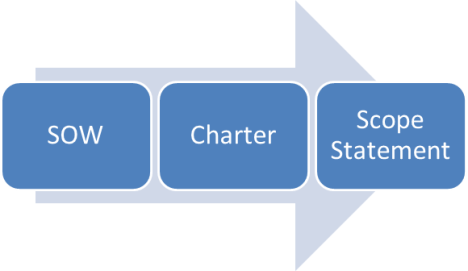
The SOW is the seed or kernel of the idea for the project which is then developed at a high level for the purpose of approval of the project during the Initiating Process Group as process 4.1, Develop Project Charter. As seen in the previous post, this Project Charter, if approved, is developed at a higher level of detail in the Planning Process Group as process 5.3, Define Scope. So here’s the flow of how the documents are connected:

3. Project Statement of Work (SOW)—Who creates it?

This is going to depend on the end result of the project is going to be a product, service, or result that is used internally within the company, or is to be delivered to an external customer.

If the sponsoring organization is the one that is going to use the end result, then the sponsor is the one that originates the SOW. If a customer is the one that is going to use the end result, then the customer is the one that originates the SOW. The SOW may be part of a bid document (request for proposal, request for information, request for bid) or as part of a contract.

4. Project Statement of Work (SOW)—What’s in it?

The PMBOK® Guide references 5 inputs to the 4.1 Develop Project Charter process, two of which are the generic Enterprise Environmental Factors (EEF) and the Organizational Process Assets (OPA), the “company culture” and “company processes” that are inputs to many PM processes. The other three are the Project Statement of Work, the Business Case, and Agreements.

Here are more detailed descriptions of these three inputs.

a. SOW
The components of the Project SOW are as follows:

  1. Business need–why do the project?   It could be because of market demand, technological advance, legal requirement, government regulations, or an environmental consideration.
  2. Product scope description–characteristics of the product, service, or result for which the project is undertaken.
  3. Strategic plan–the project must contribute to the organization’s overall objectives or high-level mission statement

b.  Business Case

How is the business need (the first element listed above) different from the business case? The business case takes the business need outlined in the SOW (element 1 in the chart above) and justifies how the result of the project (element 2 in the list above) will satisfy that need AND align with the strategic goals of the organization (element 3 in the list above).  It is the analysis that ties together the 3 elements of the SOW like so:

c. Agreements

As mentioned above, IF the product is to be made for a customer, then the SOW may come from the contract, a memorandum of understanding (MOU), a letter of intent, or some other form. The key is that the statement of work may come either internally (from the sponsor) or externally (from the customer).

Now that we have established in detail what the Project Statement of Work is, let’s discuss the Procurement Statement of Work.


5.  Procurement Statement of Work

The Procurement Statement of Work or SOW is derived from the project scope baseline (which consists of the project scope statement, the Work Breakdown Structure or WBS, and the WBS dictionary), which is one of the inputs to the process 12.1 Plan Procurement Management.    It is that portion of the project scope which is to be included in the procurement contract. As the Project SOW is the “seed” of the project as a whole, the Procurement SOW becomes the “seed” of the procurement, which from the seller’s standpoint will become the seed of that company’s project, which will be to produce and deliver that procurement to the buyer.

Like the Project SOW, the Procurement SOW needs to be clear, complete, and concise (with the understanding that the requirements of being “complete” and “concise” can sometimes seem to be in conflict and need to be balanced).    In terms of being “complete”, it needs to have sufficient detail for the sellers to determine if they are capable of producing that product, service or result.    Such details can include:

  • specifications
  • quantity desired
  • quality levels
  • performance reporting requirements
  • deadlines
  • collateral services required (such as post-operational support for procured item)

The Procurement SOW is then incorporated into procurement documents (another output of this process) used to solicit proposals from sellers.    Examples of such procurement documents include:

  • Request for Information (RFI)
  • Request for Proposal (RFP)

Once the seller makes a proposal to the buyer, the Procurement SOW is refined by both sides and then put into the procurement contract.

Another output of the 12.1 Plan Procurement Management process is the source selection criteria that, together with the Procurement SOW, are put into the procurement documents.    What elements go into the source selection criteria is the subject of the next post.


Integral Theory and Project Management (tenet #3)


This series of posts take the Ken Wilber’s introduction to Integral Theory called A Brief History of Everything and discusses the 20 tenets concerning the concept of a holon and how they can be applied to the field of project management. This post covers tenet #3.

A holon is an entity which consists of components, and yet is itself a component of a larger whole. The reason for the introduction of the concept is that bridges the philosophical divide between those who think that reality is composed of isolated units (atomism) and those who think that it is composed of a large web of interconnected parts). The first two tenets are as follows:

1. Reality as a whole is not composed of things or processes, but of holons.

2. Holons display four fundamental capacities: The horizontal capacities of self-preservation, self-adaptation, and the vertical capacities of self-transcendence and self-dissolution.

To those two tenets discussed in posts from the previous two Sundays, I add the third tenet.

3. Holons emerge

The self-transcendent capacity of holons is a vertical drive, meaning that holons have an innate capacity to organize into a larger holon. Atoms organize into molecules, which organize into cells, etc. But the larger holon (larger in the sense of complexity, and not just in terms of size) not only comprises the smaller holons within it, but adds to it the emergent properties that come from the interactions between them. Molecules can form chemical compounds that form reactions that do not occur between isolated atoms, and cells can participate in biological functions such as reproduction that do not occur between isolated molecules.

What does this have to do with project management? A group of interconnected projects is organized into a program, and a group of projects and programs that achieve the same overall strategic goals is organized into a portfolio.

The program and portfolio manager deal with problems that differ not only in degree but also in kind from the project manager. A project manager needs to report to these managers in such a way that their needs are met as well.

To repeat an example from the previous post in the series, a project manager who tries to get the cost and schedule performance index as high as high as possible should realize that from a program manager’s standpoint, too high of an index is not desirable either. This would mean that the project manager used less resources than he or she was given to work with in the schedule and budget, which would seem like a good thing. But if too many resources pile up unused, the program manager will want to use those resources for the other projects in his or her portfolio, and may see these unused resources as a waste. So releasing unused resources to the program and the company as a whole should be in the back of a project manager’s mind as well as the more usual consideration of not wanting to use more resources than originally given by the program manager.

Going in the downward direction instead of upward, the same principle applies. A project is more than the sum of the people working on it; they must function as a team. This means that creative solutions to a problem will be sparked between members with different perspectives that would not have occurred of the members had thought about the problem individually.

The project manager must reconcile competing ideas, or allocate project resources between members that come from different departments, and who therefore will have different perspectives. A blogger I know named Driftglass once described during a podcast a situation in a company he used to work for in the IT department. The software engineers who wrote the initial programming code would always try to get their code written before the deadline so they would appear as heroes in the organization as a whole. The only problem was with the next group of engineers who would have to patch together the code into a coherent system only to find it laden with bugs and errors that took so much time to correct that they would regularly blow past deadlines. This brought them negative attention from management. “Why can’t you be more like that first group of engineers? They always make their deadlines; why can’t you?” They gave incentives to the first group, and penalized the second group. This incentivized the first group to create code in an even more hurried and slapdash fashion on the next project, and of course the beleaguered second group had increasing problems of morale. This blogger said that the project manager was clueless as to the real reason for their delays, and just thought they were making excuses. The project manager did not understand the interaction between the phases of the project work, and thus failed in managing the project as a whole, which should be a set up as a non-zero-sum game of its members. The wins of one team member or group of members should never come at the expense of others.

The final example comes at the enterprise level. I read in a post by Yves Smith in her blog Naked Capitalism about a hedge fund manager who became the CEO of Sears. Because of his ideology inspired by the writings of Ayn Rand, he had a preconception that “capitalism = competition”, and so thought that his departments should compete against each other for the company’s resources. This management model has proved disastrous for Sears as their plummeting sales have demonstrated. Using the concept if a holon, you can see that a firm like Sears is a part of a larger whole consisting of other similar firms. They do indeed compete with each other and that competition does form one of the ingredients of a capitalist economy.

However, the firm is also at the same time a whole which consists of parts called departments. These must cooperate, not compete with each other, if the firm is to survive. What is happening now is that the mental energy of those in the departments is spent not on fighting the competition, but in fighting each other. The end result is that Sears is losing to the competition which consists of firms that are not embroiled to the same extent in infighting.

So holons at the same horizontal level that cooperate may allow the holons at the next highest level to be stronger in their competition. This is easy to see in the realm of biology where prey can gain survival advantage over stronger predators by cooperating in groups, where they would have no chance to win again the predator on a one-to-one basis.

For that reason the project must always look at the project as a whole, and must always remember that the project is simultaneously a part of a larger whole, the organization which is sponsoring he project. Only by holding these two aspects simultaneously in one’s mind as a project manager can you balance the combination of cooperation and competition that is the truer picture of the life of an organization than a simplistic ideology of pure competition that exists nowhere but in the pages of a novel.

Today We Saw the Face of God–a documentary on the January 2010 Haiti Earthquake


On January 24, 2010, a catastrophic earthquake of magnitude of 7.0 struck 25 km west of Port-au-Prince, the capital of Haiti.   A non-profit group called Little by Little had just finished a medical mission in Haiti at a clinic sponsored by Mountain Top Ministries.   They had gone back to the house they were staying in and preparing for their trip back to the United States the following day.

All of a sudden, they heard a sound that one of them described as a sound like an 18-wheeler careening of the road and coming straight for the house they were staying in.     Then the ground started shaking, and outside the trees were swaying violently as if caught in a severe windstorm, although the sky above was clear blue.    They realized they were experiencing an earthquake, but one more violent than those even from Haiti had ever remembered experiencing.    The house they were in was intact, but they decided to try to go to the clinic they had just finished working at to see if it people needed help.

And then, an hour or so later, reports came in to the clinic that they were desperately needed in the capital of Port-au-Prince.    Their experiences during the next 8 hours form the basis of a documentary by Mercedes Kane.    She is a filmmaker who graduated from Governors State University in University Park, who when talking to her sister-in-law who had been one of the members of that medical mission, thought that it would make a great subject of a documentary.   She went to a screening of the film at the Unitarian Universalist Church in Park Forest tonight (August 24, 2013), and she stayed for a question and answer session afterwards.

The film is based on the experiences of the medical mission team as seen through the eyes of those who experienced it, especially Sue Walsh, who wrote a book about the experience called Walking in Broken Shoes.    The title of the movie comes from one point, where in the midst of witness tremendous human suffering at the hospital, Sue Walsh remembered something that one of the pastors had said in a sermon that he gave to the Little by Little team just before they left for Haiti.   He compelled them to use their faith to see in the eyes of the sufferers they were going to help “the face of God” that would help them treat those people with grace, love, and humility.

The most moving part for me came at the end of the movie when Sue Walsh describes collapsing in a bed at the end of the most gruelling 8-hour shift of her entire life, when her clothing was still covered in the viscera of the people she had been desperately trying to help.    She felt a strange calm, almost like that of a mother for a newborn baby, whose clothing may be covered in fluids from the baby’s own body, and reacting to the experience not in disgust, but with a sense of being physically bonded to the baby in a way almost impossible to describe.    She was now bonded to the Haitian people in a similar visceral way that would make the earthquake a life-altering experience for her and others on the team.

The film had a profound impact on the audience at the screening as well, and the film was followed by a half-hour of questions from the audience about how she came to make the film, and why she thought it was important to make it.

I recalled reading stories about the earthquake brought out the worst in some people in Haiti, as looting and violence broke out in several places in the struggle for scarce resources.   So it was important to revisit the history that event and show how it could bring out the “better angels of our nature”, among the volunteers from the United States who went to Haiti to help the Haitian people help themselves, and of course among the Haitians themselves.

I thank the Unitarian Universalist Church of Park Forest for hosting the screening, and for Mercedes Kane for spending the time to answer questions from the audience.    You cannot NOT be moved by this film, and I heartily recommend that you watch out for the opportunity to see it in the months ahead as it goes into distribution.