5th Edition PMBOK® Guide—Chapter 1: Projects, Strategic Plan and Business Need


5th Edition PMBOK® Guide—Chapter 1: Projects, Strategic Planning and Business Value

1. Strategic Plan

In order to be initiated, projects have to have a reason for being carried out, a reason that is both internal and external to the organization. The reason that is external to the organization in most cases is the strategic plan which the project is a part of.

According to the PMBOK® Guide, here are the reasons for a project being initiated:

Strategic Consideration

Example of Project

1. Market demand Building more fuel-efficient cars in response to higher gasoline prices.
2. Strategic opportunity/

business need

Training company creates new Scrum Master certification preparation program in response to increasing demand.
3. Social need NGO creates infrastructure projects in developing countries
4. Environmental

consideration

Company creates electric car-share service to reduce air pollution
5. Customer request Electric utility creates new substation to serve new industrial park
6. Technological advance Advances in computer memory cause company to create smaller laptop
7. Legal requirement Establishing guidelines for proper handling of toxic materials.

To those I would add “industry standards” such as ISO standards, which may not be a legal requirement, but which may represent “best practices” for an industry and could be the reason for performing Six Sigma projects to reduce defects.

So the above “strategic considerations” are actually the external motivating factors out there in the world of business, government, or the society at large which create some sort of a need which the business will fulfill by doing a project. This is important, because if that need goes away, the project may go away as well. For example, if a project is initiated as a result of a customer request (strategic consideration #5 in the above chart), it can also be cancelled due to a request from that same customer.

2. Business Need

The second reason for being of a project is the proverbial “bottom line”, i.e., it needs to add value to the company either in terms of something tangible like monetary value, or something intangible such as brand recognition. This internal reason for being or business need has to be there as well. This is important for a similar reason as the strategic (external) consideration: if it goes away, so may the project. If a project is no longer profitable, because of excessive delays in executing it, or excessive increases in the required budget, it may be cancelled because the company will lose less money writing it off as an incomplete project than it would be seeing it through to the finish.

The external reason for the project (i.e. the strategic plan), and the internal reason for the project (i.e. the business need), are essential to understand in order to get the project initiated. The business need, the strategic plan, and a description of the product scope (i.e., what the product is designed to do) together make up the Statement of Work which can be considered the “seed” of the project. When you tie all these elements of the statement of work together, you are making the business case for the project.

Fig. 1 Elements of the Statement of Work

So you should always be aware for your project what the business need and strategic plan are; because if circumstances change that cause a change in either of these two, it can directly affect the continued existence of your project.

The next topic will be that of the role of the Project Management Office, which some organizations use to oversee projects within their organization.

Great Minds of the Western Intellectual Tradition—Lecture 1: The Problems and Scope of Philosophy


This is a summary of the first lecture in a series of lectures on the history of Western Philosophy put on by the Teaching Company. I wanted to preserve these summaries from the 2nd edition of this course because it is out of print; the Teaching Company now publishes the 3rd edition of the course which you can obtain at www.thegreatcourses.com.

This first lecture on the problems and scope of philosophy is presented by Prof. Michael Segrue, who is a Prof. of History at Ave Maria University.

1. The terminology of philosophy—nine terms to understand

The word philosophy comes from two Greek words, the “φιληο” (phileo) meaning “to love” or “to befriend” and “σοφία” (sophia) meaning “wisdom. Philosophy is true to its etymological roots, because it is indeed a love of wisdom or a passion for knowledge which goes beyond practical or utilitarian concerns.

The philosophical tradition of the West is a more or less coherent philosophical tradition with a common set of problems or issues under consideration, and a similar set of technical vocabulary which we use to discuss philosophical topics. Let’s start by considering this series of technical terms now in order to avoid confusion later on.

The first term is that of physics. By physics, we mean a theory of nature; it’s our way of explaining the world around us which we perceive through our senses. It’s the world which ranges from the familiar objects and their components which can be perceived through many senses (tables, chairs), to the larger, faraway objects which we can only perceive through our sense of vision (stars, planets). Physics also encompasses the theory of time and space in which these objects exist.

The second term is that of metaphysics. Metaphysics derives from the Greek
words μετά (metá) (“beyond”, “upon” or “after”) and φυσικά (physiká) (“physics” or “nature”). It is the description of entities which exist independently of space and time such as ideas, or spiritual entities such as angels or God (if you are a religious believers) that are outside of our immediate, everyday experience. It is the inquiry and consideration of things that outside of the realm of nature, which is the domain of physics.

The third term is ontology, which is a highly technical term in philosophy, but it could be simply defined as “speech about beings”. It is a branch of philosophy which allows us to analyze and think about the kind of existence that things have. We can say that God exists in a different way and on a different plane than everyday human beings. In addition, human beings have a set of rights that everyday objects don’t have. God, human beings, and physical objects are different kinds of beings; another more technical way of saying this is that they are all ontologically distinct classes of beings. They have a different status and a different hierarchy. There are different kinds of reasoning we need to apply to them, and differences in the way we apprehend them.

The fourth term is logic. Although this may be a little intimidating when you first encounter it in philosophy, but it is simply a system of rules for deriving true inferences. It says that if you start out with true premises, and follow the rules of logic, you will always draw true inferences. It’s not as complicated as you might have thought.

The fifth term is epistemology, which is another highly technical term in philosophy, comes from the Greek word ἐπιστήμη (epistēmē), meaning “knowledge, understanding”, and λόγος meaning “study of”). It is the speech or reasoning we use when discussing knowledge itself. We are thinking about knowledge or about thinking itself. What kinds of knowledge can we have of different types of things? Our knowledge of mathematics is different from our knowledge of scientific facts such as the boiling point of water, which in turn is different from our knowledge of right and wrong or our knowledge of the way governments ought to be organized. When philosophers engage in epistemology, what they are really trying to do is to clarify their own thoughts and those of other people to eliminate confusions that may have crept into their thinking by using a detailed analysis of how thinking works. It is a means for philosophers to be able to think clearly about various issues.

The sixth term is psychology. Epistemology is the philosophy of what is known, but psychology is philosophy of the knower, that is, the one who is doing the knowing. All of the philosophers of the Western philosophical tradition have a certain concept of the human mind or consciousness. Different philosophers have different concepts of the mind or psychology. Plato had one particular philosophy of mind, and he organized that philosophy of mind or the soul in relationship to the problem of how that mind apprehends mathematical knowledge. The philosophers of the 17th and 18th century on the other hand put together an alternative conception of philosophical psychology, which addressed their differing concerns with respect to epistemology which had to do with the rise of modern science.

Beyond the philosophy of mind, there are three related disciplines.

The seventh term is that of aesthetics, the theory of the beautiful. Is the beauty of an object within the object that is being observed or is it in the mind that perceives that beauty? What is the relationship between what it is perceived to be beautiful and that which we judge to be right or wrong? The branch of philosophy called aesthetics takes these various thoughts about beauty and tries to weave them into a harmonious whole.

The eighth term is that of ethics, which inquires into our judgments of what is right or wrong, over our certainty about what we ought or ought not do. What does it mean to engage in actions which are appropriate to a human being? How can we improve the way we behave? It discusses the part of human beings which are not necessarily the same as in animals, and are thus partially outside of the realm of nature. It discusses the choices of human beings, and the judges and values they use when making those choices.

The ninth term is that of politics or political theory¸ which is connected to the study of ethics, studies the city or society in which people live. Both ethics and politics investigate what is good or righteous, but on a different human scale. Ethics discusses what is good or righteous at the level of an individual, while political theory discusses what is good at the level of the society as a whole.

2. The Problems of Philosophy—Two Rivers, One Stream

The concerns addressed during the history of philosophy are remarkably small, as covered by the nine philosophical terms listed above, compared to the enormous diversity and richness of the traditions from which these philosophies emerged, and the vast amount of time over which they developed.

The history of philosophy goes back over thirty centuries, and to go back to the beginning of that history as the first lectures in this series will do, it will require an imaginative leap. The early philosophers in the ancient world of course did not have access to the technology we do, but more importantly didn’t bring many of the same presuppositions to the topic that we do. They lived in a world full of myths and imaginative stories which took the place of rational explanations for things.

If you are willing to make that intellectual and empathetic leap into the minds of the ancients, you will find it easier to absorb the contents of their philosophical debates.

The history of early philosophy can be seen through the answer to the question from ontology, “what is” or “what exists?” There are basically two answers to this question.

A. Nature only

This answers says that there is only the material world, and there is no supernatural or non-physical realm beyond it. As the pre-Socratics would have put it, there are only atoms and the void, and nothing else. The philosophers that believe in this answer to the ontological question “what exists” are those that belong to materialistic interpretations of the world and are called philosophical materialists or naturalists.

This philosophical tradition goes from the pre-Socratics all the way through to that of modern science in the Enlightenment.

B. Nature + something else

An alternative answer to the question “what exists” is that nature exists plus some other world or realm that is external to space and time. In the Western philosophical tradition, an example of this realm is Heaven, which for believing Christians, Jews, and Muslims contains God, the angels, and the souls of human beings that used to live in the material world.

In addition to the belief in Heaven in the Western religious tradition, there is the Greek philosophical tradition of belief in another world beyond that of immediate sense perception, and that is the created by Plato in the world of the Forms, which could be considered analogous to the Christian Heaven in the sense that its significance informs the various objects in our material world. It is a place of pure ideas and pure thought, that is purer than this world where things change and come into and out of existence.

The “two worlds” metaphysical approach goes from Plato all the way through to the tradition of the three Abrahamic faiths. This second world is of enormous significance and contains our source of virtue and moral standards, and justifies good actions.

These two answers to the question “what exists” are therefore, form the two major strata in the philosophical bedrock of the Western philosophical tradition. Which answer a philosopher chooses to this ontological question will inform that person’s views on other philosophical questions such as ethics, politics, and aesthetics, etc.

3. The History of Philosophy—Two Strands, One Braid

Besides the conceptual relationships between the various schools of philosophy, there is the historical development of these schools to consider as well. Two geographical areas stand out as fundamental to the formation of the Western philosophical tradition, and those are Athens and Jerusalem, the tradition that comes from liberated rationality and human freedom, and the tradition that comes from piety and faith in God. These are the two strands of an intellectual braid which forms the history of Western philosophy, kind of like the intertwined snakes around the central staff in the symbol of the caduceus.

The traditions of Athens and Jerusalem form that kind of an intertwined legacy of the modern Western culture. The fundamental myths and conceptions of Western culture relating ethics to otherworldly metaphysics come out of Jerusalem, and the element of rationality and human-centered values comes out of Athens, the home of Socrates, the patron saint of rational inquiry. The Greek drive towards secular knowledge stands out in its time as unique among other traditions in the world that organized knowledge around myths.

4. The Role of logos in the Two Traditions

The two words to pay attention to in differentiating these two strands of philosophical history are logos and mythos. Logos (λόγος) is the Greek word for “reason”, and means rational discourse. The Socratic dialogues raise rational discourse to the level of an art form. An alternative conception of logos is the one in the New Testament. The Old Testament is written in Hebrew, and the Qur’an is written in Arabic; alone of the three sacred books of the Abrahamic tradition, the New Testament is the only one written in Greek, and it has the most affinities to Greek culture. The attempt to unify the two strands of Western culture from Athens and Jerusalem stemmed in large part from Christian intellectuals who by virtue of being able to read Greek had access to both traditions. Logos in the Biblical tradition does not mean “free, unfettered reason”, but rather means the “word of God” in the Book of John, meaning the authoritative, fundamental divine word of God. The fact that this same word is used by the two traditions to mean very different things has been the source of an endless amount of confusion and difficulties in the history of Western philosophy. But there is a point of connection between these traditions: perhaps there is something divine about free, unfettered human discourse.

5. The Role of Myth in the Two Traditions.

The second important word is that of mythos (μύθος) which is the Greek word for “story”. A myth is more than just a story, however, but it is an archetypal story that has universal applicability. Cast in the language of fiction, it nevertheless tells the truth. An example of such universal myths is the myth of Oedipus from Greek tragedy. These are not just rousing adventure stories, but rather they tell some universal truths about the human condition.

The tradition of Jerusalem also contains many myths, and one of Prof. Segrue’s favorites is that of Job, God’s faithful servant. The Book of Job is the highpoint of religious thinking in the Bible, in his opinion. He is the perfect example of religious piety, and because he is so obedient to God, God has blessed him with health, wealth, and a wonderful family. The Devil at some point makes an argument with God that the only reason why Job is obedient to God is in order to obtain the benefits which God has blessed him with; in other words, Job’s piety and obedience to God is really disguised self-interest. Therefore, the Devil argues to God, if you remove that blessing and curse him, Job will no longer be obedient to you. The Devil and the God therefore make a bet to see what Job will do.

God then sends down to Job a terrible series of catastrophes, his family is killed, his house and possessions are destroyed or lost, and then finally his health is destroyed by a series of diseases culminating in loathsome boils that cover his entire body. However, Job is completely faithful to God throughout this, the message being that we ought not to question God because he is so far above us as we are to earthworms. Job’s friends and his wife try to convince him otherwise, but he refuses to listen to them and instead is determined to steadfastly believe in God no matter what God sends his way.

A directly contrary myth from Greece is that of a man who does not
obey God, but rather disobeys him and that is the myth of Prometheus. He is not quite at the level of the gods, but aspires to be. He knows he his inferior to the gods, but nevertheless wants to improve himself and mankind to their fullest potential. He does not have humility and faith, but rather has pride and who shakes his fist in defiance at the gods, knowing full well that he will be punished for his act of disobedience but who doesn’t care.

Prometheus is a Titan who felt sorry for mankind because they didn’t have a lot of the advantages that others in the natural world had: they had no claws, or sharp teeth, or swiftness, or protective coloration. He liked human beings and, despite Zeus’ expressly forbidding him to bring man the divine spark of fire of the gods, Prometheus goes against Zeus in a way that parallels the Satanic will in Milton’s Paradise Lost which is responsible for the line “I would rather rule in Hell than serve in Heaven”. Prometheus is an important Greek myth because it expressed core Greek values. If you read the pantheon of gods as representing for the Greek imagination the forces of nature, Prometheus’ defiance of the gods is really the tale of the heroic taming of nature and blind chance. In Greek tragedy this defiance is called hubris, the overweening desire to become something more than what you were given at birth. This megalomaniacal pride is at the core of the Greek approach to the world.

The world of Job is a God-centered world, the world of Prometheus is a human-centered world. When we braid together the traditions of these two worlds, we have to ask ourselves which set of virtues we prefer to follow. The problem is that the human psyche is made up of a heterogeneous set of components, meaning that they are not all the same. There is a rational component, there is an emotional component, and there is a religious component built into our psyche or our mind. If we focus on one tradition to the exclusion of the other, we are locking ourselves into a partial worldview that is not satisfactory from a psychological as well as philosophical standpoint. Not all edifying philosophies start with the same assumptions and end up with the same conclusions. In fact, there are alternative assumptions and alternative conclusions which may well be contradictory among themselves, but when you start to contemplate them, you may be edified in different kinds of ways; it may improve different parts of your psyche. In other words, experiencing different kinds of thinking are good for you. Wittgenstein once said, “philosophical illnesses usually stem from a dietary deficiency,” meaning one’s intellectual diet may be deficient in examples. If we think about religious texts alone, we may be lacking in scientific or mathematical examples. Similarly, if we were extremely positivistic and organized our thinking solely around physics, mathematics, and formal logic, it may well be that questions of good and evil, and human destiny may escape us.

So Prof. Segrue pleads for the listeners to this series not to have the courage of your own convictions, but the courage to call those convictions into question, to ask yourself “what if I was wrong?” and “how would I know if I was wrong?” If you sincerely apply yourself to the tradition of both Athens and Jerusalem, you will maximize your ability to absorb what the entire intellectual tradition of Western Philosophy can offer you. If you don’t make the attempt to extend the reach of your assumptions and your conclusions, at least make the imaginative leap to think about what it might be like to believe in an alternative set of assumptions and conclusions. What would the pluses and minuses be?

An example of intellectual honesty would be if we were contemplating a certain philosophical issue; let’s call it issue XYZ. What would count as evidence for this proposition or against it? Are you willing to look for evidence in favor of both what you believe and what you do not believe? The intellectual honesty you bring to this discussion will determine how much you will get out of these philosophical works. After you absorb the message of both Athens and Jerusalem, it will be up to you whether that changes you in the world of action.

The next set of lectures in this series will start at the beginning of the Western intellectual tradition of philosophy with the pre-Socratic philosophers. They are the earliest examples of the Greek drive to create secular knowledge. We are indebted to these Greek proto-physicists for the foundations of science that were developed during the Renaissance and afterwards. The skeptical, rational element of the Greek tradition that was born at the time of the pre-Socratic philosophers has remained a vital part of the Western intellectual tradition and is very much alive in the present day.

Effective Leadership at #Toastmasters International–a talk by Past International President Alfred Herzing


Today at Chapman University the Leadership and Communication Education or LACE training was given for the Founder’s District of Toastmasters International. Most of the sessions were devoted specifically to training club officers for their respective offices in their clubs. However, one of the added values you get by attending LACE training is the opportunity to go to additional presentations given by prominent members of the Toastmasters International community. At today’s LACE training, Alfred Herzing, a Past International President of Toastmasters International, gave a presentation on Effective Leadership and this blog post gives an outline of his talk.

Alfred Herzing explained that ever since he has been in Toastmasters International, he has been promoting its value in developing the leadership potential of its members. In today’s talk, he wanted to go over some of the aspects of being an effective leader, to use Toastmasters International as an example of how you can develop those skills, and to give some indications of how those skills can be used in the business world.

The six aspects of being an effective leader are:

1. Create Vision

The vision you first need to create should contain the high-level objectives you want to obtain. It cannot be some vague idea of yours like “I will leave this organization in better shape than it was when I got here.” What in the world does that mean? In Toastmasters, there is something called a Distinguished Club Program which outlines 10 goals for each club to perform in the categories of a) education, b) membership, and c) organization over the course of one year.

2. Develop Plan

Like any project, there are the major constraints of a) scope, b) time, and c) budget. The Distinguished Club Program has the major constraint of a) scope in the form of the 10 goals that need to be performed, and b) time in the form of the 1 year that they have to be performed in; the budget is not a major consideration, however, being that Toastmasters is a non-profit organization.

The Distinguished Club Program puts forth the following goals for each club:

Category

Goal

1. Education Earn 2 Competent Communicator Awards
2. Earn 2 more Competent Communicator Awards
3. Earn 2 Advanced Communicator Awards
4. Earn 2 more Advanced Communicator Awards
5. Earn 2 Leadership Awards
6. Earn 2 more Leadership Awards
7. Membership Gain 4 new members
8. Gain 4 more new members
9. Organization Have 4 out of 7 club officers trained
10. Send in club officer list, club dues in a timely manner

There are awards for the clubs that meet half or more of these goals:

Number of goals obtained

Level of Award

5

President’s Distinguished Club

7

Select Distinguished Club

9

Distinguished Club

Each club needs to create its own Club Success Plan which outlines how the club will fulfill each of the 10 goals mentioned above, in particular, who in the club will earn the Educational Awards needed for goals 1 through 6.

This is an example of a club officer going from Creating a Vision (having an excellent club) to Developing a Plan that is specific.

3. Share Goals

The club officers need to communicate the plan to achieve the club vision with the club members themselves.

4. Obtain Buy-In

The plan should be communicated in such a way as to obtain the buy-in of the club members. They need to believe that they will benefit from it and that their efforts as will not only benefit themselves individually but will help the club as a whole.

5. Delegate Smartly

Delegating does not mean dumping responsibility. It requires you to

  • Assess strengths of specific members,
  • Make assignments specific, measurable
  • Cast assignments in language of opportunity, not as a burden (“I picked you because I thought you would do well with this”)
  • If response to assignment is “no”, then listen to objections and try to overcome them (perhaps giving the person reassurance, additional resources, etc.)
  • Follow up, and track progress, but don’t micromanage

6. Resolve Conflicts

Conflicts will naturally arise in a group, and they can be healthy for an organization if handled well. They can arise because of:

  • Ego or control issues
  • Unclear goals or differing goals
  • Different perspectives or paradigms

Here are some of the ways to resolve these issues:

  • Discuss conflict with team and act as a mediator between conflicting members
  • Reinforce higher vision of overall goal
  • If one member is transgressing ground rules of behavior, then address that person in private
  • Don’t be afraid to remove toxic member from group

In the end, you should realize that to be a leader is like the description of the President of the United States being a public servant. You are there to serve the members of the group and to lead them by facilitating their achievements of club goals.

5th Edition PMBOK® Guide—Chapter 1: The Relationships Among Projects, Programs, and Portfolios


In this blog post, I discuss the topic of the relationships among projects, programs, and portfolios.

1. Definitions of a Project, Program, and a Portfolio

a. Project

We’ve dealt with the definition of a project in the blog post for January 9th. Let’s compare it in the chart below with the definitions according to the 5th edition of the PMBOK® Guide of a program and a portfolio, which are larger units of management within an organization.

Fig. 1. PMBOK® Guide Definitions of Project, Program, and Portfolio

Level

Definition

Project A temporary endeavor undertaken to create a unique product, service, or result.
Program A group of related projects, subprograms, and program activities managed in a coordinated way to obtain benefits not available from managing them individually.
Portfolio Projects, programs, subportfolios, and operations managed as a group to achieve strategic objectives.

b. Program

The key words in the definition of a program are “related” and “coordinated”. An example from the real world would be an aerospace company that makes different kinds of aircraft. The design of one particular type of aircraft would be handled as a program, and the design of parts of that aircraft, such as the engine, hydraulic system, electrical system, fuselage, etc., would each be a separate project. It should be clear that these projects are all related because they are all parts of the same aircraft, and they should be coordinated for that very reason.

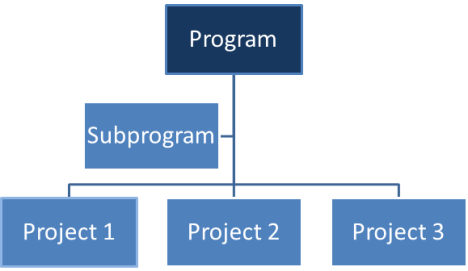
For a visual explanation of the relationship between a project and a program, let’s take a look a conceptual scheme of a program that includes, let’s say, three projects and a subprogram that is outside of the scope of the discrete projects in the program.

Fig. 2. Conceptual diagram of a Program

c. Portfolio

The key words in the definition of a portfolio are “strategic objectives.” Elements of a program are related internally through their link to the same business objective, whereas elements of a portfolio are related externally through their link to the overall strategic objective. An example from the real world would be an aerospace company that makes different kinds of aircraft. The design of one particular type of aircraft would be handled as a program, and the design of aircraft in general would be handled as a portfolio. The elements of the portfolio may be independent of each other in terms of their design, but they will be related to the same strategic goal (gaining market share in the aerospace industry).

Let’s take a visual look a conceptual scheme of a portfolio made up of a project, two programs and a subportfolio.

Fig. 3. Conceptual diagram of a Portfolio


Hmm … looks very familiar, somewhat like the conceptual scheme of the Program, right? However, here’s the important difference between the two schemes. The projects and related work that are managed as a part of the program are thematically related, indicated in Fig. 2 by all boxes being a shade of blue. The projects and program under the portfolio, on the other hand, may be independent, as indicated in Fig. 3 by the boxes being different colors. But of course they COULD be interdependent or even directly related.

However, projects in a program CANNOT be independent in the same way. Here’s a summary of the possibilities based on the definitions.

Fig. 4. Summary: Relatedness of program/portfolio components

Level

Directly related/

interdependent

Independent

Program

Yes

No

Portfolio

Possibly

Possibly

An example of a program would be the design of an aircraft, with the different projects being the design of the various systems within the aircraft. These would obviously have to be coordinated since they are all parts of the same aircraft, and changes in one system might have an impact on the other systems.

An example of a portfolio with interdependent or directly related components would be the design of a whole series of aircraft, with each program being one type of aircraft.  This would be especially true if the various aircraft shared components or even whole sub-systems.

An example of a portfolio with independent components would be an energy company that has facilities that produce energy from various sources including wind, solar, fossil fuels, and nuclear materials. Setting up production of these would be independent because the energy sources would require vastly different methods (or tactics) of production, but they would all be related strategically to company’s objective of profitable energy production.

This concludes the discussion of the difference between a project, program, and portfolio.

5th Edition PMBOK® Guide—Chapter 1: Project Constraints


In this blog post, I take a slight detour to expand on the subject of project constraints which is mentioned as one of the elements of Project Management, but which deserves a lot more attention for two reasons: it’s importance and the understated way it is presented in the PMBOK® Guide, which unfortunately belies that importance.

1. Definition of project management

First let’s take a recap of the elements of project management as listed in the PMBOK® Guide:

Fig. 1 Elements of Project Management

Category Element
1. Requirements Identifying requirements
2. Stakeholders Addressing needs, concerns, expectations of stakeholders during planning and executing of project
3. Setting up, maintaining, carrying out communications among stakeholders
4. Managing stakeholders towards meeting project requirements and creating project deliverables
5. Constraints Balancing competing project constraints, some of which are

  • Scope
  • Quality
  • Schedule
  • Budget
  • Resources, and
  • Risk

Managing the project constraints is one of the important elements of project management, and to understand its importance let us consider the history of the idea of “the iron triangle of constraints.”

2. The Iron Triangle of Constraints

Dr. Martin Barnes first described the iron triangle of constraints as far back as 1969 in terms of time, cost and output (what we today refer to scope).  These three constraints are strongly connected to each other, hence the name “the iron triangle.” To understand how this principle works, think of a water balloon in the shape of a triangle. One point of the triangle is the project’s time, the second point is the project’s cost, and the third point is the project’s scope, which can include such elements as level of quality on the project.

What happens if you squeeze one end of that water balloon? This creates increasing pressure on the other two ends. In a similar way if you constraint one of the three variables of time, cost, and scope, it will put pressure on the other two variables is why engineers have a popular saying “faster, cheaper, better—pick two”. This acknowledges that if you constrain one variable, one of the other two variables has to give.

What you cannot do is constrain all three variables at the same time. What happens if you squeeze a triangle water balloon on all three sides at the same time? A broken water balloon, or in terms of our analogy, a failed project.

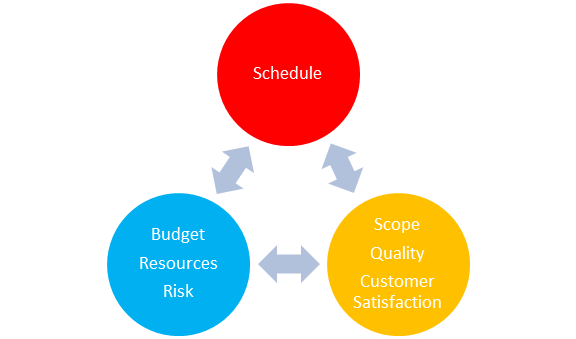
The following then, is a diagram outlining the interaction between what I will call the “Traditional Project Constraints” of time, cost, and scope.

Fig. 2 Traditional Project Constraints

3. PMBOK® Guide Definition of Constraints

From the table of elements of Project Management listed above, the PMBOK® Guide gives the following as what I will call the “Modern Project Constraints”:

  • Scope
  • Quality
  • Schedule
  • Budget
  • Resources, and
  • Risk

However, if you look at other exam prep textbooks, you may see even MORE constraints added. For example, Rita Mulcahy’s PMP Exam Prep adds Customer Satisfaction as another constraint.

In reality, however, you could map most of the “Modern Project Constraints” on the same diagram as the “Traditional Project Constraints.” The only one that is not obvious is risk, but the reason why I put it under the same category as budget and resources is that managing risk involves putting a risk response strategy in place which itself involves additional resources, so it seemed the most logical category to include it in.

Fig. 3 Modern Project Constraints

The important thing to notice is that underlying the seemingly complicated laundry list of constraints is the simple triangular structure of the traditional “iron triangle of constraints.”

It is important to notice this because many project managers who learned project management a while ago still think of “project constraints” in these traditional terms, and some of them get frustrated that the newer generation of project managers are unaware of this “iron triangle”. I know of two people who were asked at their employment interviews “what are the triple constraints on a project?” One of them knew about the “iron triangle of constraints” and gave the response, “time, budget, and scope”. The other didn’t because she had thought in terms of the laundry list of constraints that the PMBOK® Guide now gives and she couldn’t think of which three constraints the hiring manager had in mind. The one who knew about the “iron triangle of constraints” could answer the question easily and she got the job; the one who didn’t know about it and therefore couldn’t answer the question did not get the job.

So don’t let the long “laundry list” of constraints fool you; there’s an underlying triangular structure there that you need to be aware of both in terms of understanding the basic interaction among the constraints and because of the history of the very notion itself.

The next topic is how project management in an organization relates to two hierarchies of management above it, that of program management and portfolio management.

5th Edition PMBOK® Guide—Chapter 1: What is Project Management?


In this blog post, I discuss the second of the topics that need to be paid particular attention to when studying the 5th Edition of the PMBOK® Guide, Chapter 1, namely section 1.3 called What is Project Management?

1. Definition of project management

First let’s look at the official definition of a “project management” according to the 5th edition of the PMBOK® Guide:

Project management: Project management is the application of knowledge, skills, tools, and techniques to project activities to meet the project requirements.”

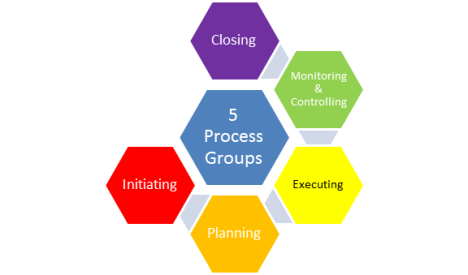
2. Five Process Groups

The knowledge, skills, tools and techniques that you need to know to for effective project management are organized into 47 logically-grouped project management processes, which are categorized into the following five Process Groups.

The names of these 5 Process Groups and their order, going from Initiating to Closing, should be one of the first you things you memorize for the PMP or CAPM exam. There are several cute mnemonics or memory tricks for helping you with this, my favorite being:

In Projects, Every Monkey Counts Coconuts

You can feel free to share this with your project team members, as long as you make sure to let them know this is simply a mnemonic device and not an editorial comment about how you feel about them and their contribution to the project.

NOTE: In going from the 4th to the 5th Edition of the PMBOK® Guide, the Project Management Institute has increased the number of formally-recognized project management processes from 42 (in the 4th Edition) to 47 (in the 5th Edition).

3. Elements of Project Management

After stating that the knowledge base you need to apply to projects is contains in the 47 processes divided into 5 Process Groups, the PMBOK® Guide goes on to describe the major elements that typically make up project management:

Category Element
1. Requirements Identifying requirements
2. Stakeholders Addressing needs, concerns, expectations of stakeholders during planning and executing of project
3. Setting up, maintaining, carrying out communications among stakeholders
4. Managing stakeholders towards meeting project requirements and creating project deliverables
5. Constraints Balancing competing project constraints, some of which are
  • Scope
  • Quality
  • Schedule
  • Budget
  • Resources, and
  • Risk

The first element deals with the category of identifying requirements, which is the beginning of the process of Scope Management. The next three elements deal with aspects of Stakeholder Management, from a) addressing their needs, concerns, and expectations, to b) setting up, maintaining, and carrying out communications with them, and finally c) managing them towards creating project deliverables and finally meeting project requirements. The last element deals with balancing competing project constraints, six of which are listed in the PMBOK® Guide. The subject of project constraints is SO important that it deserves a blog post of its own, which I will include on this series about Chapter 1.

NOTE: In going from the 4th to the 5th Edition of the PMBOK® Guide, the Project Management Institute has expanded the number of elements organized around the category of “stakeholders” in the above chart from one (element #2) to three (elements #2, #3, and #4, of which #3 and #4 are new), which shows the increased focus by PMI on Stakeholder Management in the 5th edition, to the point that it has become its own knowledge area separate from Communications Management.

4. 10 Knowledge Areas

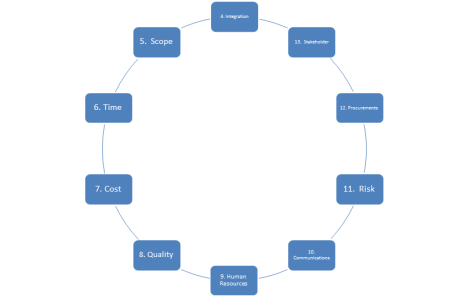
Buried in this list of 5 elements of Project Management is the core of the other dimension of the 47 project management processes besides the 5 Process Groups, and that is the 10 Knowledge Areas. Here is a chart of all 10 Knowledge Areas, giving the Chapter of the PMBOK® Guide which covers that Knowledge Area. The first element of project management given in the table above, that of identifying requirements, is the core of Scope Management, which is covered in Chapter 5, and is the first Knowledge Area going counterclockwise from the top. The second, third, and fourth elements given in the table above, are those devoted to Stakeholder Management, which is covered in Chapter 13, and is the first Knowledge Area going clockwise from the top. The last element in the table above, that of balancing project constraints, covers all of the other 7 Knowledge Areas from Chapter 6 through 12 between Scope and Stakeholder Management. The Knowledge Area at the top, Integration, pulls all of the other 9 Knowledge Areas all together.

PROJECT MANAGEMENT KNOWLEDGE AREAS

NOTE: In going from the 4th Edition to the 5th Edition PMBOK® Guide, the Project Management Institute added Chapter 13: Stakeholder Management as the 10th Knowledge Area. In the 4th Edition, this was considered part of Chapter 10: Communications Management, and there were only 9 Knowledge Areas, but in the 5th Edition, Stakeholder Management has been broken out into its own Knowledge Area in consideration of the increasing importance the Institute places on this Area.

So in conclusion, the definition of Project Management contains within it the core of both the 5 Process Groups and the 10 Knowledge Areas in which each of the 47 Project Management processes belong.

The subject of project constraints, the fifth element of Project Management in the chart above, is so important in relationship to the amount of text it receives in the PMBOK® Guide that I am devoting the next blog post to it.

5th Edition PMBOK® Guide—Chapter 1 (Introduction): What is a Project?


In this blog post, I discuss the first of the topics that need to be paid particular attention to when studying the PMBOK® Guide Chapter 1—Introduction, namely, What is a Project?

1. Definition of a project

You wouldn’t think that something as simple as “what is a project?” would cause trouble. The problem, however, stems from the fact that what is sometimes called a “project” in the real world does not always fit the definition of a “project” according to the PMBOK® Guide, but is rather what would be referred to as “operational work” or “ongoing work”.

First let’s look at the official definition of a “project” according to the 5th edition of the PMBOK® Guide:

Project: A temporary endeavor undertaken to create a unique product, service, or result.

Please note that in the 5th Edition of the PMBOK® Guide, that besides a project creating a unique product, service, or result, like it says in the above definition, it can also create an improvement in an existing product or service. It specifically gives as an example a Six Sigma project undertaken to reduce defects, so the Project Management Institute is consciously including Six Sigma projects as being subject to the rules of project management as set forth by the Institute.

NOTE: An important point to note is that a project may end in different ways:

  1. if the project’s objectives have been achieved;
  2. if the project’s objectives will not or cannot be met;
  3. the need for the project no longer exists;
  4. the client wishes to terminate the project.

Note these distinctions for later, because they may make sense of certain questions on the test that wouldn’t make sense otherwise.

With the above definition of a project in mind, let’s now contrast a project with operational work.

2. Project vs. Operational Work

A project and operational work are different in these two major respects:

Duration Creates
Project Temporary (starts and ends) Unique product, service, or result, or improvement in existing product or service
Operational Work Ongoing (repetitive) Repetitive product (mass production) or service

With that distinction in mind, we can turn our attention to the matter I posed at the beginning of this post, about companies that call things “projects” that really aren’t “projects” according to the PMBOK® Guide. Here’s a sample question that illustrates the matter.

Sample question:

Every year towards the end of the fiscal year, all of the outstanding claims of an insurance company have to have reserves that are not too small, and not too large, but just right. The purpose of confirming that the reserves are in this “Goldilocks zone” is to prepare for any potential audit and demonstrate that the company is not under-reserving (and thus going against insurance regulations) or over-reserving (and thus going against tax regulations). The company refers to this annual confirmation of the reserve calculations as the “reserve project”. It has a beginning and an end, and it produces a result (regulatory compliance and reduction of risk of an unsatisfactory audit). Is it a project according to the PMBOK® Guide?

Take a minute and look at the question, comparing it to the chart above comparing a “project” with “operational work”.

HINT: the key words are “every year”, “annual”, and a word that is missing from the question is the word “unique” before the word “result.” Note that there is a lot of unnecessary information about what the project actually does; this is a typical hallmark of PMP/CAPM questions which forces you to focus on what is important and skip what is not.

Answer:

No, because it is not a “unique” product, but one that was repeated from year to year. Therefore, although some planning may be involved in doing the “project”, there is no need for a project charter or some of the other elements you would expect as proper project management, because it’s essentially the same “project” from year to year.

This question is an example of a general phenomenon you may find on the exam, which is that the “real world” terminology with respect to certain terms or definitions such as the word “project” may not be the same as PMBOK® standard terminology, and the test may try to test to see if you know the difference. Know it!

3. Similarities between project and operational work

The above being said about the differences between project and operational work, there are some similarities. The best way to see this is to look at the famous cycle of “plan, do, check, act”, which applies to BOTH project and operational work.

In the world of project management, “plan” is covered by the Planning process group, “do” by the Executing process Group, “check and act” are covered by the Monitoring & Controling process Group.


However, with a project as opposed to operational work, there are additional elements such as a “start” or Initiating Process Group, and an “end” or Closing Process Group.

The next post will cover the next topic in the chapter, What is Project Management?

5th Edition PMBOK® Guide—Chapter 1 (Introduction) overview


On January 1st, 2013, the Project Management Institute has made available the 5th Edition of its Guide to the Project Management Body of Knowledge, known as the PMBOK® Guide for short. This new edition of the Guide is the result of a long review process at the Project Management Institute to make sure that the Guide is relevant to some of the new trends in project management, such as the growth of Agile methodology in IT projects, or the importance of Six Sigma projects for quality improvement.

IMPORTANT:    If you plan to take the Project Management Professional (PMP) or Certified Associate in Project Management (CAPM) certification test BEFORE July 31, 2013, you need to study for it using the 4th edition of the PMBOK® Guide.   If you plan to take the certification test ON OR AFTER July 31, 2013, you need to study for it using the 5th edition of the PMBOK® Guide.    You can download a copy from PMI if you are a member, or obtain one from a bookseller.  If you do order a copy of the PMBOK® Guide from Amazon.com or another bookseller, please make sure you order the right edition.   Also, if you order one of the popular exam study guides, like that by Andy Crowe or Rita Mulcahy, make sure your study guide is geared towards the correct version of the PMBOK® Guide.

For those wanting a review of the 4th Edition PMBOK® Guide, you will need to look at my tips on passing the PMP exam that were published on this blog last year.   This year I will be giving tips on passing the PMP and CAPM exam for those using the 5th Edition PMBOK® guide.

1. Introduction

For those wanting a quick overview of the basic facts about the 5th Edition, I review you to my post of October 25th, 2012:

https://4squareviews.com/2012/10/25/the-upcoming-5th-edition-of-the-pmbok-guide-10-questions-answered/

I will be going through various topics in the 5th Edition PMBOK® Guide, chapter by chapter, in the same way I did last year with the 4th Edition PMBOK® Guide, with the goal of helping those prepare for the Project Management Professional (PMP) or the Certified Associate in Project Management (CAPM) certification exam. Knowledge of the PMBOK® Guide is essential for passing either of these exams.

2. Topics in Chapter 1

The first chapter covers definitions that are basic to project management. Although often glossed over by those studying for the exam, there are some important concepts buried in the text which can, if either poorly understood or misunderstood entirely, lead one to lose precious points on the certification exam. For that reason, I will do a series of blog posts, each covering one major concept of Chapter 1. Here are the titles of the sections of Chapter 1:

Section

Title

1.1 Purpose of the PMBOK® Guide
1.2 What is a Project?
1.3 What is Project Management?
1.4 Relationships between Portfolio Management, Program Management, Project Management and Organizational Project Management
1.5 Relationship between Project Management, Operations Management, and Organizational Strategy
1.6 Business Value
1.7 Role of the Project Manager
1.8 Project Management Body of Knowledge

The first topic I will address tomorrow is that of “what is a project?”

Rant against the Cant: Prof. Harold Bloom’s Elegy for the Western Literary Canon


1. Introduction—Sympathetic viewpoint towards modern literary theory

Yesterday, I did a summary of the opening lectures to the Teaching Company Great Course called Great Authors of the Great Western Literary Tradition. In these lectures on the value and the interpretation of literature Prof. Arnold Weinstein of Brown University was sympathetic to some of the schools of interpretation such as psychoanalysis following Freud, Marxism, postmodernism, feminism, and New Historicism, among others. He shows giving examples of how each of these schools produces new insights that were not available before from more traditional forms of literary interpretation. To give an example, the character of Marsha Mason, the “madwoman in the attic” in Charlotte Bronte’s Jane Eyre, is seen through the eyes of psychoanalytic theories of interpretation following Freud as the the repressed or unrecognized libidinal drives of Jane Eyre herself.

2. Counterpoint—Unsympathetic viewpoint towards modern literary theory

I wanted to do a post on the opposing viewpoint, that is, someone who is very much unsympathetic with the modern schools of literary interpretation. In 1994, Harold Bloom, the Sterling Professor of Humanities at Yale University and Berg Professor of English at New York University, wrote The Western Canon: The Books and School of the Ages, in which he argued for the more conservative viewpoint that literature should follow the “art for art’s sake” ideal and not have it be subservient to some program of social engineering, however noble the ends may be.

Thus the first chapter of his book is called “An Elegy for the Canon,” in which he rants against the cant or jargon engaged in by the modern schools of interpretation (hence the title of this blog post). This purpose of this post is to outline his arguments, and then to make sense of them using the four quadrants from Ken Wilber’s Integral Theory.

3. Points of Agreement, Points of Departure

According to Harold Bloom, why have a canon in the first place? Let’s list the reasons that Prof. Weinstein used in his lecture. He said that literature can be used to

  • show that you are one of the elite,
  • help one how to think
  • improve one’s moral or ethical values
  • understand the culture in which it was written
  • transport you inside a time and place in a way no biography or history can

Prof. Weinstein was dubious about the first three, and posited the last two as better alternatives for the value of literature. How would Prof. Bloom come down on these points?

Regarding the first, Prof. Bloom would agree that it shows that you are one of the elite, but rather than seeing this is as a negative, as Prof. Weinstein implied, he unabashedly proclaims this is as a positive. Yes, literature is an aesthetic experience, both in the writing and in the reading of it. Reading a great piece of literature is more daunting and requires more from a reader than reading the average bestseller, and for this reason it is going to be elitist almost by definition. But along with Joseph Campbell, Prof. Bloom felt that this aesthetic elitism was a positive thing. People with the ambition to read the “literature of the ages” are naturally going to be drawn towards the classics of the Western Canon, because they were written by what has been judged to be the best writers from an aesthetic point of view.

However, the fact that great literature is written by the aesthetic elite gets conflated in the modern university system as being written by a product of the socioeconomic elite, and is, under Marxist interpretations of literature, just another tool of that socioeconomic repression of one class by another. This is where Prof. Bloom draws the line, and refuses to go along with this politicization of literature.

As far as helping one how to think, Prof. Bloom states that literature can act as the Art of Memory of one’s own cultural sources, so Prof. Bloom would partially agree with that.

On the third point, he is dubious along with Prof. Weinstein with the “moral improvement” theory of great literature and says that at the outset.

The fourth point is where Prof. Bloom and Prof. Weinstein part company the most, I believe. Reading literature may help you understand the culture in which it was created, but having that as a major value of literature is something I think Prof. Bloom would disagree with. In fact, many of the new theories of literature in trying to downplay the role of the individual author are making it sound as if the “culture” or society itself produced them. This view is something he is vehemently against, the idea that Paradise Lost, for example, can be reduced to an interplay of economic forces. To use the paired poems by William Blake on the chimney sweep that were quoted in the last post as an example, the economic relations of the various classes may be illustrated by the poems, but the originality and literary genius is took to create those poems are not illuminated at all by a knowledge of those relations.

I think the fifth point, that literature can take you inside a time and place and create an inner world that compels the reader, is probably the point where Prof. Weinstein and Prof. Bloom could most readily agree. In fact, it is that literary power of originality, to create an internal world so compelling that it changes the inner world of the reader, that is the source of where an author’s work stands in the Western Canon.

I can remember the exact bus stop I was sitting at as I finished reading the last canto of Dante’s Paradiso; that moment of wonderment will be forever etched in my memory.

4. Summing it Up with Integral Theory

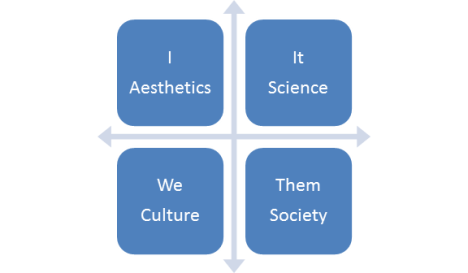
To sum up, the reason why Prof. Bloom disagrees with the modern theories of literary interpretation can be shown in this diagram from Integral Theory:

Each quadrant holds a way of viewing the world. The top two quadrants are the viewpoints of an individual, the bottom two quadrants are the viewpoints of a group. The left two quadrants are the subjective viewpoints, and the right two quadrants are the objective viewpoints. So putting it all together:

  • The upper-left quadrant contains the “I” viewpoint and is the domain of aesthetics.
  • The upper-right quadrant contains the objective viewpoint of looking at “it” and is the domain of science.
  • The lower-left quadrant contains the values of the group and is the domain of culture or ethics.
  • The lower-right quadrant contains the structures of a group and is the domain of society or politics.

To sum up Prof. Bloom’s objections to the various modern interpretations of literature, he believes that interpretations should be centered in the realm of the aesthetic, the upper-left quadrant in the diagram above. However, modern literary theory interprets literature through the lens of the culture and the society, almost to the exclusion of the individual aesthetic. And in Integral Theory, assuming that you have “cornered the market” on truth because you insist it be seen from your particular perspective, is a fundamental error.

So in my own mind, whereas I grant that there may be insights derived about the culture and politics of the age in which a piece of literature is written, as Prof. Weinstein posits, I much prefer to center the experience of literature within the realm of the individual writer and reader, as Prof. Bloom does, and state that it this dialectic that is the crucial one in deciding whether a book will enter the Western Canon or not.

Prof. Bloom’s work on the Western Canon in fact rekindled my own love of literature which started back in the 1980s after I had finished my undergraduate degree as an engineer. His work remains for me a touchstone in deepening my appreciation for literature, modern literary theory notwithstanding.

Great Authors of the Great Western Literary Tradition—The Value and Interpretation of Literature


The Great Authors is one of the Great Courses offered by the Teaching Company. This first edition is out of print, but you can obtain the current edition of the course by going to www.thegreatcourses.com. I have decided to put some of summaries of these lectures on this blog because it was one of my favorite courses from the Teaching Company.

This is a summary of the first two lectures by Professor Arnold Weinstein, who is the Edna and Richard Salomon Distinguished Professor at Brown University, where he has been teaching courses in European, English and American literature at Brown University since 1968.

1. The Value of Literature

Prof. Weinstein talks about the definitions offered in the past for the value of literature, and some of the ironic arguments he poses against those definitions.

Definition

Argument Against

A. Literature is non-utilitarian. It often is very useful indeed—for displaying your educational and socioeconomic status.


B. Literature helps one
how to think.
If society actually valued “how to think” over “what to think”, this value would mean a lot more. However, the trend seems to be towards the latter.


C. Literature is a source of
ethical values
Often heroes in literature transcend or transgress moral boundaries, even in the Bible.
Moreover, there are examples of literature being a bad corrupting influence:

i. Tale of Paulo and Francesca in Canto 5 of the 2nd Circle of Hell in Dante’s Inferno where they are corrupted by reading.

ii. Cervantes, whose hero Don Quixote is addled by reading too many picaresque novels.

iii. Flaubert’s Emma Bovary is ill-equipped to deal with reality because of her reading of romantic fiction.

What Prof. Weinstein says is a more reliable value of literature, rather than the moral improvement it may or may not effect in the individual, is to give any individual who reads great literature a greater understanding of the concerns and crisis of a particular culture.

Also, it can chart the various cultural and scientific changes going on in the background in any particular age and can therefore be used to see a historical period not in terms of dry facts about events, but rather “from the inside” as it were.

2. The Interpretation of Literature

There is a crisis with the notion of theory with regards to literature, and in response to all of this political infighting, one might just ask the naïve question: “why can’t you simply read the books?” However, the human being as an individual is, to a certain extent, the problem of his or her own culture, and you cannot read a literary text in the past without understanding not just the author’s intent, but the cultural assumptions within which that author lived.

One example is when Voltaire read Shakespeare, and translated the famous “to be or not to be” soliloquy …

“To be, or not to be? that is the question!
Whether ’tis nobler in the mind to suffer
The slings and arrows of outrageous fortune,
Or to take arms against a sea of troubles…”

… into French as follows.

“Demeure, il faut choisir et passer à l’instant
De la vie, à la mort, ou de l’être au néant.
Dieux cruels, s’il en est, éclairez mon courage.
Faut-il vieillir courbé sous la main qui m’outrage…

This translates back into English as the following:

Yet stay, we must now choose as in the moment caught,
From life to death we pass, from being into naught,
Cruel gods, if such there be, pray guide me past my daring,
Must aging’s hand bear down and crush me all despairing…

Notice how the French version rhymes because that was the style, of rhyming Alexandrian couplets, rather than the free verse of the English. Also, notice that there is a reference to “cruel gods” in the French version, a cultural reference which is inserted there by Voltaire to make more sense to his French audience, but one that is totally absent in the original English.

3. Modern Interpretations of Literature

Prof. Weinstein cites Karl Marx and Sigmund Freud as the two greater influences in 20th century literary criticism. Karl Marx tried to show how literature could illuminate the socioeconomic forces at play within the society where that literature was created. For example, the boy in the Blake’s poem about the Chimney Sweeper in the Songs of Innocence talks about a tale which the chimney sweeper tells to comfort himself.

And yet, in the poem about a chimney sweeper in The Songs of Experience, this tale is exposed for the tool of exploitation that is actually is.

“The Chimney Sweeper,” from Songs of Innocence by William Blake

When my mother died I was very young,
And my father sold me while yet my tongue
Could scarcely cry ” ‘weep! ‘weep! ‘weep! ‘weep!’ ”
So your chimneys I sweep & in soot I sleep.

There’s little Tom Dacre, who cried when his head
That curled like a lamb’s back, was shaved: so I said,
“Hush, Tom! never mind it, for when your head’s bare
You know that the soot cannot spoil your white hair.”

And so he was quiet, & that very night,
As Tom was a-sleeping he had such a sight!
That thousands of sweepers, Dick, Joe, Ned & Jack,
Were all of them locked up in coffins of black.

And by came an Angel who had a bright key,
And he opened the coffins & set them all free;
Then down a green plain, leaping, laughing, they run,
And wash in a river and shine in the Sun.

Then naked & white, all their bags left behind,
They rise upon clouds and sport in the wind.
And the Angel told Tom, if he’d be a good boy,
He’d have God for his father & never want joy.

And so Tom awoke; and we rose in the dark,
And got with our bags & our brushes to work.
Though the morning was cold, Tom was happy & warm;
So if all do their duty, they need not fear harm.

The Chimney Sweeper,” from Songs of Experience

A little black thing among the snow,
Crying ” ‘weep! ‘weep!” in notes of woe!
“Where are thy father and mother? say?”—
“They are both gone up to the church to pray.

“Because I was happy upon the heath,
And smiled among the winter’s snow,
They clothed me in the clothes of death,
And taught me to sing the notes of woe.

“And because I am happy and dance and sing,
They think they have done me no injury,
And are gone to praise God and his Priest and King,
Who make up a heaven of our misery.”

And Freud knew what he was doing when he drew upon the plays of Sophocles for material to illustrate his theories of the Oedipus and Electra complex, in order to show why they have had some emotive power for generations of audiences, because they illustrate the primordial beginnings we all go through early in life.

I am appreciate of Prof. Weinstein’s efforts to talk about the importance of literary theory, but also understand his warning about its abuses, where we read into a particular piece of literature any pet theory that we happen to have, whether it reflects any actually intention on the part of the author or not.

With this survey of the importance of literature and the measured consideration of the value of literary theory to help interpret literature, the series now turns to Homer, the first author in the Western Literary Tradition who wrote The Iliad and The Odyssey. That will occupy the next six lectures (three for the Iliad and three for the Odyssey).