Maintaining Multilingual Status


I am multilingual, having developed fluency to one degree or another in five languages other than English: Spanish, French, German, Japanese, and Chinese, while working on becoming fluent in two others, namely, Arabic and Portuguese.

My favorite multilingual online personality happens to be Benny Lewis, the author of the website http://www.fluentin3months.com/. He is a globe-trotting polyglot who is trying to show that anyone can use his methods to truly become fluent in a foreign language in three months. He does this by going to the country and immersing himself complete in that language.

Although I admire his exploits, I found that for those of us who for reasons of time and/or monetary constraints, cannot go abroad to enter that immersive environment, that the problem of maintaining one’s status as multilingual takes some sort of system. Also, he becomes fluent in a new language by totally immersing himself in another language at the expense of the other language he knows, which he lets lie fallow during the period he concentrates on the one language he is focusing on.

My challenge is to maintain one’s multilingual status by studying all the languages more or less simultaneously with the added constraints due to my status as a job-seeker that I cannot at this time travel to other countries, let alone live there for extended periods of time.

Here are the methods that I found work best for me:

1. Rosetta Stone: All around language practice

I found that the Rosetta Stone software helps me with a computer program that has an immersive-style learning approach, and it has a component called Rosetta Studio that allows you after completing a unit of language-learning material to speak to an actual native speaker for a 50-minute session. This is included in the price of the software so you can take as many sessions as you like.

I have used this to learn the two languages I am working on, Arabic and Portuguese, and to practice my fluency with Spanish, French, German, and Chinese. The only language I can’t use Rosetta Stone for is Japanese, because the language level they goes only up to 3 out of 5 levels, and I am advanced to the equivalent of level 5.

2. Goal setting: proficiency tests

One of the important things in propelling oneself forward simultaneously in several languages is to have some sort of proficiency goals. For me, I discovered the best way to set goals that are comparable from one language to another is to use the existing testing system used in Europe, the Common European Framework of Reference for languages, which rates one’s proficiency for all four language skills (reading, writing, speaking, and listening) in a series of six levels, A1 & A2 (beginning), B1 & B2 (intermediate), and C1 &C2 (advanced). I found that the Rosetta Stone language learning levels 1 through 5 correspond roughly to the first five levels of the CEFR. There is no Rosetta Stone equivalent of level 6 or native-level fluency, although there have certainly been requests for it.

In the past year, in order to demonstrate my fluency for my resume, and to use as a tool to spur me on to greater fluency, I took tests in the five languages I am fluent in to one to degree or another and passed all five tests. I started with the level A1 test in Spanish, and planned to take a higher B-level test this spring, but found that it was on the same day as the Chinese test and will have to put it off to the fall. So I am more fluent in Spanish than the level that I tested at, but the rest are reasonably close to my current fluency.

Test Level

A1

A2

B1

B2

C1

C2

Proficiency

Level

Beginning

Intermediate

Advanced

Spanish
French
German
Japanese
Chinese

A word of caution about the proficiency tests is in order: each level covers about twice the amount of vocabulary, etc., as the previously level, so can be considered to roughly double in difficulty as you go up. So if it took you 100 hours of instruction in a classroom or using Rosetta Stone to get you to level A2, for example, you will have to study 200 hours for level B1, 400 for B2, etc.

In order to pass the proficiency tests or to be proficient in the largest, most realistic test of all, i.e., real life, you need to exercise all four language skills of listening, reading, speaking, and reading. To practice all my languages using these techniques, I assign Monday as Spanish Day, Tuesday as French Day, Wednesday as German Day, Thursday as Japanese Day, Friday as Chinese Day, and I use Monday-Wednesday-Friday or Tuesday-Thursday-Saturday for Arabic and Portuguese, respectively. This puts all of them in either “slow” rotation (the once-a-week group) or “rapid” rotation (the every-other-day group).

3. Listening Practice: Audio magazines, subtitled movies

I love listening to the following audio magazines for my European languages:

Champs d’Elysées—French

Schau ins Land—German

Puerta del Sol—Spanish

I used to get them on cassettes and then CDs years ago, but now they are now available through an iPhone app called Plango. What I find useful about the iPhone app is that you can play it at ½ speed for listening practice if you find it hard to understand at first at normal speed.

Another source I enjoy is watching movies with English subtitles. You can listen to the movie first with English subtitles so you can grasp the plot and the dialogue quickly visually, and then try to listen to the dialogue to pick out the words that you can. If you improve your aural dexterity, you can then listen to the dialogue without the subtitles, especially if you already know the plot of the movie.

A third possibility is listening to the news in French, like France24, but this does not have the flexibility of a “learn-in” mode that the other two possibilities have I have listed.

4. Reading Practice: Magazines

Getting an online subscription, again through your iPhone, of a German news magazine like Der Spiegel, or a French news magazine such as L’Express. Here in LA, I read La Prensa to get the news in Spanish. Read about a story that you have already read in English, so just like the example in paragraph 3 of the movie without subtitles, you already know the “plot” of the story.

5. Speaking Practice: Meetups

If you are in a place with a large minority speaking that language, such as LA for Spanish, you can join a bilingual meetup group filled with those Americans (or those from whatever you native country is) learning that language PLUS those from that country who are trying to learn English. Why does this work? Because both sides have an incentive to speak each other’s language.

Now it seems counterintuitive for say, a Japanese-speaking person to speak English to an American who then answers that person in Japanese, but it actually works well.

6. Writing Practice: Crossword puzzles, Skritter

For European language practice, there are iPhone apps which have crossword puzzles that are moderately easy in the language of your choice. These are a fun way of practicing vocabulary for that language.

For Asian languages using Chinese characters, I recommend the Skritter service, a service which you can use online and now on your iPhone or iPad, which helps you learn the characters are review them so you master them.

These are a few techniques I use to practice my language skills that are relatively easy to do (no classes involved or traveling great distances) and yet fun to do, which keeps you motivated.

I hope those who are younger, and commitment-free take Benny’s more adventurous road of being a “language nomad” and learning a foreign language while traveling the world. For those of us who happen to have more time and money commitments and cannot follow such a path, I recommend the techniques recommended in this post. But above all, set goals for yourself, even if it is not to take proficiency tests like I have.

And then search for motivation to keep yourself constantly going one step forward. You can do it! A journey of a thousand miles begins with one step.

“World Economy: The Great Deleveraging Race”, an article by Economist Intelligence Unit #EIU


On July 2nd, the Economist Intelligence Unit published an article with the above title, and I thought it significant enough to do a post summarizing its conclusions.   Please note that the information I am quoting is contained within the article, but my commentary below does not reflect the opinions of the Economist Intelligence Unit.

It compares the five countries Ireland, the UK, Iceland, and the United States, and Spain with regards to

  • Amount of household debt incurred between 2000 and 2007
  • Policies taken to reduce household debt
  • Real private consumption growth in the two periods 2008-2011 and 2012-2016 (estimated)

On the basis of these comparisons, the article tries to draw some conclusions.   I reach my own conclusions, as you can see below.

1. Amount of household debt

The countries can be ranked as follows in terms of household debt that was racked up during the period from 2000-2007, with the top country (Ireland) having the most household debt and the bottom country (US) having the least.

Ireland

Spain

UK

US

This raises the question of why Iceland, which bucks the trend of the other four countries when it comes to policies taken to reduce household debt (see section 2 below), was not included in these statistics. Did EIU not have access to the data (hard to imagine), or was it that the data didn’t fit with the others in some fashion. There’s probably a good reason for their non-inclusion of the data, but its having been left out does naturally raise questions.

2. Policies taken to reduce household debt (green if successful, red if unsuccessful)

Country Policies taken to reduce household debt Policy Favors …
Iceland Mortgage write-downs for households in negative equity, voluntary restructuring and payment smoothing Borrower
US Federal home-loan modification program Borrower (in theory …)
UK Quantitative easing to support asset prices Lender
Spain Bank recapitalizations Lender
Ireland Bold debt write-downs unlikely Lender

If you look at the various policies either enacted or proposed, the ones in the UK, Spain and Ireland focus on helping the lenders rather than the borrowers. The policy of making bankruptcy an easier process has been a pro-borrower proposal in Ireland, but it is only a proposal at this point which is why I have not listed it above.

The US has a purportedly borrower-friendly home-loan modification program, but this is only on the surface; only a portion of that money has yet been allocated to the home-loan modifications.  The most positive pro-borrower policy that was attempted in the US was the various lawsuits put forward by state attorneys general against the banks for fraudulent practices such as robo-signing, etc. The aim of these lawsuits was to put pressure on the banks to do mortgage write-downs for households in negative equity (the so-called “underwater” loans). However, the attorneys general caved in to political pressure from the White House, and agreed to a preemptive settlement done on the Federal level, presumably so that their states could partake in the proceeds from the settlement.  However, the amount of money paid by the banks in this settlement ended up being essentially a slap on the wrist compared to the amount of liability they face. Even worse, some of those states that did end up receiving money from the settlement in some cases just put in into the general coffer to help balance their own struggling budgets, rather than give the money to the households it was designed for. The households on average would have received only the equivalent of about one-month’s mortgage, but even that insult would have been better than the empty promises they received instead.

The most pro-borrower set of policies has been taken up Iceland, which managed the mortgage write-downs that the US failed to enact.

3. Real private consumption growth

Now, here’s the kicker:

The five countries of this survey can be ranked in terms of estimated real private consumption growth in terms of % for the years 2012-2016:

Country Real private consumption growth 2012-2016
Iceland

2.6%

United States

2.2%

Britain

0.9%

Spain

0.4%

Ireland

-0.5%

Conclusion:

Those countries whose policies were the most pro-borrower with regards to the reduction of household debt are the countries with the highest projected consumption growth for the next five years? Coincidence? No. The borrowers who have had their debt reduced in such a way that reduces their mortgage on a permanent basis through a write-down will have more money to spend. And guess what? They most likely will, as opposed to those people in countries where the policies almost uniformly favor the lender under the rubric of “austerity”. An austere lifestyle does not “prime the pump.”

These are, of course, my conclusions, but I think they are pretty well substantiated by the information in the article. Even the EIU, while probably not endorsing my conclusion, would have to agree that the austerity measures proposed in the EU at present are not conducive to economic growth in the short- or medium-term future.

Passing the #PMP Exam—Study Group Discussions (Chapter 2—Stakeholders)


Passing the #PMP Exam—Study Group Discussions (Chapter 2—Stakeholders)

  1. Stakeholder definition

The concept of stakeholders consists of three parts in PMBOK® Guide:

Stakeholder Person or organization that is actively involved in the project,

or whose interests may be positively or negatively affected by execution or completion of the project.

A stakeholder may also exert influence over the project and its deliverables.

The first idea in our discussion group of a “stakeholder” was the first part of the definition, someone or some organization actively involved in the project.  But the guide goes into detail regarding the second part of the definition, showing that a stakeholder is one who may not necessarily be involved in the project, but whose interests may be affected by the project either positively or negatively.  The third part is the reverse of the second, showing that it is not just who or what can be affected by the project, but who or what can affect the project (either positively or negatively).

 A local environmental group could be considered a negative stakeholder for a new refinery project for example, because they could protest against the project and cause it to be shut down because the bad publicity is something upper management does not want.  A government regulatory authority might also be a negative stakeholder if the new project is found not to conform to governmental regulations.

The key points to remember:

  • stakeholders may be positive or negative, 
  • may be within the organization, outside of the organization but with a business relationship to it, or some organization in society that is somehow affected by the project

Now there is a diagram of all the stakeholders in the PMBOK® Guide page 24. The diagram was complete in that it listed all of the categories of stakeholders; however, it was a bit confusing because it lumped together all of the stakeholders that were external to the project itself, whether they were within the company or outside of it.

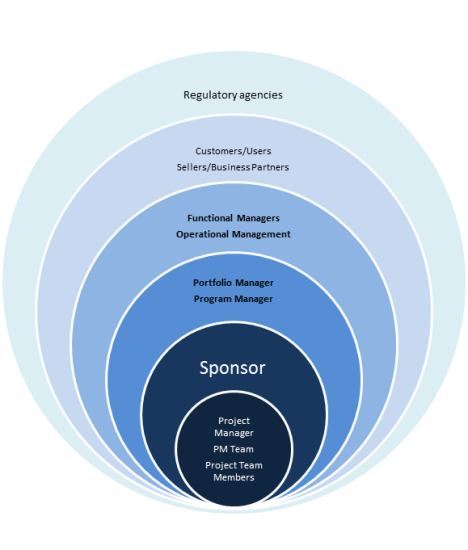
So here’s my attempt to make the categories a little bit more understandable.   Here are the categories of stakeholders on a project, starting with the team working on the project itself and the circles of influence stronger (to match the font size) and then weaker as the relationship goes outward.  

Fig. 1. Categories of Stakeholders on a Project

  1. The innermost circle is that of the people actually working on the project, namely the Project Manager, the Project Management Team (the other members of the team that assist with the management of the project), and the Project Team members who actually do the work.
  2. The second circle is that of the Sponsor, the person or group that provides the financial resources for the project and the one who champions the project within the organization when it is first conceived. The Sponsor acts as a spokesperson to higher levels of management within the organization, which is why I placed the Sponsor in the second circle.
  3. The third circle contains those higher-level organizers of projects, such as the program manager, who manages related projects in a coordinated way, and a portfolio manager, who manages a collection of projects or programs which may not be related in content, but which all serve the business model of the organization at large. I put them in this circle because they monitor the performance of the project and can even terminate if the business case for the project no longer holds.
  4. The next circle is still within the organization, but rather than the three inner circles that deal with project work, this circle represents the interests of the ongoing operational work, with the functional managers in charge of areas such as human resources, finance, accounting, and procurement. Depending on the type of organization, project managers will have to negotiate with them to allow their staff with expertise that would assist the project to work on that project for its duration. The operations management people will have to be consulted during the course of the project, because the project when completed is often handed off to them on account of the fact that they take care of normal operations and will provide long term support for the result of the project.
  5. Now we get to the circle which is outside of the organization, but one in which there is a business relationship between the organization and that stakeholder, such as sellers/business partners (vendors and suppliers, for example) in the case of a B2B relationship, and customers/users in the case of a B2C relationship.
  6. The last circle consists of elements of society that may not have any formal relationship to the organization, but which may contain groups that are affected by the project or that can influence the project. The PMBOK® Guide labels this group generically as “Other Stakeholders”, but I have put an example of “Regulatory Agencies” as just one type of entity that could be considered a stakeholder. A non-governmental organization such as an environmental awareness group that is an NGO would also be an example of a stakeholder at this level.

These concentric circles, I believe, show a little more of the different kinds of stakeholders and why some of them have more influence than others. I found this diagram helpful for our group to gain awareness of the different types of stakeholders, and I hope that it is helpful for those studying for the PMP exam as well.

That concludes this series of blog posts on the 2nd chapter of the PMBOK® Guide on the Framework of Project Management.   The 3rd chapter covers the processes of Project management, and I will cover this chapter in a series of blog posts next week.

Passing the #PMP Exam—Study Group Discussions (Chapter 2—Organizational Structures)


 The purpose of this post is to discuss the different types of organizational structure found in companies and what effect that structure has on project management.

 1. Project manager authority levels in different types of organizational structures

Fig. 1 Project Authority in different types of Organizational Structures

Functional Projectized Matrix Composite
Project Authority Functional Manager Project

Manager

Depends on type of matrix Depends on project

 In a functional organization, project authority rests with a functional manager, and in a projectized organization, it rests with a project manager. A matrix organization tries to be somewhere in between these two.

In a strong matrix, the authority is with a project manager, just like in a projectized organization. In a weak matrix, the authority is with a functional manager, just like in a functional organization. And a balanced matrix, the authority over the project is shared by both the functional manager and a project manager.

NOTE: In exam questions, you should assume that “matrix” means “balanced matrix” unless otherwise specified.

 Here’s the spectrum of authority for the different types of organization:

 Fig. 2. Project Manager’s authority over a project (increasing authority to the right)

The last type of organization, a composite organization, is one that changes the authority level of the project manager from project to project. In one project, it might be more like that of projectized organization, and in another project, more like a functional organization.

 2. Advantages and Disadvantages of Organizational Structures

 There are exam questions that discuss the advantages and disadvantages of the various organizational structures from the point of view of project management. Here’s a capsule summary:

 a. Functional: In a functional organization, there may be no formal project manager assigned. The functional manager manages the project, sometimes with the assistance of a project expediter or a project coordinator.

Authority level Organizational level
Project expediter None Staff assistant
Project coordinator Some (> expediter) Staff member

The thing to remember about these two is that for some reason, the definitions are confusing to people. The project expediter has no authority to do anything himself, but he helps coordinate communications. The project coordinator does have the authority to get things done. So many people confuse expediter and coordinator, because a coordinator sounds like he gets things done or expedites them, and an expediter sounds like he coordinates communications. BE AWARE OF THIS and make sure you know which is which!

A functional organization’s main strength is that a functional manager has the resources of its department under his or her control. But getting resources from different departments together and coordinated for the purpose of a single project is more difficult.

 b. Projectized: This would seem to be a project manager’s dream organization because the focus is on project work and not on ongoing processes that functional managers normally take care of.   However, there are some disadvantages namely that when team members complete a project, they have no “home” and will have to find other employment if there is no new project to do. Highly specialized subject matter experts or SMEs are expensive if they go idle, so it can be wasteful on resources if there is no work for them currently on the projects that are in process.

c. Matrix: This tries to get the project manager the control over the organization’s resources like in a functional organization and the communication between departments unlike in a functional organization. However, the advantages it gains by trying to combine these two forms also creates its own disadvantage: an unclear demarcation of authority between the functional manager and the project manager.

A matrix organization can remind one of the definition of a hermaphrodite once coined by Archie Bunker on All in the Family: “It’s a freak! With too much of both and not enough of neither!”

Now the various PMP guides as well the PMBOK® guide itself list up the various advantages and disadvantages of the various forms of organization: functional, projectized, and matrix. In order to organize these, I have put them into categories as listed by the left. Then if the item is an advantage I have it marked in green, and if it is a disadvantage, I have it marked in red.

 Fig. 3. Advantages and disadvantages of various organizational types (by topic)

Functional

Projectized

Matrix

Career Path

Career path well defined in specialty

Career path in project management

Client

Slow response to client

Quick response to client

Chain of Command

Team members report to one supervisor

Team members report to one PM

More than 1 boss for project teams

Communication

Cross-functional communication difficulties

More effective communications

Better horizontal & vertical info

Human Resources

Flexibility in staff use

More effort needed to acquire team

Loyalty

More loyal to specialty than project

Loyalty to the project

FMs have different priorities than PMs

Organization

Inefficient project organization

Efficient project organization

Better coordination

Project

Fragmented approach to project

Project is point of emphasis

Careful monitoring of projects required

SMEs

Easier management of specialists

Lack of specialization in disciplines

PM authority

PM has little or no authority

PM has great deal of authority

Project objectives visible to organization

Resources

Similar resources are centralized

Less efficient use of resources

Better firm-wide balanced of resources

Stability

Team members maintain a “home”

No “home” when project done

Technology

Technological continuity (resources)

Access to reservoir of technical talent

You can see that the advantage of one type of organization is balanced by the disadvantage of another type of organization: for example, with regards to the client, a functional organization has a slow response whereas a matrix organization has a fast response. Why? Because a matrix organization is more client-focused based on specific projects than a functional organization which does not have the client as a focus of activity.   Similarly, an advantage of a functional organization with regards to stability is that team members maintain a home, whereas in a projectized organization, they have no home when a project is done.   This is because there is ongoing operational work to be done in a functional organization even after a project is done, which is NOT true for a projectized organization.

If you look at the advantages and disadvantages in this comparative way ACROSS the organizational types, and then ask yourself WHY this is so, you can figure out a lot of these by logic rather than by trying to use the sheer brute force of memorization.

The last post in this series (tomorrow) will focus on stakeholders, who are they are why do they matter?


Passing the #PMP Exam—Study Group Discussions (Chapter 2—Project phases)


The purpose of this post is to deal with one or two points regarding project phases that may have been left off the discussion from yesterday that covered the differences between a

  • Product life cycle
  • Project life cycle
  • Project management process (i.e., the 5 process groups)

1.  Review of points from previous post

Because the cost of making changes to the project goes up over time, large projects can be broken up into project phases. Most of the time these can be sequential and non-overlapping.

Fig. 1. Non-overlapping project phases

Time Period

1

2

3

Project Phase

1

2

3

However, if you have to accelerate the project’s final outcome, you may try and overlap some of the phases. For example, you may have some individual modules for a software program developed in Phase 1 and then have them debugged in Phase 2, with final testing done in Phase 3.

You may want the debugging process of some of the modules to begin before they are all complete, in which case Phase 2 would start before Phase 1 is done, as in the example below:

Fig. 2. Overlapping project phases

Time Period

1

2

3

Project Phase

← Phase 1 →


←           Phase 2 →


   ← Phase 3 →

2.  Point #1 = compressing phases so that they overlap increases risk (just like with compressing project schedules)

However, one important thing to remember is that overlapping phases like this can increase the risk of having to redo some of the work. This is true within a project itself that so-called schedule compression and overlapping some formerly non-overlapping phases can increase risk, so it’s a point worth remembering, especially when you get to the Time Management chapter 6.

3.  Point #2 = project phase closure treated formally like a project closure

The other important point about the phase is that each phase is a major control point along the way and requires formal approval in order for the next phase to commence. This is why the closing process group under Integration management is called by the PMBOK® Guide “Close Project or Phase” because the same inputs, tools and techniques, and outputs apply to both.

Okay, tomorrow I will cover the topic of different types of organizations from functional, projectized, matrix and composite, and how they affect the balance of power in an organization between ongoing operations and project work. Also, the advantages and disadvantages of each of these will be covered from a project manager’s point of view.

Passing the #PMP Exam—Study Group Discussions (Chapter 2—Product Life Cycle vs. Project Life Cycle)


PMBOK® Guide Chapter 2 deals with taking a project and showing how it is interrelated with the larger environment in which a organization does business. The first topic to be discussed below is the relationship of the product life cycle, the project life cycle, and the project management process.

 1. Overview—definitions

How does the PMBOK® Guide define these terms?

Term

Definition

Product life cycle Collection of generally sequential, non-overlapping product phases whose name and number and determined by the manufacturing and control needs of the organization.
Project life cycle Collection of generally sequential project phases whose name and number are determined by the control needs of the organization.
Project management process Collection of five iterative project management process groups that includes inputs, tools & techniques, and outputs.

The first two definitions are taken from the PMBOK® Guide, and the last one is a definition I created extrapolating from other definitions for similar terms.

There are quite a few similarities between the product life cycle and project life cycle definition, so the trick in not confusing them is to a) understand their purpose, and b) focus on the differences.

2. Product life cycle

Product life cycle management says that a product goes through various phases: market introduction, growth, maturity, saturation and decline. These happen one after another, and there is no overlap between them. Since a project creates a unique product, service, or result, you can have a situation where a project exists but there is no product, i.e., in the case where it produces a service or result.

Similarly, there are parts of a product life cycle which may not require a project. Certainly the creation or design of a new product, or perhaps even a new model of an existing product, would require a project. Once the product is being mass produced, however, and the manufacturing becomes a routine part of the operational work of a company, then a project may no longer be necessary.

A product life cycle is sequential and non-overlapping, meaning that they occur like this in a linear fashion:

Fig. 1. Product life cycle

2. Project life cycle

One of the problems in any project, especially a large one, is that the cost of making a change in the project scope increases as time goes on, and not in a linear way. So making a change late in the project has HUGE consequences. To gain control over a large project, it is often divided into phases. These are sequential, but as opposed to a product life cycle, can SOMETIMES overlap. Here’s an example where the phases are sequential and non-overlapping:

Fig. 2. Non-overlapping project phases

Time Period

1

2

3

Project Phase

1

2

3

And here’s a more complicated case where they are overlapping:

Fig. 3. Overlapping project phases

Time Period

1

2

3

Project Phase

← Phase 1 →

←           Phase 2             →
← Phase 3 →

3. Product life cycle ↔ Project life cycle relationship

A product in its single phase of development to market can be split up into several projects, such as the hypothetical example below, EACH of which would go through its own complete process.

Fig. 4. Single phase of a product cycle (market introduction) broken up into several discrete projects.

Note that each of these projects could be combined into one large project with each of these projects now becoming phases, each having a start, beginning, and end.

4. Project management process

One of the differences between the project life cycle and the project management process is a distinction which the Rita Mulcahy book encapsulates as the following, which was very helpful for our group in distinguishing the two.

Project life cycle How you do the work

(i.e., how you split up to do it easier)

Project management process How you manage the work

(what processes do you perform to get it done)

The five processes of the project management process are:

  1. Initiating process group
  2. Planning process group
  3. Executing process group
  4. Monitoring & controlling process group
  5. Closing process group

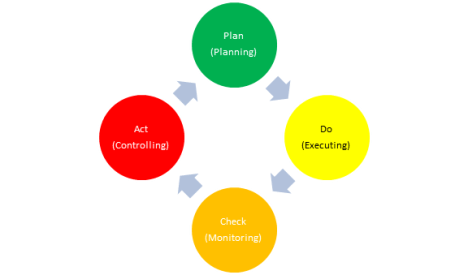
Although the project always starts with the initiating process group, then goes to the planning group, and ends with the closing process group, the executing, monitoring and closing process and the planning process again can be repeated in a cycle called an iteration as illustrated below:

Fig. 5. Planning, Executing, and Monitoring & Controlling Process Group

If the monitoring shows that the project is off of its schedule or budget, an act of controlling it and steering it back to the project baseline will occur. If it can be done without changing any of the original plans or baseline of the project, then it would go from ACT back to DO. But if the project plans now have to be changed because the change is a substantial one, then the PLAN must be done again in order to reset the baseline. Of course when the final deliverable has been produced, then and only then do you go on to the final process, the closing process.

So it is more proper to say the process groups are iterative than sequential.

In sum, it is important to distinguish between

  • A product life cycle and a project life cycle (always sequential and non-overlapping vs. SOMETIMES sequential and non-overlapping)
  • A product and a project (project can be a product OR a result or service)
  • A project life cycle and a project management process (phase vs. process)

Bill Phillips’ #Transformation Program—Chapter One (The Base and Summit)


Now it’s your turn.

1. Introduction—The Mountain-Climbing Metaphor

Bill Phillips comes from Colorado, so it is no mystery why he chose mountains as his metaphor for the journey you must go on in order to experience Transformation of one’s body.  He talks about how his Dad’s taking his family on mountain climbing treks was his way of transmitting “life lessons” on to them.  This is the reason for the “base and summit” title of this first chapter of his book which outlines the 1st week of the Transformation program.

I’m somewhat envious of his mountain-climbing adventures when he was younger, because I was born in Illinois which is very flat. However, the key life lessons he learned from his trips with his father are applicable to anyone who is undergoing a major personal project:

2. Life Lessons from mountain climbing and their application to Transformation

Life Lesson

Application to Transformation

1 Know your base and summit Admit the reality of where you are, visualize where you want to get to
2 Never climb alone Join a Transformation group for moral support
3 Know that you will face setbacks Do not blame yourself, start seeing mistakes as lessons learned
4 Don’t hold on to fear—let it go Fear should be seen as a traveling companion, and not someone blocking the way
5 Good old-fashioned hard work There is no “magic”, just the miraculous transformation that comes one week at a time

Let me talk a little bit about these “life lessons” that Bill describes briefly in his book and relate my understanding of them from the first time I did the program last fall.

I think the first one, from which he takes the title of the chapter, is very important. If you want to lose weight, you probably already have admitted the reality of your situation to some degree. But you need to explore it in its physical, mental, and emotional ramifications to REALLY tap into your motivations. And visualizing where you are going is VERY important, especially in those times when you face adversity (see lesson 3).

The second lesson is really where Transformation differs from Body for Life, his previous, wildly successful fitness program. There is some point later on in the book where Bill identifies the reason for this program. He was doing comparison of various types of diets and seeing which one did better overall in terms of results. Buried in a footnote was the observation that the one factor that was common among all diets was the fact that those who were in a support group along with the diet experienced significantly greater weight-loss results than those who tried to “go it alone.” Hence, the creation of the online Transformation community.

The third one is the realist portion of the mindset for this type of journey. Yes, focusing on your success is important, but if adversity comes you need to deal with. If something knocks you off your exercise schedule, get back on the horse first and then figure out what went wrong. And don’t make those mistakes that you made something to feel guilty over, but rather see them as lessons learned that will point you further in the direction of your eventual success.

The fourth one is to realize that fear on taking up anything new and challenging is normal. Aristotle once said that the brave man is not the one who doesn’t feel fear; he is the one who feels fear and yet still musters up the courage to go in and fight anyway. Fear has to become something which rather than paralyzes you and prevents you from moving forward into something that is domesticated that ends up accompanying you on your journey, like a rabid wolf that challenged man in his early years who then became his faithful companion.

Finally, old-fashioned work is what will get you there. This is probably one of the things some people don’t want to hear: hey, doc, give me a pill that will cure my ill! But the trick here is to plan the work, and the workouts, and then work the plan. It takes 21 days or 3 weeks to establish a new habit. After 18 weeks of this program, the habit will establish a new you.

3. Base and Summit (challenge exercise)

For those who want to take the Transformation challenge, go to the Transformation.com website and sign up—it’s free!

For the first week, you will be going into analyzing the base (where you are) and the summit (where you want to be in 18 weeks). Here are the elements you need to explore:

Elements Base (now) Summit (18 weeks from now)
Heart and Soul Give 3 heartfelt reasons for making the decision to Transform your health and life Give 3 changes you will have made that show you’re aligned with what’s important to you
Emotions Give 3 most predominant inner feelings you are experiencing related to your health and life Give 3 most predominant inner feelings you will be experiencing related to your health and life
Mindset Give 3 patterns of beliefs which may have limited your ability to change in the past Give 3 new patterns of beliefs which expand your ability to make healthy changes for the better
Body Give 3 objectively verifiable statements which reflect your physical condition Give 3 objectively verifiable statements which will describe the new and improved condition of your body

This is one of these “open mode” exercises where you have to give yourself an hour to do the exercise in such a way as to get to your inner motivations. Once having done that, however, you can refer to this “road map” again and again. I recommend actually printing it out and putting it by your computer, or your refrigerator or if you prefer.

I’m starting the program itself tomorrow. I find that doing the preparation on Sunday, the day which is normally the “day off” in terms of both exercise and diet, is the best way to get all the paperwork done and to have time for these motivational challenge exercises.

I hope that those reading this will realize that they are worth doing something this good for themselves.

Passing the #PMP Exam—Study Group Discussions (Chapter 1—Constraints on a Project)


One concept from PMBOK® Guide Chapter 1 is entitled Introduction is that of constraints on a project.  The reason why I’m including this belatedly in my series of blog posts for chapter 1 is because there seemed to be a difference between the popular notion of a constraint in the world of Project Management today, the definition according to the PMBOK® Guide, and the definition according to some of the PMP Exam prep guides.   This post takes a look at the evolution of the concept of constraints.

1. Original definition of constraints (from 1969)

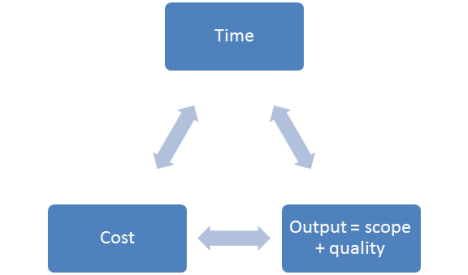
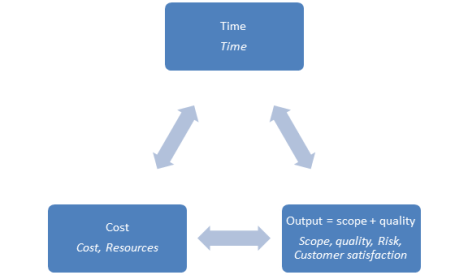
Dr. Martin Barnes first put forward the idea of an iron triangle of time, cost, and output, which he defined as the “correct scope at the correct quality.”

Fig. 1 Iron triangle of constraints (original concept)

The basic concept behind this schematic was that a change in one of the constraints would affect the other constraints. If you want higher quality, it will take you longer and/or more money to produce the product of the project. Or if you have less time than you thought, you will have to pay more to get it done on time or you may have to sacrifice on quality.

Pretty clear, right? This became known in time as the “triple constraint” of time, cost, and scope. This is the common-sense view of the concept of constraint today in the world of Project Management.

In fact, one of the members of the study group was asked the question “what are the constraints on a project” and she answered back, “time, cost, and scope” and got a lot of positive feedback for knowing the “right” answer.

2. Project Management Institute’s current definition (2011)

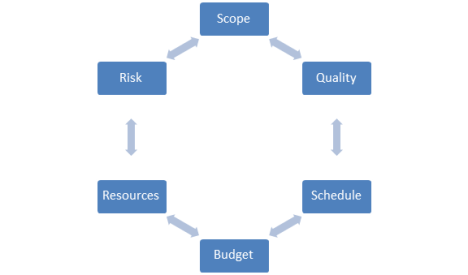
Now in chapter 1 of the 4th edition of the PMBOK® Guide, the constraints are unceremoniously listed as the following (on page 6):

  • Scope
  • Quality
  • Schedule
  • Budget
  • Resources and
  • Risk.

If I tried to reproduce the same type of diagram as in Fig. 1, the first approximation would be:

Fig. 2. Project constraints (modern definition)

But wait, I would have to add arrows in between each of the six points, yielding a total of 15 diagonals or relationships between the variables.

Yikes! What has happened to the “simple iron triangle”? It is now the “hopelessly complicated hexagon.”

3. But, wait, there’s more…

Not to be outdone, Rita Mulcahy’s book adds a 7th constraint to the mix, namely, that of “customer satisfaction. Oh, great, now we have a heptagon …

Fig. 3. Project constraints (Rita Mulcahy definition)

This creates a total of 21 relationships between constraints, which I will not add to the above diagram for fear of confusing the reader.   What a mess!  The loss of simplicity from the time of the “iron triangle” description of constraints was lamented in the excellent blog post in the blog Mosaic Projectsby Pat Weaver and Lynda Bourne:

http://mosaicprojects.wordpress.com/2009/11/19/the-demise-of-the-iron-triangle/

What went wrong?   Well, it’s not the Project Management Institute’s fault for wanting a more complete definition.   Blame it on a paradox of mathematics called …

4. Gödel’s Incompleteness Theorem

The problem of the definition of constraints getting a little unwieldy as it tries to be more complete is a concrete example of Gödel’s Incompleteness Theorem, which states in the realm of mathematics that:

Any effectively generated theory capable of expressing elementary arithmetic cannot be both consistent and complete.

If you try to limit yourself to just using natural numbers used for counting, the system is consistent in that there is no equation such as 2 + 2 that yields two different answers. However, there are some equations such as 2 – 4 that yield NO answers so it is not complete. So, add the negative numbers, and you’re set, right? 2 – 4 = -2, and it is consistent and complete because there is a right answer and only one right answer. However, this creates new problems in different areas such as x2 = 2 that don’t have answers in this new expanded theory. So it is still not complete. And so forth, and so on, if you add irrational numbers, complex numbers to the mix. There is an essential tension between the completeness and consistency of a theory that is built into the very fabric of mathematics itself.

The early “iron triangle” theory was consistent in that it yielded a very fundamental insight, i.e., you can’t change one constraint without it affecting the others. Hence the popular engineering cliché of “faster, cheaper, better—pick two. ” This is a flippant comment, but it has deadly serious consequences, as the Challenger disaster showed that the government’s insistence to NASA, that it improve on all three elements of schedule, budget, AND quality simultaneously, was disastrously uninformed.

So in a well-meaning update of the constraint theory to make it more complete, it has lost that consistency or coherence it may once have had.

5. All is not Lost

However, if you take the original idea behind the iron triangle, i.e., “changing one constraint changes the others” and apply it to the increasingly long list of constraints, I think you’ll save the baby without having to throw out the bath water (to introduce my own cliché).

In reality, if you consider the laundry list of constraints listed in the PMBOK@ Guide, they sort of map onto the old iron triangle in this way, with the iron triangle definition of constraints on the top, and the new PMBOK@ Guide constraints underneath them.

In the end, our discussion of this in our study session proved that the new definition of constraints, although more complete, was not as consistent or as coherent as the old one.

I can just imagine if the study group member who was asked “what are the constraints of a project?”, instead of the snappy one-liner “time, cost, and scope”, had answered “well, it’s like a 7-sided polygon with 21 relational diagonals.” She would have either gained points for being brilliant or would have engendered an open-mouth stare on the other side of the table. She was better off with the old definition in the interview.

Passing the #PMP Exam—Study Group Discussions (Chapter 2—Project Management Framework Introduction)


PMBOK® Guide Chapter 1 is entitled Introduction and as you would expect, it introduces the concept of the project, distinguishing it from the concept of ongoing operational work. It discusses the two levels of management above project management, program and portfolio management. And it introduces the Project Management Office, which centralizes and coordinates project management.

 Chapter 2 of the PMBOK® Guide is called Framework and it shows:

 i.  the relationship of the project life cycle (how you do the work of the project) to the project process groups (how you manage the work of the project)

ii.  the cost and risk levels associated with different parts of the life cycle;

iii.  how large projects can be broken up into project phases;

iv.  how the question of doing projects vs. operational work is affected by the way the company is organized

v. the advantages and/or disadvantages for project management of various types of company organization (functional, projectized, weak/balanced/strong matrix, composite)

vi.  the different categories of stakeholders and how they can influence a project

All of these topics are ones that led to significant discussions in our study group and which led to questions that were initially missed in our end-of-chapter review questions. I hope that the next series of blog posts based on our study group discussions help to clarify these concepts from Chapter 2 and make you successful in handling questions on the exam that deal with them.

NOTE:   There is one topic from Chapter 1 which I realized I needed to write about only after completing the other posts on that chapter.  That’s because the concept is one that has evolved over time and that is “what are the types of constraint that a project has to take into consideration?”   There used to be three categories, and now there are seven and upwards to be considered.   I will deal with that topic in the post tomorrow (on Saturday 07/07).    

On Sunday, I will have post on the first chapter of the Transformation fitness program by Bill Phillips, and then on Monday 07/09 I will start with the individual topics of Chapter 2 that I list above.  

Passing the #PMP Exam—Study Group Discussions (Chapter 1—Project-Program-Portfolio and What is a PMO?)


I hope this post is helpful to those of you who are either preparing for the PMP exam or contemplate doing so. It comes out of the discussions we had in our study group for the PMP exam prep class held by the local chapter of the Project Management Institute.   We focused on where we were getting practice exam questions wrong.  We know the discussions were helpful to us because after having our discussions on each chapter, our performance on the exam questions improved to our objective of an 80% success rate or higher.

 In this blog post, I discuss the two remaining topics that need to be paid particular attention to when studying the PMBOK® Guide Chapter 1—Introduction. The two topics to be discussed in this post are

  • The Relationships Among Project, Program and Portfolio Management
  • The Project Management Office or PMO

1. Project-Program-Portfolio Levels

We’ve dealt with the definition of a project in the blog post for July 3rd. Here is the definition of a project contrasted with the definitions according to the PMBOK® Guide for a program and a portfolio, which are larger units of management within an organization.

Fig. 1. PMBOK® Guide Definitions of Project, Program, and Portfolio

Level

Definition

Project A temporary endeavor undertaken to create a unique product, service, or result.
Program A group of related projects managed in a coordinated way to obtain benefits and control not available from managing them individually. May include elements of related work outside of the scope of discrete projects in the program.
Portfolio A collection of projects or programs and other work that are grouped together to facilitate effective management of that work to meet strategic business objectives. The projects or programs of the portfolio may not necessarily be interdependent or directly related.

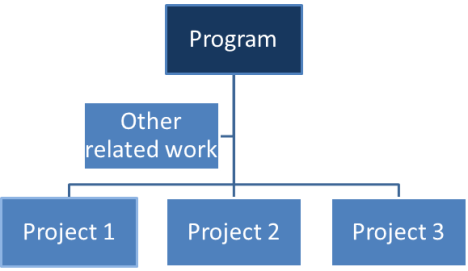
So analyzing the definition of a program, you can see a conceptual scheme of a program that includes, let’s say, three projects and some related work that is outside of the scope of the discrete projects in the program.

Fig. 2. Conceptual diagram of a Program

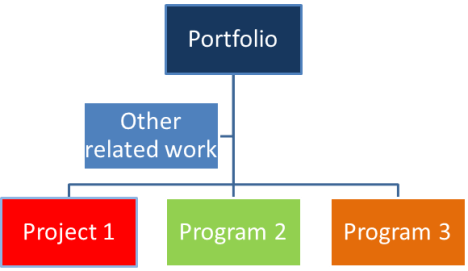
Now if you go to the definition of a portfolio, you can see a conceptual scheme of a portfolio made up of a project, two programs and some other related work.

Fig. 3. Conceptual diagram of a Portfolio


Hmm … looks very familiar, somewhat like the conceptual scheme of the Program, right? However, here’s the important difference between the two schemes. The projects and related work that are managed as a part of the program are thematically related, indicated in Fig. 2 by all boxes being a shade of blue. The projects and program under the portfolio, on the other hand, may be independent¸ indicated in Fig. 3 by the boxes being different colors. But of course they COULD be interdependent or even directly related.

However, projects in a program CANNOT be independent in the same way. Here’s a summary of the possibilities based on the definitions.

Fig. 4. Summary: Relatedness of program/portfolio components

Level

Directly related/

interdependent

Independent

Program

Yes

No

Portfolio

Possibly

Possibly

An example of a program would be the design of an aircraft, with the different projects being the design of the various systems within the aircraft. These would obviously have to be coordinated since they are all parts of the same aircraft, and changes in one system might have an impact on the other systems.

An example of a portfolio with interdependent or directly related components would be the design of a whole series of aircraft, with each program being one of the aircraft. This would be especially true if the various aircraft shared components or even whole sub-systems.

An example of a portfolio with independent components would be an energy company that has facilities that produce energy from various sources including wind, solar, fossil fuels, and nuclear materials. Setting up production of these would be independent because the energy sources would require vastly different methods (or tactics) of production, but they would all be related strategically to company’s objective of profitable energy production.

2. Project Management Organization

When the question in our study group came up of “what is a Project Management Organization,” some of us said it was directly involved in project management, and others said it was NOT directly involved, but played a “supporting role” so to speak. The answer according to the PMBOK® Guide? We were ALL right. How could this be?

Let’s take a look at the definition according to the PMBOK® Guide:

Fig. 5. Definition of Project Management Office or PMO

Definition
Project Management Office or PMO An organizational body or entity assigned various responsibilities related to the centralized and coordinated management of those projects under its domain.


The responsibilities of a PMO can range from providing project management support functions to actually being responsible for the direct management of a project.

In other words, there is no one standard for what a PMO can do with regard to the actual management of the project. One company might have it directly manage the project, while another company might have it be more of a supporting role, like being the repository of all documents related to past projects, almost like being a corporate project library (or using other terminology, handling organization process assets).

Another company still might have it provide assistance with specific project management tools, including project management software (or using other terminology, handling environmental enterprise factors).

So the PMBOK® Guide recognizes that any of these possibilities may be true for a particular organization. But in ANY of these cases, it assists the handling of projects for an organization by centralizing their management in some shape or form. To what EXTENT it centralizes it (i.e., the paperwork, the procedures, or the performance) is up to the company.