The 7 Habits of Highly Effective Project Managers–Habit 3: Put First Things First


The successful person has the habit of doing the things failures don’t like to do.  They don’t like doing them either necessarily, but their disliking is subordinated to the strength of their purpose.   E. M. Gray in “The Common Denominator of Success”

1. Introduction to Habit 3:   A Journey from Determinism to Determination

Habit 1 was the habit of being proactive, of being the creator of a circle of influence around yourself to help make the project and one’s organization successful. Those who don’t have Habit 1 live in a reactive world, one of determinism and fatalism, where you feel like you have no control.

After having established the first habit, you then go to Habit 2 which is the first creation or mental creation of a vision. Then in Habit 3 you go to the second creation, which is the physical creation in terms of results of what had been merely planned mentally before.

So whereas Habit 2 dealt with being an effective leader, Habit 3 deals with being an efficient manager in order to carry out the project. In terms of project management processes, Habit 2 would cover the initiating and planning phase, whereas Habit 3 would take you from the planning phase into the executing and monitoring & controlling phase of the project right through to the closing phase.   It shows you how to use your determination and will in order to carry out the mission statement developed with Habit 2.

2. Time—the ultimate constraint

Time is a constraint that is probably the most difficult to control on a project, and in one’s life as well. If you consider your work and your personal life as a series of projects, how does one prioritize the projects to make the best use of one’s time? To discuss this, Stephen Covey uses a four-quadrant model, which given the title of my blog I knew I was going to like the moment I saw it.

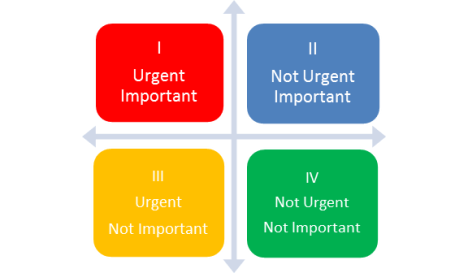
Figure 1: Time Management Matrix

The top two quadrants deal with issues that are important in terms of results that contributes to your mission, and your project. The left two quadrants are matters that are urgent in that they demand our immediate attention.

So if you give all permutations of the above two dimensions of urgency and importance, you get the following four quadrants.

  1. Quadrant I activities are urgent and important, such as crises or pressing deadlines.
  2. Quadrant II activities are activities that do not have to be done right now, but which if done would make a positive contribution to your project, such as planning, increasing your production capacity through training, building relationships with stakeholders, and brainstorming (recognizing and looking for new opportunities).
  3. Quadrant III activities are urgent, but not important, such as some e-mails, meetings, reports that are external to or peripheral to your project.
  4. Quadrant IV activities are not urgent, and not important, and these include e-mails external to your organization, and time wasters of any sort.

These are the different quadrants as they exist conceptually. If you could plot the amount of time you spend each day on these activities, what would the above four-quadrant diagram look like? For those whose quadrants I and III seem to take over, here are some suggestions that Stephen Covey makes to get back to a more balanced schedule.

3. Time management pathologies: Quadrant takeover

For those who are always fighting fires, Quadrant I takes up most of their time. If you don’t have a clear idea of what is important, you may end up taking care of urgent matters more often than you need to.

Figure 2. Quadrant I Takeover—Constantly “Putting Out Fires”

Quadrant I

Quadrant II

Quadrant III

Quadrant IV

Solution: Focus on Quadrant II, and try to spend more time on activities that prevent those urgent problems before they occur. This is the reason why there is focus on risk management.

For those who spend a great deal on dealing with problems that are based on the expectations of others outside the project. The tasks may be important to them, but not necessarily to you as the project manager because they are external to the project.

Figure 3. Quadrant III Takeover—I’m Just a Boy who Can’t Say No

Quadrant I

Quadrant II

Quadrant III

Quadrant IV

Solution: As in paragraph 3 above, try to take control of your time by scheduling time for your own project first, and learn the power of when to diplomatically say “no” to requests that are outside of your project. Alternatively, learn to delegate those tasks to others in your team who are capable of handling them.

If you have non-urgent, non-important tasks taking over most of your schedule, as in Quadrant IV, you should definitely delegate them to members of your staff.

3. Time-Management Tools

Okay, so you want to manage your time more effectively using the solutions mentioned above. How do you go about doing it?

Here is a diagram showing the different “generations” of time-management tools, from those which make you merely efficient to those which make you more effective as well.

Figure 4. The Four Generations of Time-Management Tools

The first generation consists of to-do lists. These help you remember tasks you have to do in the present.

The second generation consists of schedules. They help you remember tasks you have to do in the future as well as the present.

The third generation of tools consists of daily planners. These can help you to prioritize those tasks. The key factor here is that these priorities are based on external circumstances, which ends you getting trapped in Quadrant III at the mercy of circumstances beyond your control.

The fourth generation of tools consists of long-term planning, especially that which makes some time for Quadrant II activities that make you more effective as well as efficient.

The following represents Stephen Covey’s scheme for planning which incorporates Quadrant II activities into one’s schedule.

Figure 4. Organizing Effectively AND Efficiently

First stage is creating a mission statement. People say they need discipline to stick to their goals, but that discipline is made easier if you have a mission statement that you can refer to when you feel that you are starting to go adrift. This is something that can be read but must be VISUALIZED when it is created.

With that mission statement in mind, the second stage is to think of the roles you play as a project manager. What are your relationships to your stakeholders, which can include your project sponsors in the organization, your project management organization, your customers, those doing work on the project (subject matter experts), etc. Also, include those roles you play outside of work if you are doing a schedule that combines your work and personal life.

The third stage is to write down those goals which fit into those roles. And finally, create a long-term schedule with those goals in mind. Then you make a weekly schedule based on the long-term schedule, so your short-term focus is always aligned to your long-term horizon.

The best advice I have for you is to look at the examples in Stephen Covey’s book and especially his Personal Workbook that goes together with his text. I can say that I am incorporating his principles and am increasingly amazed not at how much I get done, but how much quality I’ve built into my life since I have tried it.

The next post takes us from the world of the first three habits which take you from dependence to independence, and into the world of the next three habits which help you take a group of independent individuals and turn them into a close-knit team.

The 7 Habits of Highly Effective Project Managers–Habit 2: Begin with the End in Mind


It’s incredibly easy to get caught up in an activity trap, in the busy-ness of life, to work harder and harder at climbing the ladder of success only to discover it’s leaning against the wrong wall. Stephen Covey

1. Introduction to Habit 2: A Call to Leadership rather than Management

Habit 1 was the habit of being proactive, of creating a circle of influence around oneself to help make the project and one’s organization successful. Now that you’ve got this influence, how are you going to use it? Now that you’ve given yourself room to maneuver in, in which direction are you going to go?

Habit 2 deals with creating a mission statement or vision, which is an integral part of leadership of a project or organization. It is using the team’s resources in an effective manner. Once the direction has been established, then it is part of management of the project to go there in an efficient manner.

2. Efficiency vs. effectiveness—the tale of the Helawi tribe

I can explain the difference between being effective and being efficient by means of an old joke told on a comedy series from the 1960s called F-Troop, a humorous take on the Wild West. A young Native American asks his father what the name of the tribe was. The father answered that they are the Helawi tribe. He said to his son that it was funny that he asked that question, because he asked the same question of the chief while they were moving their hunting grounds a while back. The chief was overlooking the landscape, and he looked up distractly from his map and in said “where the hell are we?” The father misheard and thought the chief had said, “we’re the Helawi” and mistook that as the identity of the tribe.

In a similar way, members of your team may identify with their tasks and try to do them efficiently, be as the project manager you must try to be effective and to be like that chief who stops and asks “where the hell are we?” from time to time, and to do that, he needs not a map, but a project charter.

3. The mission statement

An organization should have a mission statement or philosophy that focuses on what the organization wants to be or its character and what it wants to achieve. I like the description in the book by Stephen Covey of our country’s Constitution as being equivalent to its mission statement.

The mission statement or project charter should be centered in the following principles:

Security is your sense of your team or organizations strengths, and the guidance is what you supply as a leader to give direction to the team. Power is derived from the circle of influence described in habit 1 which gives you the capacity to be proactive. It takes the core strengths of the organization and uses them to achieve the project goals you set using your wisdom as a project manager, which is gained from lessons learned on past projects.

In this way, your mission statement will align all of the team members’ activities towards the same direction, and the project itself will align with the strategic goals of the organization.

In the next post on Habit 3, I discuss how to manage the team once you have given them direction as a leader.

The 7 Habits of Highly Effective Project Managers–Habit 1: Be Proactive


God, grant me the serenity to accept the things I cannot change, Courage to change the things I can, And wisdom to know the difference.—Serenity Prayer by Reinhold Niebuhr

1. Habit 0—Be Aware of Yourself

The first step in applying any of the 7 Habits that Stephen Covey describes requires you to stand apart from yourself and observe yourself as if you were looking at another person. I call this “Habit 0″, although Covey himself does not use that term. In my opinion, the way to get the most out of his book is to get the Personal Workbook which allows you to make observations on your thoughts, behaviors, and actions based on the material you have read in each chapter. So my recommendation for those who read his book is to go get the workbook and—work through it!

2. Habit 1: What does”proactive” mean? Let’s ask Shakespeare!

Figure 1. Habit 1: Be Proactive

I think the common conception of the word “proactive” is “Acting in advance to deal with an expected difficulty; anticipatory” according to the American Heritage Dictionary. However, in my opinion Stephen Covey’s conception of the word “proactive” is somewhat larger in meaning, more like the definition of the word in the Collins Dictionary of “tending to initiate change rather than reacting to events.” You can initiate change in anticipation of future events, but you can also initiate change in response to past mistakes, and to one’s present circumstances.

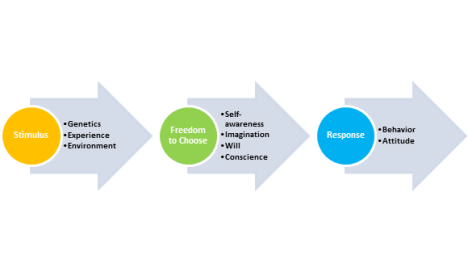
Figure 2. Freedom to Choose = Being Proactive

If you believe that genetics, one’s childhood experience, and one’s environment SOLELY determine one’s behavior and attitude, then you are believer in determinism and are reactive. If you are able to use self-awareness to examine yourself, and then use one’s imagination, will and conscience to create a space in which you have freedom to choose your behavior and attitude, then you are being proactive in the wider sense.

It is this wider sense of the word proactive that gives insight into the genius beyond Shakespeare’s plays. Harold Bloom, the most celebrated literary critic in the United States, has written about what makes Shakespeare the most celebrated literary genius of all time. One of those elements is his characters’ ability to overhear themselves and gain self-awareness, and instead of simply reacting to events, to be proactive by exhibiting a freedom of choice from which they act.

Here’s an illustration from the play Hamlet. The eponymous hero has just come from a performance of The Murder of Gonzago, a play within a play that recreates the circumstances behind his father’s murder. When the murder scene happens, Hamlet’s uncle Claudius abruptly rises and leaves the room, and Hamlet is convinced of his uncle’s guilt based on his reaction to the play. Hamlet goes off to find his uncle and murder him, when he suddenly sees him deep in penitent prayer, asking forgiveness for what he has done.

Hamlet draws his dagger to kill him, which would be simply reactive based on his desire for revenge. However, he starts reasoning that if he were to kill his uncle right then and there, his uncle would be pardoned for the murder by having died in a state of penitence for what he had done. Hamlet sheathes his dagger and walks away, because he has overheard himself and reasoned that he does not want to create the unintended consequence of sending his uncle to Heaven by killing him at that moment, saying “Why, this is hire and salary, not revenge!” or as we would say today, giving his uncle a promotion rather than a punishment. In this space created by self-awareness, Hamlet is giving himself a freedom to choose and be proactive. This freedom to choose is what gives Hamlet the quality of being a fully-dimensional human being just like the audience, and they have responded to that echo of their own humanity throughout the ages by declaring Shakespeare the most celebrated of all literary geniuses. Why? Because his best characters are proactive, not reactive.

3. A Project Manager expands his Circle of Influence

One illustration that Covey has to emphasize the difference between reactive and proactive people is create the circle of influence which is the those items over which someone has a degree of control, either directly or indirectly. We can solve our own problems:

a) directly by changing our own habits directly (habits 1, 2, and 3),

b) indirectly by changing the habits of others (habits 4, 5, and 6), or

c) or for those we have no control over, by changing our attitude to one of acceptance.

Those that spend more of their mental energy on problems over which they have no control are reactive. They are either guilty about mistakes they have done in the past, or worry futilely about problems they may encounter in the future without doing anything to prepare. Those that are proactive try to expand their circle of influence, and a Project Manager does this in three ways:

Past Present Future
Proactive method Lessons learned Active listening/empathy Planning/risk response

For mistakes done in the past, a proactive project manager acknowledges the mistake, corrects it and puts it in the lessons learned for future projects. To avoid mistakes in the future, a proactive project manager plans and makes contingencies for deviations to the plan in the form of risk responses that can be made part of a risk register.

Then, to avoid mistakes being done by oneself and others in the present, you need to be an active listener to those in the team so that any concerns, even unexpressed ones, can be dealt with as quickly as possible.

If you follow these three methods of dealing with the past, present, and future, you will not only be a better project manager, but you will become a more responsible person.

The 7 Habits of Highly Effective Project Managers–Overview


1. Purpose

I am currently taking a course that is preparing me to take the Project Management Professional certification exam. The course is being put on by the Orange County chapter of the Project Management Institute. Our main text for the course is A Guide to the Project Management Body of Knowledge or the PMBOK® Guide for short. Appendix G to that guide lists interpersonal skills that Project Managers should have to help them interact appropriately with the project team and other stakeholders.

Section G.9 of that appendix gives a list of references, and the first book on the list was Stephen R. Covey’s book Seven Habits of Highly Effective People. I decided to make a project of blogging about the seven habits that Covey presents with the idea of making them specifically relevant to Project Managers.

2. What is a habit?

The definition of a habit is “one of an imaginary race of half-size people living in holes”—oh, wait, that’s the definition of a “hobbit”, invented by J.R.R. Tolkien. But come to think of it, if you have a BAD habit, then you are half of the size of what you COULD become, and you are living in a hole of your own making.

To break a BAD habit and replace it with an EFFECTIVE habit, you need to have three components which Stephen Covey outlines in his section “The Seven Habits—An Overview”. You need theoretical knowledge of what to do, you need the practical application or skill or how to do it, and the motivation or desire to want to do it.

A project manager is motivated by a desire to see the project succeed. Gaining the knowledge of the 7 Habits and putting those skills to work will make it more likely that future projects will succeed.

3. What are the 7 Habits?

The 7 Habits are arranged according to a paradigm or pattern as follows. The first three habits 1, 2, and 3 deal with the paradigm of dependence where the focus is on you, e.g., you take care of me; and if something goes wrong, I blame it all on you. The next three habits 4, 5, and 6 deal with the paradigm of independence where the focus is on me or I, as in I can do this myself. The 7th habit is the paradigm deals with the paradigm of interdependence where the focus is on we, as in we can combine efforts to achieve success.

Habits 1, 2, and 3 deal with self-mastery, and move a person from dependence to independence. Habits 4, 5, and 6 deal with teamwork, cooperation, and communication, and take you from being independent to being interdependent and working with a team. Habit 7 is the habit of renewal, of constant innovation of both yourself and your team.

You can see why being a better leader first means being good at your craft of project management. Although there are many leadership styles, leadership by feat (or example) rather than by fear is the one that I have appreciated in my managers in the past, and is one that I hope to cultivate in the future as a project manager.

4. What is Highly Effective?

These habits are highly effective because they not only increase production (abbreviated by “P”) in the present, but increase one’s productive capacity (“PC”) or capacity to produce in the future. In the illustration Stephen Covey uses of the familiar Aesop’s fable of the goose that laid the golden eggs, the farmer ends up killing the goose (the production capacity of the eggs) to get at the eggs (the production).  Highly effective habits are the habits that keep on giving; they balance your time between activities which give short-term benefit now and those which create long-term benefits for the future.

The PMBOK® Guide recommends this book for project managers, but I recommend that you learn it not just for yourself in your capacity as a project manager, but also to impart these habits to those on your team, to help them move from dependence on you to being able to work independently, and finally to work with others in an interdependent way as part of a team.    When your team becomes more highly effective, then so do you.

With my next post, I start with Habit #1: Be Proactive.

From the Viking Choir to the Masters of Harmony–Returning to the Choral Sea


A chance encounter at one of my recent networking groups leads to my rediscovery of choral music, and a sea of musical memories from my earlier life. This post is dedicated to the memory of Walter Rodby–who started it all.

I remember going to the audition with a sense of resignation.   I was determined to do my best, but I really didn’t have any expectation of making it.  It was the end of freshman year at Homewood-Flossmoor High School, and Walter Rodby was holding tryouts for members for the introductory Male Chorus to join the premier high school chorus, the Viking Choir.  Normally, you needed to be in the intermediate chorus called the Mixed Chorus first.   Only about a dozen slots would be open for those in the Male Chorus who were good enough to pass the audition and go straight to the top choir.

For the audition, we had to sing a passage from some recognizable tune to make sure we at least had the minimum vocal quality that he was looking for. But Mr. Rodby required more than just a pleasing voice. He was a stern taskmaster, and he required that those trying out for chorus to learn how to sight-read music so that the choir rehearsals were more about harmonizing with the other parts than pounding out your own.

It was my turn to enter the room.  Mr. Rodby sat with military bearing at the piano.   He asked me to sing the passage and I was a bit wobbly at first, like one of those fawns trying out its legs for the first time, but then ended literally on a more confident note.    Then he handed me a sheet of music.   Ah, the moment of truth!   I tried to sing my part off the sheet of music, and hoped my practicing had paid off.   I did okay on the first half, but then flubbed the end of the short passage, at the end of which Mr. Rodby politely said, “thank you very much” meaning “the audition is over.”

I don’t know what came over me, but rather than leaving I said, “Mr. Rodby, I know the audition is over, but I think I did the last part of that passage wrong and would like to do it over so that I can get it right,” with my voice showing a determination that came from somewhere deep inside of me.   I redid the passage, and this time, what do you know? I did it perfectly!   I thanked him for allowing me the opportunity to get it right.    “Oh well,” I thought as I left the room, “too bad I got it right AFTER the audition was already over.”  I put it out of mind, and prepared to join the middling Mixed Chorus the next year.

One week later, the lists of those who passed the audition were put on the wall…  All the boys crowded around, and there were many disappointed looks as they returned from scanning for their name.   To avoid the embarrassment, I milled around until most of them had cleared away.  There were a couple of boys who were high-fiving each other for having made it.   I finally decided to get it over with and looked at the list of baritones and at the very bottom was the name … Jerome Rowley.   I made it!   I honestly was more stunned than happy.

Later on, I think that Mr. Rodby passed me on the audition, not because of my non-existent technical brilliance, but because I was determined to get it right.  That extra quality of tenacity was what put me over the edge, I think, and is something that I have never, ever forgotten.

The Viking Choir made history in 1970 by being the first American high school choir to tour behind the Iron Curtain. A few years later when I joined the choir as a sophomore, we went on a tour of the Netherlands and Germany, with a short stopover in France. It was the first time that many in the choir had been to Europe, and I remembered it as a time of music … and magic, as we explored castles, sailed down the Rhine River and sang in cathedrals, and went to restaurants with our choir guides and were served that ambrosia called wine. It was that experience that made me determined that when I returned from Spring Break, I would start learning French and German in addition to the Spanish I was already studying.

The person who was responsible for my success was Walter Rodby, who instilled in me a sensitivity to musical phrasing, which I can only describe as having a musical passage grow and then die down like the blooming and dying of a flower rather than being strictly played according to the rhythm and dynamics as noted in the music. This musicality combined with the dedication and discipline that I had already had in embryo as a member of the Male Chorus caused me to have the wonderful sensation of having fun while working hard together with others as a member of the chorus.

Fast forward to a few weeks ago: I was in a circle of people in a networking group I regularly attend, when we were asked to name something memorable about ourselves.  A guy named Brad said he loved to sing, and was a member of a men’s chorus called the Masters of Harmony, and wanted to know if anybody else in the group sang. “I did,” I volunteered. Or I used to—it had been two decades since my last choral singing in college and graduate school.

He invited me to go to a rehearsal that the Masters of Harmony were putting on in preparation for the International Choral Championships to be held over the 4th of July. Something in me just decided to be adventurous and to try it. I went there on a Wednesday evening and everybody was very friendly and welcoming.   And then they went to the risers and I stood among them as they started to sing …

They were amazing!  I didn’t know until I went home and checked them out on the internet, but they are Southern California’s Premier Men’s Chorus, and were the 2011 International Chorus Champions.  This makes them ineligible according to contest rules to join the international contest again until 2014, but they are going to the international contest to literally give their swan song tribute to whichever chorus wins this year’s competition.    Here’s the link for those who want to take a look at what the chorus is all about:  http://www.mastersofharmony.org/home/.

I sang for three hours and all of the musical director Mark Hale’s comments about singing musically reminded me exactly of what Walter Rodby used to drum into my head for the three years I was a member of the high school chorus.   And the excitement of being part of a group of guys all trying to do their best was just … exhilarating.

When I was done with that one rehearsal, I knew I was hooked:   I knew that whatever it takes, I have to be part of this organization. That yammering little voice I’ve learned to hate over the years started saying, “hey, it’s been over two decades since you’ve sang.” But within me, something deeper, that determination I pulled from the depths of being that one audition day back in high school said, “I will at least try out for it. I will give it my all and do my best—then I can rest.” After that wonderful experience at that rehearsal, and all the memories that it unleashed in me, I cannot NOT go through with it.

We’ll see where this musical road takes me. But even the road in front of me is new, the territory seems very familiar, and I am looking forward to exploring it. For two decades, my musical voice was hidden, but now I MUST sing.

History of the Modern Middle East–Lecture 3: Geography and Inequality (part 5)


The following are my notes from the lecture that was given by Prof. Richard Bulliet of Columbia University on January 17, 2009.

13. From inequality to equality with limitations

Prof. Bulliet wants to turn to a topic that has been on the list of the top five topics of human thought for the last several centuries, and that is the subject of inequality. Inequality is a puzzling subject; it is evident that everyone is not the same. Prof. Bulliet says, “I’m on this platform, and you’re not. Hehehe!” (laughter) Inequality is evident, but in the present today you have an empirically correct as well as politically correct ideological orientation that there is an intrinsic equality within the human species that expresses itself regardless of external characteristics. All men are created equal, and perhaps a small handful of women (laughter). It is hard to get a clear expression of equality but nevertheless we take equality as a fundamental concept in a university like Columbia, although not all of our fellow citizens would necessarily agree, according to some e-mails I got from Mr. Obama on the campaign.

Equality has always been qualified in certain ways, so just thinking of your class readings, Aristotle would say there are natural slave populations. The Old Testament would say that the descendants of Ham should serve the descendants of Shem and Japheth. So you have notions of inequality in the ancient world. There’s no point in going into detail all the way through this, but then gradually you get down to the 17th century, and you have someone like John Locke who writes an essay On Toleration. He says that everyone should tolerate religious difference, which is a wonderful idea–except for the Catholics (laughter), because they follow the Pope, except for the Muslims because I bet they follow the Sheikh of Islam in Istanbul (which they don’t, and he should have known better), and of course the atheists, because we can’t abide those.

Toleration depended therefore upon the size of the group. He was interested in whether the Protestants and the Catholics in England would continue to butcher one another over issues of who is destined to go to Heaven and things like that. So toleration grows but somehow toleration is still conditioned by the unit of analysis. You can Rousseau writing his book on the Origin of Inequality. He says that when man arrogates certain property to himself, property is the source of inequality. Then he proceeds to talk later on in his argument about natives from this or that part of the New World. Why didn’t any of those natives ever grab a piece of land and say, “this is mine?” He isn’t interested in inequality among peoples; he’s only interested in the problem of inequality within the European population that he is addressing. That is because it was assumed for the longest time that inequality among the races or among geographical regions was natural, and therefore inequality only applied to people within your fundamental unit of analysis.

14. Geographical determinism—Jared Diamond as example

So you get the American Constitution which says “all men are created equal” and yet has provisions for slavery, which is an inherited condition. Obviously, “all men” does not include all men living in bondage. There are further steps in this and clearly the Darwinian movement of saying that all humans are a single species that has a certain evolution plays an important role here. Eventually you get to an author like Jared Diamond who wrote a great prize-winning book Guns, Germs, and Steel which Prof. Bulliet hates. He starts out by saying, “I know this chieftain in New Guinea who is as clever, as witty, as talented, as able to run the 40-meter dash in a good time, as anyone in the world, and he doesn’t have a cent to his name, whereas in America, everybody is filthy rich.” Why do you have this inequality, when Diamond’s friend in New Guinea is equal of anyone in Europe and America? The fundamental question he starts out with in his book is, “why do you have inequality at a world scale?” He starts out with the all assumption that all humans are equal, that this is axiomatic; therefore, inequality has to come from some extra-human source, which he finds in geographical determinism.

Some people were lucky enough to live where horses were, and other people lived where the anteaters were. They couldn’t domesticate the anteaters, so they fell behind, so the people who domesticated horses conquered the world. He has a whole bunch of other not-very-convincing arguments for geographical determinism. So he starts out with this idea that he has this friend in New Guinea and he doesn’t have any domesticated animals—except pigs and chickens, of course. Well, they don’t have any real good domesticated animals like cows and horses. And it’s very hot, and it’s a difficult climate, and they don’t have broad acres of grain crops. They have a lot of yams, potatoes and bananas, but they don’t have barley and wheat, and so on and so forth. So how, despite their native equality, how could they have accomplished as much as the Europeans did?

He never speaks about the Mayans in the Yucatan peninsula, who had no domesticated animals, who had little in the way of grain crops, who lived in a miserably hot climate, and who created one of the world’s great civilizations. He simply leaves that out because it is inconvenient to his argument.

15. The Long Life of The Idea of the Birth and Death of Civilizations

Other people, more of the last generation than now, took that issue more seriously, and asked whether there is something about civilizations that you can look at analytically to explain why some civilizations rise and some civilizations decline in certain parts of the world.

You can find this done in different ways by different people. Arnold Spengler one of the classiest writers although one of the more infamous (?) thinkers simply saw that civilizations born, mature, die, and then they live a sort of living death for thousands of years like the Chinese civilization.—it’s not a very helpful approach.

Arnold Toynbee classified a score of civilizations and talked about their birth, their adolescence, their senescence, and their eventual death using this biological metaphor and he wrote many, many volumes that nobody reads anymore because it just wasn’t a convincing argument—there were oo many variables, too many particularities, too little knowledge, so forth and so on.

Among non-European writers, the 14th century Tunisian writer ibn-Khalduun used a biological metaphor of the birth and death of states or dynasties in his vocabulary, but he used it very differently. He saw the state as having a lifetime spelled out in a fixed number of generations, each of them 40 years long. So ibn-Khalduun could really count the years from the beginning to the end of a particular state formation. It is a theory that works fairly well because it is anchored to the human lifespan, but although it explains why it dies, it certainly does not explain very much where something comes from. He attributes that to the spontaneous and unpredictable emergence of a feeling of group solidarity somewhere out in the desert. He doesn’t really explain, however, why that occurs with the periodicity and the geographical locale that it does. So in other words, the study of civilizations has recognized the notion of rise and fall but has failed to come up with a very conclusive explanation for it, although there is a recurrent tendency to look for biological metaphors.

15. European exceptionalism and the imperialist imagination

In modern Western thought there has been deeply embedded the idea of a Western Euroamerican exceptionalism, which no matter why states rose and fell in the past, the states that arise in modern Europe and north America rise to a greatness which they will retain unchanged until the end of time.

So you can all report that to your parents, and it will be comforting to know that despite everything, America will never fall. Now this clearly is nonsense. Nobody argues that great moments are permanent, but it was very puzzling for Europeans. In the context of the war fought by the Greeks against Ottoman domination in the 1820s, it was asked “why is it that the Greeks we are hoping will achieve independence and whom we support so strongly don’t seem to be a damned thing like Plato or Aristotle?” The Greeks are supposed to be blond, and the last time the Europeans looked they didn’t see any blonds in Greece. I wonder if something happened to the Greeks; perhaps all the great Greeks all died from a terminal case of overripe greatness. Gee, I’m so great I think I’ll just … die (laughter). Well, the Europeans didn’t understand what happened to the Greeks.

When the scientists went to Egypt with Napoleon at the very end of the 18th century, they saw that Egypt is filed with all this really cool stuff like the pyramids, sort of dilapidated but really, really impressive. But the Egyptians can’t be the same as these ancient Egyptians. Racist archeologists and historians came up with theories to explain all this. They came up with theories devoted to the idea that civilization was something that was brought to different parts of the world as a gift by certain tall, white, probably blond, European guys, who went to a benighted area and taught them how to be civilized, and then quietly withdrew from the scene. Egyptologists said there was a civilizing race in early Egypt that came from somewhere else who told the semi-barbaric and unfortunately dark-skinned Egyptians how to build pyramids.

Stonehenge? They could explain Stonehenge: some Greeks or other great people sailed over from Greece, got to a place where a bunch of local Brits were living in caves and said, “okay, let’s all get together and start schlepping big stones now and put them on top of each other.” And once they had done that, they left (laughter). These theories about great conquering races were built into early archeological thought and early imperialist thought when Europeans encountered people in other parts of the world. And of course there was a subtext: if great people in the past had brought civilization and if we in the present are really great, then we can bring civilization and we can do what those civilizing tall, white people did to Egypt or what the Greeks to Stonehenge. We can bring civilization. In other words, you can’t separate this notion of the rise and fall of civilizations and the hypothesis that it is rooted in the incredible achievement of an intrusive population from the imperial imagination of Europeans in the 18th and particularly the 19th century.

16. Modernization and inequality

Nobody believes in this stuff anymore—well, some people do. But academically every each one of these theories has been thoroughly demolished and sometimes politicized in the process. Then we are left with the question that Jared Diamond addresses of accounting for this inequality. One way to do this is to say that modernity as it comes into being in the Northwestern Europe area and in North America is a unique, one-time, totally different phenomenon. It is the template for the future of the world through the process of globalization and modernization, and therefore no other examples need be given because we are dealing with a unique situation, in which it happens–not in some ancient time but happens empirically now–that the Europeans and Americas just really are better and they are the model for the future. That was the dominant view certainly in the 1960s, the heyday of modernization theory, and it is widespread to a certain degree in the present day.

But it also rests on this idea that you take this Northwest quadrant and you pick only one part of it to characterize the whole. If you decide that you’re going to deal with the quadrant altogether, then you look at the movement over time of power and importance from one part of the quadrant to another. If you’re an avowed believer in European exceptionalism, you have no discomfort in saying that the Renaissance took place in Italy,  the voyages of discovery took place in Spain, the Industrial Revolution took place in England, and it’s all the same thing because it’s all Western Europe–the fact that Italy and Spain end up in a less prosperous condition by 1900 isn’t as important because you are dealing with the same area.

If you take the entire quadrant, we have to think not just of Northwestern Europe, but we have to think of Russia, the Ottoman Empire, and North Africa. We have to look at this holistically and think about why certain areas within a cultural zone move from greater or lesser prominence at any particular point in time. This comes to a head in a debate that has been very important in the field of Middle Eastern studies, which Prof. Bulliet will start his next lecture with, and that is the debate on the so-called decline of the Ottoman Empire. There are some people who say that, if you say a people declined then that is a moral failing, unless you say there is a decline of the British Empire, which of course is a good thing (laughter). And there are other people who say that “decline” is the proper word to use.

This concludes the third lecture of Prof. Richard Bulliet of Columbia University on the Modern Middle East.

History of the Modern Middle East–Lecture 3: Geography and Inequality (part 4)


The following are my notes from the lecture that was given by Prof. Richard Bulliet of Columbia University on January 17, 2009.   This is prefaced by my recap of Prof. Bulliet’s views on cultural dissemination around the Mediterranean basin, which he discussed in the last part of his lecture.

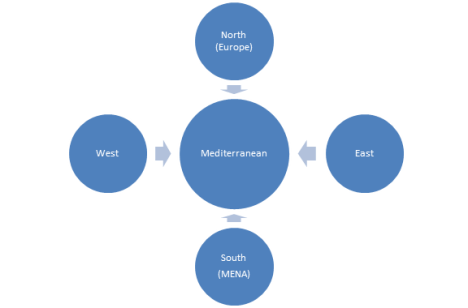
Fig. 1 Cultural diffusion around the Mediterranean Basin

Prof. Bulliet puts forward the four stages of conceptualizing cultural diffusion around the Mediterranean Basin.

Stage One. N-S, E-W cultural unity in the ancient world

Prof. Bulliet says that in the ancient world, the entire Mediterranean Basin was seen as one cultural zone which is referred to as the Greco-Roman or Classical Civilization.

Stage Two.  E-W cultural disunity in the Dark Ages

Christian civilization became split between the Eastern Roman Empire and the Western Roman Empire in the 300s in the North (Europe), and 500 years later Islamic civilization became split between the West (maghrib) and the East (mashriq) in the 800s in the South (Middle East and North Africa or MENA).

Stage Three.  E-W cultural unification in the Middle Ages

There was the beginning of cultural interplay between East and West in Europe in the Middle Ages, as well as between the West (maghrib) and the East (mashriq) in the Middle Ages in the South, albeit with a similar time lag of about 500 years.

Stage Four.  N-S cultural unification in the Modern period

There is cultural interplay between North and South which is heading towards the recognition of an Islamo-Christian civilization that starts in the Modern period. It is not that there will not continue to be differences between EuroAmerica and MENA cultural zones, but the similarities will be seen to outweigh the differences in the same way that the Greek and Roman civilizations, although quite different from each other, could be seen as the two faces of one Classical civilization.

Now I continue with the notes from Prof. Bulliet’s lecture, this time on the subject of religious assimilation in Europe and MENA.

10. Religious assimilation in Europe and the Islamic World

But the historical fact is that of the current 30 or so European countries, at least 14 of them have been under Muslim rule for at least 100 years, and sometimes several hundred years. Islam is by no means a phenomenon of the South side of the Mediterranean Sea, in the same way that Christianity is by no means a phenomenon of the North side of the Mediterranean Sea. You had Christians in the areas conquered by the Arabs who remained for about two centuries as the majority, and persisted as minorities to the present day, although they are becoming less numerous. Islam in the Middle East and North Africa is a more homogeneous faith today than it ever has been in the past. The disappearance of non-Muslim groups has been a phenomenon of the last 150 years or so, pretty much from 1860 onward.

So you had Christians on the South side of the Mediterranean Sea who gradually become absorbed into Islam, you had Muslims on the North side of the Mediterranean Sea who gradually become relegated to a footnote in the national histories. The way these things are treated in the different areas is strikingly different, and informatively so. Non-Muslim groups in the Islamic group are incorporated conceptually within the worldview embodied in Islamic law by being classified as a “People of the Book” or ′Ahl al-Kitāb. This means a people who have a scriptural revelation analogous to or related to the Quran, and as such they are entitled to protection by the Muslim state that is called a dhimma’; the adjective that refers to them as people who are protected is a dhimmi. There are times when people who belong to these dhimmi communities, whether they are Zoroastrian, Jewish, or Christians of various stripes, or in some areas Buddhists as well, are compelled by the state to wear types of costumes, or observe certain restrictions in their ritual behaviors. But by and large the communities survived and you have comparatively infrequent periods of hostility against the non-Muslim minorities. That diminishes after 1860. In other words, before 1860 you have a greater harmony of Muslims and non-Muslims than you have after 1860.

1860 is usually comprised as a mark of a significant civil disorder in Damascus and other parts of Syria which broke out along religious lines with Christians and Muslims lining up against one another. It is hard to find early episodes as extensive, important, or symbolically striking as that one in 1860. You have these tolerated minorities in the Muslim world.

When it comes to the North, that is to say, the Christian world, you did have some places where Muslims lived in Christian societies. Venice, for example, had a certain number of Muslim residents. Poland had a significant Muslim population. You had Muslims serving in Polish armies under the King of Poland. But by and large there weren’t many Muslims in the North. In those countries that had a period where they were under Muslim rule, as you get into the 19th century, and the rise of nationalism, it becomes a standard political polemic that being ruled by Muslims was a Dark Age for however long it lasted. It should be forgotten, it should be condemned historically and looked upon as an evil period in the history of the State, whether you looking at the history Serbia, Greece, or the Ukraine. You can find similar demonization of Muslims and the Muslims are demonized in the interest of promoting the notion of a pure nationality which is Christian.

11. Europe coming to grip with Muslim past

Only one European state has come to grips with the reality of its Muslim past, and that is Spain. Spain did not have what could be called an enlightened approach to its Muslim past for a very long time, that is to say, through the rule of Generalissimo Franco. But after Franco’s death, you have an extraordinary rebirth of scholarship and interest among Spanish scholars and political figures in what had happened during those centuries when you had Muslim rule in Spain.

It increasingly became recognized that during those centuries you had a living together, a convivencia, that made it possible for Muslims, Christians and Jews to have culturally productive relations in Spain. This came to an end with the expulsion of the Jews in 1492, with the destruction of the last Muslim kingdom in Spain in Grenada in 1492, and then a century and a half later, the expulsion of the remaining Muslims in Spain. The harmony that had once existed was rather brutally destroyed, and then it was rediscovered in quite recent decades. Nowadays people will hold conferences on the subject “what was so special about Spain? Why is it that Spain alone had people of different faiths who could live in harmony?” Well, of course, it wasn’t just Spain alone, but it is only Spain we know about in terms of its Muslim past because Spaniards have done research on it. It is an extraordinary and heartening intellectual intervention in the destruction of history to reimagine Muslim Spain.

12. S. D. Goitein’s study of medieval Jewish communities in Egypt

Almost everything that you can say about living together in Muslim Spain in the period of Muslim rule from the early 700s down to the end of the 1400s, you could say about Medieval Egypt. Christians, Muslims and Jews really got along extraordinarily well in Egypt. The finest study of a medieval society in the Muslim world is a five-volume work by the scholar S. D. Goitein entitled A Mediterranean Society. Goitein describes in exhaustive and exhausting detail the nature of every aspect of life and thought of the Jewish community of Cairo in the medieval period.

The reason he is able to do this is because the Jews of that time in that community (perhaps it was true of other Jewish communities in other times as well), had a norm in which they said it was wrong to destroy paper, parchment or papyrus that had writing on it because the writing might contain the name of God and it should therefore not be destroyed. This was paralleled by the practice by Muslims and other subcommunities of Cairo. Every time they had paper they wanted to discard they took it to a synagogue in the old Arab and Muslim community in southern Cairo called al-Fasad, which was the name of Cairo before it became Cairo. They deposited it in a room and that was room was called a geniza or treasure storeroom. A huge library built up in the geniza and then the synagogue was abandoned for hundreds of years. Then the geniza was rediscovered in the 19th century. Thousands of manuscripts and tens of thousands of fragments of everything from laundry lists to business letters, and so forth and so on, were discovered. So Goitein and quite a number of other geniza specialists since that time read through vast amounts of this material. They studied how the Jews lived in medieval Cairo which was a Muslim society.

One thing is apparent when you read through the five volumes. (Prof. Bulliet admitted he didn’t read volume five, but only through the first four.) There is no volume on hatred and warfare between the Jews and the Muslims. Instead you find that the Jews and the Muslims took one another for granted. They had business relations, a certain amount of social relations, and their community practices and day-to-day lifestyles were indistinguishable, except in ritual matters, from those of their Muslim neighbors. If we had a comparable work for the Christians of Egypt at that time, it would probably show pretty much the same thing. In other words, the notion of a living together, which was a wonderful notion when applied to medieval Spain, is not uniquely Spanish. You don’t require a special understanding to see why living together occurred there and not elsewhere, because it DID occur elsewhere. Now, it didn’t occur everywhere, but it is a more general phenomenon in the Muslim world than not, at least in the early Arab centuries.

By comparison, you don’t have a parallel degree of interaction in most of the parts of Europe that were under either a briefer period of Muslim rule or where modern ideology has favored a Christianity-oriented nationalism in modern times.

In the last part of his lecture which I present in my last and final post in this series, Prof. Richard Bulliet discusses

–the evolution from acceptance of inequality to the ideal of equality,

–the theory of geographical determinism as an explanation of global inequality,

–the long life of the idea of the birth and death of civilizations,

–inequality and how the European imagination explained it through the idea of exceptionalism, and finally

–the relationship between the idea of inequality and modernization theory so prevalent in the 1960s.

History of the Modern Middle East–Lecture 3: Geography and Inequality (part 3)


The following are my notes from the lecture that was given by Prof. Richard Bulliet of Columbia University on January 17, 2009. In the next part of the lecture, Prof. Bulliet dismisses a theory comparing the difference in the evolution of nomadic societies centered on the horse vs. those centered on the camel.

4. Horse vs. camel nomads—a theory by Xavier de Planhol

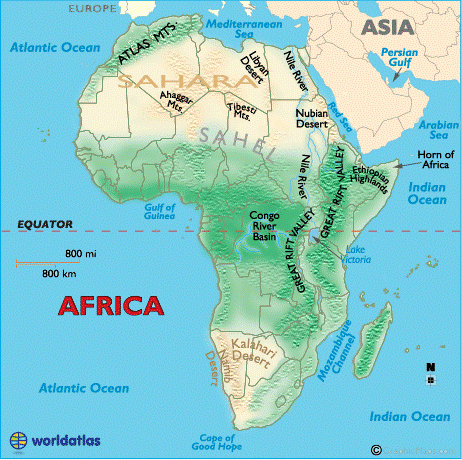
This grassland was a pastoral nomadic zone using the native species of the horse. All of the world’s domesticated horses come from here, the two-humped camels come from Central Asia, one-humped camels come from Arabia, and donkeys come from Africa. The type of climate and topography and the type of animals have an impact on the ways that people organize a society.

There is one geographical theory, which Prof. Bulliet doesn’t think works, that says that nomads using horses can become great military powers because they have a greater density of population which is in turn caused by the fact that there is more vegetation in the horse zone. Camel nomads, on the other hand, can’t become great military powers because they’re more sparsely distributed. It’s a wonderful theory by the famous French geographer Xavier de Planhol except that it doesn’t actually coincidence with history, and therefore we won’t go into it.

5. Pastoral zones—a cultural buffer zone

The reason why Prof. Bulliet is singling out these pastoral zones is because they provide a more important barrier than the physical boundaries to certain types of cultural movement. Pastoral nomads are, by the very nature of their dependence upon and reverence for their herds of animals, on the move on a very regular basis. This limits the material culture that they can develop. They don’t have cities; they often don’t have permanent settlements of any kind. They don’t have monumental artwork or things of that sort. They are more likely to develop cultural expression through song, poetry, and dance, through things that are inherently portable. They also live lives that are very abstemious. They do not have much in the way of luxury consumption. If you look at this Northwest Eurasian quadrant (see fig. 1), you will find that it is bordered by pastoral nomads in the south, and in the southwest including Iran, in the deserts to the east and the steppes directly to the north of them, which are also pastoral although not as dry as the deserts.

Figure 1. NW Eurasian quadrant aka the Mediterranean Basin
So you have a zone of settled agricultural lands and peoples that is blocked off to the east, the south, and the southeast by zones of pastoral nomads and arid lands. That Northwest Eurasian quadrant or zone is often described as the Mediterranean Basin, which Prof. Bulliet thinks puts more emphasis on the Mediterranean than it warranted. The name is somewhat realistic, however, because it does center on the Mediterranean, but it is a zone that looks inward (towards the sea). The culture in this zone tends to have a great deal of interpenetration and common features.

By contrast, when you get to the other side of the pastoral areas, whether it is sub-Saharan Africa or India or East Asia, you find dramatically different cultural patterns and internal patterns of cultural exchange and dissemination that don’t have much connection with what you have in the Northwest Eurasian zone. Prof. Bulliet thinks it is useful to think of this northwestern zone, hemmed in by pastoral nomadic life patterns, as being a single more or less unified or interconnected cultural zone throughout history.

6. Unity of Eastern and Western Mediterranean culture

This was apparent in ancient times and continues to be apparent to those who study ancient times. In other words, when you read Herodotus who lived in Greece, he speaks with Greek relations with Egypt or with Phoenicia; the connections of the north and south side of the Mediterranean are well understood. When Odysseus travels back from Troy (located in modern Turkey) he touches places in North Africa. When Aeneas goes from Troy, he goes to Carthage located in North Africa, and across the Mediterranean to Italy. The Romans fought the Carthaginians in three Punic Wars. The contacts in and around the seas of the Mediterranean were continuous not only in reality but in the imagination. In Greece, for example, you could imagine that Jason in the tale Jason and the Argonauts goes to the Eastern end of the Black Sea to collect the Golden Fleece and his charming wife Medea (laughter). Even though it was barbarian territory, it was considered within the realm.

As you looked northward, things were a little less clear. The north for the Ancient Greeks was the land beyond Mt. Borea, and the people were referred to therefore as the Hyperboreans, “above Mt. Borea”. The North was a little-known area whether it was whatever was north of Greece, or whatever was north of Italy and Spain. That was where you had people moving across the steppe land into Hungary along the Danube River and across northern Europe.

When you study these things and think about ancient history, you are in the field of classical philology, and it is assumed you study Greek and Latin. This is because it is recognized that almost all the sources that you’re going to have to read for the Eastern area (east of Italy) are going to be in Greek and those in the Western area (from Italy westward) are going to be in Latin. So we took about Greco-Roman antiquity, and we’re perfectly comfortable with that. Even though they are of the same language family and certainly closely related in the sense that you can take declensions and conjugations in Greek and see how they relate to those in Latin, they are written in different alphabets and create quite a different impression. Nevertheless they are all welded together in the studies we have of the ancient world, so we talk about Greco-Roman or Classical Antiquity. You have two different languages, two different writing systems, and in the course of time because of the division between the Eastern Christian church and the Western Christian church, you have a religious division. Nevertheless, it’s reasonable to fit it all together.

From both in the indigenous literary and cultural remains from this Northwest Quadrant, and in studies from ancient times onwards to modern times, it is considered perfectly reasonable to include the East and the West in the same cultural perspective.

7. Apparent Cultural Disunity of Northern and Southern Mediterranean culture

What happens is that, at a certain point, a line gets drawn horizontally through the Mediterranean Sea, and that line separates Christians from Muslims. That separation between Christians and Muslims is overwhelmingly an artifact of scholarship. After the death of Mohammed in 632, you have a series of Arab armies coming out of Arabia in the 600s and conquering lands in North Africa, the Middle East, and Iran, and reaching Pakistan at one extreme and Spain at the other extreme in 711. You have a political entity that is created that is called the Caliphate ruled by a Muslim ruler called a caliph. The people are almost all non-Muslims. Most of the Christians alive in the world at the time of the Conquest had great-grandchildren who were Muslims, because the most heavily Christian areas were conquered by the Muslims.

The remnant Christian areas in the South, such as Ethiopia, and Armenia and Georgia in the East, become more or less isolated. The other remnant Christian community is in Europe, in Greece, Turkey, Italy, Spain and southern France. That is the area that grows into the dominant force within Christendom over a period of centuries. Over that same period of centuries most of the people living under Muslim rule were still Christians. Conversion takes something of the order of 400 to 500 years. It is neither fast, nor organized. It is not an automatic product of the change in rule.

When you have scholars in modern times who have argued that, as soon as the Arab invasions occurred, you have a division between Europe and Islam that is complete, indissoluble, permanent, and hostile, that is an ideological construction. It does not coincide with what people thought at the time; it is not demonstrable in the documentation that survives. It is rather a reflection of later centuries in which you have periods of warfare and enmity between Muslims and Christians. You could say that periods of warfare and enmity automatically lead to permanent divisions, because how in the world can you go out and try to kill your neighbors because they have the wrong religion for a long period of time without permanently creating an unbridgeable gap between those two religions? The problem with that argument is that it simply doesn’t work; no two groups of people have ever hated each other as much as the Protestants and the Catholics (laughter), or have spent as much time trying to butcher one another and declare one another to be agents of the Devil. And yet, over time, things cool down and they say, “never mind–we don’t have to hate each other because we’re all Christians.”

The fact that Christians and Muslims went through periods of warfare only becomes central to the construction of a tremendous division IF the person who is making that construction is servicing other ideological needs, regardless of whether it is on the Muslim side or the Christian side.

8. Islamo-Christian Civilization

Prof. Bulliet is dedicated to the idea that we should think of this Northwest Quadrant of Eurasia as being an “Islamo-Christian Civilization” rather than a Christian civilization facing an enemy Muslim civilization. Prof. Bulliet says you can buy that idea or not, although you have to buy his book The Islamo-Christian Civilization because it’s one of the required texts for the course (laughter). You have to read the book, and then you can throw away the book if you don’t like the idea (laughter).

There is another division that gets included in this, and that is rarely talked about. In Euro-American thinking about “the West”, we commonly talk about Western Europe and Eastern Europe. Western Europe is the Industrial Revolution and the Enlightenment, John Locke, toleration and everything good. Eastern Europe is serfs, and thick-headed Slavs (laughter), and people who have funny alphabets like Cyrillic and Greek. It’s not like the West, but it’s still Christian, so we talk about Eastern Europe and Western Europe.

The odd thing is that, if you are living in the southern area of the Mediterranean, that area that we identify as being associated with Muslim populations, you also have the concepts of “the East” and the “West”. The East in Arabic is called the mashriq, from a verb sharaqa meaning “the sun rises” because the sun rises in the East. From it you have feel-good concepts like ishraq meaning “illumination” which gets into a spiritual sort of concept. By contrast, you have the maghrib, the Arabic term for “the West”; you could say it comes from a verb for the sun setting. But it is also a verb which means to be strange, weird, queer, or eccentric. Ghariib means “strange” or “wonderful.”

It is interesting that within the Islamic cultural context the West is the land of wonder and in the European cultural context the East is the land of wonder. So you have Orientalism in Europe, where you construct the East as a land of strangeness and wonder. However, there is no such term meaning “Occidentalism” such as istighrab or something similar in Arabic meaning “the construction of the maghrib as a place of strangeness”. When you read the histories that were written in early centuries of Islam about the West, there are full of fantasies and fairy tales and things that are not really believable as history, so the West becomes a kind of fantasy to some degree.

Here we have a situation where you have a West and an East in Europe and a West and an East in the Islamic world. They divide pretty much at the same place, that is to say, anything East of Italy is Eastern Europe–unless you’re directly above Italy and you have Central Europe, which is just an awkward concept altogether (laughter). Therefore Albania and Serbia on the Eastern side of the Adriatic Sea are part of Eastern Europe and Italy on the Western side of the Adriatic Sea is part of Western Europe.

When you divide the maghrib from the mashriq or the West from the East in the Islamic context, you really start due South of Italy with Tunisia. So Tunisia, Algeria and Morocco, are the maghrib. Is Libya part of the maghrib? Yes, it is part of the maghrib, but there are only 15 people living there throughout most of history (laughter), so it doesn’t really count a whole lot. Substantively, the maghrib was Tunisia, Algeria, and Morocco and including the ancient province of Tripolitania, which was the Northwest province of modern-day Tunisia. The East was Egypt, Syria, Iraq, Iran, Turkey, and so forth.

In other words, this division between the West and the East in Europe is pretty much identical to the division between the Greek zone and the Latin zone in the ancient world. Even though you’ve changed religion over a slow process, and even though you’ve changed the political structure so you have at least nominally and briefly a single empire, you still have that old division between the East and the West, or the maghrib and the mashriq.

9. Political Division between East and West in Islamic World and in Europe

This actually plays out in politics as well. Even though you have this caliphate that is established in the 600s, by the early 800s the maghrib is no longer functioning as part of the caliphate. You have a family of governors in Tunisia known by the unattractive name of the Aghlabids (laughter), who asked the caliphate in Baghdad whether they could be the permanent governors in return for a yearly payment and he said “yes”. And from that time onwards from the early 800s Tunisia, Morocco, Algeria and Spain are separate from the Caliphate. Going in the other direction, at the same time southern Pakistan, which had been conquered by the Muslims, also becomes an independent area by agreement with the Caliph. The wings are cut off, and the center of Islam becomes the mashriq.

You have a parallel to this, of course, in what happened to the Roman Empire. Around the year 300, during the reign of Diocletian, you have the division of the Roman Empire into the Eastern Roman Empire and the Western Roman Empire, and you have a new city Constantinople (today Istanbul) which becomes the capital of the Eastern Roman Empire, with Rome remaining the capital of the Western Roman Empire. The dominant language of Constantinople, even though it is part of the Roman Empire, is Greek. The dominant language of Rome is Latin.

What happens in the Caliphate, with the division between East and West, is what had happened 500 years earlier in the Roman Empire with their formal recognition of the division between East and West. The division between East and West is a more enduring geographical division when it comes to the Mediterranean Sea than the division between North and South. The division between North and South nowadays is often not only politicized, but is summarized as meaning “north of the Mediterranean” vs. “south of the Mediterranean.”

Note:  I was intrigued by Prof. Bulliet’s theory of the cultural significance of the terms East and West, namely that the East is the land of the strange and unknown in Europe, whereas the West is the land of the strange and unknown in the Islamic World.   As an example, notice how in J.R.R. Tolkien’s epic fantasy trilogy of The Lord of the Rings, the Shire, the familiar home of the Hobbits which opens the story told in the trilogy, is in the Western portion of Middle Earth, whereas the land of terrible danger called Mordor lies to the East.    The cultural metaphors of East and West as conceived in Europe were still present, although J.R.R. Tolkien was creating a geography of a totally mythical country.   If the Lord of the Rings had been written in the Islamic World, Mordor would have been described as being in the West and not in the East.  

Map of Middle Earth from J.R.R. Tolkien’s Lord of the Rings

(image from http://www.glyphweb.com/arda/m/middleearth.html)

In the next portion of the lecture, Prof. Bulliet talks about how the assimilation of religious minorities during the Middle Ages proceeded differently in Europe as opposed to the Middle East.

History of the Modern Middle East–Lecture 3: Geography and Inequality (part 2)


The following are my notes from the lecture that was given by Prof. Richard Bulliet of Columbia University on January 17, 2009.    In this section of the lecture, he talks about the domesticated animals of the Middle East–camels, donkeys, and horses.   I have noted those sections of the lecture, which is available on iTunes, where the class laughed at some remark of Prof. Bulliet.

3. Domesticated animals of the Middle East—camels, donkeys, horses

I’m sure this physical description of the deserts may not be of much help in visualizing it.   What may be of more significance to you than the geography is the demography of the desert, who lives there and why.

The deserts are areas with low population density and the populations that do exist there are for the most part pastoral nomads. The type of pastoralism that they follow varies according to where the desert is, particularly in terms of latitude. People who are living in northern deserts live differently and herd different animals than people who are living in southern deserts.

In southern deserts–the Sahara and Arabian deserts, and up into Syria and Iraq–you have hot-weather animals because we are dealing with an area between 15 and 30 degrees North latitude. This is a very hot region. Hot-weather animals are primarily camels and donkeys. One-hump camels are native to the Arabian Desert. In prehistoric times there were camels also in the Sahara but they seem to have become extinct long before the modern camel population arrived. Donkeys are native to the Sahara with a related species of donkey that is native to the Arabian desert called an onager which has largely died out. It is known technically as a half-ass (laughter), as opposed to the Nubian wild ass which is a full-fledged ass (laughter), which is the one from the Sahara. As you go north, and you get up to where it is much colder, you again have a couple of species of half-ass that are larger and more durable to the cold than the asses of the Sahara or the half-asses from the Arabian desert.

These are animals that are adapted to life in extremely torrid conditions and Prof. Bulliet says that at the drop of a hat he can a three-hour lecture on the physical adaptations of camels to torrid conditions. He has also written about that for a book called The Camel and the Wheel summarizing the fascinating research that has been done on the subject.

He says he will exercise restraint and not give that three-hour lecture at this time (laughter).

Principally, you have two-humped camels that are the native species of the Gobi desert in Mongolia. What is the difference between the one-humped camel and the two-humped camel? Yes, it’s the number of humps (laughter), but more than that, the one-humped camel is adapted to torrid, extraordinarily dry conditions. The two-humped camel is adapted to extremely sparse vegetation and to extremely cold temperatures, so it has very, very long and thick hair.

In the old caravan days across central Asia, the caravans moved primarily during the winter months when you had snow cover everywhere. The two-humped camel was an ideal animal because you had no problem with water, because you had snow that it could eat. And you had no problem with food, because the camel simply starved for three or four months, and utilized the fat that was stored in their two humps. By the end of the winter, their two humps were like empty bags and they had a floppy hump which was an extremely physically unappealing condition. It’s less noticeable in the winter because the hump is covered with long hair. In the spring, all the hair fell off, and they looked like scalded pigs (laughter).

The caravans, as they came to the end of their season in the spring, would have one man following them with a huge sack, and he would be picking up great clumps of camel hair as they fell off or got snagged on bushes and putting them in the sack. At the end of the caravan, then, that camel hair would be sold in the international market. So camel hair came primarily from two-humped camels, because one-humped camels don’t really have all that much hair. Camel hair in the twentieth century became extremely important because it had elastic properties that made it the ideal hair for making industrial belting or transmission belts.

Not in the deserts, but north of them, you have a zone that runs from Mongolia north of the Aral Sea, north of the Caspian Sea, north of the Black Sea, as far as Hungary. That is the known as the steppeland of Central Asia. The steppe is grassland that is pretty much continuous in this northern belt, say 50 degrees North latitude. It’s a little bit like prairie, although the American prairie is long-grass prairie, where the grass would be five feet high. Steppe land is short-grass prairie, where the native grass species were somewhat shorter, and easier to move about among. Short-grass prairie would be closer to what you have in eastern Colorado, whereas long-grass prairie would be closer to what you have in Iowa and Illinois.

The access to vegetation in deserts is obviously a great problem because there isn’t much vegetation. Therefore you either graze where the vegetation is or you use animals that can cover a lot of distance on very sparse vegetation. That makes the camel an ideal desert animal. It can live for months without eating; it can live for weeks without drinking or in the spring season indefinitely without drinking. It can cover large areas. It’s very distinctive: if you look at a one-hump camel compared with a two-hump camel, the one-hump camel has much longer legs and thus covers more territory. The longer the leg, the more territory you cover in a given stride. You have denser vegetation in the two-hump camel area than you have in the one-hump camel area. To make this possible, you have to make sure that when you move your hind foot forward you don’t kick yourself in the ankle. The camel becomes like the giraffe the only species that moves both feet on the side at the same time. When you ride a horse, you tend to go forward and back, but when you ride a camel you tend to go from left side to right side.

When it picks up the two feet on the one side, if it doesn’t put them down again, it tips over (laughter). Prof. Bulliet pointed this out to the class once, and someone asked, “if they picked them up, why don’t they fall over?” He felt constrained to point out to the student that humans have this same problem.  If we pick one up one of our feet and we don’t put it down again, we may fall over as well (laughter).

In the next part of the lecture, Prof. Bulliet talks about theories relating the impact that these domesticated animals have on the organization of society in the Middle East.

History of the Modern Middle East–Lecture 3: Geography and Inequality (part 1)


The following are my notes from the lecture that was given by Prof. Richard Bulliet of Columbia University on January 17, 2009. Since this was an audio and not a video lecture on iTunes, I downloaded some maps from worldatlas.com to illustrate his narrative.

1. Books on the Ottoman empire

He makes a preliminary remark regarding books assigned in the class regarding the Ottoman Empire. He recommends Osman’s Dream: The History of the Ottoman Empire by Caroline Finkel, a general history from its origins to its end, which he considers to be a better-written book than the one by Donald Quataert called The Ottoman Empire, 1700-1922.

2. Geography of the Middle East—general orientation

The lecture is about the geography of the Middle East. 40 degrees North latitude is where New York City is; it is the same latitude as Madrid, Rome, and Istanbul. Each degree of latitude is about 70 miles. If you go to 30 degrees North latitude, 10 degrees farther South, you are at the latitude of Cairo and Jacksonville, FL, that is to say, Northern Florida, and Houston, Texas. If you go to 20 degrees North latitude, you are at Jeddah in Saudi Arabia, which is pretty much the same level as Mecca, since it is simply uphill from Jeddah, and the level of Mexico City. This gives you some sense of what we are talking about in a North and South perspective.

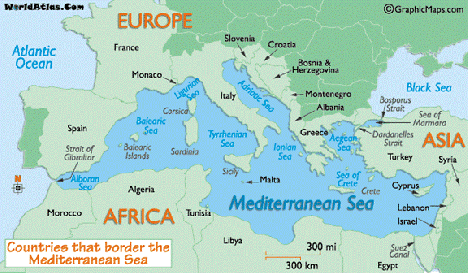
Figure 1. Mediterranean Sea and bordering countries

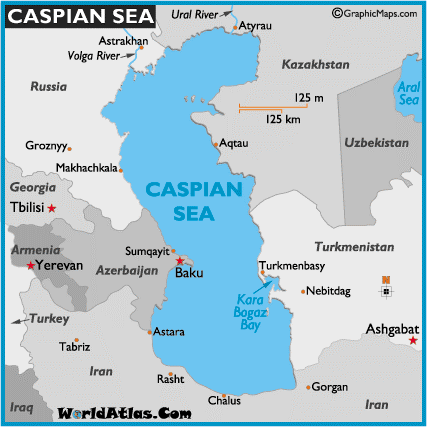
In terms of East and West, here is the Mediterranean Sea. It is connected to the Black Sea by the straits that are located where Istanbul is. Then you have the Caspian Sea, which is the northern border of Iran. And then you have a little sea bordering Uzbekistan and Kazakhstan called the Aral Sea.

Figure 2. The Caspian and bordering countries

The Mediterranean Sea was known by the Ottomans as the Akdeniz, or the White Sea, the White Sea as opposed to the Black sea. Then you have the Red Sea and the Persian Gulf.

Figure 3. Red Sea and surrounding countries

Figure 4. Persian Gulf and surrounding countries

These are the principal bodies of water that we deal with in the history of the Middle East. If you take the Caspian Sea and the Aral Sea (figure 2), and you go north, you get to a range of mountains that runs due north and south for a very long distance up into Arctic areas, and those mountains are called the Ural mountains. They are traditionally the division between Europe and Asia in the areas north of where you have a division of water between the two continents.

Figure 5. Mountain ranges of Europe (Ural mountains at Eastern edge)

This course deals with the area from 30 North latitude to 50 North latitude, from the Ural Mountains westward to the Atlantic Ocean. This essentially is the Northwest corner of the Eurasian landmass that stretches from the Atlantic to the Pacific, and the Northern part of Africa, or the Afro-Eurasian landmass. This description probably doesn’t really help you at all (laughter).

What helps more is to note that this area (Figure 6) is the Sahara desert. It runs from the Atlantic Ocean to the Red Sea. It is crossed only by the Nile River.

Figure 6. Sahara Desert

Once you get across the Red Sea, you continue to have a desert (Figure 7) called the Arabian Desert, but it stretches up somewhat farther. As you go up, the desert regions trend to the northeast. In Iran, it is the central part of Iran that is mostly desert, and it is north of the Arabian Desert. There is a desert just south of the Aral Sea, and a desert on the other side of the river that feeds into the Aral Sea, called the Kara Kum desert. Deserts continue on east from here over to Northern China.

Figure 7. Arabian Desert and Deserts of Iran

After the orientation to the class of where the areas are on the map that he will be speaking of during the rest of the course, Prof. Bulliet turns from geography to demography of the various regions that make up the Modern Middle East.  That is what I will cover in the next post.