21 Days to A Positive Mindset—A #TED Talk by Shawn Achor


“If we study what is merely average, we will remain merely average.” Shawn Achor

Shawn Achor is a psychologist who is the CEO of Good Think, Inc. He gave a talk about positive psychology at a TED talk  in May 2011.  I outline his talk below which he concludes with a methodology on how to press the “reset” button for your mindset so that you are more optimistic.   At the end of the talk, I relate the results I had in using his method for 21 days.

1. Escaping the law of the average

Social scientists make pronouncements about trends based on averages within populations, but people have to realize that when you are dealing with the potential for individual happiness or creativity, you need to escape the “law of the average”. When psychologists strive to make people “normal”, then if they succeed, people will continue to remain merely average.

I can illustrate Shawn Achor’s point with a story.  A friend of mine who was taking economics in graduate school, and I saw him one day in a coffee shop looking a little glum. “What’s wrong?” I asked him. “Oh, it sounds silly, but I’m a little bummed. My statistics professor said that up to 50% of us in the class would end up doing below average on the test.”

Intellectually, he knew that this was of course true because it hinges on the technical definition of the word “average”. However, it was the implication that he had only a 1 out of 2 chance of escaping mediocrity that was a challenge to his self-esteem.

2. Studying outliers

Shawn Achor has studied those individuals who have higher than average potential to find out what their secret is in order to be see if some of those secrets can be passed on to the rest.  Instead of a psychology model that tries to drag everybody down towards being average by making them “normal”, he wants to have a positive psychology model that moves everyone’s average up.

3. Changing the lens

We view the world through the lens of the media, which selectively captures negative events and brings them to our attention, with the news hour occasionally ending in a positive story. This has an effect on us where we start to assume a false picture of the world where that same ratio of negative events to positive events is replicated throughout the world.

4. External circumstance does not determine inner attitude

Shawn Achor related how the students he counseled at Harvard University should have been happy to be at such an elite school, but they sought counseling because they concentrated on the negatives of the workload, peer pressure, etc. He realized that no matter how good the outer circumstances, there were some people who have a negative attitude internally. He found that the external circumstances only account for 10% of a person’s happiness over the long term; the other 90% are determined by the way in which that person views the world.

In the work environment, he found that only 25% of job successes are predicted by a person’s intelligence level. The other 75% are accounted for by your optimism levels, your social support levels, and your ability to see stress as a challenge rather than as a threat.

5. How can you change your mindset?
Here’s the kernel of what Shawn Achor came to talk about. Most schools and workplaces have the mindset “if you work hard, you will be successful. If you are successful, then you will be happier.”  This theory of motivation is backwards.  If you have a success, then the workplace or school simply changes the goalposts and you have to achieve even better success the next time. If happiness is thought to be on the other side of success, your brain never gets there, it pushes happiness over the cognitive horizon.   Just remember that one of the definitions of a horizon is “an imaginary line that gets farther away from you the closer you get to it.”

The problem with this method of motivation is that our brains work in the opposite order:  if you raise a person’s happiness in the present, then their brain experiences a happiness advantage, meaning that performs better than if it is negative, neutral, or stressed.  Every business outcome improves for an employee who has this happiness advantage: people are 31% more productive, they produce 37% more sales, doctors are 19% more accurate at diagnosis, etc.  So if our brain is more positive in the present, than it becomes more successful.

If people do the following 21 days in a row, it can rewire their brains to be more optimistic and therefore more successful.

Activity

Explanation

1

3 Gratitudes Write 3 new things you are grateful for each day

2

Journaling positive experience … in a journal, along with one positive experience you have had in the last 24 hours.

3

Exercise 15-20 minutes of vigorous exercise, 3-6 days a week.

4

Meditation 15 minutes of meditation, 1-2 times per day.

5

Random Acts of Kindness Write down one random act of kindness you have done in the past 24 hours to someone you did not know.

6

Lessons Learned Write down how you will take a negative experience you have had in the past 24 hours and turn it into a learning opportunity for the future.

Here Shawn gives an explanation of these 5 factors; I have added a sixth factor which I explain below.

1. Writing down the 3 gratitudes changes you mind so that it starts scanning the world for the positives rather than the negatives. It doesn’t change the ratio of positives to negatives in the outside world, but it does change which factors you focus on as being the most significant.

2. Writing about a positive experience you’ve had in the past 24 hours allows you relive it.

3. Exercise teaches your brain that behavior matters.

4. Meditation allows you to detach from the cultural pattern of ADHD which we are creating through the constant attempts at multitasking, and increases the ability of the brain to focus on the task at hand.

5. You can write in your journal about a random act of kindness which you performed in the last 24 hours for someone, meaning that you did it without consideration of being paid back by the person whom you helped.  Alternately, perform a conscious act of kindness by sending a note of support to someone in your social support network.

6. To these activities, I have added a sixth of my own to Shawn’s list, which is to take a negative experience which you had in the past 24 hours, and created some lessons learned from it so that you will experience it in the future not as a threat, but as an opportunity to overcome a challenge.

I have to tell you that Shawn Achor’s method WORKS! I did try it for 21 days and found that I do see live in a more positive way than I did a month ago. The interesting thing for me was that, at first I thought I was just changing the way things were appearing for me, that is, the same ratio of negatives to positives happened out there in the external world, but I was gradually starting to focus on the positives.  The negatives were seen as less and less threatening and more and more as opportunities.

However, by the end of the 21-day period, I was starting to experience more and more positives on the outside. I think that the positive attitude I took with me while networking, for example, automatically drew people towards me and made them more helpful to me than they would have previously precisely BECAUSE I had a positive attitude.  So it does change your interior “weather” first, but that sunnier internal weather will gradually become reflected in your exterior circumstances.  I don’t know if it will work for everybody, but I recommend that you at least try it, because you have literally nothing to lose, and we could all stand to win a little more, right?

Orange County Digital Arts—Adobe #CS6 Preview


On Friday, June 1st, I attended a preview of Adobe’s Creative Suite (CS) software (version 6) which was recently released. It was hosted by Scott Trodick, the facilitator of Orange County Digital Arts (OCDA).

Below is a summary of the preview that was given by Scott and other members of OCDA. Besides food and prizes, which made the evening fun, there was a great chance to see practitioners of the Adobe Creative Suite demonstrate the new features of version 6.   I have had two classes with Scott Trodick that he taught at Santiago Canyon College:  one on Adobe Acrobat Pro and the other on  Adobe Photoshop, and I love his infectious enthusiasm for the visual arts.    The only criticism I have about the evening is that OC Digital Arts needs to get together with an Audio Arts group to improve the constant feedback that the microphones were giving off through the evening.   It wasn’t enough to loosen my dental fillings, but it was unfortunately a distraction.   Otherwise, it was a wonderful, informative evening and I hope to start joining some of OC Digital Arts’ user groups now that my classes are done!

A. Tablet Apps—Scott Trodick

One of the new directions that Adobe is going in version 6 is to enable people to create content not just for the Web, but for various mobile devices, including smartphones and tablets.

In particular, Adobe is releasing the following tablet apps to be used with the various applications of its CS6 software.

Tablet App

Purpose

1 Collage Design
2 Debut Showing presentations
3 Ideas Digital sketchbook, creative companion
4 Kuler Picks color themes
5 PS Touch Social tool
6 Proto Wireframe markup for web designers

B. Adobe Illustrator (Ai)—Jaqui Miles

Jaqui said the following were improvements in Adobe Illustrator in CS6.

  • Menus are more intuitive—now it is not just the tool you choose, but the type of selection you make which adjusts the menu
  • Line trace à Image Trace—this makes it easier to move shapes whose components intersect each other
  • Gradients can now be put on a stroke (thick borderline) or even text

C. In Design (ID)—Frank Martinez

Frank said that, in addition to web mock-ups of traditional magazine content, you can now choose to view that same content in several digital formats, including those for smartphones and tablets, such as Nook, Kindle, Android 10, iPad, etc.

This is important because of the explosion in publishing of e-Books, which you now need to be able to produce in several different (and not always compatible) formats.

D. Adobe Special Project—Bill Vallely

Scott Trodick introduced Bill Vallely, a freelance illustrator who in recovering from a terminal illness had suffered from a condition called “dry eye” that was a side effect of one of the medicines he had been taking. He produced a web cartoon on the subject of dry eye using the Adobe Creative Suite which can be seen at the site eyetoon.com. The web cartoon was important for him for two reasons: one was that it showed that web cartoons are a great medium for discussing medical or otherwise “heavy” information in an entertaining, engaging way.

And speaking of engaging, his web cartoon is interactive in that, if you choose to get more information by clicking on one of the panels, the cartoon changes after you’ve returned from the digression. This multiple storyline format is something that is yet to be exploited, according to Bill.

E. Photoshop—John Haverstick

Here are the new features which John mentioned:

  • The new menu is darker and less intrusive for those who don’t want to be distracted from the image they are working on—this is consistent with the interface in the Lightroom software made specifically for photography
  • Content aware technology—if you move a subset of the image to another area, you can use “content aware technology” to fill in the image that you left behind in a manner consistent with the surrounding space
  • Chromatic aberration, an effect which sometimes occurs in the boundary between areas with high contrast (i.e., black and white), is now something you can adjust by filling in one checkmark rather than having to adjust sliders as before
  • 3D functions have all improved

F. Dreamweaver—Scott Trodick

As people go from shared hosting to cloud hosting, Dreamweaver now makes it easier to create websites by blending the HTML language, which handles content, and CSS language, which handles design elements.

The idea is that when you create the content, you then can use Dreamweaver to not just view the site on the web, but now on several formats for mobile devices.

Using Dreamweaver allows you to have the 4 Cs,

a) clean code,

b) consistency (both logically and semantically),

c) complete keyword searchability, and

d) compatibility for cloud servers,

which optimize your website for search engines such as Google.

#Toastmasters —The Road Towards Competent Leadership (part 2—Advanced Training and FAQs)


In the last post, I described how to earn the basic level of leadership training in Toastmasters International, culminating in the Competent Leader award. In this post, I described the advanced leadership training program and answer some FAQs regarding the leadership program in general.

3. Advanced Leader Bronze

Once you have completed all the possible roles in the club, and fulfill the requirements for becoming a Competent Leader, the next level of leadership is that of Advanced Leader Bronze, and it requires you to train and then to serve as a club officer. Here are the listings of the various club officers.

Figure 5. Club Officer Roles and Rankings

Club Officer

Ranking

President First
Vice President Education Second
Vice President Membership Third
Vice President Public Relations Fourth
Secretary Fifth
Treasurer Sixth
Sergeant at Arms Seventh

To become a club officer, you have to be nominated at a meeting and then win an election of all nominated candidates at an election. After being voted in to office, you must attend a LACE or Leadership And Communication Education workshop to be trained in that new role. The final requirement is that you give two special presentations to the club on the subject of leadership.

4. Advanced Leader Gold

Once you have completed some of the roles in the club and have progressed to the level of being the Club President or Vice President Education, you can then go beyond the club level of organization and take a role in the wider world of Toastmasters. Clubs are organized in the following hierarchy: areas, then divisions, then districts, then regions, all of which are part of the worldwide organization of Toastmasters International. Below is a schematic diagram of the organization hierarchy starting from the club and going on up to the top level of the organization, using my own club as a reference.

Figure 6. Toastmasters International Organization Hierarchy

To qualify for the Advanced Leader Silver, you need to take one of the following roles outside of the organization:

Figure 7. District Officers

Area

Division

District

Governor Governor Governor
Lieutenant Governor
Public Relations Officer
Secretary
Treasurer

The area governor and division governor are considered to be district officers, because they meet regularly with the five district-wide officers.

Then the other two requirements are to complete a leadership program called High Performance Leadership program, and to take an entire club and be its sponsor, mentor, or coach.

5. Distinguished Toastmaster—putting communication and leadership together!

What do you get if you get the highest awards level for BOTH the educational and leadership tracks? If you get the Advanced Communicator Gold AND the Advanced Leader Silver award, that qualifies you for the highest award Toastmasters International can bestow to an individual at the club level, and that is Distinguished Toastmaster.

Figure 8. Distinguished Toastmaster achievement

6. Frequently Asked Questions

What is the best way to go about fulfilling the various roles for the 10 leadership projects?


Forget about doing them in order, like you normally would do for the speeches. Just take the agenda for the next meeting, and figure out whether the role you’ve been assigned potentially fulfills any of the 10 projects. As you progress and fulfill various roles, you’ll have a better idea of which ones you need to complete each project, and you can inform the Vice President Education that you would like to be assigned that particular role.

In our club, the Vice President Education sends out a master schedule for 3 meetings at a time, to give people time to do exactly what I’ve outlined in the last paragraph. In that way, if there are any “special requests” for particular roles, that can be done well in advance of the meeting.

How long does it take to obtain the Competent Leader award?

There are 21 or 22 roles needed to fulfill the 10 projects (see table earlier in this post). Given that there are on average 20 members to a club, which meets twice a month and has 10 roles that qualify towards a leadership project, that will mean it takes one month for each person to obtain a role. Therefore it could take close to 21 or 22 months or a little less than two years.

Can I shorten the amount of time it takes to obtain the award?

In a similar way to being prepared in advance for speeches, it is best to a develop a generic script for each of the major roles as you do them. Then if the Vice President Education says “so-and-so can’t be a Toastmaster; can anyone fill in for her/him?” If you have that script ready, you can easily update it and volunteer to do that role. That’s how I will be able to finish my Competent Leader award in two weeks after having started in the club a little less than a year-and-a-half ago.

What is the fastest way to get the Advanced Leader awards?

If you are a member of a club for one year, you will certainly have enough experience to be able to be a club officer WHILE you are finishing up work on the Competent Communicator and Competent Leader awards. Then if you are club officer, even if just for a six-month period, and you have completed the training, then the only remaining thing you have to do is give two leadership presentations, and you’re at Advanced Leader Bronze!

Then after going for one of the lower-ranking offices in your club, I would try next to be either the Vice President Education or President. This will qualify you in the following term to run for the office of area governor. This is the lowest-ranking district officer, but it still qualifies you for the Advanced Leader Silver award after you complete a High Performance Leadership Program and the club mentorship program.

As a rule of thumb, it takes about one-and-a-half or two years’ worth of work to complete each level, so to become a Distinguished Toastmaster, you are looking at a five-year commitment.

But, take it one speech and one role at a time, and be consistent—you’ll get there some day!

#Toastmasters —The Road Towards Competent Leadership (part 1—Basic Training)


In the previous two posts, I discussed the educational path that most people associate with Toastmasters, that of becoming a competent communicator. There’s another educational path that is just as important, that of becoming a competent leader. This educational program is one of the reasons why enlightened corporations encourage their members to participate in Toastmasters; indeed, some of them even have their own onsite Toastmasters clubs.

1. Competent Leadership educational program

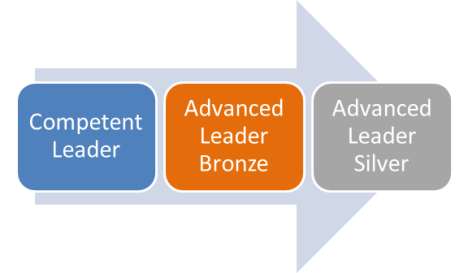
The leadership track is at a first glance similar to that of the educational track, except there is no GOLD level.

Figure 1. Leadership Educational Program Track Progression

Figure 2. Leadership Educational Program Track Requirements

2. Competent Leader

The first level of leadership is done by completing 10 leadership projects as follows:

Figure 3.  Competent Leader Projects 1 through 10

Project Number Project Name

1

Listening

2

Critical Thinking

3

Giving Feedback

4

Time Management

5

Planning and Implementation

6

Organization and Delegation

7

Facilitation

8

Motivation

9

Mentoring

10

Team Building

Each of these leadership projects concentrates on a specific skill needed for effective leadership, and these skills are practiced by performing for each project a number of roles in the club. I have composted a list of the roles that one can perform in the club and indicated which projects they can be utilized for. The solid circles represent a role which is obligatory for the project; a hollow circle is the symbol for a role which can be used for the project. Most projects can be completed by only doing a certain number of the potential roles for the project, such as 3 out of 4 possible roles. The total number of roles required for each project is given in the bottom column.

Figure 4.  Competent Leader Projects 1 through 10–Requirements

Project Number 1 2 3 4 5 6 7 8 9 10
Ah-Counter
Befriend a Guest
General Evaluator
Grammarian
Speaker
Speech Evaluator
Table Topics Speaker
Timer
Toastmaster
Topicsmaster
Chair Club Special Event
Chair a Membership Campaign
Mentor a Club Member
Organize Club Special Event
Total Number of Roles to be Done 3 2 3 2 3 1 2 3 1 1 or 2*

* The 10th project can be completed by being the chair of a membership campaign or other club event OR by doing both roles of being a Toastmaster and General Evaluator

So if you add up all the roles you must do, there are 21 or 22 roles required for one to complete all 10 projects.

Tomorrow I will post about Advanced Leadership training that is available from Toastmasters International, and will include some Frequently Asked Questions regarding the leadership program.

#Toastmasters—The Road Towards Competent Communication (part 2–overview, FAQs)


Toastmasters International club helps you become a better public speaker by taking you through a series of speech projects which build up the various skills that make up an effective speech presentation. This posts gives the overall view of the Toastmasters International educational program with regards to communication skills, and gives details about the first part of the program, that of becoming a Competent Communicator.

1. Toastmasters International Communicator Educational Program—overview

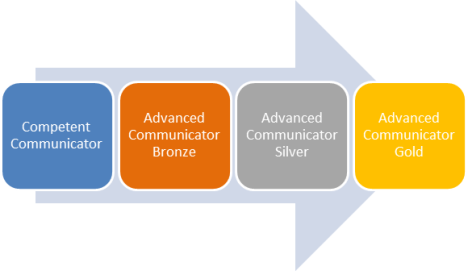
The communication program takes you through four different levels of competency, the basic level (Competent Communicator), and three advanced levels corresponding to the traditional Olympic Games levels of Bronze, Silver, and Gold (see Figure 1 below).

Figure 1.

Communication Educational Program Track Progression–Overview

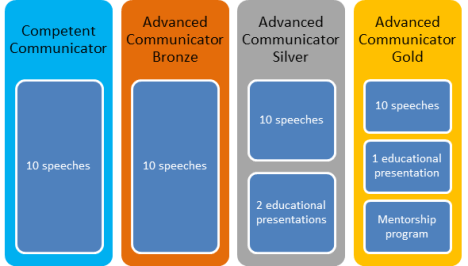
You have to complete 10 speeches to win the Competent Communicator Award. The advanced levels have the same requirement of 10 speeches, but there are additional requirements for the Advanced Communicator Silver and Gold levels.

The Silver Level requires you two additional special presentations that are on a specific educational theme relating to the Toastmasters program itself. The Gold Level requires only one additional special presentation, but it requires you to be a mentor for a new member of the club while they go through their first three speech projects. The idea is that, while you are advancing your own skills at the advanced level, you are trying to help those who are just starting out in Toastmasters.

Figure 2. Communication Educational Program Track Progression–Details

2. Competent Communicator (basic level)—details

There are 10 speech projects to be completed for the first level of being a Competent Communicator. How it works is that each project is designed to focus on one aspect of making a good speech presentation: organizing it, emphasizing it, and delivering it. Here are the speeches I did for my award, which shows the project title and the actual speech I used to complete each project.

Speech

Project

Title

Subject

1 The Ice Breaker The Power of Language AutobiographicalIntroduction
2 Organize Your Speech Risky Business Introduction to Risk Management
3 Get to the Point Mr. X and Mr. Y National SecurityPolicy
4 How to Say It Sound of Silence Silence as a form of communication
5 Your Body Speaks Eat that Frog—Now! Procrastination andhow to stop It
6 Vocal Variety Garden of WordlyDelights My love of language
7 Research Your Topic Celestial Music Einstein’s Theory of Relativity
8 Visual Aids Map of the Mind Introduction to IntegralTheory
9 Persuade with Power 2 Weeks to Eternity History of Cuban Missile Crisis
10 Inspire Your Audience The Power of Now The Works of Eckhart Tolle

3. Frequently Asked Questions

How long does it take to complete the 10 speeches you need to get your Competent Communicator award?

Based on the assumptions that a) there are 20 members in a Toastmasters Club, b) there are 3 speeches given per meeting, and c) the club will meet twice a month, it works out that individual member will be able to give about 4 to 6 speeches per year or one every two to three months. At this rate, it will take you between two and two-and-a-half years to complete the requirements for a Competent Communicator award.

Is there are any way to get it done even faster?

Yes, there are three ways to do this, two of which I used to get the award done in less than a year-and-a-half.

a. Fill in for absent members

Each meeting there are three speeches given, but sometimes people will cancel at the last minute because of a sudden illness or they have to work overtime at work on a special project. In this case, one of the club officers will contact members to see if they can fill in for the missing club member. This is why it is vital to at least prepare an outline of your next speech ahead of time. Also you should try to get a draft of the speech completed by the meeting BEFORE the one where you have to give yours. In that way, you can work on polishing the speech in the two weeks you have before your speech is to be given, but in a pinch you can complete the speech on short notice and be able to volunteer to give yours early.

b. Have a Speak-A-Thon meeting

Clubs usually meet twice a month on a specific day of the week, like every second and fourth Tuesday, as in our club. However, there are usually two months out of the year where there is an extra fifth week. Our club has an extra meeting on those months where we dispense with the first portion of the meeting on impromptu speeches and have 5 prepared speeches rather than 3. This gives an additional 10 speeches during the year, which helps the club members get additional opportunities to speak.

c. Do speeches at more than one club

There are an increasing number of Toastmasters International Clubs, and you may have one than one that are in comfortable traveling distance from where you live. In this case, you can either join an additional club and give speeches there, or you can contact the President of your own club and express your desire to give speeches at another club in your area as a “guest speaker”.

One of our club members got her Competent Communicator program done in a single year using this method.

How much does the program cost?

There are two components to membership dues: membership in Toastmasters International, the parent organization, and the dues to your local club that you are applying to. The membership in Toastmasters International is $36 for six months (with additional $1.55 for sales tax if you are in a club in California), and then your own club will have additional club dues to help pay for rental of the club facilities, etc.

How do I choose a club?

Go to www.toastmasters.org, fill in “Club locator” in the search box, and then on the left-hand side there will be a box labeled FIND at the top of which is a square button under the title “Meeting locations”. Press this button and it will take you to a form for you to fill out with information on a) what days you would like to meet, and b) what your location is and how far you are willing to travel to go to the club.

How do I try out a club?

Once you get a list of possible clubs, then go to the websites provided for each individual clubs and see those that are of interest to you. Some clubs are open membership, and others, usually those that are corporate-sponsored clubs for members of the company, are closed membership.

Once you find two or three clubs that interest you, contact the club membership officer or other club officer whose name should be given on the site. Call them and get more information—and then make a date to visit the club!

I found my own club through word of mouth, from two different people I knew who had recently joined a Toastmasters club and were very enthusiastic about it. I figured that if two people independently thought that the club was great, well then, that’s good enough of a recommendation for me.

What should I do when I decide to join a club?

Get the two manuals you will receive and look over the Communicator manual from cover to cover for about half an hour to acquaint yourself with all the resources at the end of the manual, as well as getting a brief overview of all the speeches you need to do.

Then ask a club officer for a mentor who will guide you through the first three speeches in the manual.

Then go through at least the first three speech projects and get an idea of the speech topic you would like to do for each of them and have your mentor review your ideas. Then start within the first two weeks before your next meeting to write a sketch or outline of your first speech, followed by a draft, using the speech manual as your guide in terms of your speech objectives. Your mentor should help you here as well. Perform the speech with notes and time yourself so that it takes you no more than 5 minutes to complete. Here’s where you make editing decisions about what to leave our. Then perform it FIVE TIMES to get it to the point where you perform it smoothly, and you figure out what works out well, and what needs to be changed.

Then you’ll be ready for your first speech, and you’ll be on your way to becoming a Competent Communicator!

One of the most overlooked benefits to being a Toastmaster is not just being a good speaker, but being a good leader. The next post will focus on the other educational track sponsored by Toastmasters International, that of being a Competent Leader.

#Toastmasters — The Road Towards Competent Communication (part 1—Introduction)


Yesterday was a significant day for me for two reasons: first of all, it was my birthday. (And there was much rejoicing: yay!) Second of all, I received word from Toastmasters International that I have been granted the Competent Communicator award for having completed 10 speeches.

For those of you who may be interested in Toastmasters, I wanted to write a series of posts that may help explore how Toastmaster may be of benefit to you by showing how it has been a positive influence on me.

1. Introduction to Toastmasters

The first person who told me about Toastmasters was my aunt Mary Hose, my father’s older sister. She was a bank manager in St. Louis in the 70s and 80s. When she was promoted from being a teller to being part of management, she noticed that many of her male colleagues belonged to a club devoted to public speaking called Toastmasters.

She asked if she could join and her question was met by, well I was going to say “howls of derisive laughter”, but that’s perhaps a bit of an exaggeration. However, one comment she received was particularly memorable for being offensive: “honey, that’s where we go to get away from our secretaries and our wives!”

A secretary in the office overheard that remark and gestured for Mary to talk to her. “There’s a public speaking club just for women that you may be interested in,” she said in a hushed voice reminiscent of Yoda when he said to Luke “there is … another … Sky … Walk … urgh!” Mary’s disappointment of not being able to join Toastmasters was quelled by her quest to follow this new lead she had been given.

She was put in contact with a parallel group that had formed by professional women who had been excluded from Toastmasters, and they called it Toastmistresses. Imagine the smile on Mary’s face when she was introduced to the local club president, who told her “this is where we go to get away from our bosses and our husbands!”

About five years later, Toastmasters was made co-ed, and she continued to be a member of the newly-expanded organization for the next few decades. She said it gave her confidence to be a woman manager in a mostly male-dominated field at that time. Joining Toastmasters was always on my Someday Isle task list, as in, “someday I’ll …”  But I always felt too busy to join a professional organization that didn’t seem directly related to my job, so I didn’t pursue the matter.

When I was in transition after working for an insurance company, I joined a professional networking group called Experience Unlimited.  Two members of the group had joined Toastmasters and asked if I was interested. Now it was my turn to increase my self-confidence, albeit for different reasons that my aunt Mary had had. If it helped her confidence, maybe it could help mine at a time I really needed it.  And the two members confirmed that it was helpful to them in gaining confidence during job interviews, so I decided to go to one of their meetings.

My first impression was that it was well-organized and professionally run, a swiftly and deftly-moving piece of human clockwork. An additional impression I had was that it was supportive: all suggestions for improvements that came from the people I later learned were called “evaluators” was done with an underlying tone of encouragement rather than approbation. And finally, it was fun! There were many moments of laughter, not just scripted ones from remarks done in prepared speeches, but by people who got up to speak spontaneously during various portions of the meeting.

Well, this is definitely a group I want to be part of, I thought, and I joined right then and there.   The two members who introduced me to the club have since gone on to get employed in the field of project management, something which I am aspiring to enter now.  This series of posts is dedicated to them and to my Aunt Mary, because the three of them together were responsible for giving me that push towards joining Toastmasters.

I on the other hand have introduced several other people in Experience Unlimited to Toastmasters, and am happy to say that two of them ended up joining our club. One dropped out of the club because our meeting night conflicted with a certification class he was taking; the second just joined and I have hopes for his becoming an active member of the club.

In the next post I want to talk about the two educational tracks of professional development that Toastmasters provides, the communication track and the leadership track.

John Cleese on Creativity (part 3)


John Cleese of Monty Python fame gave a talk for Video Arts on creativity at the Hotel Grosvenor House in London.   The video can be found on YouTube.   I listened to the lecture and am presenting below a summary of the talk.

After his presentation of how to enter the open mode, John Cleese shows how to maintain the open mode, how to collaborate with a team to foster creativity, how the Japanese use the open mode in their meetings, how the concepts of creativity and humor are bound together, and finally a tongue-in-cheek presentation on how management can successfully strangle at birth any possibility of creativity in their organization.

11. Maintaining the focus in open mode

While you are in the open mode, you must keep your mind gently around the subject you are pondering. You may daydream and wander away, but just keep bringing it back as you would in meditation. The amazing thing about creativity is, if you just keep your mind resting against the subject in a friendly but persistent way, sooner or later you will get a reward from your unconscious—maybe in the shower later, or at breakfast the next morning. Out of the blue, a new thought mysteriously appears—if you’ve put in the pondering time first.

NOTE:   In a different talk on the subject of creativity, John Cleese goes into more detail on how, if you work on a problem in the evening just before going to sleep, you are more likely to be rewarded by your unconscious with a solution to the problem the next morning.

12. Creative collaboration and the open mode

It is easier to be creative if you’ve got other people to play with. If two or more people throw ideas backwards and forwards, you get to more interesting and original places than you can ever get to on your own. But there is a danger: if there’s one person around you who makes you feel defensive, you lose the confidence to play and it’s goodbye creativity. So always make sure your play friends are people whom you like and trust. And never say anything to squash them either; never say “no” or “wrong” or “I don’t like that.” Always be positive and build on what is said. You should say things like the following:

  • “Would it be even better if …”
  • “I don’t quite understand that—can you just explain it again?”
  • “Go on …”
  • “What if …”
  • “Let’s pretend …”

13. Japanese and the open mode

Try to establish as free an atmosphere as possible. Sometimes Cleese wonders if the success of the Japanese isn’t partly due to their instinctive understanding of how to use groups creatively. Westerners are often amazed at the unstructured nature of Japanese meetings. But maybe it is because it is that very lack of structure, that absence of time pressure, which frees them to solve problems so creatively. And how clever of the Japanese to plan that unstructuredness, insisting that the first people to give their views are the most junior so that they can speak freely, without the possibility of contradicting what’s already been said by somebody more senior.

14. Creativity and humor

In a joke, the laugh comes at a moment when you connect two different frameworks of reference in a new way. For example, there was a woman who was doing a survey of sexual attitudes. She stopped an airline pilot, and asked him, amongst other things, when was the last time he had sexual intercourse. He said, “1958”. She was surprised at this remark, and asked him about it, “well, it’s only 2110 now.” (Laughter in the audience.)

The joke comes at the moment of contact between two frameworks of reference; in this case, the way we express what year it is and the 24-hour clock. Now having a new idea is exactly the same thing. It is connecting two hitherto separate ideas in a way that generates new meaning. Connecting two ideas together isn’t difficult; you can connect “cheese” and “motorcycles”, “moral courage” with “light green” or “bananas” with “international cooperation.” You can get a computer to make a billion random connections for you, but these new connections or juxtapositions are significant only if they generate new meaning.

As you play, you can deliberately try inventing these random juxtapositions and then use your intuition to tell you whether any of them seem to have any significance to you. That’s what the computer can’t do; it can produce millions of random juxtapositions, but can’t tell whether any of them smells anything interesting. And of course you will produce some juxtapositions which are absolutely ridiculous. In that case, good for you! Because Edward de Bono, who invented the notion of lateral thinking, specifically suggests in his book “Po: Beyond Yes and No” that you can try loosening up your assumptions by playing with deliberately crazy connections. He calls such absurd ideas “intermediate impossibles.” He points out that the use of an intermediate impossible is completely contrary to ordinary logical thinking where you have to be right at each stage. It doesn’t matter if the intermediate impossible is right or absurd; it can nevertheless be used as a stepping stone to another idea that is right. It’s another example of how when you’re playing, nothing is wrong.

So if you don’t know where to start, or if you’ve gotten stuck, start generating random connections and allow your intuition to tell you if one might lead somewhere interesting.

15. How to stop creativity in your employees

In the final part of his talk, John Cleese talks about how to stop your subordinates from being creative, which is the real threat. No one appreciates more than Cleese does what trouble creative people are and how they stop decisive, hard-nose bastards from running businesses efficiently.  If you encourage someone to be creative, the next thing is they’re rocking the boat, coming up with ideas, and asking questions. Now if you don’t nip this kind of thing in the bud, you’ll have to start justifying your decisions by reasoned argument, and sharing information the concealment of which gives you considerable advantages in your power struggles.

So here’s how to stamp out creativity in the rest of the organization and get a bit of respect going:

A. Allow subordinates no humor

It threatens your self-importance, and especially your omniscience. Treat all humor as frivolous or subversive, because subversive is of course what humor will be in your setup as it’s the only way that people can express their opposition. This is because if they expressed their opposition openly you’d come down on them like a ton of bricks.

So let’s get this clear: blame humor for the resistance that your way of working creates; then you don’t have to blame your way of working.  Solemnity is no laughing matter!

B. Criticize everything

Keeping ourselves feeling irreplaceable involves cutting everybody else down to size. So don’t miss an opportunity to undermine your employees’ confidence.  A perfect opportunity comes when you’re reviewing work that they’ve done. Use your authority to zero in immediately on all the things you can find wrong. Never ever balance the negatives with positives: only criticize, just as your schoolteachers did.  Always remember that praise makes people uppity.

C. Constantly press the accelerator

Demand that people always be actively doing things. If you catch anybody pondering, accuse them of laziness and/or indecision. This is to starve employees of thinking time, because that leads to creativity and insurrection. Demand urgency at all time, use lots of fighting talk and war analogies, and establish a permanent atmosphere of stress, of breathless anxiety, and crisis. In a phrase: keep that mode closed! In this way, we no-nonsense types can be sure that the tiniest, microscopic quantity of creativity in our organization can all be ours. But let your vigilance slip for one moment, and you could find yourself surrounded by happy, enthusiastic and creative people whom you might not be able to control ever again.

As a result of this talk, I bought a separate diary or journal which I am dedicating to the “open mode”.   I have been keeping a journal ever since college days, but I have been using mine recently mainly as an organizational and inspirational tool.   After listening to John Cleese’s speech, I remembered how I used to capture the open mode in my journal, and decided to buy another new journal just for the open mode.   We’ll see where it takes me!

John Cleese on Creativity (part 2)


John Cleese of Monty Python fame gave a talk for Video Arts on creativity at the Hotel Grosvenor House in London.   The video can be found on YouTube.   I listened to the lecture and am presenting below a summary of the talk.   

This part goes into detail about how you enter the open mode in order to foster creativity.

7. Fostering the open mode—the first two elements: space and time (endpoints)

There are certain conditions that make it more likely that you will get into the open mode and that something creative may result. You can’t guarantee that something creative will result; it is more of a happy accident when it occurs. You can, however, make yourself more accident prone, as it were.

There are five elements you need to enter the open mode:

Element

Explanation

1. Space Create space for yourself away from demands that accompany the closed mode. Seal yourself off where you will be undisturbed.
2. Time (endpoints) You need to create your space at a specific beginning time and a specific ending time in order to create an atmosphere which is closed off from the closed mode in which we normally operate.
3. Time (duration) You need to create sufficient time within which to allow truly creative solutions to emerge.
4. Confidence Allow yourself to play and suppress the fear of making a mistake.
5. Humor Use humor to become more spontaneous and creative.

John Cleese never realized the true importance of the first two elements until he read an historical study of play by the Dutch historian Johan Huizinga in which he said, “play is distinct from ordinary life both as to locality and duration. This is its main characteristic, its seclusion, its limitedness. Play begins and at a certain moment, it’s over—otherwise, it’s not play.” Combining the first three elements you create a place where creativity is possible by setting boundaries of space and of time which is separate from everyday life.

8. Fostering the open mode—making the transition

After you’ve arranged to take no calls, and sat down to ponder whatever problem it is you are trying to turn into an opportunity, you may find after about 90 seconds that your mind starts procrastinating going the open mode by presenting you with a parade of all the things that you must attend to. It is easier to do trivial things which are urgent than it is to do important things that are not urgent. It’s easier to do little things we know we can do rather than to start on big things that we’re not so sure about.

You need to tolerate the racing of the mind and slight anxiety that comes with the mind switching over from the closed to the open mode. After a time your mind will quiet down.

9. Fostering the open mode—the third element: time (duration)

Because it takes some time to enter the open mode, it is no use to arrange an oasis of time for the open mode that lasts only 30 minutes because just as you enter the open mode, it’s time to go back to the closed mode. You must allow yourself a good chunk of time; John Cleese recommends an hour and a half. Allow yourself a half hour to enter the open mode, and an hour for something to happen (if you’re lucky), but don’t put a whole morning aside. After about an hour and a half, you need a break. It’s better to do three hour-and-a-half sessions spaced throughout the week rather than to try to do a single four-and-a-half hour session on a single day.

Why do you need an hour and a half? To illustrate the necessity of using a sufficient amount of time, John Cleese told the story about a fellow writer from Monty Python who was more talented than he was, but who would not produce scripts as original as his. If he was presented with a problem, he would take the first solution that came to mind, although the solution may not have been that original. Cleese on the other hand if he were faced with a problem and saw a solution, would continue to write after that point, sometimes as much as an hour-and-a-quarter longer. In the end, he would consistently come up with more creative solutions than his colleague because he spent a longer time working with the problem.

He said he was excited to find that his experience was corroborated by the findings of Donald MacKinnon, who found that the most creative people were prepared to play with a problem much longer before they tried to resolve it. They were prepared to tolerate that slight discomfort that we all experience when we have not been able to resolve a problem.

We feel inside a sort of internal agitation at the prospect of not having solved a problem, a tension that makes us uncomfortable. So in order to get rid of that discomfort, we make a decision–not because we sure it’s the best solution to the problem, but because taking the decision will make us feel better. The most creative people have learned to tolerate that discomfort for much longer. So just because they put in more pondering time, their solutions are more creative.

The people who John Cleese finds hardest to collaborate with in a creative endeavor are those who need to project an image of themselves as decisive, and who feel that, in order to create this image, they need to decide everything very quickly and with a great show of confidence. Cleese finds behavior to be the most effective method of strangling creativity at birth.

Cleese is not arguing against real decisiveness; he is 100% in favor of making a decision when it has to be taken, and to sticking to it while it is implemented. Before you make a decision, however, you should always ask yourself the question, “when does the decision have to be made?” Then you defer the decision until then in order to give yourself maximum pondering time in order to create the best solution.

If somebody accuses of you of indecision while you are pondering, realize that don’t have to make the decision yet, and don’t chicken out of your creative discomfort by making a snap decision before then. So, summing up the third factor, give your mind as long as possible to come up with something original.

9. Fostering the open mode—the fourth element: confidence

When you are in your space-time oasis getting into the open mode, nothing will stop you from being creative so effectively as the fear of making a mistake. If you think about play, you’ll see why. To play is to experiment, “what happens if I do this?” The essence of playfulness is being open to anything may happen, the feeling that “whatever happens, it’s okay.” You cannot be playful if you are frightened that moving in some direction will be wrong, something you shouldn’t have done. You are either free to play or not. As Alan Watts put it, “you can’t be spontaneous within reason.” So you have to risk saying things that are silly, illogical, and wrong. The best way to get the confidence to do that is to know that, while you’re being creative, nothing is wrong. There’s no such thing as a mistake; any drivel may lead to the breakthrough.

10. Fostering the open mode—the fifth element: humor

The main evolutionary advantage of humor is that it gets us from the closed mode to the open mode quicker than everything else. We all know that laughter brings relaxation, and that humor makes us playful. But how many times have discussions been held where really original and creative ideas were desperately needed to solve important problems, but where humor was taboo because the subject being discussed was so “serious”.

This attitude stems from a very basic misunderstanding of the difference between “serious” and “solemn”.

Cleese suggests that a group of us could be sitting around after dinner and discussing matters which are extremely serious, like the education of our children, our marriages, or the meaning of life (and he is not referring to the film), and we could be laughing. That would not make what we were discussing one bit less serious. On the other hand, Cleese doesn’t know what solemnity is for. What is the point of it? The most beautiful memorial services he has ever attended had a lot of humor, and it somehow freed them all: it made the services inspiring and cathartic. But solemnity only serves pomposity and the self-important always know at some level of their consciousness that their egotism is going to be punctured by humor and that is why they perceive it as a threat. And so dishonestly they pretend their deficiency of humor makes their views more substantial, when it only makes them feel bigger.

Humor is an essential part of spontaneity, an essential part of playfulness, an essential part of the creativity that we need to solve problems, no matter how serious they may be. So when you set up a space-time oasis, giggle all you want. So these are the five elements which you can arrange to make your life more creative, space, time (endpoints), time (duration), confidence, and humor.

In the last part of his speech, John Cleese elaborates on the link between humor and creativity, and how the lack of humor associated with solemnity can “strangle creativity at birth”.   He concludes with a tongue-in-cheek discussion of how a leader can destroy any possibility of creativity in the organization.    This was entertaining as well as very informative.


John Cleese on Creativity (part 1)


John Cleese of Monty Python fame gave a talk for Video Arts on creativity at the Hotel Grosvenor House in London.   The video can be found on YouTube.   I listened to the lecture and am presenting below a summary of the talk.

1. What is creativity? It is not

–a talent or innate ability

–correlated with IQ (above a certain minimal level)

However, as John Cleese puts it, a negative definition is only of limited use. It’s like asking a sculptor how he sculpted an elephant, and hearing the reply, “I took a big block of marble and hacked away all the bits that didn’t look like an elephant.”

2. Early studies of creativity—Donald MacKinnon

To look at the historical research on creativity, John Cleese consulted Brian Bates, former Chairman of Psychology at the University of Sussex. He told him about the work of Donald MacKinnon, a professor at the University of California at Berkeley who was an expert on the creative process, who formulated controversial theories on creativity in the 60s and 70s.

Donald MacKinnon studied scientists, engineers, architects and writers who were regarded by their peers as being more creative. They had acquired an ability to get into a way of operating which allowed their natural creativity to flourish. This ability to play or to become childlike allowed them to explore ideas, not with any immediate practical purpose, but just for the sheer enjoyment of it.

3. Open mode vs. closed mode

John Cleese wrote a book with Dr. Robyn Skynner called Families and How to Survive Them, in which they explored the habits of psychological healthy families. They did a sequel called Life and How to Survive It in which they took the lessons learned in their earlier book with regards to families and used it to foster psychological healthy relationships within corporations and other organizations.

He and Dr. Skynner looked at the work of Donald MacKinnon and realized that people work in two modes: open mode and closed mode. Creativity is possible in the open mode, but not in the closed mode. Here’s a comparison between the two:

OPEN MODE

CLOSED MODE

Relaxed Anxious
Expansive Focused
Playful Purposeful
Humorous Not much humor

4. Examples of open mode

Alexander Fleming who discovered penicillin had arranged Petri dishes the previous day so that culture would grow upon them. Upon noticing that on one of the dishes, no culture appeared, rather than throwing it away, he started to wonder why, and this led to the discovery of penicillin. He must have been in the open mode when he made the discovery. In the closed mode, an uncultured dish would have been an irrelevancy; in the open mode, it became a clue.

Alfred Hitchcock, when working with co-writers on a screenplay, if there was some sort of block and the discussion became heated or intense, he would say, and then suddenly start telling a story that at first seemed to have nothing to do with the work at hand. One of the co-writers in describing this said at first he was annoyed because it seemed that Hitchcock was avoiding the problem, but in reality, he was helping solve it by getting the conversation to steer towards the open mode. Hitchcock would say, “we-re pressing; we’re working too hard. Relax, it will come.” And the co-writer said, of course, it finally always did.

5. Cycling between open mode and closed mode

In practical terms, one must use both the open mode and the closed mode in order to effectively create and implement ideas. How does this process work?

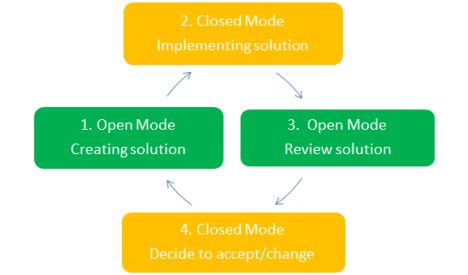
In the diagram below, the green boxes representing the open mode and the yellow boxes representing the closed mode:

In the first part of the process, one uses the open mode to ponder and create a solution.

In the second part of the process, one must switch to the closed mode in order to implement it. Here is where one needs to narrow one’s focus and act decisively towards one’s purpose.

After the solution has been tried out, then you go to the third part of the process, where you review with an open mind the feedback arising from the decision. Once you’ve looked at the solution, you can then go to the fourth stage, and use the closed mode to make a decision to either a) accept the solution or continue with the next stage of one’s plan, or b) to create a plan to correct any error perceived. This will start the cycle again.

It is important to distinguish the two modes: being in the closed mode when you should be in the open mode it not good. The example he uses is that it is normally a bad idea when you take a running start at the edge of a ravine and are about to leap over, to suddenly start reviewing alternate strategies.

Likewise, it is a bad idea to be in the open mode when you should be in the closed mode. The example he uses is that when you’re focusing on attacking a machine gun turret, you should not be putting any mental effort into seeing the funny side of what you’re doing.

6. Getting stuck in closed mode

The problem according to John Cleese is that we too often get stuck in the closed mode. Under pressure, we tend to maintain tunnel vision at times when we really need to step back and contemplate the wider view. This is particularly true of politicians. They become so addicted to the adrenaline of dealing with problems that come up almost on an hourly basis that lose the desire and/or ability to ponder problems in the open mode.

In the next part of his speech, John Cleese talks about the five elements that go into fostering the open mode.    The discussion of these five elements begins in the next post.

In Search of Symmetry–Marcus du Sautoy’s TED Talk


In Search of Symmetry

I watched a TED talk called Symmetry:  Reality’s Riddle given by Marcus du Sautoy, an Oxford mathematics professor:

http://www.ted.com/talks/marcus_du_sautoy_symmetry_reality_s_riddle.html

He studies the concept of symmetry by means of mathematical structures such as groups and the building blocks of prime numbers, which are the “atoms” of number theory.    This mathematical concept of symmetry underlies a lot of physical phenomena.

It was a fascinating talk and it brought me back to the days when mathematics was the polestar around which my academic world revolved back in junior high school…

1. When Logic Ruled my World

My eighth-grade math teacher was especially encouraging, and she allowed me the creative outlet of doing special reports on various subjects like symbolic logic, complex numbers, or abstract algebra.  These reports kept getting longer and longer, until the last one I did covered two full spiral notebooks. It was a comparison between the symbolic logic notation our algebra books used and the so-called Polish notation that was popularized with the logic game called Wff ‘n Proof.

My interest in the syntax of mathematical logic was connected with my growing interest in the syntax of natural languages. In the same way that there are natural languages that have different syntax in the form of differing word order, logic notations can have a different order of the logic variables (x, y) and the logic operators (AND, OR, NOT).

So the logic notation used in our algebra books was an infix notation, where the logic operator comes in between the two variables, such as A OR B. The Polish notation was a prefix notation, so the operator comes before the variables, such as OR A B. Something called Reverse Polish Notation or RPN was yet another syntax where the operator came after the variables, such as A B OR.

Why is this significant? When you have an infix notation, such as the one used in our algebra books, you need brackets to make sure you do the operations in the correct order if you have a more complex expression such as A AND B OR C. This can be interpreted as (A AND B) OR C or A AND (B OR C). But if you say A B AND C OR in postfix notation or RPN you get the same as the first result unambiguously without parentheses, and the second you would get with B C OR A AND. The elimination of clumsy parentheses made RPN useful for handheld calculators, and many engineers got used to using it.

As my education progressed, my passion for mathematics started to be rivaled by other passions: foreign languages and music in high school, physics and philosophy in college, art and literature between my undergraduate and graduate school years, and finally history in graduate school.

2.  Adventures in Mathematics

However, Marcus du Sautoy’s talk brought me back to the primacy of mathematics as my main intellectual interest back in junior high school.   As I mentioned above, I did special reports in the areas of abstract algebra, which I learned these through a series of advanced mathematics textbooks that my father got me called Adventures in Mathematics published by Science Research Associates.   It tried to introduce various concepts of higher mathematics in a form that would be palatable to those in the upper school grades.   For example, it taught abstract algebra by introducing “clock mathematics.”  If it’s 9:00 AM, and you have a four-hour meeting, it ends at 1:00 PM, which you get through the following logic: 9 + 4 = 13, but any time your answer is over 12, you subtract 12 from it until you get an answer that it between 1 and 12, in this case 1. You can perform arithmetical operations on a clock that has a different number of hours than 12, such as 5, and you would get the following if you constructed an addition table of the hours for a 5-hour clock, with the 5th hour being designated by a 0:

Figure 1: Addition on a five-hour clock (modulo 5)

+

0

1

2

3

4

0

0

1

2

3

4

1

1

2

3

4

0

2

2

3

4

0

1

3

3

4

0

1

2

4

4

0

1

2

3

You notice how each of the hours is represented in each column and each row. This is a property that shows that there is some underlying symmetry in this operation (addition) on this particular set of numbers (those on a 5-hour clock).

This “occurs once in each column and row” symmetry is precisely the symmetry which underlies the popular math game called Sudoku. You figure out the puzzle by using the underlying symmetry to deduce what the various numbers should be in the blank spaces.

Just in the same way that you can do an addition table using clock or modular arithmetic as it is known, you can also make a multiplication table

Figure 2. Multiplication (modulo 5)

*

0

1

2

3

4

0

0

0

0

0

0

1

0

1

2

3

4

2

0

2

4

1

3

3

0

3

1

4

2

4

0

4

3

2

1

Except for the 0 row and column, which give you 0’s all the way down or across, the other rows and columns also have the property of having every number appear from 0 to 4.  However, if you were to do a multiplication table for a 4-hour clock or a 6-hour clock, you would not have this same property of symmetry.   I was trying to figure out why, and then it suddenly dawned on me: an n-hour clock would have this Sudoku-like property for addition AND multiplication if and only if n was a prime number. I still remember the thrill I got in having my mind pierce to the heart of a mathematical truth.

This was the first mathematical insight I remember having with respect to abstract algebra.  Although this is several orders of magnitude less significant than British mathematician Andrew Wiles’ proof of Fermat’s last theorem (namely that an+bn=cn has no solutions among positive integers a, b, and c if n > 2), I still feel some sort of spiritual kinship with him, because I know what that thrill of discovery and challenge of proof feel like. You don’t have to be able to climb Mt. Everest to experience the thrill of mountain climbing.

I thank Marcus du Sautoy of reminding me of one of my first academic interests and bringing all of those years of “mountain climbing” back to me.