Eaarth: Making a Life on a Tough New Planet by @BillMcKibben—Lightly, Carefully, Gracefully


Eaarth—Making a Life on a Tough New Planet by @BillMcKibben—Lightly, Carefully, Gracefully

This post is on the last chapter called Lightly, Carefully, Gracefully of Bill McKibben’s book Eaarth.

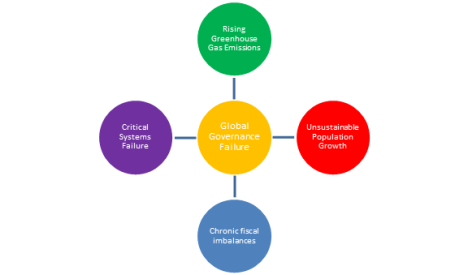
According to Bill McKibben, the most effective way of mitigating the risks due to climate change is through decentralization. The current situation according to the World Economic Forum in its Global Risk Report 2012 is given in the following diagram, where the most prominent global risks are given in various categories: environmental (green), societal (red), economic (blue), technological (purple), and geopolitical (yellow).
How would Bill McKibben’s preferred strategy of decentralization work to mitigate these risks? Here’s a summary of what measures can be taken to implement this strategy based on the five categories of risk listed above:

1. Urban Farming (societal)

Using undeveloped urban space for the growing of fruits and vegetables is not radical; it was done at another crisis point in our recent history, which is World War II. The food output in Britain almost doubled due to the implementation of these measures.

2. Supporting Credit Unions (economic)

Having the government support measures which help break up the big banks would make our system more robust, since the top six banks now have assets equivalent to more than 63% of GDP. However, waiting for the government to act on this in an election year is unrealistic. One way to support the decentralization of economic power is to encourage people to take their money out of the big banks and put it into more locally-controlled banks and financial institutions such as credit unions.   This is not explicit mentioned by Bill McKibben but is an example I thought of which would be consistent with his decentralization theme.

3. Conservation (environmental)

Americans could save three-fourths of the electricity they use by adopting relatively inexpensive conservation measures. This is probably the most promising area for decentralization, because it reduces energy consumption in the most local area of all: your own home.

4. Social Media/Meetups (technological)

To spread information about conservation and other measures, social media and the internet can be used, but Bill McKibben encourages local meetups and other forms of local neighborhood interaction to spread information. It will reduce our reliance on the government, and promote societal ties at the neighborhood level.

5. Reform (geopolitical)

Finally, to decentralize the power of both government and business it will be necessary to promote those reforms which do so, such as the Dodd-Frank law. To push those reforms in an election year will require people power.

CONCLUSION

All of these measures are things that can reduce our dependence on the centralized system of distribution and control which will make it easier for people to survive the shocks to the system that Bill McKibben feels are coming.   In the series of science-fiction novels by John Barnes called Daybreak, a technological terrorist attack debilitates the Federal government in the first novel called Directive 51, but the second novel called Daybreak Zero shows that the ordinary people of small-town America are the main force driving the reconstitution of civilization.    That is why I found the series terrifying in its initial implications, but ultimately uplifting in its faith in the power of ordinary people to band together and persevere in the face of adversity.

It happened before, when people in this country rode out the dual shocks of the Great Depression and World War II, and the government helped steer the country successfully between the political Scylla and Charybdis of communism and fascism that overtook Europe.    This fueled a sense of optimism after the conclusion of the war which took us from here to the Moon.

I look now at our nation’s capital and all I hear is the language of diminishing dreams.   I do not have faith in our current governmental system to steer us to anything but a standstill during this election year.   However, as Nietzsche once said in the quote that opened this series, “The fates lead those who will–those who won’t, they drag.”   We have received a repeat of the economic shock that started the Great Depression, but the enemy we face is more implacable than anything we faced during World War II, namely the cold equations of physics and chemistry, which are preparing for us a shock of an order of magnitude greater than we have ever seen before.    We must stop relying on the large, complex systems within which we live, and start forging links with our neighbors like the struts of a geodesic dome in order to withstand what is coming.

There may be resistance to these ideas, but ask yourself if the place the resistance is coming from has a vested interest in the debate.   I think this is perfectly illustrated by a Jules Pfeiffer cartoon which has the picture of someone in a business suit sitting at a large desk in an office saying, “you want oil? We own the oil fields.  You want coal?   We own the coal mines.  You want nuclear power?  We own the uranium mines. You want solar power?  We own the … we own the … it’s just not feasible!”

Eaarth—Making a Life on a Tough New Planet by @BillMcKibben—Backing Off


 This post is on the third chapter called Backing Off of Bill McKibben’s book Eaarth.

“The whole intellectual edifice collapsed in the summer of last year because the data inputted into the risk management models generally covered only the last two decades, a period of euphoria.” Alan Greenspan, a few months before the financial meltdown in 2008

 1. Too Big to Fail?

 Bill McKibben in his third chapter starts off with talking about the problem with systems that are large too to cope with the stresses put on them. He starts off the example of the financial system, which avoided collapse in 2008 but which has been severely stressed ever since. The Global Risk Report 2012 put out by the World Economic Forum is discussed in the following post:

https://4squareviews.com/2012/05/15/world-economic-forum-wef-global-risk-report-2012-part-2-methodology-2/

 In this report, the five most serious risks currently facing global civilization were listed for the five risk categories of 1) environmental (green), 2) societal (red), economic (blue), technological (purple), and geopolitical (yellow). The problem of rising greenhouse gas emissions is, of course, the subject of Bill McKibben’s book as a whole. But the book also illustrates the connection between some of the other risks and that facing the environment. For example, the last chapter deals with the problem of chronic fiscal imbalances and how it is making it more difficult to spend resources on environmental protection.

Figure 1. Top five global risks based on Global Risk Report 2012

The third chapter, the one I am writing about in this post, deals with the geopolitical risk of global governance failure which is linked to the economic problems we are facing. In the economic arena, the big banks were labeled as TBTF or Too Big To Fail, as a reason for the enormous government expenditure made to keep them afloat during the financial crisis of 2008.

However, the problem now is that the banks are even BIGGER than they were at the beginning of the crisis. Two years before the crisis, the assets of the top big banks accounted for 55% of GDP in the US; two years after the crisis in 2010, that figure had risen to 63%. If the collapse of the Eurozone later on this year causes another “Lehman moment” to occur, what is the chance that the big banks will NOT ask for another bailout? Zero. What is the chance that the government, especially right before the election, will NOT give it to them? Given that even more of the nation’s GDP is tied up with the big banks, there will be more pressure on them from the financial and business community in general.

The response from some of the electorate is that the government itself suffers from being too big. This anti-government populist strain is entertained by those who view government as a constraint of business, but Bill McKibben takes the radical view that both government and business have to be constrained and their power decentralized. This seems like a radical notion to sum, but he tries to put it in historical perspective in the next section of the chapter.

2. Centralization and decentralization

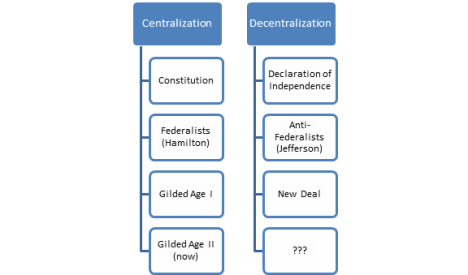
Greater concentration of wealth and power followed by periods of decentralization of that same wealth and power are the two polestars of American history (and one might argue world history as well).

In the political sphere, the Declaration of Independence represented a movement away from the political and economic dominance of the colonies by Britain, and the fledgling United States were set up with Articles of Constitution. The weaknesses of this system were recognized and a Constitution was set up as a compromise between those advocating for a strong Federal Government and those trying to preserve the rights of the individual States within the Union.

In the late 19th century, the economic inequality we faced as a country caused a political backlash which took the form of the Progressive movement, and eventually to the mixed economic system which was ushered in by the New Deal. The reaction against this started in earnest with the Reagan administration and now we are in the midst of what I call the Gilded Age II. This is where we are now, where the extreme economic inequality is creating feedback loops of corruption which are undermining our democratic framework of government.

Bill McKibben would argue that the decentralization of both economic and political power is a good thing, because it will prove stronger and more capable of coping with the tremendous stresses that the environmental problems of climate change are putting on the system.

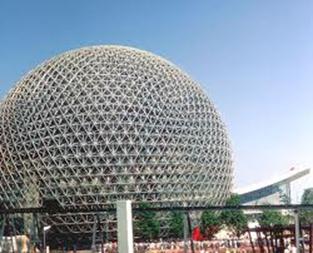
I think the best analogy for this would be the geodesic dome designed by Buckminster Fuller.

The individual links are not strong in and of themselves, but they interlock with so many other links that when a stress is put on any one point of the dome, it is dispersed through so many different nodes that it doesn’t overwhelm the structure. This theoretical concept was tested in one of the first uses of the geodesic dome, to house US government installations in Antarctica which face tremendous winds during the winter.

Supporting farmers’ markets and other more local forms of food suppliers rather than large agribusiness may not seem efficient, but it is effective in reducing the burden on the infrastructure of roads, highways, etc., AND it also increases social cohesion by encouraging people to interact with each other on a local level.

In the science fiction series called Daybreak by John Barnes, a major technological catastrophe (the spread of biological and nanotechnological plagues) cause the central government to collapse. The first book describes this breakup, but the second book shows how it is the small communities that are the more isolated from the system pre-Daybreak that actually do better than the urban areas which are dependent on resources that only the system can provide.

Although the stresses our society will face in the next 10 years are more likely to come from environmental problems rather than technological ones, I think the same principle applies that “smaller is better” under the current circumstances.

The next post covers the last chapter, which outlines some of the forms that this decentralization may take.

Eaarth—Making a Life on a Tough New Planet by @BillMcKibben—High Tide


 This post is on the second chapter called High Tide of Bill McKibben’s book Eaarth.

 1. Cost of action vs. cost of inaction

This book was written in 2010, after the financial crisis of late 2008 and the ensuing recession from which we are still slowly recovering. He recognizes that the cost of taking action to control the emission of greenhouse gases is a formidable barrier. However this chapter shows that the cost of not taking action is even greater.

Here is a comparison of these two categories of cost when it comes to controlling the emission of greenhouse gases:

COST OF ACTION

COST OF INACTION (STATUS QUO)

1. Reduction in growth rate of economy 1. Increased cost of infrastructure, insurance
2. Sunk costs in fossil fuel extraction 2. Increased incidence of dengue fever and malaria
3. Reduced profits to extractive industries 3. Increased geopolitical problems due to struggle over water/energy resources

Why was SOPA or the Stop Online Piracy Act stopped in Washington? Because it pitted two corporate sectors against each other, namely, the entertainment industry vs. the tech industry, with the entertainment industry being for it, and the tech industry (Google) against it. It transferred the liability from one industry to another, rather than onto the taxpayer directly, as corporations would normally prefer.

It is interesting to me that although the extractive industries are against greater regulation in the area of controlling greenhouse gas emissions, the insurance industries would be supportive of such regulation because they are the ones that are bearing the consequences of the increased risk caused by climate change. However, Bill McKibben mentioned one ally in the fight against climate change that surprised me, namely, the Pentagon. Their interest is particularly when it comes to the third category of costs mentioned above, namely, the increasing number of geopolitical problems that resource scarcity will most certainly lead to. In that case, they are the ones that will have to bear the consequences of increased risk.

In my opinion, rather than environmentalists railing against corporations and capitalism in general as the ultimate cost for our fetish for growth that fuels our need for increasing amounts of energy resources, it would behoove them to positively engage those corporations or government entities which have a vested interest in mitigating the effects of climate change.

2. Global politics

Bill McKibben said that the various international accords such as the Kyoto accord of 1997 have not been supported by the US Congress or by the Bush Administration.   The reason given was that the accord would force the US to make sacrifices when the powerhouses of the developing world, that is China and India, are not willing to make the same sacrifices. The echo on the other side of the argument from China and India is that the US has a vested interest in having the developing world sacrifice its economic development for the sake of the accord because this would then allow the US to continue its economic hegemony over the developing world.   It is cast as a zero-sum game: either the US wins, or the developing world wins, but both cannot win in the frame of the argument.

However, the underlying assumption of this argument is that the developing world SHOULD consume natural resources as the US. There simply aren’t enough resources in the world to allow the developing world to consume at the same rate as the US; therefore, a better plan would be for the US to share those resources with the developing world.

This would reduce the extraction of those resources from the Earth AND allow growth in the developing world: you would then have a non-zero-sum game where both sides can win. In reality, there are no “sides” to the debate: we are all on the same side when it comes to the real argument against the reality of physics and chemistry, and we are all currently losing that argument.

3. Limits to Growth

The Club of Rome got together and used computer models to simulate the level of global population given the various inputs and feedback loops that were known to exist at the time. The results were released in a book called The Limits to Growth that was published in 1972 and are summarized below.

Topic

Conclusion

1. Growth In the next 100 years, the limits to growth would be experienced in a collapse of global population.
2. Stability This collapse could be avoided and global equilibrium achieved by implementing measures that would promote global equality.
3. Mitigation The sooner such measures are implemented, the greater the chance of their avoiding such a global population collapse.

I think this explains some of the popularity of the movie Soylent Green that was released in 1973, because it was a timely topic, the Limits to Growth having been released the previous year. I remember reading this in high school and being very sobered by its conclusions. However, as Adam Curtis mentions in his 2011 documentary on the history of computers called All Watched Over By Machines of Loving Grace, there was one element missing in the computer model used by the Club of Rome, and that was the role of government and non-governmental organizations.

Bill McKibben argues that these institutions can allow us to make a choice. We are being offered a choice, not by the nanny state, as many conservatives would frame it, but by the even greater authority of the physics, chemistry, and biology of the planet itself. We cannot have unlimited growth because we don’t have unlimited resources. We cannot even sustain the growth we have in its current form based on the consumption of fossil fuels, because it will make our planet unlivable.

Therefore the only way to mitigate the risk of effects of climate change and bring us to a sustainable growth model using renewable energy sources to use the institutions we do have, either public institutions such as government or public-private partnerships such as non-governmental organizations.    This would allow us to achieve a managed transition rather than an uncontrolled collapse as envisioned by the Club of Rome.   This will be the topic of the next chapter.

Eaarth—Making a Life on a Tough New Planet by @BillMcKibben—A New World (3)


This is the third and last post in a series on the first chapter called A New World of Bill McKibben’s book Eaarth.

“History is a nightmare from which I am trying to awake” James Joyce’s Ulysses

6. The curveball—positive feedback loops

One of the complications with the chain of causation that was shown in the second post on this chapter is that some of the effects of climate change, as seen in the first post on this chapter, are unleashing processes that accelerate the processes behind climate change and make it worse. The book gives three examples which illustrate this process of acceleration:

Figure 1. Melting sea ice

This feedback loop occurs when the increasing global temperature of the atmosphere causes the Arctic icecap to melt. Right now, the icecap reflects the sunlight back, but with the icecap gone, the ocean beneath the icecap will absorb rather than reflect light and increase the temperature of the ocean. This heat will transfer from the water to the atmosphere and feed back into the cycle of increasing global temperatures.

Figure 2. Permafrost becomes perma-gone

This feedback loop occurs when the permafrost or tundra, in areas near the Arctic Circle like Siberia, starts to melt and release the methane trapped within. Methane is a more potent greenhouse gas, and releasing this feeds ever-higher concentrations of greenhouse gases into the atmosphere, intensifying the cycle.

Figure 3. Forest fires

The structure of this loop is similar to the last one, but it is forests that are storing greenhouse gases in the form of CO2. However, higher temperatures and increased severity of thunderstorms mean that forest fires are more common. The forest fires release CO2 into the air, but they also destroy the trees that absorb CO2 from the air in the first place.

The real end result that I am concerned with is the destruction of the ocean food chain. We all have become increasingly aware of the collapse of certain fish stocks in the ocean, but at the very bottom of the food chain are phytoplankton.

(WARNING: Spoiler alert!) The whole premise for the movie Soylent Green made in the year 1973 was that in the year 2022, environmental catastrophes would continue in magnitude until the phytoplankton start to die off, and the government in increasing desperation moves to the one food resource that is in abundance: people, due to increasing overpopulation. They are manufactured postmortem into Soylent Green which is sold as a new and revolutionary foodstuff. Charlton Heston plays a New York detective who uncovers a plot to prevent this secret from being known to the public.

I irreverently thought of this movie recently when I found myself mistakenly in the pet food aisle of our local supermarket and saw on display a box of “People Crackers” that were geared towards dogs as a response to the “Animal Crackers” which human beings love to consume.

The quote I began this post with comes from James Joyce’s Ulysses, but rather than history being a nightmare from which one should try to awake, the dystopic future represented by Soylent Green is the nightmare from which we should try to awake. However, awakening has its costs and these are addressed in the last section of the chapter.

7. The price of action and the price of inaction

The cost of mitigating the risks of climate change comes down to the cost of reducing greenhouse gas emissions. There are several ways to do this:

a) reducing consumption through conservation measures,

b) increasing storage of greenhouse gas emissions from the atmosphere (a process called carbon sequestration), or

c) switching to energy sources that do not create as much greenhouse gases.

Reducing the emission of greenhouse gases by government regulation does represent a cost to corporations, especially those in the industries that extract, refine and produce petroleum products, with indirect effects on the economy as a whole. This is a legitimate question to be raised, but it must be balanced by the effects on the economy as a whole of inaction or insufficient action.

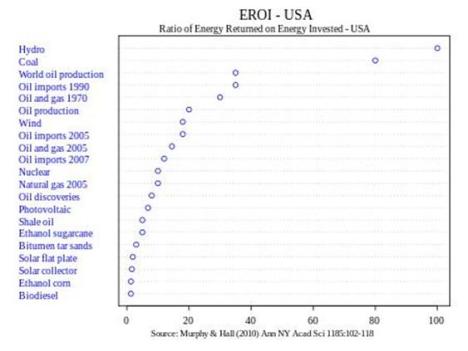
To illustrate the difficulties of just one of the strategies, let’s say the third one, one must use the concept of EROI, or Energy Return on Investment. How much energy does it take to produce a certain amount of energy? EROI measures this by taking the usable energy acquired and dividing by the energy expended to acquire it.

For example, in an oil well, you must drill the well and then extract the oil. But with shale oil, you have to break the shale apart in a process called fracking, and then extract the oil. This fracking process itself costs energy, so the EROI is only 5.2:1 as opposed to a 20:1 ratio for a simple oil well.

The above chart is taken from Murphy, D.J.; Hall, C.A.S. (2010). “Year in review EROI or energy return on (energy) invested”. Annals of the New York Academy of Sciences 1185: 102–118.doi:10.1111/j.1749-6632.2009.05282.x.

If you take a look at the above chart, anything to the left of the 20:1 ratio, the standard for fossil fuels that are easily extracted, is LESS ENERGY EFFICIENT. You can see that wind power is on par with oil, but solar panels have an EROI of somewhere between 2.5 and 4.3:1, and are thus much less energy efficient at this stage. Therefore the economics of energy extraction as expressed by this graph show that solar power cannot replace fossil fuels. However, if solar panels become slightly more energy efficient, they would be more efficient than extracting fossil fuels from tar sands.

Bill McKibben feels that the global economic crisis that started in November 2008 has distracted the world’s governments from the global environmental crisis that is in actuality of much greater potential impact. This topic opens up the next chapter of Eaarth called “High Tide”.

Eaarth—Making a Life on a Tough New Planet by @BillMcKibben—A New World (2)


 This is the second post in a series on the first chapter called A New World of Bill McKibben’s book Eaarth.

3. Chain of Causation

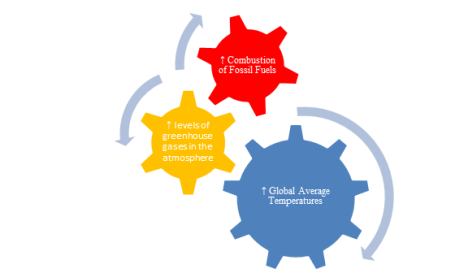
The next part of the first chapter called A New World deals with the next link in the chain of causation. If the rising global average temperatures are responsible for the various phenomena that are exhaustively described in the book and summarized in my previous blog post, then what is causing this rise in global average temperatures?

Figure 1. Global climate change “chain of causation”


The above diagram illustrates the next two links in the chain of causation: the increased global average temperatures are being caused by the rising levels of greenhouse gases that are released in the atmosphere, which in turn is being caused by the release of fossil fuels. The main greenhouse gas is carbon dioxide, although there are others, which are talked about in the next section of the chapter on feedback loops.

4. Concentration of carbon dioxide in the atmosphere

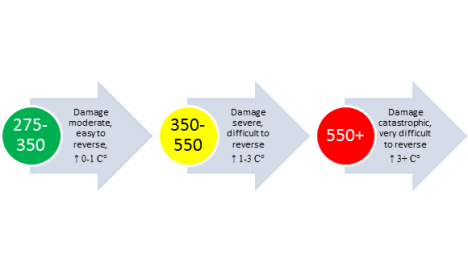
What is the “safe” level of carbon dioxide in the atmosphere? In pre-Industrial Revolution days, it was 250 parts per million or 225, and it is 390 ppm now. It was in December 2007 that James Hansen, the planet’s leading climatologist, gave a talk at the American Geophysical Union meeting in San Francisco where he concluded that the safe number was 350 ppm, much lower than the earlier proposed benchmarks of 450 or 550 ppm.

A level of 550 ppm gets into territory where there may be “feedback loops” that are discussed in the next section of the chapter (and the next post). I remember the cartoon-within-a-cartoon movie called Who Framed Roger Rabbit?, in which the temperature controller on the oven read, “warm … HOT … VOLCANO HEAT!”.  That’s the territory we are getting into after 550 ppm. This is my own shorthand way of understanding the various levels based on what was written in the book.

Figure 2. Concentration of Carbon Dioxide in the Atmosphere (measured in parts per million)

5. Mitigating Risk

One of the ways of mitigating the risk of rising global temperatures caused by the increase of greenhouse gases emissions would be to get the world’s governments to enact measures to reduce them. However, the measures increased so far are not sufficient. After the 2009 United Nations Climate Change Conference in Copenhagen a group from MIT called Climate Interactive calculated two scenarios:

  • If all government pledges AGREED TO at conference were enacted, then the world in 2100 would have more than 725 ppm carbon dioxide.
  • If all government pledges DEBATED BUT NOT AGREED TO at conference were enacted, then the world in 2100 would have 600 ppm carbon dioxide.

So if the response to climate change continues along its present course, therefore, we have two choices: HOT and VOLCANO HEAT.

The real problem about the area above 550 ppm comes from the process of feedback loops where the release of carbon dioxide sets up effects that in turn release OTHER greenhouse gases such as methane and peat which are even more powerful in their effect. That will be the subject of the next part of the chapter and the next post.

Eaarth—Making a Life on a Tough New Planet by @BillMcKibben—A New World (1)


This looks at the first chapter of the book Eaarth called A New World. Here are the concepts covered in the first chapter.

1. Holocene à Anthropocene

The fates lead those who will – those who won’t, they drag.” Nietzsche

The Holocene period is the geological period we were in until recently which covers roughly the last 10,000 years. During the entire time our human civilization grew and flourished, the average global temperature has been between 58 and 60 degrees Fahrenheit.

The first major point of this chapter is that we are now leaving that “comfort zone. Bill McKibben mentions the Apollo 8 Earthrise photograph, the iconic photograph taken below, which was the midwife to the birth of the ecology movement.


Since that photograph was taken in 1968, the global average temperature has risen 1.5 degrees Fahrenheit. We no longer live on the same planet as we did back then; hence the term “Eaarth” as Bill McKibben thinks of a new name to call our planet in this new geological period (which some term the Anthropocene).

2. Consequences of higher global average temperature

“Turning and turning in the widening gyre”—The Second Coming, W.B. Yeats

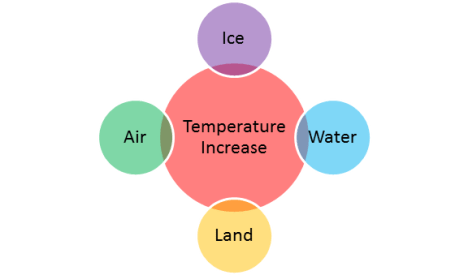
Text section of the chapter outlines some of the consequences for the Earth’s air, land, and oceans of the higher global average temperatures that are occurring. The problem from my standpoint was that the various statistics he gave were mind-numbing, and I tried to make sense of them by showing how they were all connected in the following diagram:

The temperature increase affects the temperature of the land, the water (oceans and fresh water), the air, and the ice which covers the land (mountain ranges such as the Himalayas, the land masses of Greenland and the Antarctic) and the water (the Arctic sea).


The temperature increases in these domains are creating the following effects:


Some of these effects are related; for example, higher temperatures means that the earth’s atmosphere can hold more moisture, part of which it takes from the land. This explains why some portions of the land such as Australia have drought, while other portions are experiencing increasing rainfall.

Now that the various global warming effects have been catalogued, Bill McKibben goes to the next level of the question “Why?”, and shows that the temperature increase is linked to the amount of carbon dioxide in the earth’s atmosphere.   This will be covered in the next post.  


Eaarth—Making a Life on a Tough New Planet by @BillMcKibben (preface)


In this post I consider the preface to his book, and in the following 4 posts, I will discuss each of the 4 chapters of the book in turn. 

Bill McKibben, the nation’s leading environmentalist and founder of the organization 350.org, wrote the book Eaarth to give a message that global warming is no longer a threat but it has rather become our reality.   The purpose for my reading this book is to look into risks involved with rising greenhouse gas emissions.   This happens to be one of the environmental risk factors that are considered to be one of the most likely risks to affect the globe in the next 10 years, according to the Global Risk Report 2012 published by the World Economic Forum.   For details on the methodology of this report, see this earlier blog post:  https://4squareviews.com/2012/05/15/world-economic-forum-wef-global-risk-report-2012-part-2-methodology-2/.

1.  Past is Prologue

In the preface, Bill McKibben states that his first book for a general audience was written in 1989, twenty years before he wrote Eaarth.   Twenty years before that, the novel Stand on Zanzibar by British science fiction author John Brunner won the Hugo award.   The novel had overpopulation as its theme, and as I read it, I hoped that the world in the year 2010 (the year the novel is set in) would not be as much of a dystopia as John Brunner described.

One passage I remember from the book on the subject of overpopulation comes from one of the short chapters interspersed throughout the book called The Hipcrime Vocab, kind of a futuristic version of Ambrose Bierce’s The Devil’s Dictionary.  It describes overpopulation as “something which everyone talks about as if it will happen in the future, but in reality it happened yesterday when nobody was looking.”

That passage to me explains the premise of Bill McKibben’s book, which is that we need to stop thinking about global warming as a threat that might or might not happen sometime in the future, but rather something which has already started and is part of our reality whether we like or not.   In the field of risk management, risk is technically defined as an event with an uncertain outcome.   Death according to this definition is not a risk because it comes for us all with perfect certainty.    Therefore there is no risk of global warming; there is only the risk we face by not accepting the reality of the situation.

Accepting this reality is admittedly a bit of a shock; it is sometimes mind-numbing that I am living in a world that is fast becoming the kind of environmental dystopia that I was introduced to through science-fiction, whether it be Stand on Zanzibar by John Brunner in 1968, the movie Soylent Green in 1973, or the later novels Timescape by Gregory Benford and David Brin’s Earth in 1990.

2.  No succor for the suckers … or for us

In the four chapters of the book, he lays his case for what can be done to mitigate not the risk, but the damage that global warming will do.   There are two types of climate-change deniers, those whom I refer to as the “weak” deniers and those who are the “strong deniers”.   The weak denier is one who admits that global warming, defined technically as the increase in average global temperature, has started to occur, but denies that the cause of the warning is excess carbon dioxide generated by the combustion of fossil fuels.   The strong denier will not even admit that global warming has even occurred, let alone that it is anthropogenic, or man-made, in origin.    The various useful idiots who prattle on about the ridiculousness of the idea of global warming after each major snowstorm in winter are strangely silent after each summer’s heatwave that kills an increasingly large number of people.

Bill McKibben has no comforting words to give succor to the open-minded public, let alone the suckers who fall for misinformation campaigns.   He offers “a valuable slice of acid-tongued reality”, in the words of the San Francisco Chronicle.   Companies that have a stake in the extractive industries that produce fossil fuels may fuel the arguments against global warming, but I assure you that the various experts that contributed to the Global Risk Report 2012 mentioned above take these matters very seriously, as do I.

Let’s listen to what he has to say…

Foreign Service Institute (#FSI) Language Courses–great free resource!


When I am networking, one of the typical “getting to know you questions” that facilitators like to spring on the unwary is “name one memorable fact about yourself.”

Although I was reluctant to do so at first, due to my inbred Midwestern modesty, I now say “I know half-a-dozen foreign languages.”   This is because no matter what else I would say to a person in getting to know them, they would invariably pick up on this one fact that I am multilingual and remember that, and sometimes only that.   “Oh yeah, I remember you, you’re the, um, language guy, right?”    I decided not to resist what works, and so I now use the label of “multilingual” as part of my “branding” while networking.

Okay, so I end up telling people I’m the language guy so they’ll remember me.   But I don’t like to boast, because my skills pale in comparison to one of my personal language-learning heroes, Benny the Irish Polyglot who runs the website http://www.fluentin3months.com/.    I personally prefer the term “multilingual” to “polyglot” because the latter conjures up the picture in my mind of a “thick-tongued parrot”.    In any case, I am fascinated with Benny’s methods and his people-centered approach.

But when people ask me, what do you recommend to study a language, what do I tell them?

One of the things I tell people who want to study Chinese is to go to the Foreign Service Institute’s Language Courses website, http://fsi-language-courses.org/Content.php, because the foreign language courses which have texts and audio to download are well-developed courses and, most important of all for frugal foreign-language fans, free!

I used the Standard Chinese:  A Modular Approach back in college at the University of Illinois.   Its modular approach was geared towards practical language skills, as can be seen by the titles of the modules Orientation, Biographic Information, Money, Directions, Transportation, etc.    The explanations of grammar are very clear in the Comprehension and Production (listening and speaking) tapes, and they are practiced in the Drill tapes and then put to the test in the exercises that accompany each unit.

The ONLY caveat I have about the FSI Foreign Language Courses is that they are old-fashioned in terms of vocabulary.   You are not going to find “software” or “cell phone” in the vocabulary lists, since these courses were developed almost 50 years ago.   Also, the lack of political correctness may be a bit of a cultural shock for some.   In the Spanish course, there is a phrase “la gente aqui es muy sucia” or “the people here are very dirty” which made me laugh out loud, along with “no quiero bailar con la gordita”, or “I don’t want to dance with the little fat girl”.    Nevertheless, if you want to really PRACTICE listening and speaking a foreign language, these courses are very helpful.    I would have them be a supplement rather than a main course for those studying a particular language.   I have used not only the French, German, and Spanish courses and found them helpful in practicing grammar.

But particularly for those wanting to learn both Chinese grammar and vocabulary on a limited budget, I would definitely recommend the Chinese course.

World Economic Forum (#WEF) Global Risk Report 2012 (part 3—X Factors)


The last posts have dealt with the methodology World Economic Forum used to come up with the 50 risk factors and to show how they are interrelated. The purpose of this post is to discuss risk factors that were NOT included in the list of 50, which the WEF refers to as “X factors”. I want to illustrate these X factors with a science fiction series that has been written by John Barnes with the concept of “Daybreak”.

1. Methodology for coming up with X Factors

When the WEF did its survey to ask participants about their estimates regarding the 50 risk factors, they included a blank field for the participants to identify any risk factors which were not included in the original survey. These were factors that represent risks to be watched over in the future. The risk survey has a time horizon of 10 years, but with the rapid growth of technology, it is very possible that certain risks may rise in prominence that most people may not even be aware of today.

2. Examples of X Factors

Here’s a few examples:

 Mega-accidents—rather than industrial accidents having to do with oil or chemicals, accidents of the future may come from genetically modified micro-organisms or nano-scale materials.

 Mis-information—traditional broadcast media collapse, and mass reporting online takes its place

 Neotribalism—Polarized subcultures in the physical world create borderless communities that can affect political regimes in the real world

 Volcanic winter—A major volcanic eruption could alter the Earth’s atmosphere and cool the planet, temporarily but severely disrupting food supply

3. X factors in science fiction—John Barnes’ Daybreak series

There are others that are listed on page 46 of the Global Risk 2012 report, which can be accessed here: http://reports.weforum.org/global-risks-2012/. However, I chose the above 4 risk factors because they are an integral part of the science fiction series called Daybreak by John Barnes, consisting of the novels Directive 51 and Daybreak Zero. 10 years in the future, there is a growing subculture of resistance against the Big System. This repository of resentment of those who oppose the technological, political, and economic elites grows through the Internet and social media until it reaches critical mass.

On October 28th, 2022, a coordinated release of genetically modified micro-organisms and nano-scale materials (called “biotes” and “nanoswarm” in the novels) is coincided with the kidnapping of the Vice President of the United States and an attempted “911” style mass terrorist attack. The Office of Future Threat Assessment has been studying Daybreak, but their expertise is now critical to the Federal government’s attempted response to that threat. This initial attack is part of a series of attacks that attempt to eliminate the Federal government and the bases of modern civilization itself.

To counteract this threat, it is important to figure out what Daybreak is. One group in the government treats it as if is a terrorist group with a discrete set of leaders. However, some argue that it may be a “system artifact”, an emergent property of the Internet that has somehow become self-aware and is the force manipulating the attacks.

What is left of the government tries to organize the pockets of small-town America that have banded together to protect the remaining resources and one another against the tribes that are growing in the periphery in the absence of any authority.

4. Lessons learned

I didn’t want to add any more descriptions of the plot for those who intend to read the novels. If you are a science-fiction fan I would definitely recommend the novels because they are very good indeed. The multiple characters are well-drawn, and the plot is fast-moving and detailed enough to be quite believable.

The interesting lessons for me having read the novels after reading the Global Risk 2012 report are as follows:

a. The novel shows how risks in one category affect the others. The initial attack is of a technological variety, but the nature of this combination biological/nano-technological attack is that it destroys the infrastructure of society, creating a societal risk. The kidnapping of the Vice President of the United States and the subsequent attacks on the Federal government represent the geopolitical risk of the collapse of global governance.

b. The novel shows that there is a need for imagination when it comes to risk analysis, because there are always going to be X factors which may be negligible now, but which may come to the forefront in the future.

Even in the current time frame, there may be factors which one may not have thought of which could affect one’s project and even become mission critical.    One of the reasons why I like reading science fiction is because it stimulates my imagination.

I was reminded of Apollo 1 fire, which occurred during a launch simulation test of the Apollo Command Module and killed astronauts Gus Grissom, Ed White, and Roger Chaffee. Frank Borman was one of the Apollo astronauts on the panel investigating the causes of the fire. The fire was technically caused by a spark from a wire which had lost its Teflon coating. The spark ignited highly-pressurized oxygen atmosphere in the Apollo Command Module, and caused the runaway fire. However, when a Congressional inquiry was made and Frank Borman was asked about the causes of the fire, he said it was a “failure of the imagination”. NASA had been considering the risks involved with travel out in space, but had not analyzed carefully enough the risks involved with testing here on the ground.

 The design flaws that caused the fire were uncovered and led to an improved design which would carry the later Apollo astronauts all the way to the moon.   Therefore, it is important to “look forward” and “look backward” when dealing with risks, to be aware of the possibility of unaccounted-for risks, and to make sure the risks that are uncovered are accounted for and mitigated against in future projects.

New Light in #Myanmar—White Elephant or New Tiger? EIU Webinar


These are my notes from an Economist Intelligence Unit webinar that was given this morning by Sumana Rajarethnam, Senior Analyst from Singapore.  The Economist Intelligence Unit gives regular webinars on various key areas that represent a combination of global risk and opportunity.

Move towards political reforms in Myanmar have led to a call for the removal of international sanctions. The removal of these sanctions in turn could lead to greater foreign direct investment (FDI), higher economic growth, and a greater integration of Myanmar in the economy of Southeast Asia. The purpose of the webinar was to talk about the impact and the likelihood of this optimistic scenario.

A. IMPACT OF ECONOMIC REFORMS

Before talking about the likelihood of the scenario, what is the impact of this scenario if it takes place? Myanmar has the potential to become the following:

1) A new energy and food source for Asia

Myanmar could become a source of food for Asia because it has twice the amount of arable land as Vietnam (11M hectares). However, the agricultural sector is very poorly capitalized, with little equipment such as tractors, and low fertilizer consumption. Therefore the potential for capital efficiency gains are huge. It is most likely that the agricultural sector will be developed first, to be followed by the development of manufacturing and mining.

The energy sector is also very promising—the natural gas resources are 22 Tcf (Trillion cubic feet) and there are still surveys of additional coastline and offshore sources being conducted.

2) A new consumer market

There are 60 million people in Myanmar, and it has the third largest population in Southeast Asia after Indonesia and Vietnam. The data on current income levels does not give you a good picture of the purchasing power of consumers in Myanmar because there is a large informal economy. If transportation infrastructure could be developed and supply chains established, markets will grow rapidly.

3) A regional transport hub

There is an ambitious $50B project to create transport linkages that is being spearheaded by China. This could bypass the current shipping bottleneck of the Straits of Malacca (between Singapore and Indonesia).

4) A low-cost manufacturing and export base

The labor market has a lot of potential for growth. 65% of the population is under 35 years old. In 1990, Myanmar had hundreds of companies in the state sector which were mostly in the garment industry. Growth here was curtailed by the ban of imports from Myanmar by the US in 2003.

The largest opportunities for investment are in the telecommunication, agri-business, and tourism sectors. It will take more investment on a longer-term scale to take on the construction sector; but this investment in infrastructure is essential for a take-off in the manufacturing sectors. However, if manufacturing sectors, this would lead to the next wave of investment opportunities, which is health care, retail sales for the domestic market, and the banking sector. This is the longest-term investment opportunity, but one with the largest potential return if reforms to take hold and the economic growth creates a burgeoning middle class.

5) Good news for the world

An emerging economy and potentially emerging democratic movement in Myanmar would be a welcome relief to the world which is hungry for good news after the current slate of problems, particularly those in the Eurozone.

B. LINKS BETWEEN ECONOMIC AND POLITICAL REFORMS

Of course, this economic impact can only occur if the political reforms are successful. These reforms hinge on the following factors:

1) Is there real hope for change in the political order?
The President Thein Sein is moving for reform, but the success of this movement depends on the military. At the present, it holds veto power over any changes to the constitution. It is entirely possible that the current reforms are being orchestrated by the military as a form of window dressing in order to lure foreign investment. However, the people in Myanmar would not be fooled by this and opposition to the current form of military rule would continue.

2) Will structural reforms be introduced?

This would happen only if the military agreed to these changes. If the government came under civilian control, the military could be tried for past atrocities. If there were a reconciliation and amnesty movement similar to that which occurred in South Africa, this might give the military the incentive to relinquish control.

3) How will the West respond to changes on the ground?

The lifting of sanctions by the European Union is one thing, but the REAL “green light” for foreign investors will be the lifting of sanctions by the US. These sanctions can be done through the executive branch and do not require congressional approval, which is fortunate because that branch of the government is paralyzed by the fact that this is an election year. The fact that Myanmar is promising to stop buying weapons from North Korea will be helpful in convincing the US that it is serious about ending its international isolation.

4) Can the military resolve long-standing ethnic conflicts?

Although these ethnic conflicts are in outlying areas of Myanmar, they effect the entire country because the military has in the past used the suppression of these conflicts as an excuse for why it needs an iron fist and why democratic reforms needed to be postponed. If these conflicts, especially those in the Kachin state, can be resolved, then the military would have no excuse and pressure for democratic reforms in the rest of the country would increase.

The analogy here is with India: India has several local insurgency movements. Those regions with these movements are also those with the least developed economies, which tends to give impetus to the insurgency movements. Myanmar has a chance to break that vicious cycle.

C. LIKELIHOOD OF POLITICAL & ECONOMIC REFORMS

Now that Sumana Rajarethnam has had a chance to discuss the impact of economic reforms, and what political roadblocks need to be removed to empower these economic reforms, what is the likelihood of these actually taking place? He envisions three scenarios, the most likely scenario, the optimistic scenario, and the pessimistic scenario, which are summarized in this chart below.

Scenario Economic Political GDP Growth Likelihood
1) Most likely Investment occurs, but reform lagging
Military in control, democracy does not take firm root, NDL reform party still marginal 7% 60%
2) Optimistic Breakup of state monopolies, reforms implemented Multi-party democracy, NDL not majority but very influential 8.5% 25%
3) Pessimistic Only growth in extractive industries Military cracks down on reforms, sanctions reinstated 5% (current baseline) 15%

The reason why there is hope for Myanmar is that sum of  the moderate and rapid growth scenarios above (the most likely and the optimistic) together represent an 85% probability. The reason why there is hype in the press at the moment is because the optimistic scenario which would lead to the positive outcomes mentioned in part A above has only a 25% probability of occurring.  There needs to be continue international pressure and monitoring of the situation so that the military has an incentive to help make that scenario happen, and to avoid the pessimistic scenario, which would be a backslide to where the country was before this reform movement started.

D. EVENTS TO WATCH

The key events to watch for in the coming months are:

  1. Aung San Suu Kyi’s upcoming visit to Britain in Norway in June
  2. US’s re-engagement with Myanmar which is being directed by State Department
  3. Myanmar’s progress in reaching reconciliation with Kachin, Karen, Rohinga and other ethnic minorities

I thought this seminar was an excellent presentation on the risks involved in that it laid out the potential that a positive economic scenario would have, it linked that scenario to other risks such as those in the political and societal (infrastructure) arena, and it then laid out the likelihood of three different scenarios.   I appreciated the in-depth analysis provided by the Economist Intelligence Unit, particularly in comparison to the mainstream press which has concentrated on the hype (sole mention of the optimistic scenario without any analysis of its likelihood or the roadblocks to its implementation).