Organize Yourself in 2015: Use Lessons Learned (and Relearned)


In the past three posts, I have shown how to take your yearly goals for 2015 for the various categories of your life (based on Maslow’s hierarchy of needs) and to break them down into monthly and weekly goals.

I also talked about prioritizing goals and using the Pareto principle to take the 20% of the goals for each day that give you 80% of the results towards your ultimately yearly goals, and to label those as your “frogs” or “top priority” tasks.   Then you put them towards the very beginning of your schedule.

Okay, that is the basic organizational scheme.   How do you get good at this?   Through practice, and through improvement. You practice is by doing it every week, but you improve by reviewing it every week.

What should you watch for?   The biggest thing you should look out for are “top priority” tasks which have been skipped or remain incomplete.   If you keep putting off a certain task, then this could be because you are unconsciously procrastinating on it.

One of the books I recommend for those who procrastinate is The Now Habit, by Neil Fiore, Ph.D.   One thing that Brian Tracy admits he does NOT do in his book on preventing procrastination, Eat That Frog, is he does not get into the psychology behind procrastination; he just gives practical techniques to try to stop it.   But if you are really having problems with procrastination that have a psychological origin, then Neil Fiore’s book may be for you.

In any case, a review of each week at the end of the week, and then a review of each month at the end of the month, can give you clues into how well you follow your plans, and they can tell you whether you need to redo the plan.

If you consider your yearly goals as projects in and of themselves, then you should do what is called a “Lessons Learned” exercise to improve your performance.   However, one of the new trends in project management is not to wait until the end of a project in a kind of post mortem to figure out what went wrong.   Many project management experts now recommend that you do a “lessons learned” review at several periods during the project.   In that way, if something needs to be corrected, it can be done early on before the project is done, so your wisdom can not only be used on future projects but the current ones you are working on as well.

In a similar way, constant review at the end of any particular time period, be it a week or a month, can be really helpful in changing your behavior to fit the plan, or changing your plan if it turns out to be unrealistic.

You may have to learn lessons and sometimes relearn them, but that is the incremental change you will need to truly transform your organizational practice!

If you are no longer procrastinating on the “top priority” or “starred” items, then you already have triumphed due to your organizational practice.   However, if you are still not completing the “A” or “B” tasks as much as you would like, it’s time to add two new letters, “D” and “E, to your three-letter sorting system of “A”, “B”, and “C”.   That will be the subject of tomorrow’s post.

Organize Yourself in 2015: Using the Pareto Principle


In the last two posts, I have presented the goal-setting techniques of Brian Tracy in his best-selling book Eat That Frog!    In today’s post, I will explain why his book has such a strange title, because it has to do with the subject of his third chapter on the Pareto principle, and how you can use it to boost your productivity.

Mark Twain once wrote “Eat a live frog first thing in the morning and nothing worse will happen to you the rest of the day.”  The reason why Brian Tracy named his book on avoiding procrastination “Eat That Frog” is because, if you think of the most challenging task you have each day as a “frog”, then the best thing for you to do to improve your productivity is to “eat that frog”, meaning, to do that task as early as possible in the day.

How does this fit into the Pareto principle.   This is the principle developed by the Italian economist Vilfredo Pareto that says that 80% of the results you need to achieve will come from 20% of the activities you perform.   So if you want to achieve more, identify those activities in the “vital 20%” that will gain you 80% of the benefits you are looking for.

Here’s how you can adapt the goal-setting technique using the Pareto principle.

1.   Let’s say you have taken your yearly goals, split into the various areas of your life as defined through Maslow’s hierarchy of needs, as specified in the first post on the series I published on 1/1/2015.

2.   Now say you have divided these yearly goals into monthly goals, weekly goals, and day-specific goals (goals that you work towards on a daily basis as a matter of routine should remain in the weekly goal list), as specified in the second post on the series I published on 1/2/2015.

3.  Now say you have identified those activities which you are going to do the next day, and listed them by priority using the letters A, B, and C for activities which must be done on a given day (“A”), those which should be done on a given day if the “A” activities are completed (“B”), and those which can be done on a given day if both the “A” and “B” activities are completed (“C”).

Take a look at the “A” and “B” activities.   Identify the 20% of your activities which, if you perform then, will give you 80% of the results from that day’s activities towards your yearly goals.   These are your “Frogs” and should be identified with a “star”.  If you have a journal and can find a small frog-shaped stamp, then go for it!   But a “star” should suffice to show that these activities are your ultimate challenges for the day.

4.  THIS IS THE MOST IMPORTANT POINT–put these at the beginning of your day, meaning that they are simultaneously the most urgent!   Or as Brian Tracy would say, “Eat That Frog!”

Why is this important?  Well, I urge you to read Brian Tracy’s book to get the full list of benefits and anecdotes about why this is so.    In a nutshell, it’s because one of the key strategies procrastinators use is to spend their time not on working towards achievement, but creating the illusion of achievement by doing the easy, “C”-level tasks to prop up their ego and let them pretend they are busy.   This is being efficient by doing a lot of activity, but at the price of not being effective by doing activities which give you the least amount of return or “bang for your buck.”

By accomplishing the most challenging thing first thing in the day when you have the most energy, you will be achieving more early on in the day, and as Mark Twain indicates in his quote, you will feel that the rest of the day will go downhill from there!

5.  Prepare yourself well before eating the frog

If you prepare yourself well, with a morning routine that includes, besides the usual hygiene rituals, things that strengthen your body, your mind, and your spirit, such as the following (which I do every morning), you will be ready to take on the world when you get to work:

  • Qi Gong or Stretching (5-10 minutes)
  • Yoga (15 minutes)
  • Meditation (15 minutes)
  • Exercise (10-15 minutes)

My routine takes me about an hour, but I don’t begrudge the time because it gets my ready and accelerates my body and my mind to be able to handle anything that the day can dish out.    These cover the physical body, the subtle body, and the mind (the causal body), and so bring your entire self up to speed.   You will be ready to eat that frog!

Tomorrow’s post will be on one of the most important parts of your week, which is the weekend.   Just like the month January, which we are in now, comes from the Roman god Janus that faces both directions (the past and the future), the weekend should be your time not only when you do your weekly goal for the next week, but you look back on the week you have just completed to review what has worked, and what hasn’t, which will give you a chance to do a miniature “Lessons Learned” which you should use to tweak your organizational system.   A small mid-course correction done on a weekly basis will prove to be much more effective in “sharpening your saw”,the 7th Habit of Steve Covey’s 7 Habits of Highly Effective People, than a retreat that you do on an occasional basis during the year.

Organize Yourself in 2015: Setting Monthly, Weekly, Daily Goals


“The journey of a thousand miles begins with one step.” – Lao Tzu

The last post talked about setting your “grand vision” for the year.   But like the saying from Lao Tzu reveals, you can only get to that completing that vision by taking a single step now.

Once you have created a list of yearly goals in the various areas of your life arranged in their order on the Maslow hierarchy of needs, as described in the last post, you need to take those goals and break them down into monthly goals, and then weekly goals.

There are two schools of thought regarding breaking down the weekly goals into daily goals.   After discussing the alternatives, I will give you my take on which I prefer.

1.  Brian Tracy–do daily goals

In the second chapter of his book on preventing procrastination called “Eat That Frog!”, Brian Tracy recommends taking the yearly goals you have broken down into monthly and weekly goals, and taking the additional step of creating a list of daily goals.

This gives you the following advantages:

a.  This will allow to focus on activities, rather than accomplishments during the day.   Just start on the list based on priority and urgency of the items involved, and keep up a steady pace, while allowing occasional breaks for you to “come up for air”. Priority means based on the A, B, C system mentioned in the last post.    “A” is an activity that must be done that day.  “B” is an activity that should be done that day, but which is not absolutely required, and should be done after the “A” level activities are completed.    “C” is an activity that can be done that day as long as the “A” and “B” level activities are completed.

Urgency means what part of the day the activity is required.   Although completing a report at work may have higher priority than doing exercise, if your exercise plan requires you to exercise before work rather than after work, you will be exercising before you do the report.    Use the combination of priority and urgency to create the order in which the items should be done like this:   A1, A2, A3, …, B1, B2, B3, …, C1, C2, C3, etc.

b.  The list will allow you to get a feeling of accomplishment when you check them off after completion.

c.  The list will allow you confidence at the end of the day when you really how much you have accomplished.

d.  The list will allow you to review the day’s activities, and help you plan for the next day based on putting items on that list that were not yet completed on the current day.

2.  Dave Allen–don’t do daily goals

Dave Allen, the author of Getting Things Done, says that a monthly goal and weekly goal should be all that you need to do.   If there are day-specific actions or time-specific actions on a given day, they should be added to your calendar (using Outlook or a physical appointment calendar), along with any day-specific information related to those appointments, events, or activities.   But a list of activities from the weekly list put into a daily plan is not recommended for the following reasons:

a.   Shifting priorities at work may make it hard to pinpoint exactly what activities should be done on a given day.   Let’s say it’s Monday and you are looking to see what to do.   Check the weekly goal list and figure out which you should start on first, usually based on their priority (A, B, C) as mentioned before.

b.   If you keep a list in writing and don’t finish all the items, and have to rewrite them the next day, then it could be demoralizing and a waste of time.

c.  If there’s something on the daily list that’s on the “C” level that don’t need to be done, it will dilute the emphasis on the items on the “A” level that DO need to be done.

Here’s my take on this.   I combine the Brian Tracy and Dave Allen methods in the following way:   for those activities that need to be done on a daily basis (exercise, taking vitamins, etc.), then these don’t need to be repeated every day.   There should just be a list on the weekly goal list with a grid for each day of the week.   Once you do these daily activities, just check off the box on the grid in the weekly goal for that particular day.

Then I do create a daily goal list, but for those activities which are to be done on a specific day rather than every single day.  This creates a daily goal list (which goes along with the Brian Tracy method), but eliminates from the daily goal list those repetitive items from the weekly list (which goes along with the Dave Allen method).   So I reduce the burden it takes to create a daily list–I just find that the psychological advantages of having a daily goal list mentioned in paragraph b and c in section 1 are worth the extra time it takes to create that daily goal list.

The next post will explain what the “frog” is in Brian Tracy’s book title on preventing procrastination, “Eat that Frog!”, and what it has to do with something called the Pareto principle.

Organize Yourself in 2015: Setting Yearly Goals


One motivational author who has been very helpful to me in my quest to get better organized is Brian Tracy.   His books on goal setting (Goals!) and preventing Procrastination (Eat That Frog!) have been instrumental in my keeping the various pieces of my life connected into a coherent picture rather than just being separate pieces of a puzzle.

I thought I would share some of the techniques from his book, although I must emphasize that to really understand them, you should take his book and read it, because it has a lot of explanations for why they work as well as examples of how they have worked for some of his clients.

Want to be more productive in 2015?   Follow these steps, which I have adapted from Chapter 1 of Eat That Frog! by Brian Tracy.

1.  Decide what you want to accomplish in 2015

This can be a daunting task, so I suggest you divide your life into various sections based on the Maslow hierarchy of needs120412_1244_1.png

Here’s the 12 sections I’ve divided my life into based on this pyramid.

1.  Health

2.  Organization

3.  Finance

4.  Work

5.  Family/Friends

6.  Networking

7.  Spiritual Community

8.  Toastmasters

9.  Professional Development

10.  Reading

11.  Language Study

12.  Games

The physiological needs are taken care of by Health.   The safety/security needs are taken care of through Organization and Finance.   Work is transitional, because it has to do with Finance as well as love/belonging needs.   Family/Friends, Networking, and Spiritual Community are all having to do with love/belonging needs.   Then esteem needs are taken care of through Toastmasters, which helps give me self-confidence in communication and leadership skills.    Professional Development is transitional, because it helps me with esteem in the sense of achievement, but it also fulfills a self-actualization need.   Your list will be different of course, but it should at least cover the five sets of needs in the pyramid above.

Take each of the areas of your life and think of an accomplishment, or series of accomplishments, you want to achieve in 2015.

2.  Write it down

I take a notebook, put a column to the left marked “Purpose”, and then list the 12 sections mentioned above, giving about three lines each for section.

I create a second column marked “Goals”

I then start filling in accomplishments I want to accomplish in that area, but I write them in the present tense, so I say “I weigh 210 lbs” under Health, not “I would like to …”   By stating the accomplishment as if it has already occurred, you are sending a message to your subconscious that you are going to do what it takes to make it a reality.

I use the “rule of three”, which means that for each of my 12 sections, I list the three most important goals I have in that particular area.   This ensures that I am working on the goals that have the most “bang for the buck” during the year.

Also make sure you that the accomplishment is written with a specific, measurable goal.   I don’t say, “I have lost weight”, I say, “l have lost 20 lbs.”

I put at least one accomplishment, but a maximum of three for each area.

3.  Set a deadline on your goal, set subdeadlines if necessary

Put a third column to the right marked “deadline”.  For each accomplishment, put a deadline.

4.  Make a list of everything you can think of that you’re going to have to do to achieve your goal

Here you are going to take the completed skeleton list of goals, and you are going to start with a new sheet of paper, with “Purpose”, “Goals/Tasks”, and “Deadline”.    Each of the “Goals” you created in section 1 should be numbered 1.1 for the first goal in section 1, 1.2 for the second goal, etc.   Now go to goal 1.1, for example, “I weigh 210 lbs”, and start listing the tasks, in order, you will have to do to reach that goal, “Join gym,” “Buy new gym shoes,” “Hire personal trainer,” etc., however you decide to reach that goal, and for each task write 1.1.1, 1.1.2, 1.1.3, etc.   You are creating what is in essence a miniature project plan.    Then you can start filling in deadlines for each task.

5.  Organize your list by priority and sequence

Create a fourth column for “priority” to the right of “deadline”.   You will see that your goals can be sequenced by when their deadlines are.  Once you have put the first goal to be completed at the top, you can rename that as goal 1.1, the second goal to be completed as 1.2, etc.   (All of the tasks will have to renumbered as well, so that the first task under goal 1.1 is called 1.1.1, etc.)   Then put the priority of goals in the fourth column, with “A” being goals you feel you “must” accomplish in order to improve your life, “B” being goals you feel you “should” accomplish in order to improve your life, and “C” being goals you feel you “want” to accomplishment in order to improve your life.   Sometimes to create the task list you may have to draw a diagram with boxes or circles to figure out what needs to be done first to accomplish a goal.   You can do this on a separate sheet of paper.

6.  Take action on your plan immediately

What goals/tasks take place in January?   Create a monthly plan for those tasks.   Then for those goals/tasks, create a weekly plan for the first week of January.   Then create a daily plan based on the weekly plan.   I find that it takes about 3-4 hours to create a yearly plan, 2 hours to create a monthly or weekly plan, and about half hour to create a daily plan.

Don’t resent the time you spend on planning thinking that it could be wasted on doing something.   Believe me, you will be a lot more productive in the time you spend on doing things, if you have spent the time planning ahead.
7.  Resolve to do something every single day that moves you towards your major goal.
Even if you only spend five to ten minutes on a goal every day, it is better than trying to cram a lot of activity for an hour or two on a weekly basis.   It will constantly in your thoughts, and you may find that your plan enters your dream life and you wake up gaining new ideas or insights on how to head towards your goal.
At the end of the week, before drawing up the weekly plan, review the last week’s activities and see where you did well, and where you need to improve.
I have a planning journal which doubles as my gratitude journal, and the attitude that my gratitude journal gives me helps me tackle the tasks in my planning journal, and together they make a formidable team in my effort to achieve my goals and dreams.
I hope you take these adaptations of mine of Brian Tracy’s goal-setting ideas and make 2015 the most productive, and therefore most profitable, year yet for you!

Multilingual Learning Plan for 2015


I’ve been enthused about language learning all my life, but my discovery of Benny Lewis and his multilingual abilities at his website fluentin3months.com has really inspired me to expand my fluency in several languages in 2014, something I plan to continue doing in 2015.

1.  Keeping Your New Year’s Resolution

One of the things he encourages those members of his community to do is to set out a plan on how they want to tackle a new language in the coming year.   See his post on keeping a New Year’s Resolution with regards to learning a new language (or improving your fluency in one you already know).

How to Make a New Year’s Resolution and Actually Keep It

His main tips are:

  1. Create goals that are specific and measurable
  2. Allow yourself to feel a sense of accomplishment and progress
  3. Know your limitations and don’t let setbacks derail your momentum
  4. Use tools to track your progress

These tips are good for any goal, not just ones having to do with learning languages, by the way.

2.  How to create specific and measurable language goals.

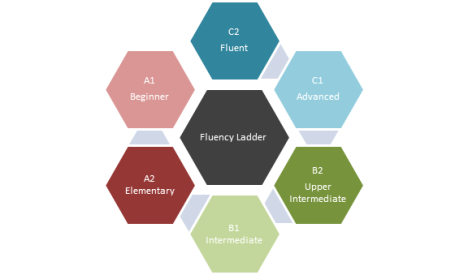
One way to measure your specific fluency level is to use the Common European Framework of Reference for Languages.  There are six fluency levels, with A1, A2 being the levels needed to survive in a country, B1, B2 being the levels needed to live in a country, and C1, C2 being the levels needed to thrive in a country.

This framework has been influential worldwide because China’s proficiency exams have been changed to conform to this framework.

Level Explanation
A1 Beginner Can introduce oneself and understand familiar everyday expressions.
A2 Elementary Can describe oneself and communicate about one’s immediate environment.
B1 Intermediate Can talk about past and future events and about most situations encountered at work or school.
B2 Upper Intermediate Can communicate about simple ideas and concepts in a way that is generally understood.
C1 Advanced Can communicate about complex ideas and concepts in a way that is easily understood.
C2 Fluent Can summarize complex idea and concepts and create coherent presentations.

So when you start to learn a new language, your first goal should be to reach the “A1” level.   Once you’ve achieved that, you can go on to A2, etc.   The rough rule of thumb is that is takes twice as much time to go to each higher level than the one before.   How much time it takes to go up any particular level depends on a) your consistency, b) the difficulty of the language, usually measured by how far it is on the linguistic “tree” of languages from your own (so Chinese takes three times as much time per level as Spanish for an English speaker).

3.  My Multilingual Plan

Last year around this time I put together a “multilingual plan for 2014.”   Today I put forward my new plan for 2015.

In the chart below, I list for each language what level of fluency I am at now, any recent achievements in that language, and then what my target level for 2015 is, together with any specific goals I have and what method I plan to use to reach those goals.

With the fluency levels understood to be those referred to above, here’s my language planning chart for 2013. In the chart, RS means “Rosetta Stone”, DL means “Duolingo,” TB means “Textbook”, FSI means “Foreign Service Institute course.”  The various abbreviations in the “Recent Achievements” and the “Plan for 2015” columns are for the officially recognized proficiency exams for that language.

Language 2014
FluencyLevel
Recent Achievements 2015 Fluency

Level

Plan for 2015 Learning Resource(s)
Spanish B2 RS Level 4 C1 DELE B2, DL 25
RS Level 5, FSI Advanced Spanish,
FSI, Duolingo
French B2 RS Level 4 C1 DALF C1, DL 25
RS Level 5, FSI Advanced French B
FSI, Duolingo
German B1 RS Level 4 B2 Zertifikat B2, DL 25
RS Level 5, FSI Advanced German
FSI, Duolingo
Japanese C1 Passed JLPT N2 C2 JLPT N1 (C2), Kanji Kentei Level 5 TB (Live in Tokyo), iPhone Apps for Kanji
Chinese B1 Passed HSK 3 (B1), FSI Module 6 B2 HSK 4 (B2), FSI Module 7 FSI, iPhone Apps for Chinese Characters
Arabic A1 RS Level 1 A2 RS Level 2-3, ALPT A1 RS, Living Language
Italian A2 Duolingo 10 B1 Duolingo 20, RS Level 3,
CELPE-Bras A1
RS, Duolingo, FSI
Portuguese A2 RS Level 1,

Duolingo 10

B1 Duolingo 20, RS Level 3,
CELPE-Bras A1
RS, Duolingo, FSI
Dutch A1 Duolingo 10 A2 Duolingo 20 Duolingo, Teach Yourself
Danish A1 Duolingo 10 A2 Duolingo 20 Duolingo, Teach Yourself
Irish A1 Duolingo 10 A2 Duolingo 20 Duolingo, Teach Yourself
Swedish A1 Duolingo 10 A2 Duolingo 20, FSI Duolingo, FSI
Turkish New None A2 Duolingo 10, FSI Duolingo, FSI
Korean New None A2 Learn Hangul, A2 Integrated Korean

So essentially my plan is to move up one level of fluency in the five languages I’ve studied and am already proficient in (Spanish, French, German, Japanese, Chinese) as well as in the two languages I’ve studied on Duolingo and am still a beginner in but would like to improve to intermediate level (Italian, Portuguese).   The four new languages I started in 2014 (Dutch, Danish, Irish, and Swedish) I intend to improve my fluency from beginner to elementary level.   And finally, there are two languages I plan to start studying in 2015, Turkish and Korean.

How do I study all these languages at the same time.

  1. I subscribe to the List app, which helps you create and maintain daily habits through the power of social media.    This helps you create a consistent practice:   even if you study for only 5 minutes every day, this is better than studying 30 minutes every week!   Benny Lewis recommends Memrise, an app I plan to try out.
  2. I listen to foreign language recordings while driving, in particular my Chinese recordings from the FSI course.
  3. I listen to language recordings while doing housework.  It takes away the drudgery of routine physical tasks by listening to foreign languages while doing it.   You’ll reorder your brain while putting order into your environment, let’s put in that way.
  4. I use Duolingo for my European languages, which includes Spanish, French, German, Italian, Portuguese, Dutch, Danish, Irish, and Swedish.  It is like Rosetta Stone lite, in that it helps you practice the four language skills of reading, writing, listening, and (to a lesser extent) speaking.   It’s such a great app that I use it every day–I have a 468-day non-stop studying streak that I intend to stretch to 500 days.   This Duolingo app is the core of my daily practice, and it takes about one hour.
  5. For a more difficult language like Arabic which is non-European, I use Rosetta Stone.   
  6. Finally, the proof of language learning is in the speaking, and I plan to find incorporate the learning of foreign languages through Benny Lewis’ Conversation Partners and through professional teachers at Italki.    

These are some creative ways I try to use my time so that I can do something as audacious as to follow Benny Lewis’ lead, whom I mentioned at the beginning of the post.   Last year I really stretched and added four new foreign languages to the eight I already knew (the five “core” languages plus the three I added on to it).   There’s no reason why I can’t shoot for the same goal of being fluent (C2 level) at a dozen or more foreign languages.   It is a journey of 1,000 miles, but I can do it–one step at a time for each language I’m studying!

Parable of the Sower: 10. Take the Hero’s Journey–Become the Mythmaker


This year I read a biography of Ronald Reagan by Rick Perlstein called The Invisible Bridge:  The Fall of Nixon and the Rise of Reagan.   I was fascinated by the turn of events that caused Ronald Reagan as an inwardly-focused, shy boy to transform into the outward-going, charismatic individual he would be for the rest of his life.  It was not an external event, but an internal one.   He went to the library and started reading tales of heroes such as the “rags to riches” stories by Horatio Alger, and the Tarzan novels by Edgar Rice Burroughs.   He decided that he would embody the hero’s journey that he had been reading about.

It’s important in having a passion in life to recreate it from being the mere prosaic concatenation of events, the everyday version of what the historian Arnold Toynbee once called history as being described in dull textbooks as “one damned thing after another,” to being a hero’s journey or adventure.

1.  The Hero’s Journey:  the 10 Elements

What is the Hero’s Journey?   If you look at the illustration which I have borrowed from Jeff Salzman’s website The Daily Evolver, you can see that it has the following 10 elements, which I will illustrate using a modern myth that most people will recognize, that of Star Wars (the first trilogy).

a.  Call to Adventure

The hero is living a normal life, when he or she suddenly gets the call to adventure.   In the case of Luke Skywalker, he is living a prosaic life of what is the future equivalent of being a farmhand, when he purchases two droids, C-3PO and R2-D2. R2-D2 goes off in search of Obi Wan Kenobi, a “retired” Jedi master.

b.  Supernatural aid

In following the droid R2-D2, Luke gets to meet Obi Wan Kenobi, who invites him to help him on his quest to save Princess Leia.   Although Luke initially declines the invitation, his return to the farm brings the horrifying discovery that his aunt and uncle have been brutally murdered by agents of the Empire.   He decides to go with Obi Wan and so they go to town to sell Luke’s speeder and to gain passage on a space ship that will take them to the Princess.

c.  Threshold Guardian(s)

The Mos Eisley Cantina, (a “space bar”) is the threshold between the “known” (the planet Tatooine) and the “unknown”.  Here Luke sees people who have been out there in space, and has his first glimpse of aliens.    The guardians are the beings at the interface between the known and the unknown which test the readiness of the hero to move forward.   In the Star Wars saga, you could say that the aliens in the Cantina are the first test of the hero, because of them threatens Luke, who is rescued by Obi Wan Kenobi.

d.  Threshold (beginning of transformation)

Once they meet Han Solo, they leave the planet in the Millenium Falcon, which gets caught in the tractor beam of the Death Star.   When Luke decides to risk his life to save that of Princess Leia, to whom he is inexplicably drawn, that is the first step on his journey to becoming a hero.

e.  Challenges and Temptations (Mentors and Helpers)

Obviously, Obi Wan is the first mentor that appears to help Luke on his journey.  But as Joseph Campbell pointed out in his analysis of the Star Wars saga in his conversations with Bill Moyers, Obi Wan not only gives Luke a physical instrument of power (the lightsabre), he gives him a new psychological center as he teaches him about the Force and how a Jedi must work with it as the source of his power.

When Obi Wan sacrifices himself to allow Princess Leia, Hans Solo and Luke Skywalker (and the two droids) to leave on the Millenium Falcon, it is a temporary blow to Luke.   However, at the key moment when Luke is approaching the Death Star with a missile aimed at an exhaust post, he hears the voice of Obi Wan encouraging him, and with that encouragement, he manages to blow up the Death Star.   This is the end of the first movie.

In the second movie, he gains training from a new, even more powerful Jedi Master named Yoda, and with the training, he goes of to confront Darth Vader.

f.   Revelation

In the ensuing battle with Darth Vader, Luke has his hand cut off by Darth Vader’s lightsabre, and in the ensuing conversation with Luke, Darth does not kill Luke but invites him to join him and fight the emperor, and rule the Empire in his stead … as father and son!    Luke at first refuses to believe he his Darth Vader’s son, but after he escapes, he realizes it.   When I saw this in the theater for the first time, my shock was almost as great as that of Luke.   I thought this was simply going to be a Disney-like good vs. evil story, but it gained a level of intensity when I found that in this story, good was related to evil.

g.  Abyss (Death & Rebirth)

In a key scene at the end of second movie, he is given a prosthetic arm and it is clear that he is wondering if he himself is becoming part machine, like his father.   He decides that he must fight on the side of the good, even if it means doing the unthinkable, namely, killing his father.   This is the end of the third movie.

h.  Transformation

In order to get guidance from Yoda before the final battle, he returns to Yoda’s planet only to find that Yoda is dying.  Before his death, Yoda reveals that he has a twin sister from whom he was separated at birth … namely, the very Princess Leia whom he saved in the first movie!

i.   Atonement

Luke’s atonement is the killing of his father, or symbolically killing off the evil within himself.   During the very enervating battle, Darth Vader reads Luke’s mind and suddenly realizes that Luke has a twin sister.    Luke’s wanting to protect his sister from harm finally gives him the strength to subdue his father.   At this crucial moment, the Emperor comes to Luke’s side, and asks him to kill his father and take his father’s place at his side.   Luke refuses, throws away his weapon to signal that he rejects evil entirely, and then the Emperor starts attacking Luke.   This rallies Darth Vader, and he ends up killing the Emperor.   However, in doing so, he uses up his last ounce of strength.   He takes off his mask, thus essentially denouncing the evil role he had decided to play in life, and he and Luke have a reconciliation.    His father passes away having been saved spiritually by Luke’s overwhelming dedication to the light side of the Force.

j.   Return (Gift of the Goddess)

Luke returns to help celebrate, and he reconciles with his friend Han Solo and his sister.   The spirits of Obi Wan Kenobi, Yoda, and Luke’s redeemed father appear reminding him of the victory that he has won.   That is the end of the third movie.   In this case, the “boon” or “gift” he receives is knowing that he has saved his sister, and allowing her to pursue a romantic relationship with his best friend Hans Solo.

This is a typical Hero’s Journey and one of the reasons why the first triilogy (the less said about the second trilogy, the better) of Star Wars resonated with a generation of young people is because it told the timeless tale of that Hero’s Journey in a new, modern guise of science fiction and fantasy which George Lucas rightfully thought would appeal to that generation.

2.  Become the Mythmaker

Although my politics are very different than Ronald Reagan’s, I did come away from Rick Perlstein’s biography with an admiration for how he rewrote the script of his life, by making himself its centerpiece and hero rather than just a sullen observer from the sidelines.   He did it by imbibing the hero myths embedded in the stories he read in the library, but then he made the leap by deciding to become the hero himself.

So how do you become a myth-maker?   Here’s some ways to take the hero’s journey.

a.  Your play is your passion

What do you do when you play?   What do you think about when you are by yourself and day dreaming?

b.  Read fiction, watch fiction movies

Find out what type of books you like to read for fun, and among those books, which protagonists are the ones you identify most with.

c.  Record your dreams

What do you dream about?   What kind of plots are there, and if there are larger dreams that have a plot, what kind of obstacles or challenges do you face?

This method of inspecting the contents of your conscious mind when you are playful, or when you are unconscious and REALLY playful, is a good way to connect with what your passion is.

3.  My Journey

A few years back, I found myself, like many others in my company, suddenly told we were no longer working there.  I tried to go back to the same type of job for another company, but I found obstacle after obstacle where I had never found any in similar searches in the past.   I realized I was going to have change direction, but … what direction?  What new career should I embark upon in the middle of my life?

Toastmasters helped me change the narrative of my life, in a way similar to how Ronald Reagan changed his life by changing the narrative of it.   Now rather than focusing on the past and what society liked labeling as “failures”, I was now focusing on the successes I was having in the present, and extending that in my imagination to future successes I would continue to have.

I went through a period of introspection where I networked and asked others about what direction I should take, and I ran into someone who convinced me to look into project management because my work experience and my interests, she said, would make me a great project manager.   I took an introductory class at a community college and was fascinated.   This is really interesting, I thought.   Then I took a course on Microsoft Project to learn one of the tools of the new career I was contemplating.   I took to it like the proverbial duck to water.   Maybe this is for me, after all!

So I took a course that helped me prepare for certification as a project manager.   I took the class and passed!   But rather than resting on my laurels, I decided to volunteer and help put on the course the next time it was held.   As I did this, I started to help the next class of students study for the exam, and so I started my blog (the one you are reading now) where I would put the study group notes for the students to read between classes.

When the project manager putting on the class quit, I ended up being the project manager and put on three additional classes, and I also got project management experience by helping organize a job search seminar for project managers who were looking for work (like me).

At that time, I was called back to Chicago by my father who was having health difficulties.   When he had improved, I made the choice to stay here rather than going back to California, because I was starting to really connect to the community through my joining a local Toastmasters club.   I joined a church, and felt comfortable there as well.   And finally, I got project management experience again by being the project manager for one of the tracks of programming at the Professional Development Day event in 2013 put on by the local Chicagoland chapter of the Project Management Institute.  This lead, in turn, to my being named the Chief Project Manager for the entire event this year.   And then, in July, I was chosen to be the Director of Certification for the Chicagoland chapter because of my experience helping run the PMP/CAPM certification exam prep class.

All of these experiences happened because I decided to leave the known and enter the “unknown”, in this case, a whole new career in the middle of my life.   But when I started taking that journey, people and experiences that helped me a long the way started to appear, and I am passionate about my career for the first time in a long, long time.   That passion makes me constantly look for ways to improve my knowledge base about project management, and to pass such knowledge along to others in the form of this blog.   Since others helped me along the way, it is natural for me to want to help others who are taking that journey as well.

One of the most satisfying things I do is to take phone calls as the Director of Certification from people who are wondering about the profession, or who are wondering how to further their profession through certification.   I want to help other’s take the Hero’s Journey as well!

That is why I look forward to 2015, as a way to go further on the adventure.   When you come to your profession as a calling rather than just a job, then you know you have made the right choice!

Parable of the Sower: 9. Learn a New Language–Become a Mapmaker


Language helps us create a map of the exterior world so that we can understand it, and even manipulate it using our interior world.   It creates a map of reality in the brain, in other words.

When you learn a new language, you are essentially learning a new map of reality.   Creating a new map ends up changing the mapmaker.   It has the practical benefit of increasing brain plasticity, which has shown to delay the onset of Alzheimer’s for those who learn a second language.   But it has the effect of increasing one’s ability to take on perspectives.   When you have a conversation in a foreign language, you are learning about the culture of that country automatically.

In the past year, I’ve made two language study decisions which have helped expand my repertoire of languages from five–Spanish, French, German, Japanese and Chinese–to eleven.   I have added Italian, Portuguese, Dutch, Danish, Irish and Swedish to the languages which I am studying.   I am still at the beginning or “A” level with these languages on the scale of the CEFR (Common European Framework of reference), but hope to bring at least some of them to the “B” level in the coming year while pushing for improvement in my five “core” foreign languages I mentioned above.

The first decision was to sign up for Duolingo, which I did to study two new languages Italian and Portuguese.   After I while, I enjoyed the platform so much that I decided to use it to review the three European languages I had already studied, Spanish, French, and German.

Duolingo is free, and it just requires that you sign up and register at the site, http://www.duolingo.com.  Choose the language you want to study, and then you start out with the skill at the top of the skill tree called “Basics 1.”  Once you have covered the lessons that are comprised in that skill, the skill tree unlocks the skills underneath it, which are “Phrases” and “Basics 2.”   There are, at current count, 10 skills in the first “tier” of the tree, 8 skills in the second tier, 14 in the third tier,and 35 in the final fourth tier.   Each time you get a set number of “experience points” or “XPs”, you go up a level in the language, starting at level 1 and going to level 25.   I think it takes going to about level 18 or 19 to get to the bottom of the skill tree, because I’m at level 17 on Spanish and have 10 more skills to go until I finish the tree.

Once you finish a skill, however, the system will sometimes require you to go back and review it after a certain amount of time has passed in order to cement it into your memory.   So when you go to the skill tree page every day to practice, you will see some completed skills will now have the orange strength bar counter on the left of the skills icon go from being all the way complete (5 strength bars), to being incomplete (4 strength bars).   If you simply left of practicing that skill, it would soon go down to 3 strength bars, etc.   But I usually shore up these attenuated skills by practicing them all until they are all at full strength, and THEN going to study new lessons in a skill at the bottom of the tree.

To do 10 XPs of practice takes about 5 to 10 minutes of one’s time.   If you study every day for just 5 to 10 minutes, therefore, you will see steady progress in your ability to read and write, and even speak the language.   Now, even if you get to the bottom of the skill tree you would not necessarily be fluent in the language, because that would require reacting with a live person rather than a computer program.  But you would understand enough so that going on to practice with a live person would make you progress ever so more rapidly than if you hadn’t practiced the language beforehand.

Right now, I’m currently studying Spanish, French, German, Italian, Portuguese, Dutch, Danish, Irish and Swedish on Duolingo.   New languages that are being prepared for release are Turkish, Hungarian, and Russian.    One question that always gets asked in the comments section is “why aren’t there any Asian languages being offered?”   Chinese and Japanese would be welcome by the language-learning community that goes to Duolingo, but there is a lot of challenge in offering languages that do not rely on a Western-style alphabet, but instead offer a series of syllables and/or characters.  I hope that the Duolingo team is able to surmount this technological hurdle in the coming years.

The second decision was to take advantage of the offer by Benny Lewis, the Irish polyglot and language-learning leader who runs the website Fluent in 3 Months, to join his “Language Hacking League” on Cyber Monday when he offered the program for half price.  I had wanted to join his program in 2015, but the Cyber Monday sale pushed me into starting it early.   There is a ton of material on learning specific foreign languages as diverse as Chinese and Irish, and general methods for studying any foreign language.   He is great proponent of studying language by immersing yourself in actual conversations with native speakers, rather than just taking a course where you are interacting with a CD, DVD or computer program.   I have read his tips on how to get started in either a language exchange program where you agree to teach your own language to a native speaker of the language who wish to learn, but he also offers tips on how to find a language teacher if you want to pay for lessons.   My biggest question for 2015 is not whether I will do or not, but which language I’ll start with!   I’m torn between Chinese, Brazilian Portuguese, and Swedish!

In any case, discovering his program gave me a huge boost in passion for language learning in the coming year, because I was frankly stuck in the language learning paradigm where I was using courses.   These are useful for learning a language, but they have a decided disadvantage in that they can lead to boredom.   Speaking with a native speaker will very rarely lead to boredom, and although it is more challenging, the excitement it brings in actually communicating with a real person will carry one through any difficulties one faces.

I am in fact assembling my multilanguage learning plan for 2015 which I will post on this blog on December 31st, and I hope that you will visit Benny Lewis’s site, fluentin3months.com, and share in the passion of learning a new language.  It will help you explore the world, and expand your inner world at the same time!

Parable of the Sower: 8. Communicate in a Sacred Manner


The idea for this post came to me from the series of workshops called Sacred Communication run by Rev. Henrietta Byrd at our Unitarian Church, and which I have been going to for a little over a year.   The starting point for these workshops is the Golden Rule:   do unto others as you would have others do unto you.

If you are coming from a Western religious tradition, you do this because the other is as much of a creation of God as you are.  If you are coming from an Eastern religious tradition, you do this because the other contains as much of a divine spark of God as you do.   In either case, no matter what side of the religious and/or mythological divide you find yourself on, the ethical endpoint should be the same.

But in Rev. Byrd’s Sacred Communication class, we turned the Golden Rule inside out, meaning that you need to treat yourself in the same way as you are supposed to treat others:   with a combination of compassion or tough love, as appropriate.   One way of starting to go about doing this is to ask yourself the important question:   what is that bothers you the most?    In other words, what are your pet peeves?   This should be something more like a character trait, and not some trivial thing insisting on the correct way to pronounce the name “Goethe”, for example.

When doing this exercise, most everybody picks something about other people that they don’t like.   Rev. Byrd pointed out two things after it was done.    First of all, she didn’t say she wanted people to pick something out about other people that bothered them; she just asked for people to pick something out that bothers them period.   Usually people pick characteristics of other people, and not their own foibles.

However, here’s where things got interesting.   Most people when they analyzed what bothered them about other people found that the source of the annoyance wasn’t in the other, but in one’s self.    Often times, we don’t recognize something in ourselves for whatever reason, and we project this onto others.    This is called the “shadow”, and must be confronted if we are to have authentic communication with ourselves, which includes having communication with our unconscious.

Normally when we think of the unconscious we think of the primitive parts of the mind that come out during dreams.   This is partially true, but the unconscious can be something that is potentially within our conscious awareness that we have simply refused to consciously recognize.    This process starts early, as in the following example from the talk The Neurobiology of Shadow done by Dr. Keith Witt in the The Shrink and the Pundit segment on Jeff Salzman’s “The Daily Evolver” website.   Shame is an emotion which everyone thinks of as negative, but it actually has an evolutionary purpose.   Let’s say a toddler is in the kitchen and is about to do something dangerous, like stick a fork in a toaster or light socket.   The mother is, say, on the other side of the room.   What does she do to stop the child?   She says “NO!” in a voice which is abnormally loud and usually abnormally low in the vocal register.   This creates a negative wave of energy that hits the child and temporarily stuns it, which accomplishes the task of stopping the child from doing the deed which could be a danger.    How does the child process this?   The emotion of “shame” comes up as the child perceives itself temporarily cut off from the normal flow of the mother’s affections.    Being cutoff from this wellspring of loving attention is difficult for the child, and even frightening.  Now once the child stops the behavior, the mother may come over and reassure the child that everything’s okay, but that the child must not do that dangerous thing again.   However, let’s say the child is angry for the mother cutting off its supply of emotional nourishment, so to speak, but rather than getting angry at the mother, which may not be perceived as being “within the rulebook” of toddler behavior, the child may displace this anger, and project it on the mother.    Mother is angry at me, the child may think, rather than at the behavior it has just shown.    This shows how the “shadow” begins, because the child is unable to face up to its own anger at his or her mother, which is not allowed.

In any case, by the time one is adult, the shadow has a lot of power, and it is the job of psychoanalysis to help reduce the shadow’s power by allowing the conscious mind to recognize more and more that the shadow is really oneself, hence the psychoanalytical saying, “where it is, there I shall be”.   In the original German, what we call the ego is the “I” and what we call the Id is the “it”.   In translating the German terms to English, the Latin terms for “I” and “it” were used, causing the concept to seem more scientific and less intuitive than the original German terms are.    But the process of psychoanalysis is basically that of “redeeming the shadow” by showing what you have originally labeled to be “out there” in the third person as an “it” is really something within you, that is therefore really in the first person as an “I”.   The process in Integral Theory of recognizing one’s shadow through dream work, or by Rev. Byrd’s method, by seeing what bothers you or excites you out there in the world, is sometimes called the “3-2-1 Process”.   You recognize a simple or a person that bothers you, and you describe in the 3rd person.   Then you go to the 2nd person, and you have an imaginary conversation with that person or thing.   Then you finally go to the 1st person, and imagine that person or thing having a conversation with you, but this time you take the part of the ostensible “other”.   It is very powerful, and yields tremendous insights.

And this is part of the power of the Sacred Communication workshops, in that we learn to deal with what bothers us in ourselves.   Of course, when you recognize what bothers you, what do you do about it?   You use creative visualization to create a new reality where you are now different.   For example, last year I came to Chicago looking for a new position in my newly chosen career as a project manager.   I was looking to be hired, so I was looking for leaders or bosses to whom I could act as a helper or assistant.   Henrietta said no, you have to see yourself as the boss.   What she meant was that I had to see myself as the boss or CEO of my own life, of my own career.   I had to take charge.   With that attitude, I was to walk into meetings and do activities with the idea that, rather than following a leader, that I would be a leader that others would follow.

In the course of about six months, I found this turnaround in my psychological narrative started to bear fruit.   I had three leadership opportunities come my way:   1) at church, I was made a member of the Board of Directors, 2) at Toastmasters, I was made an Area Governor, and 3) at the Project Management Institute, I was a made a Chief Project Manager for their main professional development event called Professional Development Day, AND I was made the Director of Certification for all of their certification programs.   It showed that the way I communicated with myself had an effect on how others perceived me, and my reality changed accordingly.   This is why when you want to change the world, start by changing your way of addressing the world by seeing it as a challenge rather than a battle, but then change your way of addressing yourself.   Rather than drawing closer to others by helping them fight their battles, see yourself as a leader rather a soldier, and you will start to draw others towards you!

Parable of the Sower: 7. Adjust Your Attitude and Your Altitude


When I try to deal with people in the various groups I am a leader of, I realize that I have to adjust my attitude sometimes when I deal with certain people in order to be able to relate to what their feelings are.   But even more importantly, I have to adjust my altitude as well.   What do I mean by “altitude”?   I mean what level on the spiral dynamics developed by Don Beck and Chris Cowan in their 1996 book by the same name, and subsequently adapted by Ken Wilber as part of his Integral Theory model as the stages of development.   These levels of spiral dynamics refer to core value systems which people adapt as they go from stage to stage.

It is similar to Maslow’s hierarchy of needs, in that people start at the bottom of the spiral and progress to the next stage only after they have fulfilled the current when they are in.    It is different in that Maslow’s hierarchy refers to psychological needs, but spiral dynamics refers to both psychological and social value systems, covering the subjective and intersubjective (“cultural”) quadrants in the Integral Theory model.

1.  First-tier memes

I’m borrowing these descriptions from the Wikipedia article on Spiral Dynamics, mainly because they show with very specific examples what characteristics people or groups of people show who are at a specific stage.   The stages could have been named 1, 2, 3, etc., but they are labeled with colors in order to make it easier to memorize and distinguish between each other in discussions.   There are six first-tier memes, which are as follows:

a.  Beige

Survival/Sense. The Instinctive vMEME

  • Automatic, autistic, reflexive
  • Centers around satisfaction
  • Driven by deep brain programs, instincts and genetics
  • Little awareness of self as a distinct being (undifferentiated)
  • Lives “off the land” much as other animals
  • Minimal impact on or control over environment

b.  Purple

Kin Spirits. The Clannish vMEME

  • Obey desires of the mystical spirit beings
  • Show allegiance to elders, custom, clan
  • Preserve sacred places, objects, rituals
  • Bond together to endure and find safety
  • Live in an enchanted, magical village
  • Seek harmony with nature’s power

c.  Red
PowerGods. The Egocentric vMEME

  • In a world of haves and have-nots, it’s good to be a have
  • Avoid shame, defend reputation, be respected
  • Gratify impulses and sense immediately
  • Fight remorselessly and without guilt to break constraints
  • Don’t worry about consequences that may not come

d.  Blue
TruthForce. The Purposeful vMEME

    • Find meaning and purpose in living
    • Sacrifice self to the Way for deferred reward
    • Bring order and stability to all things
    • Control impulsivity and respond to guilt
    • Enforce principles of righteous living
    • Divine plan assigns people to their places

e.  Orange

StriveDrive. The Strategic vMEME

  • Strive for autonomy and independence
  • Seek out “the good life” and material abundance
  • Progress through searching out the best solutions
  • Enhance living for many through science and technology
  • Play to win and enjoy competition
  • Learning through tried-and-true experience

f. Green

HumanBond. The Relativistic vMEME

  • Explore the inner beings of self and others
  • Promote a sense of community and unity
  • Share society’s resources among all
  • Liberate humans from greed and dogma
  • Reach decisions through consensus
  • Refresh spirituality and bring harmony

Let’s just take an example:   not all conservatives are created alike.   When I am talking to someone who is a fiscal conservative, I am usually dealing with someone at the Orange level; when I am talking to someone who is a foreign policy conservative, I am usually dealing with someone at the Blue level, and when I am talking to someone who is a social conservative, they are often at the Red level.   So when I am discussing an issue with them, I have to use the language of the level they are at in order to get through to them.   If I am trying to talk to them about the issue of “fracking” for example, someone at the Red level will want to know how it fits in with their traditional, usually religious, values.   Someone at the Blue level will want to know how it fits in with the idea of national security and our country’s place in the world, whereas someone at the Orange level will want to know if it profitable or not.   Someone coming from the Green level who is concerned about how fracking will affect the environment will not get far talking to any of these other three levels just by advancing the value system that includes the environment as opposed to the economy, the country, or one’s religion.

Of course, a society in the aggregate can be at a certain “center of gravity” that can be approximated by one of these memes.   When the United States decided to invade Iraq, which was at the Red level of value development because of Saddam Hussein ruling as a dictator, the naive idea was to bring democracy to the region, which would be the equivalent of bringing it to at least the level of Orange, the level achieved by the United States at its founding, an evolutionary leap above the Blue levels of the nation states of Europe.   However, rather than bringing Iraq up closer to its own level, the United States merely removed a dictator, and allowed the sectarian strife between the Sunnis and Shias, which had been suppressed by Saddam Hussein,  to erupt and now the region is reduced to the Purple level of a conflict between clans.

Whether you are a person or a society, you cannot just magically leap from stage to stage; the evolutionary process requires the structure at each level to be complete before you can go to the next one.

Although the memes appear to have different themes, the reason why it is called a spiral is because each meme has an emphasis on the individual or the group.   For example, the Orange meme is very individualistic whereas the Green meme favors the formation of a group or collective.   Ayn Rand, for example, is a quintessentially Orange-level philosopher, and she sees any expression of a group or collective (what she would call “socialism”) as an anathema.   And this gets me to the feature that all the six memes have in common:   they all agree that the real problem in the world is all of the other memes, and they have a conviction that the world would be simpler if the other memes didn’t exist.    One simple way to describe the first-tier memes is that they are a fear operating system, with fear or even hatred of the other memes as a common thread.

2.  Second-tier memes

The second-tier memes are inhabited by those that understand that they are the culmination of a spiral, meaning that the meme they are in has been achieved only by going through an evolutionary process involving all the previous memes at the first-tier level.   Seen in this new light, the first-tier memes are not to be feared, but to be loved, because they represent  where the person used to be earlier in their evolution.   And in certain situations, those first-tier memes are still valid.   Here are the two second-tier memes, the first one being the individualistic version, and the second one the communal version.

f.  Yellow

FlexFlow. The Systemic vMEME

  • Accept the inevitability of nature’s flows and forms
  • Focus on functionality, competence, flexibility, and spontaneity
  • Find natural mix of conflicting “truths” and “uncertainties”
  • Discovering personal freedom without harm to others or excesses of self-interest
  • Experience fullness of living on an Earth of such diversity in multiple dimensions
  • Demand integrative and open systems

g.  Turquoise
GlobalView. The HolisticvMEME

  • Blending and harmonizing a strong collective of individuals
  • Focus on the good of all living entities as integrated systems
  • Expanded use of human brain/mind tools and competencies
  • Self is part of larger, conscious, spiritual whole that also serves self
  • Global networking seen as routine
  • Acts for minimalist living so less actually is more

I identify myself as being at the Yellow meme, trying to achieve the Turquoise stage by linking up with others who are at the second-tier level.   My conviction is that anybody who is a leader is going to be more effective if they are dealing from the second-tier level because they will relate to anybody else on the spiral, whereas those who deal from the first-tier level will identify those at a different level as a potential enemy, rather than a potential ally.;   And that is how you make the world a better place is by stooping to conquer, to borrow a phrase from the Oliver Goldsmith classic.

Parable of the Sower: 6. Come out of the Shadow


The four modules of Integral Life Practice are:   Body, Mind, Spirit, and … Shadow.   Most people are familiar with practices that strengthen one’s body (strength training), mind (language study), and spirit (meditation), but what is shadow?

Shadow is an aspect of ourselves which we have denied or rejected, and thus project onto others.   Since it is therefore an unconscious drive or need, how do we make it conscious?   There are two ways to do this, one of which is dream analysis, using a technique called “gestalt”, where you take something that scares you in a dream, and 1) observe it, then 2) have a conversation with it, and finally 3) describe the dream from the first-person standpoint of that which scares you.

Another way to become aware of shadow, is to describe someone who “rubs you the wrong way”, someone whom you have an emotional reaction to which seems a little exaggerated or over the top.    Then observe that person and their characteristics, have an imaginary conversation with that person, and then join the conversation by taking a first-person perspective of that person talking back to you.   This is referred as the 3-2-1 process, because you are relating to the shadow figure in the third person, then in the second person, and finally in the first person.

The reason why this is important is because what bothers you about others is many times what bothers you about yourself which you fail to recognize.

Now I have to say that there is such a thing as a positive shadow image.   For example, although I am a person dedicated to finding peaceful solutions to problems through diplomacy, I still had a positive attitude towards people in the military.   For many years, I just took this as a result of the fact that my father and two of my brothers were in the military.   But I realized that the source of my positive feeling was somewhere else.    In a series of dreams I had when I was in my 40s, I found myself being drafted into the military, and I would try to explain to the people at the recruiting station that somehow there must be a mistake, because I was too old to be in the military.   Somehow, the dream would always resolve it by the people in charge giving me a job anyway, and I reconciled myself to the fact that “I’m in the army now.”

In analyzing these dreams according to the gestalt procedure outlined above, I found out what was happening.   I associated the military with discipline, and somehow I had a self-image that refused to believe that I was disciplined.   This was because my older brother and I had almost defined ourselves in terms of each other, and I saw him as the disciplined one, and he saw me as the undisciplined one.   This may have been true in relative terms when we were in high school and college, but in reality I was very disciplined, at least in the areas I cared about, like language study.   So the positive quality of being disciplined was something I refused to recognize in myself, so the dream was saying “you are disciplined after all.”  That was what was meant by my being drafted in the military and my reconciling myself to that reality despite my initial objections.

So we can have people we meet whom we admire, those people who rub us the right way rather than the wrong way, and have them be a shadow projection in the same way as people who irritate us inordinately.   Being aware of your shadow whether it is a positive or negative projection helps you deal with others honestly because you are dealing with the actual people in front of you and not the masks that you project onto them.   It helps you deal with yourself because you are dealing with the source of problems you project onto the outside world.   If you try to deal with the projections, you will fail, like that line from the song Hotel California,

“And in the master’s chambers,
They gathered for the feast
They stab it with their steely knives,
But they just can’t kill the beast”

You can only kill the beast by recognizing that you yourself are the beast.   So come out of the shadow, and recognize that the reality you face is always less scary than the one you run away from.