Integral Life Practice–Chapter 10 Additional Modules


The purpose of the Body Module is to introduce you to practices which cultivate your health by taking care of the matter of your gross physical body.   But beyond this, the module introduces you to the other bodies that are also vital for one’s health, the energy in your subtle body, and the causal body of stillness within which the other two bodies rest.

1.   Three Bodies

In the same way that your consciousness normally has three states–waking, dreaming, and deep sleep–your body also has the corresponding gross, subtle, and causal bodies.    Remember the distinction in the quadrants between the interior and exterior dimensions of reality?   The interior quadrants are the ones are the left, and the exterior quadrants are the ones on the right.

Each state of consciousness is an interior dimension which has a corresponding exterior form or dimension that is referred to as a body.   Let’s take a look at each of the three states of consciousness in turn and the associated form or body which encapsulates them.

this post to be continued

Reviewing China’s National People’s Congress–a EIU Webinar


in March 2014, the Economist Intelligence Unit put on a webinar entitled “Reviewing China’s National People’s Congress: A reform landmark?”   It was presented by Duncan Innes-Ker, Regional Editor (Asia).   I am putting the raw notes summarizing the webinar onto my blog today, and will edit them during the next week so that they are more organized.

Assessing the impact on the economy and discussing whether the government’s targets are realistic.

EIU website on China is a good source for news, but also the Forecast

Reviewing the NPC

Last few days have seen some new information coming out on what the government policies are going to be.

Everything you need to know about the NPC

The work reports

–The budget

–The premier’s report

Power to the Party

-NPC China’s legislature

Meets once a year, passes legislation, supervises appointments & work

Not as feisty as it once was, sometimes has the reputation of being a “snooze fest”, a “rubber stamp” operation

There was speculation on whether the NPC would be a check on the government’s power.  It is not as feisty as the Vietnamese NPC.  Nevertheless it is still important in China.  But can still stock important policies—e.g. property rights law in 2006.  The property rights guaranteeing private property rights was blocked by conservative members in the NPC.

In 2013, over a third of delegates failed to vote for the environmental and conservation committee because of rising concern over pollution in China.  The environment was a big theme in this year’s session.  It was a smooth Congress.

Key moments are premier’s report on overall government’s policy and targets.  And also the budget

The budget

Defense budget up 12.2% to US$ 132 bn

The first year that the defense budget has increased faster than the overall growth rate in the budget.

The public numbers may be understated, they may be 40%.

US budget is $673bn.  Even if China’s budget were twice as large, it would less than half the size of the US.

It’s difficult to see what the government’s spending will ACTUALLY be, because 2/3 of the spending is what’s going on at the local level, and the central government is not saying what is going on at the local level.  However, you can get a picture of what the different priorities are.

Health up 15.1%, fastest growth

Transport & environment spending increase by less than average.  On the one side, spending on health, education, and anti-poverty measures are still the priorities for the administration.  On the transport & environment side, when you hear that the government is spending a lot on combating pollution, the money isn’t really there, and rhetoric is stronger than action in achieving these goals.

Faster move towards environmental protection tax and real estate tax.  At least in terms of rhetoric.  EIU is dubious about how fast they will go.

Thrift & oversight to be strengthened.  Reining in expenditure and increasing oversight of the budget.  The budget is being put forward in a more explicit and straightforward manner.

Fiscal strains are mounting.  Central government revenue shrank for the first time in many years.  There is a period where civil servant’s wages are rising, but revenue growth is slowing in real estate investments.

The premier’s report

Growth target of around 7.5%–so little progress on rebalancing. We’re already lower than 7.5%.  The reason that the government is putting on an ambitious target is that there will probably be stimulus measures.  EIU thinks it will end up 7.3%

Inflation around 3.5%

Higher priority to fiscal and tax reform:  local government bonds

The government is moving to be more flexible in terms of the spending.   2/3 of government goes towards to the center, but 2/3 of the spending is done by the local level.

We aren’t seeing a lot of indications that thinks are changing with regards to tax reform.

Financial reforms & deposit insurance.   More aggressive reforms year,.

SOEs contribute more to central budget—mixed ownrership models..  Part privitzation

Premier is associated with push to urbanization.  The 3 Rs:  residency (100,000,000 migrants given), 100,000,000 have their houses renovated, relocation (100,000,000 from countryside to city).

Urbanization:  3 X 100 M

PUSH TO ADDRESS POLLUTION—but tough to achieve

The premier used very tough language “war against pollution”, fierce tone of attack but it is a very tough target to achieve.  Actually meeting targets will be very difficult.  For every factory they close down, another tends to pop up.

POWER TO THE PARTY

The party advances, the state retreats?
The government is a little disengaged from the legislative mood.  It was a relatively quiet session as contrast to what’s going on in the party.  Two power structures, the party and the government.  There is competition between them.  The party has always been dominant.  The party seems to be emphasized at the moment as compared to the state structure.


Little in way of structural change at NPC

–contrast to big shifts in CCP organization

–running corruption & mass line campaigns

–and to changes made at NPC in 2013

Bureaucracy emasculated

–200+ approvals decentralized from State Council

–Slimming down the number of government officials

No new government buildings being built or refurbished.

Power is pushed up to higher-level vehicles in the party, pushed down to lower levels in the government.

Focus on Party as channel for reform

–Is it enough?


What does it mean for the reform agenda?
Financial reforms moving forward swiftly

–exchange rate liberalization

–interest rate liberalization

–Capital account opening

Outlook for fiscal reform less clear

National housing database won’t be in place until 2020, the tax may be lost in action

–Property tax lost in action

–Resource & Pollution taxes may see more progress

SOE restructuring to be done mostly indirectly

It is done indirectly by adding competition to the sector

–More opportunities for private sector players

Changes there will be quite gradual, and will open the playing field to privatization.

We may be seeing public—private partnerships.


What does it mean for business?

New opportunities

–Private sector involvement in previous SOE turf

–Shanghai FTZ

–Investment & growth to remain elevated in short term

Bureaucracies seek a purpose

–NDRC focus on anti-monopoly & pricing

–Approvals confusion to continue?

–Lost contacts as officials leave

Monetary conditions will be slightly looser.  The interbank lending rate has come down a bit this year.  These slightly looser liquidity conditions will continue for the next few months.

The government is trying to reduce the ability of ministries to interfere in the economy.

The national development reform commission (NDRC) is looking to focus on new areas, such as the ani-monopoly law and pricing policy.

We could see continued confusion among lower-level bureaucrats.  As we are seeing officials moving out of government sector into public sector, there is a great churn among government officials.  They were considered very stable jobs.  People that serve as gateways as clarifiers of regulations, as these people leave, companies become uncertain about how to approach the various ministries.

China’s growth—we don’t believe in the “hard-landing” scenario.  The overall picture remains optimistc.

Q&A

1.  Might be seeing public-private partnerships.  What will be the main opportunities for businesses any particular sectors

Government is mentioning railways an awful lot.  Especially given restrained spending ability. In terms of other areas.  A lot of effort to bring private sector investments in education,

Big concern will be how to engage in a venture that is very strong, very well connected politically, in ending trouble waters.  In terms of protecting IP, and seeing that contracts are well-constructed.

2.  More information on environmental protection?

It is very tame terms that the government has talked about this.  There are environmental standards, but the actual hard detail of these policies has yet to be worked out.  Just be cautious on that front and don’t necessarily , enforcement is skewed against foreign companies.

3.  What kind of stimulus wil be expect to see in the coming year?

The currency has weakened in the past month or so.  But the policy may be reversed pretty quickly.  The government is effectively loosening monetary policy.  Targets on monetary policy in terms of growth of money supply, aiming to bring it down from it was in 2013.  That suggests that they will be trying to rein in the leverage factors.

Likely to see a lot of fiscal investments, direct government investments in expressways, railways.  To connect every city that has over 200,000 population with railways, and every city over 500,000 with high speed rail.

4.  Urbanization in china and government’s plans to investAre problems that can be easily resolved?

Ghost cities and the urbanization policy are in many ways key sides of anargument. There is a widespread perception that if they build it, they will come.  In many cities, especially in central china, there is a low level of urbanization.

There are a number of other parts of china, partticulatly in the northeast where urganization is already advanced.
This is a big concern, ghost cities are related to property markets, which have their problems.The big challenge will be a fiscal once.

5.  Will government be less supportive to foreign enterprsie?
The environment has been deteriorating since 2008.  There is a lot more frustrated.  Many people are looking at the government, about investment liberalization equal treatment of foreign and local investotrs in the foreign free trade zone.

The opening aspect of the agenda is one that the government supports in terms of competition.  But over all this is not considered a proper government concern.  Things won’t improve in china in this area.  Foreign companies are finding a lot of problems, enforcement regulatory arbitrariness.

With the opening of the financial sector, what do you see the richest portential emergin?

This is definitely one of the big concerns.  It is not debt as its stands.  Public debt is a manageable level.  There is an argument that central government believes that its reform agenda will boost productively growth and that will lift the GDP growth in and of it self.  If you look at growth and the structure of the econojy, it is reliant on investment and credit more than ever before.  Redressing the balance will take a lot of effort.

That issue is being pushed into the medium-term by decisions that have come out.  Setting a high growth target indicates that it is not a high priority for the government this year.

Why is health care spending increasing?
Government is increasing its payments into the healthcare system.

It is a shallow insurance scheme, you are left on your own after an initial payout.  The government contribution is being increased.  There is a lot of money going to hospitals, and health care reform of various types.  In terms of the budget, the money is going essentially into insurance.

The central government is handing over a lot of the power of spending to local governments.  This is the nature of why they keep so much money coming into the center.  The center wants to keep control over the pursestrings to dictate to local governments what they need to do.  They are moving to more general allocations giving more leeway to the local government.  They want to hold the whip over the local tgovenrmens through allocation of money.

There are some local  governments in china that have poor record of spending wildly.  There is a question about whether these will be receiving more central government help to alleviate their problems.

4G mobile broadband structure,rollout will it have effect on economy?

Thy are going to spend more money on 4G rollout.  From an investment sense, that should help support growth.  The telecom infrastructure side won’t need private capital, maybe from the service sector.  But mostly it iwill be coming from the highly profitable telecom companies.  The online economy will do tremendous growth in online retail.  Exciting developments in online finance.

Report on judicial reforms?  Do you see this?
Yes, one of the most exciting aspects of this government.  One of the reforms that was talked about in November was making lower-tier elements of the party more responsible to higher tiers of the system.
If you are talking about improving business law and contract enforcement, it is much more organic.  In Shanghai and Beijing it has happened, in other areas more quality decisions will be coming out.

Do you see restrictions of the shadow banking system?

On shadow banking side, we are seeing the central bank wanting to bring out, they are lightly regulated banks, those elements have to fit into the regulatory system.  IT is trying to do two things simultaneously, reducing systemic risk by transparency.  It is trying to encourage innovation and creativity.  Where things serve to support the economy without creating risk, they will be allowed to continue.  It covers a wide range of activities.


Scope Creep and the St. Francis Dam Disaster of 1928


I just joined the Toastmasters Club sponsored by the Project Management Institute’s Chicagoland chapter.   At the next meeting, I intend to do a speech about the concept of scope creep, using the St. Francis Dam Disaster of 1928 as an object lesson on how dangerous a phenomenon this can be. 

Scope creep is the phenomenon whereby the scope or extent of the project is changed, without an analysis of how those changes will effect the project plan, or the resources needed to accomplish the revised plan.

The most dramatic illustration of this phenomenon I found in an event now long past but still important in California history, namely, the St. Francis Dam Disaster of 1928.   The reason for the failure of the dam was analyzed at the time as being due to an inadequate geological survey, but more recent analysis by civil engineers and historians point to a culprit that is more familiar to project managers, namely, that of scope creep, which is adding of work to a project without accounting for its effect on the project as a whole.    This mistake can have serious consequences for a project, but in the case of the St. Francis Dam, the results were catastrophic and led to the deaths of up to 600 people.

1.  What was the St. Francis Dam

The St. Francis Dam was a concrete curved gravity dam built about 40 miles northwest of Los Angeles in the San Francisquito Canyon.   It was designed and built between 1924 and 1926 by the Los Angeles Department of Water and Power under the supervision of the legendary engineer William Mulholland.    Here is a picture of the dam looking north, with water in its reservoir, in 1926.

St Francis Dam crop.jpg

2.  What was the scope creep involved?

The original capacity of the reservoir was to be 39 million cubic meters of water, and it was to rise 185 ft (56 meters) above the stream bed level.    However, at some point the height of the reservoir was changed twice by 10 ft, for a total height of 205 feet, in order to increase the storage capacity of the reservoir to 47 million cubic meters.   However, the base of the dam was not widened to accommodate this additional volume of water.    Therefore, in the final analysis, the dam collapsed because of scope creep, which is defined in the 5th Edition of the PMBOK Guide© as “the uncontrolled extension to product or project scope without adjustments to time, cost, and resources.”

3.   What were the consequences?

On the morning of March 12, 1928, the dam keeper discovered a leak in the dam, and he notified Mulholland immediately.   The muddy color of the runoff from the dam indicated that the water might not just be coming from a crack in the structure, but might be eroding the very foundation of the dam itself.   Mulholland came and inspected the dam, but proclaimed that the leak was “not dangerous” and left.

At two and a half minutes before midnight on March 12th, the dam burst and 12.4 billion gallons of water surged at 18 miles an hour down in the canyon in a wave that was 120 feet high.   By the time it had emptied into the Pacific Ocean 5 1/2 hours later, it had became a raging torrent 2 miles wide and bodies were found scattered as far as the Mexican border.

4.  What were the proximate causes of the dam collapse?

According to Dr. J. David Rogers, Chair in Geological Engineering at the University of Missouri-Rolla, the base of the dam was lifted upwards by a phenomenon called “hydraulic lift.”    The center of the dam was the only section left standing when it collapsed, because it was the only section that contained uplift relief walls at the base.    The eastern section was the first to collapse, which undercut the central section and caused it to tilt and rotate towards the western portion.   When this final portion collapsed, the dam finally burst and the flood waters were then released.

5.  What were the consequences for Mulholland?

Although the investigation done at the time pointed to deficiencies in the geological survey of the foundation as the cause of the problem, rather than on the engineering design done by Mulholland.   Nevertheless, Mulholland took full responsibility for the disaster, and it ended his career.

The more modern re-investigations of the incident showed that the geological instability of the area on which the dam was built was indeed a factor, but the failure to compensate for the additional height of the dam in the rest of the design, plus the fact that the design was overseen by only Mulholland himself were the factors which were the real crux of the problem.    The phenomenon of “hydraulic lift” was actually starting to become known in the civil engineering community in the 1910s and 20s, and if Mulholland had researched the design more diligently, the dangers of the changes to his design might have become more apparent.

This failure to compensate for the two additional height changes is the essence of scope creep, which is why the first step in whether to accept a change to the scope should be to analyze the impacts of that change on the other parameters and constraints of the project, or in this case, the design.   The analysis should be done by as many members of the team member as have expertise in the area, with additional expertise being sought by subject matter experts outside the team as necessary.   Mulholland’s failure to take these steps not only ended his career, but the lives of up to 600 people, and caused the 2nd largest civil disaster in California history.

So if you wonder why we project managers take scope creep seriously, just remember the St. Francis Dam Disaster of 1928!

Note on sources:   the main source for this post was the March-April 2010 issue of the Santa Clarita Valley Historical Society newsletter.   For more details, see http://www.scvhs.org/news/dispatch36-2.pdf.  

The Advantages and Disadvantages of Dual Membership in Toastmasters


This is an updated post that I did before when I lived in California and became a dual member of a home club AND a club that was specifically created for project managers.    After moving to Chicago recently, I found that the local Chicagoland chapter of the Project Management Institute also sponsors its own Toastmasters Club.   I joined a local home club right after I moved; after becoming the Chief Project Manager for the upcoming Professional Development Day 2014 event for the Chicagoland chapter of PMI, I decided I should start becoming more active in the chapter and decided to join their Toastmasters Club.   I was going to write a blog post on the experience when I thought, wait, did I ever write a post on it before?   Yes, I did, it turns out!   And when I read it again, I realized that everything I wrote it in before is still valid, so I did some minor revisions and am publishing it again…

1. Benefits of Regular Membership

I’m sure if you talk to anyone who is a member of Toastmasters, they will tell you about the benefits of membership in the group. Being a better speaker, being a better leader, developing self-confidence—all those reasons are valid. They certainly have rung true for me.

When I ask new members what brought them to Toastmasters, the answer usually includes the fact that knew someone in the organization that told them about the benefits of being a member. However, when a person decides to take the next step and visit a Toastmasters club, what do they do? They go to the Toastmasters International website at http://www.toastmasters.org/and go to the left-hand side where it says “Meeting Locations” right above a red button which says “FIND a location near you”. But what happens if, especially in a crowded metropolitan area like Los Angeles where I live, you find a list of 10 or more clubs near where you live? THEN how do you choose?

2. Pitfalls of a Dual Membership—too much confusion for a newbie
My best advice would be to go to someone’s club whom you know as a Toastmaster—they will be able to give you the “inside scoop” on how the club runs. Although Toastmasters International gives general guidelines on how to conduct meetings, it is surprising to learn that not every club runs in exactly the same way. Just like individual people, individual clubs have their own personalities.

We had one member who liked the location of our club, which we shared with another club that meets on the other alternate Tuesdays of the month. She decided to join both clubs and was totally confused by the fact that the two clubs’ meetings were run differently. In the end, she chose to be in our club because it “fit” better with her personality.

So joining two clubs at first, and then deciding later on the one you like best is NOT recommended. When WOULD I recommend such a thing?

3. Benefits of a Dual Membership

Some clubs are general membership clubs, that is, they are open to all members. Some clubs are corporate clubs that are closed membership clubs, that is, you can only belong to the club if you are a member of that corporation. This is mainly because the club usually meets at that corporation’s office or related facility.

However, there are some clubs which are “special purpose” or “themed” clubs. When I decided to become a project manager, I found out there was a special club devoted just to those who were project managers or who aspired to become one. I wanted to join that club, but I was quite happily “married” to another club where I had been a member for a year and a half. Besides, I was a club officer in the original club and so I didn’t rightly feel like “abandoning my post”. So I decided to join the 2nd club as a “dual member”.

Once I joined the second club, which I was able to do because it met on a different night of the week; I realized that it gave me certain benefits or advantages. These seemed to outweigh the disadvantages.

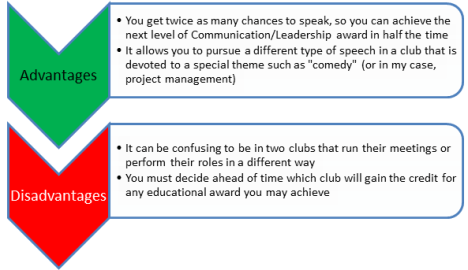
Let me expand on these advantages and disadvantages. The fact that you are in two clubs gives you twice as many chances to speak. When you are working an advanced level of communication award, each level requires you to do 5 speeches each from 2 different manuals. In my regular club, I have decided to do the “Entertaining Speeches” manual. However I will do speeches more geared towards professional presentations from a manual called “Speaking To Inform” in the club that is geared towards project managers. That way I can pursue both types of speech, each in a venue that will be more receptive to it.

However, I would wait until one is at least halfway through the Competent Communicator (CC) or Competent Leader (CL) manual before trying a dual membership That is because you need to understand really well how your club functions before you go to a different club and try to participate in an environment where the rules are somewhat different.

Finally, the last disadvantage is one that I heard about through talking to one of the officers in our division, namely, a case where someone who was in clubs A and B, let’s say, promised the educational award he would earn to club A. Then halfway through the manual, he changed his mind and decided to give that award to club B without telling the Vice President Education of club A. Club A only found out about this months before the end of the year, and had been counting on that award as one of the points the club wins towards becoming a Distinguished Toastmaster Club. That caused the club to have to scramble and find someone else to complete that award within an accelerated time frame because it was towards the end of the year. It turned out well for that Club, but it caused a bit of friction there for a while.

So the lesson is, if you decide to become a dual member, find out if your award is going to be needed by your club for its Distinguished Toastmaster Club award. Talk to the Vice President Education or VPE and find out. It could very well be that your club already has somebody else getting that award and so doesn’t need to claim credit for your achievement. Then you can feel free to give it to the other club.

But if your VPE in your first club says “we need it for our club”, then let the VPE of the other club know. He or she may be disappointed, but it is better to know this at the BEGINNING of the year rather than right before the end.

4. CONCLUSION

So I think having a dual membership does have its advantages, and for me they outweigh the disadvantages. I am fortunate to have the financial and time resources necessary to attend both clubs. Therefore I recommend it as an option for those who want to take one step deeper into the pool of experience that Toastmasters International has to offer.

The Assumption that Almost Destroyed the World


This is the text of a speech I am going to give tonight, my first upon joining the PMI Chicagoland Toastmasters Club.  It is a speech from an advanced manual called “Technical Presentations”, where I try to explain a technical concept from project management, in this case the role of “assumptions” in shaping the strategic planning of a project.   It also serves as my Icebreaker speech, since I am going to be speaking at the club for the first time tonight.

The purpose of this speech is to explain why examining assumptions is important in a project.   I take as an example the Cuban Missile Crisis, and treat it as if solving the crisis were a project, with President Kennedy as the project manager, and the various parts of the US–and the Soviet–government as the stakeholders.

There were two weeks in October 1962 when the Cold War between the United States and Soviet Union was in danger of becoming a very hot war indeed.    How hot?   Oh, a couple million degrees, because that’s the temperature in the center of a nuclear explosion.   You see, we almost had a nuclear war during the Cuban Missile Crisis.  At that time, John F. Kennedy was the president of the United States and Nikita Khrushchev was the Premier of the Soviet Union.

The United States had deployed nuclear missiles in Turkey that were capable of reaching Moscow, and so in a sort of global chess game, Khrushchev conceived of a plan in May 1962 to counter this by deploying nuclear missiles in Cuba that could be pointed towards the U.S.  This was readily accepted by the dictator Fidel Castro, because it would also serve as a deterrent to prevent the U.S. from another attempt at invasion of the island of Cuba, like had been tried in the Bay of Pigs incident the previous year.

On October 14th, 1962, their plans were found out.   A US spy plane on a reconnaissance mission over Cuba took pictures of seemed to be a missile base construction site.

The CIA analyzed the photographs identified the objects as being medium-range ballistic missiles.   These were rockets that were capable could carry nuclear warheads to their targets in the U.S., and estimated that if they were all armed, they would put the lives of 90,000,000 Americans at risk.   They did not see any warheads themselves.    So they assumed that the warheads had not yet been delivered, and that the Soviet Union would soon be sending ships to deliver them to Cuba, and that the Soviet ship the Voltava on the way from Moscow would be the first one to reach the island in a matter of weeks.

The President was informed of the existence of the missiles in Cuba and he held a meeting with members of his cabinet including the Secretary of State and the Secretary of Defense, the National Security Council, and the Joint Chiefs of Staff of the U.S. military.   There were essentially four options discussed other than doing nothing:   use, diplomacy, use the US Navy to create a blockade to prevent the warheads from reaching Cuba, use the US Air Force to perform a series of attacks on the missile sites, and finally, a full-scale invasion of the island using all the branches of the military.

The State Department argued for diplomacy.  The Joint Chiefs of Staff unanimously agreed that the only option to remove the threat was a full-scale attack and invasion.   They figured that since the nuclear warheads were not yet in Cuba, the Soviets would not be able to stop the U.S.  The National Security Council preferred the blockade option, with an air strike as a fallback position.

Kennedy met on October 18, President Kennedy met with Soviet Minister of Foreign Affairs, Andrei Grumyko, who claimed the weapons were for defensive purposes only.  This was obviously false because the missiles were medium range, not the kind that would be used against an air strike.  So the diplomatic channel seemed futile, at this at this level.

Kennedy then opted for a blockade, with the military to be instructed to be prepared for an air strike and a possible invasion if the blockade were to fail.  180,000 troops ended up being mobilized.

Meanwhile, on a beach in Miami, Florida there was a little boy who was playing with his grandfather.    He and his mother had flown from Chicago to spend a vacation there.    That night they saw President Kennedy on the television who announced that Cuba had missiles aimed at the U.S. and that the U.S. would launch a blockade around Cuba.

The Soviet Union now gave its response, and Khrushchev said the Soviet Union would view a blockade as an act of aggression and that their ships would defy the blockade.   The situation was now at a stalemate; the U.S. raised its defense level to condition red, or DEFCON 2.   There is only condition beyond this, condition white, or DEFCON 1, so we were literally one step away from nuclear war.

At 6:00 PM on the night of October 26th, the State Department received by teletype a very long and emotional letter written by Khrushchev .

Mr. President, we and you ought not now to pull on the ends of a rope in which you have tied the knot of war.  “Let us take measures to untie that knot.  We are ready for this. ” He was offering to take the missiles out of Cuba if Kennedy agreed to take his missiles out of Turkey.

Tommy Thompson from the State Department,  a former ambassador to the Soviet Union, was sitting at the elbow of the President reading what he referred to as the soft, diplomatic message which he said had come directly from Khrushchev.    Just then, another message that came in that was more threatening, saying that an invasion would invite certain retaliation, and it was the message that had written by the hardliners in the Kremlin, who supported the idea of a military confrontation.

The crucial question now was:   which message should the U.S. respond to, the soft message or the hard message?

Tommy Thompson had knowledge of the Russian language, but even more importantly, because of his time as the former US ambassador to the Soviet Union, he knew the Premier personally.   He could empathize with him, and knew exactly what the Premier was thinking.  At first, President Kennedy was skeptical that negotiation could be used to get the missiles of Cuba.  However, Tommy Thompson disagreed, and said the Premier was being pushed by his hardliners into a military confrontation and he wanted desperately to find a diplomatic solution that would allow him to save face politically not just in Cuba but in Russia.   He could say to Fidel Castro and the Cubans that he saved them from invasion by the US, and he could say to those in the Soviet Union that he was responsible for getting those missiles out of Turkey that were pointed towards the Soviet Union.   As a fellow politician, President Kennedy knew exactly how Khrushchev was going to sell it to his people, and knew that he could sell the deal to the American public as well.  Kennedy agreed with the Khrushchev deal , and the crisis was averted.

In 1992, it was discovered that the CIA had made a mistake.    Remember how they had assumed there were no warheads in Cuba?   There were over 160 nuclear warheads already in Cuba.   So the blockade accomplished nothing.    But more importantly, if Kennedy had listened to the military, who based their strategic plans on what the CIA had told them, the invasion would have failed and nuclear war would have resulted.

And I would not be standing here today.    Why?   Because that boy I mentioned in the story–was me.   That night, the boy who staying with his grandfather heard the voice of his father on the telephone calling to tell him that he loved him very much.    You see, the father was a reporter who knew the seriousness of the situation, and knew that his son was in a place that would very likely be a target of a nuclear attack in the case that war broke out.   He wanted to memorize the sound of his son’s voice in case he never heard it again.

I urge you to see the documentary The Fog of War, the former Secretary of State Robert McNamara listed several lessons to be learned from the Cuban Missile Crisis, among them 1) be prepared to re-examine your assumptions, which you can see by the fact that the CIA made a mistake regarding the warheads, and 2) empathize with your stakeholders, which was the key to Tommy Thompson’s diplomatic breakthrough.  In this way you can imagine their motives and predict what how they will react to your moves.

And to that, I would like to add a lesson of my own.  We can learn from Tommy Thompson and use the power of language to engage the language of power.   And it is the power of language, and its ability to be an window of understanding, and through that window, to be an instrument of peace, that has motivated me throughout my life, and it is what inspired me to join Toastmasters.

PADS and the Hidden Face of America


I spent yesterday evening at the First Christian Church in Chicago Heights helping a contingent from our church serve dinner to a group of homeless men at a shelter run by PADS (Public Action to Deliver Shelter).    Our church has done this since October of last year, and this month is the last month in the year that these winter shelters are being run.   It will resume in October of this year.   It was good that they kept it going until April because, being Chicago, it started snowing and temperatures went into the 30s.    

There I got to see the hidden face of life in America today.   There were some men that had the “grizzled prospector” look that before I would have associated with the homeless, but most of the faces I saw told a different story than the ones painted by the media.  

–There are former blue AND white collar workers who cannot get work no matter how hard try because of policies which deliberately exclude them from consideration for jobs on the very basis that they are unemployed.

–There are veterans who were willing to sacrifice their lives for their country, and now they find that their country’s indifference is an enemy that is harder to fight against than any enemy they ever faced on the battlefield.

–There are young people who ARE working, but their bare minimum wage does not give them enough money to pay rent.

–There are those who have such a tenuous grasp on reality that they are cannot work even if they want to, but any programs that would help them regain their sanity have disappeared in the name of fiscal austerity.  

Having heard those that would like to make blanket statements like “homeless people are lazy” or “people are homeless by choice”, it is clear to me that these statements are used not to afflict the homeless, but rather to make themselves feel comfortable.

If they didn’t believe these patently untrue statements, then they would have to admit that our system is broken and would have to turn to politicians to solve the problem, or they would have to attempt to contribute their own energy to solve it.    And they would have to feel compassion for these people, which would put even more emotional pressure on them to do something about the situation.    But by telling these lies, they allow themselves to sit back, ignore the suffering, and go back to sleep.

I choose not to go to sleep, but to wake up.   I do not have the power on my own to fix this broken system.  I can, however, do what I can from time to time to remind these people who are caught up in it that they are still human beings, after all.

Two Years of Blogging Dangerously


On April 9, 2012, a little more than two years ago, I started on a project to write a blog that would help me establish myself in the new career I had chosen for myself as a project manager.

1.  How it Started

I had been urged by Greg Johnson, who ran a blog for his Above the Rim Executive Coaching business, to start a blog to establish my identity or “brand”, and I set one up at the end of 2011.    I did a few posts, but didn’t really “get” what I was to use the blog for.    Then I took a 7-week course from the Project Management Institute’s Orange County chapter that would help me prepare for the project management certification exam.    A group of us who were taking the course got together for a study group, and I decided I would take the material we were studying for that week and write one blog post every day reviewing it.    On the weekends I relaxed and did blog posts on subjects I was interested in personally, if not professionally.    I started on April 9th and produced that first post–and I have been going every day since then, missing on average only one day per year.

2.  How it Grew

Gradually, not just the people in our study group, but others in the class started looking at the collection of notes I had built up, and then those studying for the certification exam in other locations around the world  happened to look up my blog articles on project management by looking up key words like “earned value management” and being directed to my blog.

When I first started, I was excited if I got 10 “hits” on my blog.   Now there are days when I’ve reached 1,000 or more.  Here are my current statistics for the blog:

Number of posts:  739

Number of viewers:  179,340

Number of countries:   186

The last statistic is the one that is actually the most impressive to me, because it means that people from 186 out of 196 countries around the world.  Practically the entire globe contains people who have read my blog.

Compared to some internet celebrities, this figure is probably not that impressive.    Stephen Fry has over 4,000,000 followers on Twitter.   Prof. Juan Cole often gets 100,000 visitors regarding a single post alone.    But compared to where I started, it is a clear tale of growth and success.

3.  What it Means

When I say “two years of blogging dangerously”, what I mean is that the contents of my blog are not dangerous.   I may cover global warming and other risks of global scale, but what I mean is that the blog has given me confidence, the confidence that I allowed to be taken from me when I was laid off in 2010.    The dangerous idea is that I will not wait for someone to give me a chance, a lament I heard from so many other people who like me had been laid off.   I will use this space to take myself from an amateur to an expert in my new profession, and I will refuse to internalize the low regard some members of society manufacture towards those who are looking for work in order to absolve itself of any responsibility for the welfare of its members.    I absolutely refuse to believe that narrative, and instead I have used this blog to create my own narrative.

Here I work hard every day, at least an hour or sometimes more, to create notes that I write to myself and others on subjects that I am passionate about.    It is an online journal, if you will.   I have a private journal which I use for planning purposes, but also to inspire myself into thinking positively.    I take the same attitude that Lincoln did in the midst of the Civil War, when according to Doris Kearns Goodwin in her book Team of Rivals, “Lincoln withstood the storm of defeat by replacing anguish over an unchangeable past with hope in an uncharted future.”   No, I cannot change the fact that I, along with many others, were cast out of their jobs and in some cases, their professions by companies that were doing this in order to survive in the worst economic conditions since the Great Depression.   I can, like Lincoln, spend time hoping in an uncharted future, but even more than that, this blog allows me to be able to, to the utmost of my ability, chart that future.    This makes it dangerous, but only to the status quo which I used to believe in.   It didn’t believe in me, and I now return the favor of not believing in it.   What I believe is that engaging the world every day in a passionate way will cause the world to engage me back–and it’s already starting to happen.

That is why I blog, and will continue to do so.


Integral Life Practice–Chapter 9: Additional Modules


The purpose of the Body Module is to introduce you to practices which cultivate your health by taking care of the matter of your gross physical body.   But beyond this, the module introduces you to the other bodies that are also vital for one’s health, the energy in your subtle body, and the causal body of stillness within which the other two bodies rest.

1.   Three Bodies

In the same way that your consciousness normally has three states–waking, dreaming, and deep sleep–your body also has the corresponding gross, subtle, and causal bodies.    Remember the distinction in the quadrants between the interior and exterior dimensions of reality?   The interior quadrants are the ones are the left, and the exterior quadrants are the ones on the right.

Each state of consciousness is an interior dimension which has a corresponding exterior form or dimension that is referred to as a body.   Let’s take a look at each of the three states of consciousness in turn and the associated form or body which encapsulates them.

this post to be continued

Tale of a Toastmistress-Part 3


This is the story of my aunt Mary, whose funeral I attended today. She was my inspiration to join Toastmasters, for she joined a parallel organization called Toastmistresses in the late 1960s. Why? Because Toastmasters was, until the early 1970s, a men’s-only club.

I will continue this story upon my return to Chicago…

Tale of a Toastmistress-Part 2


This is the story of my aunt Mary, whose funeral I attended today. She was my inspiration to join Toastmasters, for she joined a parallel organization called Toastmistresses in the late 1960s. Why? Because Toastmasters was, until the early 1970s, a men’s-only club.

I will continue this story upon my return to Chicago…