For Which It Stands: 10 Risks to the American Republic


1.  Introduction

On this 4th of July, I went to the hometown parade, had a picnic with the family, and will later on watch fireworks.  All of the standard elements of the holiday celebration are there; and yet I always try to take a little time out on this holiday to reflect about the words in the pledge of allegiance:

“I pledge allegiance to the flag of the United States of America, and to the republic for which it stands, one nation under God, indivisible, with liberty and justice for all.”

 These words are said by those citing the Pledge of Allegiance, but when I repeat them as I do at the beginning of every Toastmasters meeting, it almost becomes a prayer asking God that our Republic continue to stand.  For there are certain risks to the Republic, and to the notion of our country being indivisible, with liberty and justice for all that make it a possibility that our country, this first product of the Enlightenment, may not survive, at least in recognizable form.

2.  Global Risk Report 2013–prototype for this post

The World Economic Forum puts out a Global Risk Report every year in which they rank certain risks in 5 different categories (technological, economic, geopolitical, societal, and technological) in terms of which are estimated to have the greatest impact and greatest likelihood over the next decade.

In a similar way, I decided to list risks which I feel threaten the form of government that we have today here in the United States.  I have listed the risks according to the category.


  Category Risk
1. Geopolitical Federal governance failure
2. Geopolitical Pervasive entrenched corruption
3. Environmental Failure of climate change adaptation
4. Environmental Land and waterway use mismanagement
5. Economic Chronic fiscal imbalances
6. Economic Chronic labor market imbalances
7. Societal Rising religious fanaticism
8. Societal Mismanagement of population ageing
9. Technological Cyber attacks
10. Technological Massive disinformation campaigns

Here’s an explanation of the risks.

1.  Federal Governance Failure

Since the minority party cannot by definition govern the country, they can either compromise with the majority party or try to magnify their power in a perverse way by being the “party of Nope”.  Filibusters and other tools that in normal political times prevent the minority from being run roughshod by the majority are now being used to stop the mechanism altogether, and appear to be a tool to run roughshod over the majority.  This has led to a paralysis of the government in both the Senate and the House.    Some of this paralysis is deliberate, so that rear-guard actions against individuals can be taken at the state level without interference from the federal government–that is the purpose behind the gutting of the Voting Rights Act decision recently by the Supreme Court.

2.  Pervasive entrenched corruption

The Citizens United decision by the Supreme Court went beyond the court giving corporations property rights, and gave them political rights as well.  This influx of political money several orders of magnitude larger than in previous elections has distorted the political process and made the impact of billionaire donors also several orders of magnitude greater.

3.  Failure of climate change adaptation

The strain on state governments to manage the infrastructure, that is increasingly stressed by a failure to adapt to climate change, means that many programs that help social stability are being crowded out and downsized.

4.  Land and waterway use mismanagement

The true environmental cost of fracking is not being considered when making the decision to proceed with this controversial method for obtaining shale oil and gas.  The benefits are considerable, but they will not accrue to the general public because this shale oil and gas is going to be sold overseas and will not appreciably affect the domestic supply.

5.  Chronic fiscal imbalances

The deficits in the long-term do appear to have a tendency to decrease, which is the good news.  For this reason, the stubbornness of economic theories that preach austerity measures during a recession has led to disastrous consequences in Europe.  We are unfortunately not learning the lesson here in the United States are hell-bent to copy those same self-injurious policies.

6.  Chronic labor market imbalances

Companies are reluctant to hire, but not because of any vague fears of “uncertainty” but rather the very real fear of lack of demand.  Until demand is somehow stimulated in the economy, unemployment will therefore remain high.  What little nascent demand there is in the economy could be strangled at birth by policies that try to cut unemployment benefits, and now even food stamp programs.

7.  Rising religious fanaticism

The recent bill in North Carolina designed to wipe out an imaginary threat to the Republic posed by Sharia Law has adopted some of the same religious fundamentalist language and tactics to impose some of the sweeping anti-abortion restrictions in the country.  These attempts to hijack our Republic by a theocratic mindset have grown increasingly bold over the past few years.

8.  Mismanagement of population aging

Companies who lay off people in their 50s and 60s disproportionately to the rest of the population do so because they view people as renewable resources—hey, just hire younger and cheaper ones.  The problem with this view is that the people who have been laid off now face discrimination in the workplace in being hired for a new position.  And what is the response from the solons in Washington?  To increase the retirement age so that these people will have an even harder time making it to that age at all, especially since health insurance is tied to being employed in this country.

9.  Cyber attacks

I’m talking here about the government’s attacking of the basic citizen’s rights guaranteed under the Fourth Amendment , and the toll it takes indirectly on their rights under the First Amendment of freedom of speech.  The Internet is a counterbalancing, decentralizing force in the flow of information, and for that reason the government seems determined to try to control it.  This reminds me of a saying from the game Alpha Centauri:  “Beware of he who would deny you access to information, for in his heart he dreams himself your master.”

10.  Massive disinformation campaigns

Also known as “the mainstream media.”  One of the reasons why it is hard to have a political dialogue in this country is because the various factions who should be talking to each other are listening to sources of information that sometimes have no external validity, and so the debate cannot even start by an agreement on what the facts are.  The other mainstream myth is that of “centrism”, that the purpose of the press is to counter what one side says with what another side says, without doing an analysis of whether one side or the other has any factual merit to its claims and allegations.

These are risks which cause political extremism and make it more difficult for those who want to forge any sort of political compromise.    The last time political compromise broke down in this country we had a Civil War about 150 years ago; let us pray to God that we can control the forces that may lead us in a direction just as ruinous to the health of our Republic.

5th Edition PMBOK® Guide—Chapter 10: Communication Requirements Analysis


1.  Introduction

One of the only formulas that involve the communications management knowledge area is the one that gives the number of potential communication channels, N, given stakeholders involved with a project.    The formula is

N = n(n-1)/2

The number of communication channels increases quadratically or to the second power as the number of stakeholders increases linearly or to the first power.    In practical terms, this means that there is an inherent tendency towards complexity of communications on a project as the number of stakeholders goes up, and it is important for the project manager to limit that complexity by introducing a communications plan that gives enough information to stakeholders, but not so much that they are inundated by information that they may not necessarily need.    The purpose of this post is to discuss Communication Requirements Analysis, one of the tools & techniques of process 10.1 Plan Communications Management.    This is where the communication needs of the stakeholder are analyzed to determine who gets what information, and when.

2.  Communication Requirements Analysis

One of the human resource tools is a RACI chart, which stands for Responsible-Accountable-Consult-Inform, which answers the following questions with regards to different roles stakeholders play on various aspects of the project:

  • Responsible–who will do the project work
  • Accountable–who will make the project decisions
  • Consult–in case a decision needs to be made, who will be consulted
  • Inform–in case a decision is made, who will be informed

The stakeholders should be given information in the case of “consult” and “inform”, the last two items on the RACI chart.  This gives you an idea of how the stakeholders communication requirements are determined, by what role they will play in the various aspects of the project.

3.   Inputs of Communication Requirements Analysis

  • Organizational charts
  • Project organization and stakeholder responsibility relationships
  • Stakeholder information and communication requirements from within the stakeholder register
  • Disciplines, departments, and specialties involved in the project
  • Logistics of how many persons will be involved in the project and at which locations
  • Internal communication needs (when communicating with stakeholders within the organization)
  • External communication needs (when communicating with stakeholders outside of the organization, including the public and the media)

The first three are involved with knowing what the stakeholder’s responsibility is within the organization and within the project.   The fourth is involved with those subject matter experts who will need to be consulted on issues that require specialized knowledge.   The fifth is involved with logistics, and the sixth and seventh deal with company guidelines that may come into play with these types of communications.   In summary, the first four inputs affect who gets what communication, and the last three affect how  they will receive the communications.

4.    The Communications Goldilocks Zone

The stakeholder should not get so little information that they cannot do the role that have on the project, but they should also not get so much information that they start tuning out all of it in order to reduce the complexity of their own in-box.    They should get just enough information in order to get the job done, but not so much that they don’t have time for the other jobs they must do.    That is the Goldilocks zone of communication.

The advancements of technology afford a project manager with various methods of communication that can be employed on a project.    In choosing which technology is the right one for the project, the project manager must considered various factors, and these are the subject of the next post, which I will be writing after tomorrow (a vacation day).

5th Edition PMBOK® Guide—Chapter 10: Process 10.1 Plan Communication Management


1.  Introduction

The first out of three communications-related processes is a planning process, and it is used to develop the Communications Management Plan.  This post describes the inputs, tools & techniques, and outputs that belong to this process.

2.  Inputs

Inputs include the project management plan, in particular the management plans from other knowledge areas, and most importantly, the stakeholder register.  This will be updated during the process to include which stakeholder gets access to which information.  EEFs and OPAs, the company culture and the company’s previous experience with similar projects, respectively, are also considered inputs to the process.

9.1 PLAN HUMAN RESOURCE MANAGEMENT
INPUTS
1. Project Management Plan Provides information on how other management plans will be used to execute, monitor & control the project.
2. Stakeholder Register Provides information needed to plan the communication with project stakeholders.
3. EEFs The structure of an organization will have a major effect on the project’s communication requirements.
4. OPAs In particular, lessons learned and historical information from previous similar projects.
TOOLS & TECHNIQUES
1. Communication Requirements Analysis Determines the information needs of the project stakeholders.  The requirements depend on the type and format of information as well as the value of that information.
2. Communication Technology Analysis of the factors which affect the choice of communication technology.
3. Communication Models Used to facilitate communications and the exchange of information.
4. Communication Methods Used to share information among project stakeholders.
5. Meetings Used to update and communicate project information, and to respond to requests from various project stakeholders.
OUTPUTS
1. Communications Management Plan Describes how communications will be planned, structured, monitored and controlled.
2. Project Documents Updates
  • Project schedule
  • Stakeholder Register

3.  Tools & Techniques

The analysis of the requirements shows which stakeholder gets access to which information.  That takes care of what will be communicated.  How that information will be communicated is determined by an analysis of the  methods and technology available to the project manager.  Communication models create a theoretical framework within which all of these other tools & techniques can be made to serve the needs of the project.

4.  Outputs

The output of Plan Communications Management is the Communications Management Plan, which becomes a guideline for the other two communications processes.  The stakeholder register will need to be updated with the results of the Communication Requirements Analysis, and the project schedule will need to be updated with the various meetings that are determined to be necessary in the course of the project.

I have left various vague descriptions of the tools & techniques of this process, but they all need to be elaborated because of their importance.  The next posts will discuss them in more detail.

5th Edition PMBOK® Guide—Chapter 10: Communications Management Knowledge Area


1.  Introduction

The next chapter, chapter 10, covers management of the communications on a project.   The flow of information so that it gets to the appropriate stakeholders in a timely manner is one of the crucial aspects of managing a project.

2.  Communications Management Processes

There are three project management processes in the Communications Management Knowledge Area.  One of them is in the Planning Process Group, one of them is in the Executing Process Group, and the last one is the Monitoring & Controlling Process Group.

The first process, that of Plan Communications Management, creates the Communications Management Plan which is the framework for all of the other processes.  The second process, that of Manage Communications, is in the Executing process group and is where the project manager makes sure that the appropriate stakeholders have information that they need to do their project work, to make decisions, or simply to be informed of the results of decisions.  The last process, in the Monitoring & Controlling process group, is the process Control Communications.  Like any other process in the monitoring & controlling process group, it may require an update to the Project Management Plan, or even require change requests that need to be evaluated in the process Perform Integrated Change Control


Process Group Process Number Process
Name
Process Description
Planning  0.1 Plan Communications Management Developing an appropriate approach and plan for project communications based on stakeholders’ needs and requirements, and available organizational assets.
Executing 10.2 Manage Communications Process of creating, collecting, distributing, storing, retrieving project information.
Monitoring & Controlling 10.3 Control Communications Process of monitoring and controlling communications throughout the entire project life cycle.


The next post will cover the first of these processes, process 10.1 Plan Human Resources Management.

Vice President Education–being a Servant-Leader


1.  Introduction

An area governor once wore a shirt that read “Servant Leader” when he came to visit our Toastmasters Club.   I asked him about it, and I asked, “okay, I’m confused–which role are you advocating for, that of being a servant or being a leader?”    He said “both” in an enthusiastic voice.    During the meeting, I was thinking about what he said, and I had a chance to discuss it with him afterwards.    “To lead is to influence others”, he said, “and one of the best ways to influence others is to show them that you are there to help them achieve their goals.”   I think I understand, “and so in serving them in their goals, you make it easier to lead them to YOUR goal, right?”    He smiled and said, “that’s it!”

All the 7 club officer posts in Toastmasters (Sergeant at Arms, Secretary, Treasurer, Vice President Public Relations,  Vice President Membership, Vice President Education, President) have an opportunity to serve others in the club, but this opportunity is especially prominent in the role of Vice President Education.   I am soon to take over this role in my new Toastmasters Club, and so I have been reflecting on my previous experience, and the concept of a Servant-Leader has therefore been very much on my mind.    This post is to describe this idea a little bit more in terms of the Vice President Education role.

2.  Goals of the Members–Educational

The Vice President Education helps create the environment in general and the programs in particular which allow club members to fulfill their educational goals within Toastmasters.    The educational goals of club members usually are, at first, to complete their Competent Communicator awards by doing the 10 speech projects from the Competent Communicator manual.    But the unsung virtue of Toastmasters is the leadership program, where a person can obtain the Competent Leader award by doing 10 leadership projects from the Competent Leader manual.

3.  Goals of the Members–Leadership

Many people in joining Toastmasters don’t see the virtue of that program, so it is up to the Vice President Education to tell them about its benefits.    Then, if the members choose not to pursue it, well, that’s okay.   Don’t be afraid to tout the benefits of the program–you’d be surprised how many members find out about it only months after joining Toastmasters, and wish they had started pursuing the leadership program from the day of their very first meeting.    This is why orienting the members within 2 weeks of their receiving their Competent Communicator and Competent Leadership manuals is important.   You show them all the possibilities that exist for their development, but you also keep them from being overwhelmed by the magnitude of the task before them by showing that they should just take it one speech or one supporting role at the meeting at a time.

4.  Goals of the Members–Mentoring

Many people are caught up in the initial excitement of being a Toastmasters member, but then they go to write their first speech, and it may be the first speech they have ever written in their life.   What do they do NOW?    To help with the process of writing and practicing one’s speech for performance at a meeting, it is extremely important for new members to have a mentor, at least for the first three speeches out of the 10 in the Competent Communicator Manual.   The importance of this cannot be overstated:   in my previous club, we had someone who had narrowed her choice of clubs down to two, including ours, but picked ours in the final analysis because we had a mentor program and the other club didn’t.   She felt she would be better guided through the process if she had someone “on tap” for advice whenever she needed it in order to complete the first speeches of her manual.

4.  Goals of the Members–Awards and Recognition

Let’s say the members keep plugging away at their speech projects or leadership projects, and they get to the point where they complete the Competent Communicator or Competent Leader Manuals.   Make sure to have the entire club celebrate the event.   It will motivate the person receiving the award, of course, but it also motivates the other members who see by witnessing this kind of event that the club values their efforts.

5.  Goals of the Members–Beyond the Comfort Zone

If you see a person that is blossoming at the club level and proceeding past their 6th speech in the Competent Communicator manual, you should introduce them to the world beyond  the club in the form of Speech Contests.   This really helps hone their speech-writing and speech performing skills by having them compete at successively higher levels of the Area, Division, and District (and beyond that, for the International Speech Contest held each spring).   My favorite description of the speech contest came from Lance Miller, a past World Champion of Public Speaking, who was the keynote speaker at the 2013 Leadership Conference for District 30 (Chicagoland area) a few weeks ago.

He said the purpose should not be to “win the contest”, i.e., to be better than the other speakers, but to better than you were in the past, by uncovering and filling in weaknesses in your speechcraft.   You should explain it that way to those in the club whom you would like to see try to enter the speech contest.    When I entered the contest for the first time, I won at the club, and then at the area level, but didn’t win at the division level.   I was disappointed, but somehow I figured out instinctively what Lance Miller explained explicitly at that conference:    that I was nonetheless satisfied that I had tried to enter the contest, because I was a better speaker for having done it.

6.   Goals of the Members = Goals of the Club

If you engage your members from the start by going through an initiation process (explaining how the program works), continuing their education through the mentor program, and celebrating their successes along the way, you will serve your members by helping them reach their goals.   What’s in it for the club?   There is the Distinguished Club Plan, a plan which calls for your club to achieve the following goals:

  1. Two CC awards
  2. Two more CC awards
  3. One ACB, ACS, or ACG award
  4. One more ACB, ACS, or ACG award
  5. One CL, ALB, ALS, or DTM award
  6. One more CL, ALB, ALS, or DTM award
  7. Four new members
  8. Four more new members
  9. A minimum of four club officers trained during each of the two training periods
  10. On time payment of membership-renewal dues accompanied by the names of renewing members for one period and on-time submission of one club officer list

If your club gets 5 out of the 10 goals, your club becomes a Distinguished Club; 7 out of 10 goals achieved and your club becomes a Select Distinguished Club; 9 out of 10 goals achieved and your club becomes a President’s Distinguished Club.  Notice that 6 out of the 10 goals relate to the Vice President Education’s role.   If your members can achieve their education and leadership goals, then and ONLY then will your club be able to reach its goals of becoming a Distinguished Club.

7.  Conclusion

The Distinguished Club program at Toastmasters is the program through which you can translate your ability to serve the members in their own individual goals to becoming a leader of your club towards success.


5th Edition PMBOK Guide–Chapter 9:Theories of Motivation


With regards to the material in Chapter 9 on Human Resources Management, PMI likes to pose questions on its tests for the PMP or CAPM certification test on theories of motivation of one’s project team members.    The purpose of this post is to review these theories, and give some practical advice for the project manager who would like to use them to motivate his or her project team  members.    This post is adapted from a talk I gave for Toastmasters at the OC Project Masters Club in the Leadership Excellence Series in order to earn my Advanced Leader Bronze award.


1.   Introduction

Theories of motivation are part of the Human Resource knowledge area those that are covered as part of the Project Management Body of Knowledge or PMBOK. Just a word of caution: these are not listed in the PMBOK Guide, but if you study for the PMP exam, you must study these theories of motivation as part of the Human Resources Management knowledge area. That is why they are included in any of the well-known PMP exam prep textbooks, like Andy Crowe’s or Rita Mulcahy’s.

Being a good project manager is motivating your team. Our sixth President of the United States, John Quincy Adams, once said “If your actions inspire others to dream more, to learn more, do more and become more, you are a leader.” How do you get people to dream more and learn more so that they will do more and make your project successful?

To discuss this, I will first present theories of what is it that truly motivates people, and then discuss how as a leader you can provide this motivation.

2.   Theories of Motivation

There are several theories of motivation mentioned in the PMBOK, but I think they can all related to the most elaborate theory, that of Abraham Maslow.

His hierarchy of needs expresses that people have a certain priority of needs or motivations. The needs of one level need to be fulfilled before the person is motivated to attend to the higher level of needs. The bottom level is physiological needs. If a person’s basic physical survival is assured by getting food, water, oxygen, sleep, etc., then the person seeks the needs of the next level, that of safety or security.

Examples here include employment, healthy, family, and property. If those are fulfilled, the social needs are at the next level, and these include the need for friendship, colleagues, and sexual and emotional relationships.

If these needs are fulfilled and you are a member of a society or group, then you need self-esteem, or the respect of others. You can have a relationship with others without being respected by them. This respect can come from achievements that are recognized by the group.

And finally, if you do have confidence or self-esteem, you are free to grow and develop, or what is called self-actualization. You want to learn new things and solve problems; you are free to express yourself.

When we get a raise, we are being motivated at the level of physical needs. When we get a promotion, we are motivated by the level of self-esteem or earned respect. But the highest form of motivation is when we are not motivated by others, but by our own desire to grow and develop our skills. In reality, you cannot fulfill people’s needs at this level, you can only fulfill them up to here. From here on, people have to motivate themselves, but you can at least but them in a good position to be able to do so.

3.  Douglas McGregor—Theory X and Theory Y

Let’s go through some of the other theories of motivation. Douglas McGregor at the MIT Sloan School of Management said that there are two kinds of ways of dealing with team members.

You can use management Theory X, which assumes that people need supervision and need to be pushed into doing something. Theory Y on the other hand is where you assume employees are self-motivated and you just need to motivate them so that they pull themselves towards the goal.

If you’ll notice, Theory Y acknowledges this top layer of self-actualization needs, where Theory X assumes that people are just interested in satisfying their more immediate needs, either physical or social.

4.  Herzberg—Dual Factors (external/internal)

The psychologist Frederick Herzberg postulated that people were motivated negatively by external factors such as the work environment. If you have a negative work environment, it will affect your performance. Therefore it is necessary to have a good external work environment in order to perform well. But it is not sufficient for good performance. That is, if the environment is poor, people will perform poorly. But if the environment is a healthy one, they may or not perform well. What guarantees good performance in a worker is not an external factor, but an internal one.

Again, you can relate this to Maslow’s hierarchy of needs because the external factors are the ones lower down in priority. Once these are fulfilled, people need something else, an internal motivation, in order to thrive in the workplace.

5.   McClelland—Acquired Needs

Finally, another psychologist named David McClelland developed his own theory of needs, Acquired Needs which said that people are motivated by different things, namely achievement, affiliation, or power. Achievement-oriented people work best when they have challenging goals. Affiliation-oriented people work best when they work together with others in a team. Power-oriented people work best when they are organizing and influencing others.

But if you look at Maslow’s hierarchy of needs, you can see how this maps really well onto the top 3 categories. Those who have social needs will be more affiliation-oriented. Those who have needs for respect by others may be power-oriented because they want to influence others. However, self-actualizing people will be achievement-oriented, because the ones that are in competition with are not others, but themselves.

6.  Review of Maslow model

The one superior feature I see in the Maslow model is that, in reality, it subsumes the categories that the others have developed. But also, it is fluid and dynamic, meaning that a person can, depending on their external and internal circumstances, change their needs and therefore their basis for motivation. The other theories I mentioned tend to put people into categories that are perceived to be static, and people are in reality not static at all.

So all the theories agree on this point, which is that internal motivational factors are superior to external ones. But since people are different, and have different needs and motivations, how do you know what will work for each person?

Matching team members skills and personality types to the job

That’s where your powers of observation come into play. Let me bring a system of recognizing different personality types to your attention, called Myers-Briggs.

It was developed by Katherine Briggs and her daughter Isabel Myers in 1942, and was used in World War II to test women who were working for the first time in munitions factories and other jobs outside the home to know what type of work they would be most suited for.

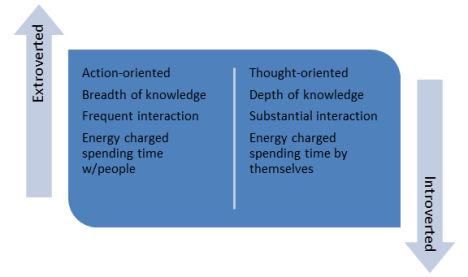
7.   Myers-Briggs: Extrovert vs. Introvert

There are four dimensions in the Myers-Briggs assessment, but I will relate just one which should be familiar to everybody: Extroverted vs. Introverted. This basically determines how you focus your attention and gather your energy.

On one episode of Star Trek, for example, Captain Kirk thinks he is going to punish Scotty by telling him he can’t go on short leave. Scotty is delighted because he is says that will give him some time to catch up on his reading of technical journals. It was not perceived by him as a punishment, but as a reward, because Kirk and Scotty have opposite personality types.

So find out what your team members skills are but also what their personality type is, so that you can match your motivation to his or hers.

8.  Reward properly

As a leader, you must reward people in such a way to motivate them to exhibit positive behavior and stop negative or undesirable behavior. Now what this behavior is depends on the context, but does it help further the project towards completion or not?

  1. Recognize them immediately or as soon as possible after the achievement, to encourage repetition of the behavior.
  2. Reward behavior that you want that is better than the standard. You can recognize or acknowledge behavior that meets the standard, but a reward should be something extra given for extra effort.
  3. Address undesirable behavior. This is crucial and controversial, because if you do not address that behavior, others on the team that do perform well will become discouraged. However, criticizing someone’s behavior in front of others may decrease their motivation, so I find it best to talk to that person individually so that issues of esteem with regard to the group do not show up. One way to address people’s concerns about others on a team is to have an issue log. This lets the person know that their concern is being addressed.
  4. Eliminate obstacles. If there is something in the environment, and not let’s say another person, who is causing a problem for a team, do what you can to eliminate that impediment.

I think the best way to get a feel for this in Toastmasters is to pay attention to how you do your evaluations. There’s a lot that goes into an evaluation that is directly applicable to being skilled at motivating others to improve.  So in retrospect, recognizing that different people have different motivations based on their individual needs and personality types will help you recognize what to use as motivation. You also need to learn when and how to use that motivation to both increase positive behavior and reduce negative behavior of a team member.

So with that, I hope I’ve motivated you all to improve your performance as  leader of your project team.

5th Edition PMBOK® Guide—Chapter 9: Leadership Styles on a Project


5th Edition PMBOK® Guide—Chapter 9:  Leadership Styles on a Project

1.  Introduction

Interpersonal skills are considered to be one of the tools that a project manager uses in the process 9.4 Manage Project Team.    These skills comprise leadership, influencing, and decision-making.

I went into some detail in the last post about influencing and decision-making; this post deals with the various leadership styles.   These styles are not spelled out in the 5th Edition PMBOK® Guide itself.    What I’ve done is taken the styles that are listed somewhat randomly in the 7th edition of Rita Mulcahy’s PMP Exam Prep book, and reorganized the list in terms of three basic categories.

2.  Categories of Leadership Styles

The three categories of leadership styles are

  • Top-down:   where  the leadership consists of taking the manager’s vision and essentially using the team members as the means by which this vision is carried out.   As the name implies, it gives the most autonomy to the leader and is the least empowering from the standpoint of the team members; they are the servants of the project manager.
  • Bottom-up:   where the leadership consists of taking the input from the team members and coordinating or integrating it in some fashion in order to carry out the vision of the project.    It gives the most autonomy to team members and the leader is actually the servant of the group, rather than the other way around.
  • Lateral:   this is where leadership consists of having the entire group, including the project manager, get involved in carrying out the vision of the project.    It gives the most autonomy not to the manager or the group, but to the dynamics of the team itself.    In this style, each person in the group is the servant of the other, and yet also has the opportunity to contribute towards the solution.

3.  Leadership Styles

With these three broad categories in mind, let’s take a look at the list of leadership styles that Rita Mulcahy’s book lists seemingly at random and put them into the categories so you can see the thematic similarities between them.

Category

Style

Explanation

Top-Down Analytical Making the technical decisions for the project which are communicated to the project team.
Autocratic Manager has power to do whatever he or she wants
Bureaucratic Making sure that the project team follows procedures exactly.
Consultative-Autocratic After soliciting input from team members, makes decisions by him- or herself
Directing Telling others what to do.
Driver Constantly giving directions
Bottom-Up Facilitating Coordinating the input of others
Consultative Obtains others’ opinions and acts as the servant for the team
Charismatic Energizing and encouraging team to perform project work.
Laissez-faire Not directly involved in the work of the team, but manages and consults as necessary.
Lateral Coaching Helping others achieve their goals
Consensus Problem solving in a group, and decision-making based on group agreement
Delegating Establishes goals, gives project team sufficient authority to work
Democratic Encourages team participation in the decision-making process.
Influencing Emphasizes teamwork, team building, team decision making.
Supporting Providing assistance along the way

Notice that, although PMI does not officially endorse one style over another, it is probably pretty clear that the top-down, “my way or the highway” type of style is definitely “old school” and a project manager should be trying to develop styles from the other two categories, because the top-down approach requires a certain amount of authority that the project manager may not have access to.

There are certain situations where a top-down approach may make sense.   If the project manager is also a technical expert, more so than any of the team members, then the analytical approach may make sense.   However, this is probably a rare case.    A more common situation in a project where a top-down approach may be required is if an unforeseen risk occurs and rapid action is required:   here the project manager may be forced by virtue of the urgency of the matter to make a decision without going through the more democratic but time-consuming processes of consensus-building.    But this, again, is the exception to the rule, which should be to get members of the project team to be involved in the planning and decision-making process as much as possible so that they buy into the solution, since they were an important part of creating it.

4.  Conclusion

Leadership styles must match the organization, and the personality style of the project manager, not to mention the nature of the project itself.    A more decentralized approach is more difficult than simply barking out orders, but in the long run it will get you more cooperation not just on the current project, but hopefully on future projects that you will given to manage because of the successful outcome of the current one.

5th Edition PMBOK® Guide—Chapter 9: Interpersonal Skills


A project manager is, at first glance, a person who manages projects, but in order to do so, he or she has to manage the people on the project team.    Adding t0 the project management knowledge that the project manager must have, PMI recognizes the necessity for skills in people management.    One of the tools & techniques listed for process 9.4 Manage Project Team is Interpersonal Skills.   The purpose of this post is to list what skills are described in the 5th Edition of the PMBOK® Guide under that heading and to describe these skills.

1.  Leadership

The two main roles of leadership are to communicate the vision of the completed project to the team, and to inspire the project team to achieve high performance in achieving that vision.    Now when it comes to styles of leadership, that is a vast subject in and of itself.    The next post will cover leadership styles in the various categories of top-down, bottom-up, and lateral.

2.  Influencing

PMI recognizes that many organizations are of a matrix type, that is, where the project manager may not have authority outside of the project over the members of the project team.    Replacing authority is the less direct and less coercive form of getting people to do things, and that is influencing them to do so.

There are five skills under the larger category of influencing skills.

  • Persuasion–the ability to clearly articulate points and positions
  • Listening–active and effective listening skills
  • Perspective–awareness of the various perspectives in any situation, and to be able to integrate them
  • Information gathering–gathering information that is relevant and critical to addressing the important issues
  • Trust–maintaining mutual trust in reaching agreements

The PMBOK® Guide itself takes the last two in the list and combines them into one, but I think maintaining mutual trust in reaching agreements is a matter of following through, and not just on being able to gather relevant information.   Gathering relevant information may help you to achieve the trust of the group, but maintaining it comes from having a track record of following through with what you say you will do.   If you don’t follow through, the influence of what you say will be diminished.

The perspective skill is one that is overlooked, but in the IT world for example, software and hardware engineers sometimes find it hard for the other group to take their perspective.   You need to be able to bridge that “perspective gap”.   In fact, the very name of this blog, 4squareviews, comes from the Integral Theory approach of solving problems by seeing it through various perspectives, so this skill is one I am particularly sensitive to.

Information gatheringlistening, and perspective are the input skills of influencing, because they are what you take in when you are getting ready to make a decision or to put forth your viewpoint.    Persuasion and trust are the output skills of influencing, because they are what you must do while you are making a decision or following up afterwards in order to make sure that your viewpoint is heard and agreed to.

3.  Effective decision making

Leadership skills cover communicating a vision and inspiring others.  Influencing skills help persuade others to do the work involved that you set forth with your leadership.    The third set of interpersonal skills, those of effective decision making, are designed to help you negotiate and influence the project team as a whole and the organization of which you are a part.

  • Focus on the goals to be served (derived from your leadership skills)
  • Follow a decision-making process (make your process as objective and transparent as possible)
  • Study the environmental factors (what factors in your organization and in your industry must you take into account in making your decision, this is the political part of being a project manager)
  • Analyze available information (same as under influencing skills when you are trying to influence individuals on your project team)
  • Develop personal qualities of the team members (improve the interpersonal skills of those on your team)
  • Stimulate team creativity (this reliance on the diversity of your team creates decisions that are bought into by the team)
  • Manage risk (reduce those environmental factors which may endanger the project or be prepared to deal with them if you cannot reduce them)

4.  Conclusion

I would say that any manager could benefit from these interpersonal skills, but the project manager needs them perhaps even more so because the authority he or she may have on a project may be limited by the organizational structure, or other factors.    These are sometimes given the description of “soft skills”, but they can translate into hard currency or an increased bottom line for your organization.


5th Edition PMBOK® Guide—Chapter 9: Conflict Resolution


In human resources management, one of the tools and techniques listed for process 9.4 Manage Project Team is that of Conflict Resolution.  The purpose of this post is to discuss the five categories of conflict resolution, according to the PMBOK® Guide, and discuss what PMI has to say about them.

1.  Five Categories of Conflict Resolution

The following chart shows each method of conflict resolution, and what it means in terms of group dynamics.  Note that these methods have alternate names, which it is necessary to know if you are preparing for the PMP or CAPM exam.

  Method Explanation Group Dynamics
1. Withdraw/

Avoid

Postponing the issue to be better prepared or to be resolved by others Neutral/Neutral
2. Smooth/

Accommodate

Emphasizing areas of agreement; conceding one’s position to the needs of others Lose/Win
3. Compromise/

Reconcile

Searching for solutions that bring partial satisfaction to all parties Lose/Lose
4. Force/

Direct

Pushing one’s viewpoint at the expense of others Win/Lose
5. Collaborate/

Problem Solve

Incorporating multiple viewpoints and insights from different perspectives Win/Win

2.  Discussion of Conflict Resolution methods

Although the PMBOK® Guide says they are not given any particular order, because “each one has its place or use”, I think the last method of collaborating and problem solving is the one that PMI would generally prefer, and the force/direct the one that PMI would generally NOT prefer.  However, you can understand a situation such as an emergency where a manager must make a decision in a hurry and the others must acquiesce to it simply because there is simply no time to discuss the problem at leisure as a group.

Also, withdraw/avoid could be the smartest strategy if a) there is not enough information to resolve the conflict, or b) the group does not have the authority to resolve the conflict.  In those cases, tabling the issue temporarily until such time that additional information can be obtained, or in the latter case, escalating the conflict to a group that does have authority to handle it, might be better than trying to thrash out the solution prematurely.

Compromise sounds nice, but in reality, it means that both sides have to give up something, and it may work in the short term, but generate hostility that may surface later on in the project.  Not as much hostility, of course, as when a manager tells them what to do without their input (force/direct), but nonetheless it is best to frame the debate in terms that are non-zero-sum, that is, where if one party wins, the other party automatically sees itself has having lost.  The win-win scenario is best both in terms of getting to a solution that has buy-in from all sides, but it also generates good will that will last throughout the project.

Smooth/accommodate is when one person voluntarily gives up their position in order that the group arrive at a solution.  The key word is voluntarily, because if they are forced to give up their position, then it really just the old force/direct method in disguise.  Here’s an analogy I use to explain this method.  When I’m driving in traffic, I often see somebody who is playing a zero-sum game, for whom the object is to get ahead of, at all costs, whether you actually have the right-of-way or not.  If I have the right-of-way, and I detect that the person is being an aggressive driver, then I will slow down and let the person take “pole position” because in reality, I am not playing the same game as the other driver.  I am playing the game where the object is not to get ahead of the driver next to me, but to keep the traffic flowing smoothly.  Today this may require me to sacrifice the position that is ”rightfully” mine; the next day however, the driver next to me may wave me ahead in a gesture of courtesy.  It’s all good—because it contributes to the flow of traffic, whereas playing the traffic game like outtakes of the movie Fast and Furious can land one in the hospital—or worse!

NOTE:   Collaborating and problem solving were considered separate methods in the 4th Edition of the PMBOK Guide; the 5th edition has combined them.  Also, the method of problem solving used to have a second name of confronting 
but I think the term was dropped because the idea that you should be confronting the problem and not the other personalities on the team.   So the new edition of the Guide has this framed in terms of collaborating, which makes sense not just from the practical point of view (focusing on the problem), but also on how you get there, by working together with the others on the team.

3.  Conclusion

Knowing the different methods of conflict resolution will help you be a good project manager; knowing the right situation to use these different methods of conflict resolution is the key to becoming a great one.

5th Edition PMBOK® Guide—Chapter 9: Process 9.4 Manage Project Team


1.  Introduction

The fourth out of four human resource-related processes is in the executing process group, and it is used to develop after acquiring and developing the team, to manage the team as it performs the project work throughout the course of the project.

2.  Inputs

The inputs come from the outputs of the first process 9.1 in the form of the Human Resource Management Plan, the second process 9.2 in the form of the Project staff assignments, and the third process 9.3 in the form of Team Performance assignments.  The issue log is a project document which is an important input for recording what issues exist, and for recording any resolutions to those issues, and work performance reports help project managers decide who should get recognition and awards for outstanding work.


9.4  MANAGE PROJECT TEAM
INPUTS
1. Human Resource  Management Plan This is an output of the process 9.l Plan Human Resource Management.  In particular, the elements of the plan that are used in this process are:

  • Roles and responsibilities
  • Project organization (who reports to whom, etc.)
  • Staffing management plan (when team members are to work on project)
2. Project staff assignments These are an output of the process 9.2 Acquire Project Team:  they tell who is going to be on the project, and what their roles and responsibilities will be.
3. Team Performance assessments These are an output of the process 9.3 Develop Project Team:  they are the project management team’s assessments of the project team’s performance.
4. Issue log Documents who is responsible for resolving specific issues by a target date.
5. Work performance reports These are an output of the process 4.4 Direct and Manage Project Work.  This information assists in determining recognition and awards for team members, and in planning future human resource needs on the project.
6. Organizational process assets Templates for

  • Certificates of appreciation
  • Newsletters, websites
  • Bonus or other incentives
TOOLS & TECHNIQUES
1. Observation and conversation The project manager needs to monitor not just the work, but the attitudes of project team members as they make progress towards project deliverables.
2. Project performance appraisals Project performance appraisals can be useful towards the following:

  • Clarification of roles and responsibilities
  • Giving constructive feedback to team members
  • Giving recognition for accomplishments by team members
  • Resolving interpersonal issues
3. Conflict management There are five techniques for conflict management:

  • Withdraw/Avoid
  • Smooth/Accommodate
  • Compromise/Reconcile
  • Force/Direct
  • Collaborate/Problem Solve

(NOTE:  will be covered in separate post):

4. Interpersonal skills The following are skills which the project manager can use to analyze situations and skillfully interact with team members:

  • Leadership
  • Influencing
  • Effective decision-making

(NOTE:  will be covered in separate post)

OUTPUTS
1. Change requests Staffing changes may affect the rest of the project management plan, and need to be processed through the Perform Integrated Change Control process.
2. Project management plan updates Roles and responsibilities may be clarified and updated; any staffing changes will result in changes in the Staffing Management Plan.
3. Project documents updates
  • Issue log (if issues are resolved)
  • Roles and responsibilities (RACI chart)
  • Project staff assignments (if there any staffing changes)
4. EEFs
  • Project performance appraisals may be inputs to organizational performance appraisals
  • Personnel skill updates
5. OPAs
  • Lessons learned
  • Templates
  • Organizational standard processes


3.  Tools & Techniques

Observation and conversation may seem obvious as tools & techniques for managing a project team, but remember that there are two types of experts on a project:  subject matter experts, whom you consult when making a decision, and work experts, whom you consult when asking how things are going.  What are work experts?  The project team members themselves:  since they are doing the work, that’s whom you need to talk to if you want to know how things are going.  And doing the observing and conversing in an informal setting will get you a lot more honest picture of what’s going on rather than just relying on reports and meetings.   Also, they will give you the best information with regards to how to improve the process, because they are the ones doing it day in and day out.

Project performance appraisals are used for either recognition and rewards, or constructive criticism.  The art of constructive criticism deserves a post on its own, but suffice it to say that it is delivered with relationship to objective criteria, it is specific, it suggests ways to improve, and is delivered in a way to make sure the person knows it is nevertheless your subjective opinion, and not the “law of the land.”

Conflict management and interpersonal skills are SO important for project managers to use in managing one’s team that I will devote the next few posts to these.

4.  Outputs

It could be that conflicts may require, in the extreme, staffing changes, or it could be that changing circumstances on the project may necessitate these as well.  In this case, any potential staffing changes should be treated as change requests, and as such, need to be sent through the Perform Integrated Change Control process, especially since they may necessitate a change in the budget, the schedule, or both.

The project management plan, in particular the human resources management plan, may need to be updated as a result of the activities in this process, as well as some of the project documents relating to human resources management, such as the issue log or the responsibilities matrix (or RACI chart).  Another by-product of dealing with issues is not just resolving them for the project, but making sure that any resolutions are shared with the organization at large in the lessons learned for future projects.

As mentioned above, the tool of conflict management is considered very important by PMI considering the amount of discussion given in the PMBOK® Guide.  Therefore, I am devoting the next post to this subject to discuss the various techniques of conflict management.