5th Edition PMBOK® Guide—Chapter 6: Process 6.1 Plan Schedule Management


This post gives an overview of the first of the six planning processes in the Time Management Knowledge Area, with summaries of the inputs, tools & techniques, and output of the process.

1. Inputs

As far as inputs are concerned, the most important ones are the scope baseline, because that represents the work that needs to be done, and the schedule will tell you how much time is required to do it. Other knowledge management plans may provide input as well, some of which are completed after the schedule management plan in the list of planning processes. This shows that the planning process is iterative and may require several passes through in order to integrate the various knowledge area management plans.

The project charter will give the high-level time constraints and the list of critical milestones to be achieved on the project, some of which may actually be tied to project approval requirements (i.e., the project may absolutely have to be done within a certain amount of time).

The main EEF or Enterprise Environmental Factor is probably going to be the project management software used to create the schedule; the main OPA or Organizational Process Asset is probably going to be the historical information on prior similar projects that can be used to help estimate the schedule.

6.1 PLAN SCHEDULE MANAGEMENT
INPUTS
1. Project Management Plan The following elements of the PM Plan are used in the development of the Schedule Management Plan:

  • Scope baseline (= project scope statement, WBS, and WBS dictionary)
  • Cost, risk, and communications management plans
2. Project Charter Summary milestone schedule, project approval requirements (particularly those dealing with time constraints).
3. EEFs
  • Organizational culture and structure
  • Resource availability and skills
  • Commercial information available on resource productivity
  • Project Management Software
  • Organizational work authorization systems
4. OPAs
  • Policies, procedures, guidelines, templates for schedule control
  • Historical information on similar projects
  • Monitoring and reporting tools, schedule control tools
  • Change control procedures
  • Risk control procedures
  • Project closure guidelines
TOOLS & TECHNIQUES
1. Expert judgment Uses historical information from prior similar projects and adapts it appropriately to the current project.
2. Analytical techniques Used to choose strategic options related to estimating and scheduling the project:
3. Meetings Planning meetings are used to develop the schedule management plan.
OUTPUTS
1. Schedule Management Plan Establishes the criteria and the activities for developing, monitoring and controlling the schedule.

2. Tools & Techniques

Expert judgment and meetings should be familiar by now as typical techniques that project managers of creating something as complicated and intricate as a schedule. The analytical techniques that can be used with specific reference to the schedule are such methods as:

  • Schedule compression (fast tracking or crashing)
  • Rolling wave planning
  • Leads and lags
  • Alternatives analysis
  • Reviewing schedule performance

UPDATE:   Based on some comments, I wanted to add that the analytical techniques are not actually used in this process, because the schedule itself has not been developed (that takes place in process 6.2 through 6.6).  What the Schedule Management Plan can do is LIST the options for tools & techniques that can be used later on in those scheduling processes.   Sometimes details can be given in terms of under what conditions they will be used, what scheduling software or other tools to be used in conjunction with those techniques, etc.

3. Output

Finally, the output, as you could probably guess by the title of the process, is the Schedule Management Plan. Let’s take a closer look at the contents of the Schedule Management Plan in the next post to see all that goes into it, and how these contents relate to the other project management processes in the Time Management Knowledge Area.

5th Edition PMBOK® Guide—Chapter 6: Time Management Knowledge Area


After Chapter 5, which discusses Scope Management, the next knowledge area covers one of the other major “triple constraints”, that of time.

There are seven project management processes in the Time Management Knowledge Area. Six of these are in the Planning Process Group and one is the Monitoring & Controlling Process Group.

The first planning process, that of Plan Schedule Management, creates the Schedule Management Plan which is the framework for all of the other processes. (NOTE: In the 4th Edition, this plan was created not as a separate process, but as part of the Develop Project Management Plan process in the Integration Knowledge Area.)

The second through six planning process are done in sequence, but may be done in an iterative fashion in the case that not all of the activities are specified in the first pass through these processes. Once the schedule is produced as the output of the last of these planning processes, Develop Schedule, it becomes the schedule baseline against which progress is measured throughout the rest of the project in the Control Schedule process in the Monitoring & Controlling Process Group.

Process Group Process Number Process
Name
Process Description
Planning 6.1 Plan Schedule Management Establishes the policies, procedures, and documentation for planning, executing, and controlling the project schedule. Provides guidance and direction on how the project schedule will be managed throughout the project.


Planning 6.2 Define Activities Identifies and documents the specific actions to be performed to produce the project deliverables. Breaks down work packages into activities that form the basis for the project work.


Planning 6.3 Sequence Activities Identifies and documents relationships among the project activities. Defines the logical sequence of work to obtain the greatest efficiency given all project constraints.


Planning 6.4 Estimate Activity Resources Estimates the type and quantities of resources required to perform each activity. Identifies type, quantity, and characteristics of these requires which allows for more accurate cost and duration estimates.


Planning 6.5 Estimate Activity Durations Estimates the number of work periods needed to complete individual activities with estimated resource. Provides the amount of time each activity will take to complete.


Planning 6.6 Develop Schedule Analyzes activity sequences, durations, resource requirements, and schedule constraints to create the project schedule with planned dates for completing project activities.


Monitoring & Controlling 6.7 Control Schedule Monitors status of project activities to update project progress and manage changes to the schedule baseline in order to achieve the plan. Provides the means to recognize deviation from the plan and to take corrective and preventive actions and thus minimize risk.

The next post will go into more detail regarding the inputs, tools & techniques, and outputs involved in the first process, 6.1 Plan Schedule Management.

Between China and Japan–A Tale of Two Cultures


Yesterday, I performed my first professional speaking engagement, by being the Master of Ceremonies for the 50th wedding anniversary of the parents of the person who was hosting the celebration.    She chose me because I was a member of Toastmasters and therefore used to public speaking, and because I was fluent in Japanese, because her family is Japanese-American.

At the party, I met the daughter of a family friend whose father was Chinese and whose mother was Japanese.   I told her that at the University of Illinois, I had studied both (Mandarin) Chinese and Japanese in graduate school to get my Master’s Degree in Asian Studies, and often felt torn between which culture I enjoyed exploring the most.   I told her that it was like being the parent of two children whom you both love equally well despite their very different personalities, and the fact that they do not always get along well with each other.

She knew exactly what I was talking about, because she was curious about both the cultural heritage from China through her father and the cultural heritage from Japan through her mother.    She, like me, was fascinated with them both but realized that they were so different that she almost felt schizophrenic for being drawn to them both.

When we talked about the differences between the two, we first of all talked about the similarities.    Yes, relationships (guanxi in Chinese and kankei in Japanese) are very important and must be nurtured with constant care almost in the way that you would tend to a garden.    Respect for status with regards to one’s age, and a respect for the value of education, are both things we encountered as being valued in either culture.   But once we went down the list, it turned out many of these similarities were in fact legacies that China had given to Japan culturally.    When I was living in Japan, the fact that much of Japanese culture has its own origin in Chinese culture was not something that was admitted very freely or openly.    It’s kind of like how Americans think of their culture as unique, when it really derives primarily from European culture.

Regarding the differences, though, it was interesting that we both agreed that Japanese were more reserved than the Chinese, meaning that it took more time and effort to break through the outer wall that many Japanese erect within themselves against outsiders.    Breaking the barrier with Chinese, especially urban Chinese, didn’t seem to be quite as difficult.   However, once you are able to go beyond mere acquaintance to friendship with a Japanese person, I found them to be more steadfast and loyal friends.   Americans are more “easy come, easy go” when it comes to friendships, and Chinese are probably somewhere in the continuum between Japanese and Chinese.

Japanese behavior in public places such as restaurants, coffee houses, or offices tends to value silence more, whereas Chinese tend to be more “rowdy” or energetic in such places.    If they were to be described as a person, you might describe Japanese culture, at least in my experience, as being introverted, that is, gaining energy in silence and solitude and expending it in social company, whereas the Chinese seem to gain energy in social company.     My friend liked my description of the difference in energy level between a Japanese and a Chinese coffeehouse being like that between a cathedral and a gymnasium!

This is obviously just my take on the difference between the two cultures, but since I myself am more introverted (INTJ in the Myers-Briggs typology) I tend to find myself more comfortable in Japan, but that could obviously be a product of the fact that I lived there for 5 years whereas I have never lived in China.   If I were to live there for two years, I might feel differently.

In any case, we both found ourselves fascinated by the respective histories, language, and literature of these two countries, and felt that it was a privilege rather than a burden to be “between China and Japan”.   Being able to relate to them both, especially in today’s more intricately-woven world, should be an increasingly important asset in the next few decades!

#Chinua #Achebe, the Father of African Literature


When I read that Chinua Achebe, the father of African literature, had died on Thursday, March 21st, I remembered the  effect his novels Things Fall Apart and No Longer at Ease had on me as a graduate student at the University of Illinois.

1.  Introduction–the novels of Chinua Achebe as great literature

Although I was focusing on Asian studies as the basis for my Master’s degree, I was introduced to the novel Things Fall Apart by one of my classmates in my Japanese class who also was interested in Africa and African culture.    As Harold Bloom describes in his book about the classics of Western literature, The Western Canon, one of the aesthetic emotions one encounters with great works of literature besides that of the experience of beauty is the experience of the sublime.

The experience of beauty is what we associate with something that is “good”, but the experience of sublime is when we encounter something that is so powerful that it goes beyond our conventional notions of what is “good” or “evil”.   We come to works of great literature not necessarily being better selves, but we definitely come back as larger selves than we were beforehand.

2.  Things Fall Apart–ancient tragedy

With Things Fall Apart, I read the story of the clash of civilizations, the culture of the Igbo tribe in what would become Nigeria, and the culture of the European colonizers of Africa.   The protagonist Okonkwo is destroyed by the encounter, and I was moved by his downfall and this opened up a reservoir of compassion for people whose cultures have been destroyed through colonization.    From Dances with Wolves to Avatar, my heart is always on the side of those who have faced the threat of extinction by a civilization that is superior perhaps only with respect to technology.

But the mere story itself would have made it a good book that was memorable; to me what made a piece of great literature was to see it as embodying the emotions of Greek tragedy, which according to the formula expressed by Aristotle as quoted in James Joyce’s An Artist as a Young Man is that which arrests the mind before what is grave and constant in human suffering.    Because it is grave and constant to the human condition, it causes compassion.   This means that I no longer saw Okonkwo as a product of another culture, but as a fellow human being.   And after having read the story, I could not look at people from Nigeria the same way as before, as an “other”.

3.  No Longer At Ease–modern tragedy

And then with his novel No Longer At Ease, I read the story of Obi, the grandson of Okonkwo from Things Fall Apart, who is facing corruption charges in Lagos.    The transfer from tribal to urban life in two generations is a bit of a cultural shock for the reader, but the tragedy of Obi, although moving, is a story of different sort than that of his grandfather.   It is not an example of ancient tragedy, but modern tragedy.   What I took as the difference between the two was that in modern tragedy, one’s destiny was not determined by God or Fate as in ancient tragedy, but by the State.   It was a thought that was frightening to me, but compelling at the same time because it had been so beautifully depicted in his novel.

4.   Chinua Achebe–astride continents and centuries

And this comes to the heart of why Chinua Achebe will have a special place in my heart.   For having written a novel exemplary of ancient tragedy, he wrote a work of completely different character which was exemplary of modern tragedy.   It was like reading the Iliad and the Odyssey and then contemplating the kind of genius that Homer must have been to create BOTH works, each a piece of great literature in and of themselves but so different in character that it was hard to believe that one person could span them both.

And that for me is the legacy of Chinua Achebe.   Yes, he caused me to have an interest in Africa and African culture that has stayed with me for all of my life.   However, he also showed me that great literature not only knows no geographical boundaries, but it also knows no temporal boundaries and can forge a link between the world view of primal cultures, of so-called “modern” culture, and whatever culture may turn into in the future.

The world will certainly miss you, Chinua Achebe, but will always have access to your wisdom as long as there are people that love to read.

The St. Francis Dam Disaster of 1928–A Tragic Tale of Scope Creep


At a Toastmasters Club, you end up learning things that you didn’t know before you came to the club, not just about the art of public speaking, but the various subjects that people present in their speeches.   At our Project Masters Orange County Club, which was founded by the Project Management Institute of Orange County, California, we had many speeches given by project managers about the subject of project management, and I definitely learned many things at that club about the subject.

However, the most dramatic presentation in my mind was that given by a fellow Toastmaster Van Wray about an event now long past but still important in California history, namely, the St. Francis Dam Disaster of 1928.   The reason for the failure of the dam was analyzed at the time as being due to an inadequate geological survey, but more recent analysis by civil engineers and historians point to a culprit that is more familiar to project managers, namely, that of scope creep, which is adding of work to a project without accounting for its effect on the project as a whole.    This mistake can have serious consequences for a project, but in the case of the St. Francis Dam, the results were catastrophic and led to the deaths of up to 600 people.

1.  What was the St. Francis Dam

The St. Francis Dam was a concrete curved gravity dam built about 40 miles northwest of Los Angeles in the San Francisquito Canyon.   It was designed and built between 1924 and 1926 by the Los Angeles Department of Water and Power under the supervision of the legendary engineer William Mulholland.    Here is a picture of the dam looking north, with water in its reservoir, in 1926.

St Francis Dam crop.jpg

2.  What was the scope creep involved?

The original capacity of the reservoir was to be 39 million cubic meters of water, and it was to rise 185 ft (56 meters) above the stream bed level.    However, at some point the height of the reservoir was changed twice by 10 ft, for a total height of 205 feet, in order to increase the storage capacity of the reservoir to 47 million cubic meters.   However, the base of the dam was not widened to accommodate this additional volume of water.    Therefore, in the final analysis, the dam collapsed because of scope creep, which is defined in the 5th Edition of the PMBOK Guide© as “the uncontrolled extension to product or project scope without adjustments to time, cost, and resources.”

3.   What were the consequences?

On the morning of March 12, 1928, the dam keeper discovered a leak in the dam, and he notified Mulholland immediately.   The muddy color of the runoff from the dam indicated that the water might not just be coming from a crack in the structure, but might be eroding the very foundation of the dam itself.   Mulholland came and inspected the dam, but proclaimed that the leak was “not dangerous” and left.

At two and a half minutes before midnight on March 12th, the dam burst and 12.4 billion gallons of water surged at 18 miles an hour down in the canyon in a wave that was 120 feet high.   By the time it had emptied into the Pacific Ocean 5 1/2 hours later, it had became a raging torrent 2 miles wide and bodies were found scattered as far as the Mexican border.

4.  What were the proximate causes of the dam collapse?

According to Dr. J. David Rogers, Chair in Geological Engineering at the University of Missouri-Rolla, the base of the dam was lifted upwards by a phenomenon called “hydraulic lift.”    The center of the dam was the only section left standing when it collapsed, because it was the only section that contained uplift relief walls at the base.    The eastern section was the first to collapse, which undercut the central section and caused it to tilt and rotate towards the western portion.   When this final portion collapsed, the dam finally burst and the flood waters were then released.

5.  What were the consequences for Mulholland?

Although the investigation done at the time pointed to deficiencies in the geological survey of the foundation as the cause of the problem, rather than on the engineering design done by Mulholland.   Nevertheless, Mulholland took full responsibility for the disaster, and it ended his career.

The more modern re-investigations of the incident showed that the geological instability of the area on which the dam was built was indeed a factor, but the failure to compensate for the additional height of the dam in the rest of the design, plus the fact that the design was overseen by only Mulholland himself were the factors which were the real crux of the problem.    The phenomenon of “hydraulic lift” was actually starting to become known in the civil engineering community in the 1910s and 20s, and if Mulholland had researched the design more diligently, the dangers of the changes to his design might have become more apparent.

This failure to compensate for the two additional height changes is the essence of scope creep, which is why the first step in whether to accept a change to the scope should be to analyze the impacts of that change on the other parameters and constraints of the project, or in this case, the design.   The analysis should be done by as many members of the team member as have expertise in the area, with additional expertise being sought by subject matter experts outside the team as necessary.   Mulholland’s failure to take these steps not only ended his career, but the lives of up to 600 people, and caused the 2nd largest civil disaster in California history.

So if you wonder why we project managers take scope creep seriously, just remember the St. Francis Dam Disaster of 1928!

Note on sources:   the main source for this post was the March-April 2010 issue of the Santa Clarita Valley Historical Society newsletter.   For more details, see http://www.scvhs.org/news/dispatch36-2.pdf.  

Going From #Toastmaster to Professional Speaker–Some Things to Know


I have been in Toastmasters International for a little over two years.    I have achieved several milestones during that time: my first Icebreaker speech, followed by my first educational award (Competent Communicator), my first speech from an Advanced speech manual, my first speech contest, my first involvement in Area and Division-level meetings (as Assistant Area Governor), and the first educational award going to the person who was the first person I mentored at our club.

All of these achievements have been very gratifying for me, but none of them were a total surprise because I had planned on  achieving them.   However, a recent speaking opportunity came to me out of the blue, and that was the opportunity to actually get paid to speak.    A fellow Toastmaster was planning on her parents’ wedding anniversary, and was planning a celebration with family and friends.   She was going to be so busy at the celebration that she wanted to get a Toastmaster who a) was a good public speaker and b) was fluent in Japanese, because she is Japanese-American and many of her relatives (especially the older ones) can speak Japanese.   I was the only person she knew within Toastmasters who fit that bill–I am fluent in Japanese because I lived in Japan for five years and have worked for most of my career at Japanese companies.

So I am going to be the Master of Ceremonies at the celebration this weekend, and I have been working on my presentation the past few days.   What tips can I give to someone who is going to give a professional speech for the first time or who aspires to do so?    That’s the subject of this post.

1.  Know your room

You should visit the room or hall where you are going to speak if at all possible.   Second best would be to get a floor plan, but nothing substitutes for physically BEING THERE.    When I went over to discuss my presentation, I insisted on seeing the room the celebration was to be in.    I was shown a floor plan, but realized when I got to the actual room that it was wider than I had envisioned, meaning that I would have be turning to the side more often than I had anticipated to sweep everybody into my eye contact and gestures.

2.  Know your audience

I talked three times before the final meeting with this woman about what the purpose of the celebration was.  Yes, I know it’s a wedding anniversary celebration, but who is coming?   What generations are involved?   What is each generation’s involvement in the Japanese, American, or Hawaiian culture (since many of them live in Hawaii now)?    The answer to these questions would determine for me how much to say in Japanese vs. English, and also how much more to emphasize Hawaiian rather than Japanese culture.   I want to use enough Japanese to please the older generation, but not so much as to show up the Japanese-Americans who may have lost contact with their culture.

3.  Know your hosts

The woman putting on the celebration was going to be busy setting up several commissioned art pieces that celebrated her parents’ anniversary.    My job therefore was to make her job easier by explaining some of the background of these pieces and the significance of the art in terms of Japanese and/or Hawaiian culture.   This would allow her to realize that the older generation would recognize HER effort to keep in touch with their culture, but also clue the younger generation to the beauties of a culture that they might have started to lose touch with.

4.  Know your guest of honor

I had a chance to meet her parents and know how important it talk about the year they were married, 1963, in a way that would evoke memories that would emphasize the long journey they have made since then.   So my remarks talk about leaving a legacy with is … the people sitting in that room, their immediate and extended family.   I know that emphasizing the family connections rather than just focusing on the two of them as a couple would please them more, based on what the host told me about their personalities.

5.  Know your schedule

I have a list of the main events:  the entrance, the dinner, the art work unveiling, the dessert and toast, and I have written remarks for all the places where I need to step in and give a transition.   I have marked some empty spaces as possible areas where I may need to improvise a transition if it is called for and am thinking ahead with remarks that could possibly fill in those spaces.

6.  Know your purpose

I will start with an introduction of myself, not because I want to focus on myself, but because I want to establish that I too have a relationship with the host as a fellow member of a Toastmasters club.    A Distinguished Toastmaster or DTM once told me that as a beginning Toastmaster, you tend to be concerned about getting across your message more than you are about establishing a relationship with the audience, but this is a mistake.   You need to establish a rapport first, and then the message will flow.    If they care about you as a human being rather than as the role that you are playing, then they will truly listen to what you have to say.    Your purpose as the MC is not to draw attention to yourself, but to take the attention that you can and focus it towards the guests of honor, in this case, this woman’s parents.

7.  Know yourself

The reason why I became a Toastmaster was to be able to touch people, to inspire people, to persuade people, based on the power of words.   But the leadership aspect of Toastmasters gradually becomes more important the more you get involved in the organization, and I can truly say that I am less and less interested in appearing clever and smart in front of others, and more about encouraging others to feel that they are clever and smart by stimulating them to think and feel something that they might not have done otherwise.

I hope my first professional speaking engagement is a success, but I think that all the points I mentioned above are ones that I have learned throughout the two years in speaking at various Toastmasters events.    The difference of someone actually paying me to do it, is a gesture of appreciation that is, of course, very gratifying.   But hearing applause and seeing smiles on people’s faces is a form of repayment that will be gratifying as well!


5th Edition PMBOK® Guide–Chapter 5: Validate Scope


One quick post I wanted to add about the process 5.5. Validate Scope is that in the 4th Edition PMBOK® Guide, the process of checking whether deliverables meet the acceptance criteria is called something different whether it is

–the internal checking within the project done as part of Quality Management, or

–the external checking with the customer or sponsor as part of Scope Management.

  Knowledge Area 4th Edition

PMBOK® Guide

5th Edition

PMBOK® Guide

Internal checking Quality Validate Scope Verify Scope
External checking Scope Verify Scope Validate Scope


In the 4th Edition, the first is referred to as validating the scope, and checking with the customer is verifying the scope.

Unfortunately, in the 5th Edition, the definitions are switched around.  The internal checking is referred to as verifying the scope, and checking with the customer is validating the scope.

I normally don’t like to compare the two different versions of definitions from the 4th and 5th Edition of the PMBOK® Guide, to avoid confusion, but in this case I thought it was important because those who are studying for the 5th Edition test might be taught by somebody who learned from an earlier edition, and you need to know that the earlier terminology is out there.  So be forewarned!

5th Edition PMBOK® Guide—Chapter 5: Work Breakdown Structure


1. Introduction

The Work Breakdown Structure is a fundamental tool of project management which is formed as an output of the process 5.3 Create WBS. It is one of the three elements of the scope baseline.

Table 1.  Three Elements of the Scope Baseline

Element Name Process
1. Project Scope Statement Output of 5.3 Define Scope
2. WBS Output of 5.4 Create WBS
3. WBS dictionary Output of 5.4 Create WBS

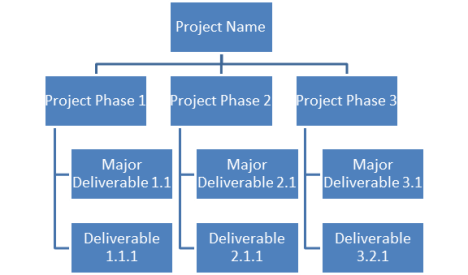
The work breakdown structure can be pictured like an organizational chart, with the highest level being the project itself, and the various levels under that consisting of increasingly more detailed breakdowns of the scope of the project.

For example:

Although it can take the form of an organizational chart, it does not show who does the work, but simply displays the hierarchy of the various levels of decomposition of the scope.

2. Decomposition technique

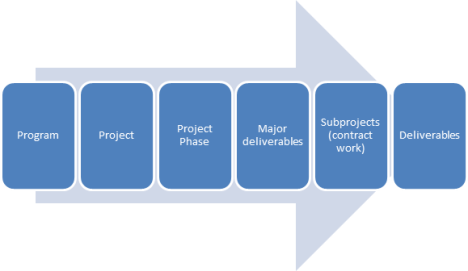
The techniques of decomposition means subdividing the project scope and project deliverables into smaller, more manageable components to the level of work packages. Here’s how the project is broken down through the decomposition process.

Figure 1. Work Breakdown Structure Levels (from program to deliverables)

a. Programs are groups of related projects.

b. Projects can sometimes be broken down into distinct phases.

c. Major deliverables are first identified within each phase.

d. That work which can be outsourced to a contractor is referred to as a subproject.

e. Deliverables are broken down from the major deliverables.

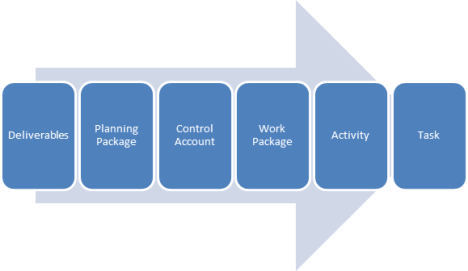
Figure 2. Work Breakdown Structure Levels (from deliverables to activities/tasks)

f. Once deliverables are identified, for large-scale projects planning packages are identified which are basically fill-in-the blank packages for work that has not yet been identified, but will be in the course of progressive elaboration.

g. A control account is a summary level in WBS one level above a work package. Once a group of work packages under a control account are completed, some sort of monitoring & controlling activity is done here to make sure the project is proceeding according to plan.

h. Work package is the lowest level in a work breakdown structure which both defines specific deliverables and those resources (people, equipment, etc.) assigned to complete the work (through the WBS dictionary).

i. The work package, which specifies the smallest unit of deliverables, is further broken down into activities during the process 6.1 Define Activities. In some companies with large work packages, the activities can be further broken down into …

j. Tasks, but this is sometimes a confusing term because some companies have tasks at a higher level than activities. So for the purpose of the PMP exam, just focus on activities as the steps taken to produce the deliverable within each work package.

3. Work Breakdown Structure—What is it for?

The work breakdown structure is to the project what the blueprints are to the product, a guide for getting it realized. Although I have listed the WBS under Scope Management, because it helps prevent unnecessary changes to the project (also known as preventing scope creep), but it helps in EVERY knowledge area.

Project Management Area How does WBS help the Project Manager?
4. Integration Management Helps the project management team see the entire project laid out in a single diagram.
5.. Scope Management Helps prevent unnecessary changes.
6 Time Management Helps create realistic basis for estimating schedule.
7 Cost Management Helps create realistic basis for estimating costs.
8 Quality Management Helps focus work on what needs to be done at the right time, increasing quality. If problems do occur, assists process improvement by making it easier to isolate root cause.
9 HR Management Creating the WBS as a team helps build the team and creates a sense of active participation that lasts throughout the project.
10 Communications

Management

Helps explain the project to stakeholders and helps project team members from different functional areas to cooperate with each other.
11 Risk Management Makes it easier to identify risks by making the work steps and work sequence easier to understand.
12 Procurement

Management

Helps identify those work packages which cannot be done with current company resources and/or expertise level.
13 Stakeholder Management Helps manage stakeholder engagement by helping to explain the impacts of changes suggested by stakeholders.

So, in conclusion, with all of these benefits, why wouldn’t you make creating a WBS one of the key parts of your planning process?

5th Edition PMBOK® Guide—Chapter 5: Requirements Documentation


1. Introduction

The Project Scope Management knowledge area contains 6 processes, 4 of them in the Planning Process Group and 2 of them in the Monitoring & Controlling Process Group. The first planning process is that which creates the Scope Management Plan. The next 3 planning processes go from 5.2 Collect Requirements, where the requirements from key stakeholders are collected and analyzed, to 5.3 Define Scope, where the high-level scope from the Project Charter is defined in more detail in the Project Scope Statement, and finally to 5.4 Create WBS, where the detailed scope is broken down through the process to deliverables down the level of work packages.

This post goes into some detail of the two outputs of the first of these three planning processes, 5.2 Collect Requirements: Requirements Documentation and Requirements Traceability Matrix.

2. Requirements Documentation and the Requirements Traceability Matrix

How are these two outputs different?

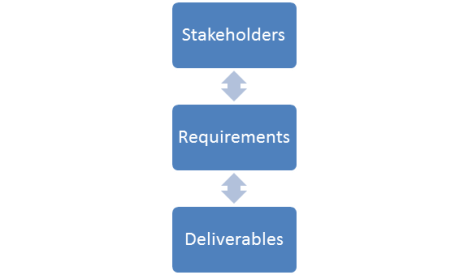
The Requirements Documentation is the collection of the requirements from various stakeholders. The Requirements Traceability Matrix is the connection between the requirements, the stakeholders who originated them on the one hand, and the project deliverables which will fulfill them.

3. Requirements Documentation

The following is a list of the categories of requirements, together with an explanation of what purpose they serve, and a list of examples of these types of requirements.

Category Explanation Examples
1.1. Business requirements Higher-level needs of the organization. Business and project objectives
1.2 Business rules for the performing organization
1.3 Guiding principles of the organization
2.1 Stakeholder requirements Needs of various stakeholders Impacts to other organizational areas
2.2 Impacts to other entities
2.3 Stakeholder communication and reporting requirements
3.1 Solution requirements Features, functions, and characteristics of product. Functional (behaviors of product) and non-functional requirements (environmental conditions for product).
3.2 Technology and standard compliance requirements
3.3 Support and training requirements
3.4 Quality requirements
3.5 Reporting requirements (with texts, models, etc.)
4.1 Project requirements Actions, processes, or other conditions of product Levels of service, performance, safety, compliance, etc.
5.1 Transition requirements Temporary capabilities required to utilize product Data conversion, training requirements
6.1 Quality requirements Condition or criteria needed to validate successful completion of project deliverable. Acceptance criteria
7.1 Requirements boundaries Describes assumptions behind requirements, and interactions between requirements. Requirements assumptions, dependencies, constraints

4. Requirements traceability matrix

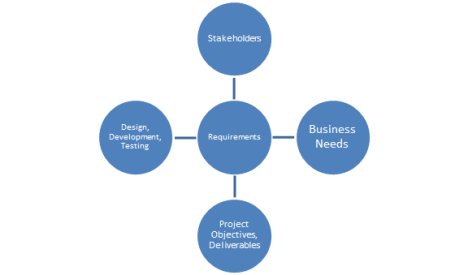
The requirements are traced back to the stakeholders who originated them. This is so that these stakeholders can be consulted if there is any change to the project which would affect these requirements. The requirements are traced to the external business needs and the internal strategic plan of the organization.

Finally, the requirements are translated into the overall project objectives, and then the detailed deliverables. Within the organization, the requirements are linked to the various life cycles of the product development and the functional areas of the organization that handle them.

The purpose of this matrix is to enable the analysis of the potential impact of any changes in the scope of the project as the project goes forward.

The requirements of the stakeholders are translated into the deliverables of the project through the creation of the Work Breakdown Structure, or WBS, which is the subject of the next post.

5th Edition PMBOK® Guide—Core Performance Concepts #CPC Webinar


On March 13, 2013, the PM training and education company Core Performance Concepts put on a webinar in which Kristine Munson, PMP, presented a summary of the changes involved in the 5th Edition PMBOK® Guide. I have already written extensively on these changes, but I attended the webinar to get a project management professional’s viewpoint on the subject.

1. Changes in the 5th Edition Guide

The changes to the PMBOK® Guide reflect the current consensus regarding project management knowledge and practices, so there is emphasis on the role of PMOs, and the practice of agile methodology (especially in IT). There has been an attempt to create consistency between the Project, Program, and Portfolio Management standards, and clarity of terminology within each standard.

2. New Knowledge Area

The biggest change, however, is the creation of a 10th knowledge area, Project Stakeholder Management, which is the first new knowledge area in over 10 years. This was previously included as part of Project Communications Management.

So in essence, Communications Management in the 4th Edition was split into two, creating the Communications Management and the Stakeholder Management knowledge areas in the 5th Edition.

The goal is not just to communicate, but to effectively engage the stakeholder in key project decisions as early as possible in the development of the project.

Communication and engagement with stakeholders are separate but intertwined subjects. Now Communications Management focuses more singly on communications needs and activities on a project.

Here are the processes involved in Stakeholder Management.

Process No. Process Name Explanation
13.1 Identify Stakeholders Same as before in 4th edition when it was under Communications Management.
13.2 Plan Stakeholder Management Having identified stakeholders in process 13.1, you now develop strategies on how to engage stakeholders and manage their expectations. This determines what information needs to be distributed to the various stakeholders.
13.3 Manage Stakeholder Engagement Communicating and working with stakeholders to increase support and minimize resistance. Issue logs and change requests are tools of this process.
13.4 Control Stakeholder Engagement Monitoring and controlling (adjusting) stakeholder engagement strategy.

Now the Communications Management processes are as follows:

Process No. Process Name Explanation
10.1 Plan Communications Management The stakeholder register from process 13.1 Identify Stakeholders is used as an input, and the output is the Communications Management Plan.
10.2 Manage Communications

(previously called Distribute Information)

Creation and distribution of project communications such as:

  • Performance reports
  • Status reports
  • Costs incurred
10.3 Control Communications (previously called Report Performance) Monitoring of communications to make sure stakeholder information needs are met.

3. ITTOs (inputs, tools and techniques, and outputs)

The business rules on how ITTOs are handled have changed. An input is now any document used in the process. An output must map as an input to another process. The sequence of the listing of inputs has changed: first subsidiary plans, then project documents, then the “generic” inputs of EEFs and OPAs.

Meetings were added as a tool in many project management processes.

4. New Planning Processes

Four planning processes were added: 1 of them having to do with stakeholder management (see process 13.2 Plan Stakeholder Management in chart above), and the three planning processes for the three main constraints of scope, time, and cost.

5. Process Titles Harmonized

The titles of many processes were harmonized so that they are more consistent internally (i.e., Monitoring & Controlling Processes are now often called Control “X”, where “X” is the name of the knowledge area covered).

6. Changes (by chapter)

Finally, Kristine went through each chapter of the 5th Edition PMBOK® guide and demonstrated the changes in each chapter.

Chapter Title Changes in 5th Edition
1 Introduction Definitions are harmonized between

project, program, and portfolio standards.

2 Organization Influences and Project Life Cycle Reorganized for clarity. Emphasis on necessity to understand business case for project. Lifecycle descriptions added: predictive, iterative, incremental, adaptive (agile).
3 Project Management Processes Process details now in appendix
4 Project Integration Management Differentiates between project management planning documents (subsidiary plans) and project documents (issue logs, stakeholder registers, etc.)
5 Project Scope Management Plan Scope Management is a new process. Collect Requirements includes categories of requirements: business, stakeholder, solution, transition, project, quality. Traceability matrix added to make sure all requirements for a deliverable are met.
6 Project Time Management Plan Schedule Management is a new process. Example of critical path calculation is given. Distinction made between resource smoothing (does not impact critical path) and resource leveling (delays project).
7 Project Cost Management Plan Cost Management is a new project. Management and contingency reserves more clearly differentiated. Earned value calculations and definitions are now summarized.
8 Project Quality Management New figures describe the 7 quality tools in detail. More care taken to distinguish quality assurance and quality control. Mapping between plan-do-check-act (PDCA), initiate-plan-execute-control-close (IPECC), and 5 PM process groups.
9 Project Human Resources Management Updated definitions. Expanded discussion of advantages and disadvantages of virtual teams.
10 Project Communications Management Old Communications Management knowledge area split into new Communications Management + Stakeholder Management (processes described in previous chart).
11 Project Risk Management Shifted terminology from “positive risk” to “opportunity”. More expansive definitions or risk attitude, appetite, tolerance, thresholds.
12 Project Procurement Management Former “Administer Procurements” process name changed to “Control Procurements.
13 Project Stakeholder Management New knowledge area (processes described in previous chart).

I think Kristine Munson did an excellent job of encapsulating in 1 hour the changes that took PMI 4 years to make! I also thank Diane Altweis and Janice Preston of Core Performance Concepts for putting on this series of webinars, which are very informative and give great capsule summaries of many subjects in Project Management. I definitely recommend that you subscribe to the series!