One Year after #Iraq Day—A Conversation between Ian Masters and Robert Dreyfuss (part 2)


This is the second half of a conversation between Ian Masters on his radio program Background Briefing and Robert Dreyfuss, an investigative journalist who has written extensively on Iraq, the War on Terrorism, and national security issues, and is a senior correspondent for the American Prospect. He is the author of “Devil’s Game: How the United States Helped Unleash Fundamentalist Islam. The conversation was held on December 31st, 2012, and aired on January 2nd, 2013 on KPFK in Los Angeles.  The subject of the conversation is Iraq, one year after the anniversary of the US exit from that country.

Ian Masters: But there are two questions which still remain. What is happening to the oil revenues which are coming in now? And even if the US makes a deal with Iran, Iraq still could start to unravel which it appears to be starting to do. If the Assads fall you have a Muslim Brotherhood government in Syria that it is fronted towards the Sunnis in Anbar province, which has oil potential, and you have to the Kurds wanting to go their own way, who seem to have sovereignty over the oil there, you have the potential for balkanization.

Richard Dreyfuss: That’s the worst-case scenario. The whole region could begin to be embroiled in a very complicated ethnic and sectarian conflict that would spill over into Lebanon, Turkey, Syria, and elsewhere. Let’s hope that doesn’t happen.

As far as what happened to Iraq’s oil revenue, oil revenue for Iraq, and for many countries like that that are oil producers, is the prime underpinning of the entire economy. So what they are doing with their oil revenue is they are using it to pay for imports of everything that they need, from military supplies, basic foods and medicines, technology and infrastructure needs, especially for the oil industry. They needs tens of billions, perhaps one hundred billion dollars to expand their oil industry in terms of pipelines, refineries, new wells, shipping terminals, and everything else.

If they’re going to expand oil production, from whatever it is now, about two and a half million barrels a day, to up to ten million barrels, they could have a fourfold increase in oil exports over the next 10 to 15 years. Don’t forget that this is a very poor country whose economy has been shattered. So in answer to your question, what are they doing with their oil revenue, they’re trying to rebuild the country, which has been devastated and is beyond their capacity to repair.

Ian Masters: Presumably the country that devastated their economy, the United States, in a war that it looks like the Americans and Iraqis lost and the Iranians won, is it going to pony up and help rebuild this country?

Richard Dreyfuss: I don’t know if the United States is particularly wanted there, but there are a number of American companies that are involved. It’s just that, Iraq on its own, despite having oil revenues, is still a poor country. So unless it’s going to get aid and charity, which isn’t too likely, it’s likely to continue just limping by. It’s just not a great booming recovering economy. It’s going to take many, many years for Iraq to get to the point where its economy is back on track. Neither the United States nor any other country are going to come in and help. We’ve left and the rest of the coalition is gone; Iraq is now on its own. As a country trying to scramble by on its own, it’s having a great amount of difficulty.

Ian Masters: And it’s certainly forgotten by the United States and by the American people. There would be no way in the world in which anybody could go to the Hill and ask for money for Iraq at this moment or any moment in the foreseeable future. Nevertheless, it is a year since the United States withdrew, and that’s one of the reasons why I’m calling you today, Robert Dreyfuss, is to get a sense of where we are a year later. With these constant bombings and these demonstrations that seem to be getting more and more intense now in the Sunni areas against Maliki’s crude and clumsy use of power, Maliki is now threatening to use force against the demonstrators.

Richard Dreyfuss: It’s difficult to find a new political balance and it’s hard to see who might be an alternative to Maliki. They do have a parliamentary system and so it is not a dictatorship. It’s a fledgling democracy, let’s call it. If there were a majority in the parliament, that would comprise the Kurds, let’s say, and the Sunnis, and Muqtada al-Sadr’s forces, among them they have enough votes in parliament to have a vote of no confidence against Maliki and force him to resign. The problem is these various opponents of his can’t agree among themselves and would also have great difficulty finding somebody to replace him. In other words, if we get rid of Maliki, what then? There certainly couldn’t be a Kurdish prime minister, and it couldn’t be a Sunni, so it would have to be a Shiite prime minister because they represent two-thirds of the country.

Then you get down to people like Ayad Allawi who is a Shiite who has a lot of support among Sunnis but he is not too popular these days. There’s a former prime minister who came before Maliki who might be a candidate. You know, you couldn’t find somebody who would be anti-Iranian because the Iranians would probably act pretty forcibly to undermine that person. So it’s a very difficult political situation and that’s why Maliki has been able to survive for so long. He’s ironically had the support of both Iran and the United States for the past several years, and he knows how to play that game. He can keep both Washington and Teheran in his court, because there doesn’t seem to be an immediate alternative.

Ian Masters: The Kurdish leader is in Germany now with health problems. They are pretty much independent and they seem to have their own oil revenues as well. Without being apocalyptic, if these demonstrations continue, and if Maliki, who doesn’t appear to be very deft, comes down with a heavy hand, things are likely to become unhinged.

Let’s go forward and think about what’s Iran to do when they lose Syria, and the Anbar Sunnis are emboldened by their brethren who by then would be running Syria. That’s a different world we’re talking about.

Richard Dreyfuss: I’m not apocalyptic about it. Certainly there are very dangerous things that could happen here. I think the Iranians have figured out by now that Assad is gone. I think the Russians have concluded that as well. So it’s only a matter of time, and so the first thing that Iran and Russia would do would be to work to establish if not friendly, at least tolerable relations with the new coalition in Syria. They’re not all Islamists or Muslim Brotherhood, and so, who knows, maybe something will emerge out of the ashes in theory. Let’s hope it doesn’t go the other direction, towards a civil war.

The same thing holds with Iraq. I disagree with you; I think Maliki is quite deft; I think that’s why he’s been able to stay in power this long. He seems to know how to balance heavy-handed use of force with behind-the-scenes deal making, so my guess is that it’s more likely that Iraq will muddle along than it will dissolve into civil war. Let’s be hopeful for 2013 that Iran sees that its best interest lies in reaching an accord with the United States, that Obama feels the same way and that he keeps the lid on Israel, which he seems to have done effectively so far, so that the Israelis don’t attack Iran.

Certainly he’s freer now in his second term to make concessions to Iran, which he would not have been able to do so easily when he was preparing to run for reelection. Now that Obama is reelected, he has a lot more maneuverability in conceding to Iran to allow them to continue to enrich uranium under guidelines, inspections, and so forth, and the Iranians in turn have a reason to make that deal, especially if it can lead to the end of sanctions. Before we go all apocalyptic about the idea that the Middle East is falling apart, let’s remember that people who live in these countries have gigantic incentives to avoid going over the cliff, and I think they’ll all work very hard to make sure that doesn’t happen. Let’s just hope that the United States doesn’t do anything stupid to make it worse in the next year or two.

Ian Masters: Well, I thank you for joining me here today.

If the events play out in 2013 as one of the scenarios mentioned in the above conversation, where Syria falls to a Sunni Muslim Brotherhood-led coalition, and Anbar province in Iraq asserts its independence from the Iran-leaning Iraqi government, then Iran could face a shrunken sphere of influence as indicated in blue in the map below, which originally appeared in Prof. Juan Cole’s blog Informed Comment.

iran_me2

One Year after #Iraq Day—A Conversation between Ian Masters and Robert Dreyfuss (part 1)


This is a conversation between Ian Masters on his radio program Background Briefing and Robert Dreyfuss, an investigative journalist who has written extensively on Iraq, the War on Terrorism, and national security issues, and is a senior correspondent for the American Prospect.  He is the author of “Devil’s Game: How the United States Helped Unleash Fundamentalist Islam”.   The subject of the conversation is Iraq one year after the anniversary of the US exit from that country.  The conversation was held on December 31st, 2012, and aired on January 2nd, 2013 on KPFK in Los Angeles, and I am splitting it up into two posts because of its length.

Ian Masters: We’re speaking on the one-year anniversary of the day when Iraqis celebrated “Iraq Day” when the US troops departed on December 31st 31st, 2011, which the Iraqis celebrated as “Iraq Day.”  One year later it looks like Iraq is coming apart at the seams.

Richard Dreyfuss: The conservative argument during the late Bush years and the early Obama year was that the United States should stay around in Iraq or else it would come apart at the seams. In fact, Iraq has been coming apart ever since we removed the cornerstone of Iraq, which was Saddam Hussein’s government, back in 2003. Ever since then it has fractured along ethnic and sectarian lines, and a lot of its neighbors have intervened. It verged on civil war for several years in 2006 and 2007. It was a mess years ago and it’s a mess now, and it doesn’t look like it’s getting any better.

Ian Masters: President Bush was not given any dissenting opinions by anybody about his decision to invade Iraq and, for reasons I’m still mystified by, his own father did not weigh in on the decision. Brent Scowcroft, who was his father’s national security advisor, understood the mistake that the Neocons and most of the Bush administration, largely led by Dick Chaney, were about to make. Bush, however, got no counsel to warn him except what Colin Powell apparently said to him using the Pottery Barn analogy, “if you break it, you own it.” So we broke Iraq but we left it in pieces. So who owns the pieces now? As far as I can tell, Iran does.

Richard Dreyfuss: The problem is we don’t own it. By the way, the Pottery Barn doesn’t actually have that rule. If you go into a Pottery Barn and break something, they’ll say, “oh, I’m sorry that this happened,” and they’ll clean it up, but you don’t have to buy it. So even Colin Powell was wrong about the so-called Pottery Barn rule. Iraq is a fractured state; we broke all the institutions of power, we shattered the economy, we destroyed the Army, we destroyed the Baath party, we shut down all the ministries, and they really didn’t get rebuilt properly. So Iraq is a catastrophe. It will take a generation to recover from the damage of the almost 10-year-long war that happened there.

What we see happening now is the consolidation of power by a pro-Iranian government under Prime Minster Maliki, who spent years living in Iran, and whose party was supported by Iran for decades before the US invasion going back to the 1970s. Maliki is doing what most leaders in a vacuum do in a former authoritarian state; he’s aggregating power to himself. He is trying to systematically knock off his rivals one by one, but really not having that much success because the Kurdish parties to the North and East of Iraq are really armed and have their own military and paramilitary forces and are not submitting to rule by Baghdad. The Sunni powers, not quite warlords, in the Western part of Iraq are growing increasingly angry about Maliki’s efforts to imprison or accuse or repress their various leaders, including the Finance Minister, the Vice President, and others who are opponents of Maliki. And now the Sunnis of Iraq are emboldened by the fact that a religiously-based insurgency is gaining momentum next door in Syria. So there is a lot of cross-pollination between the Syrian revolt and the revolt of the Sunnis in Iraq. Both of them, in turn, draw strength from folks in the Arab Gulf states, like Saudi Arabia and others, that are funneling money and support and weapons to the Sunnis in both of these countries, so it’s a very dangerous situation.

Ian Masters: Your point is well taken, that we shouldn’t tie the withdrawal of the United States to the fact is falling point. We broke it, and if anybody ended up owning it, it’s Iran. Now Iran is watching as in Syria, in what had been Iran’s major foreign policy success to date, the Assad family seems to be losing their grip. As you mentioned, this is emboldening the Sunnis in the Western Anbar province of Iraq. There have been a series of demonstrations now in Anbar province by the Sunnis because of Maliki’s order to arrest the Finance Minister. Even the Shia leader, Muqtada al-Sadr, has held a press conference yesterday criticizing Maliki’s government for not responding to the people. He even said he would go to Anbar to join in the demonstrations. He’s not a trustworthy character, but surely this indicates that this government we’ve helped put in there is completely unresponsive to the public. He’s consolidating power, and what’s happening to all that oil revenue? There’s no evidence that the condition and the lives of the average Iraqis are going in any direction but downwards.

Richard Dreyfuss: There’s a whole bunch of interrelated issues here. Maliki has certainly in the last year or two taken a number of steps indicating that he is moving closer to Iran. He has integrated some fairly radical Shiite militia groups, really terrorist groups, into his political establishment. He has released a number of people from prison, including Ali Musa Daqduq, who was an outright terrorist and supporter of Hezbollah. He has allowed Iran to transit Iraq in bringing supplies to Assad, even though the United States put a lot of pressure on Iraq not to release Daqduq and not to allow the Iranians to use overflight of Iraq to resupply Assad.

All things being equal, I think Iran would find it difficult to control Iraq as it began to develop its own oil industry and its own independence, because Iraqi nationalism would start to assert itself. But the problem is Iraq is caught between all of these conflicting crises. In order to bolster his position, Maliki, rather than trying to act as a nationalist, which he flirted with a couple of years ago, is now moving closer to Iran. I think he’ll move even closer to Iran as the crisis in Syria moves into its endgame.

Iraq has the potential to be independent because of its oil, because it can produce a vast amount of oil exports, which can allow Iraq to develop ties to countries like India, China, and even others like Japan which might want to buy Iraqi oil independently of the United States. Iraq has a lot of potential, but it is not capitalizing on that potential because it is caught in between a lot of big powers that are trying to gain hegemony in the region. The biggest conflict of all is that between Iran and the United States.

We don’t know what’s going to happen in the next year or so. I’m quite sure President Obama does not want war with Iran, and I’m sure he will work fairly hard to reach an agreement with Iran, although it may take a year or two. That is something that alarms some of the other countries in the region like Saudi Arabia, so they’re angling to increase their leverage so that the United States doesn’t make a deal with Iran that would work against their influence. Iraq is caught in the middle of all that.

The same thing is true of Turkey, which is a very powerful country both economically and militarily in the region; it’s a NATO member. It has a great deal of concern about Iraq and the problem of the Kurds because the Kurds have a huge presence inside Turkey and the southeastern part of that country.

It’s a huge regional tangle and I think it would be enormously useful if the United States and Iran could come to some sort of agreement, because that would then ease a lot of the pressure and the motives for conflict in that whole part of the world.

The rest of the conversation is in the next post.  

#Toastmasters Leadership & Communication Education (LACE) Training


It’s the beginning of the year, and it’s time when the thoughts of all club officers in Toastmasters International turn to … LACE training! I hope to convince you in this post that it’s not just for club officers, though!

LACE stands for Leadership & Communication Education, and its main purpose is to train club officers in their respective roles for the club. The club officers are the following, from the highest ranking on downwards.

Officer Role

Explanation

1. President Responsible for providing the supportive club environment members need to fulfill their self-development goals.
2. Vice President Education Responsible for providing and maintaining the positive environment and the educational programs through which members can learn and grow.
3. Vice President Membership Responsible for building membership and ensuring a strong membership base by satisfying the needs of all members.
4. Vice President Public Relations Responsible for coordinating an active public relations and publicity program.
5. Treasurer Responsible for keeping clear and accurate financial records of club business and for seeing that the club remains financially stable. 
6. Secretary Responsible for keeping clear and accurate records of club business, including membership records and correspondence with Toastmasters International’s World Headquarters and others.
7. Sergeant at Arms Responsible for maintaining club properties, arranging the meeting room and welcoming members and guests at each meeting.

The LACE training consists of a series of workshops put on during the course of a single day, where each club officer attends a session where they gain training on how to do their job more effectively. That in itself would make the training worthwhile attending.

But wait, there’s more! There are other workshops that you can attend that can help you learn about various aspects of speech craft, for example, how to use acting techniques or humor in your speech. There are workshops you can attend that help you on the creative process of speech writing, on doing better evaluations, or on becoming a more effective leader within your club whatever your role happens to be.    These workshops can be attended by anyone, whether you’re a club officer or not, and are what make LACE training special, in my opinion.

And of course by meeting together with fellow club members and officers from a wide variety of clubs in the District, you will have a chance to network and exchange ideas about what works for you in your club. I have learned so much from these “Toastmasters culture jam” sessions and picked up great ideas for our club to try out.

So it’s education, both practical and inspirational, it’s a chance to meet and exchange ideas with your peers, and all for a reasonable price ($12 for the entire day). I had a wonderful time and would talk about it afterwards in our club during our Educational Minute, so much so that some regular members ended up coming and joining the various sessions that were not for club officers.

So it’s really for anyone who wants to get further education on all aspects of public speaking and how you can use it to strengthen your role as a leader within Toastmasters and without. I hope to see many people there in the coming weekends when it takes place!

Blogging Plan for 2013: Familiar Territory & Expanding Horizons


Happy 2013 to all bloggers and blog readers!

Stephen Fry once thought that Amazon and Netflix, rather than offering you similar choices to one you have just purchased or rented, should offer you something that is the exact opposite how your normal tastes run in order to expand your perspective.

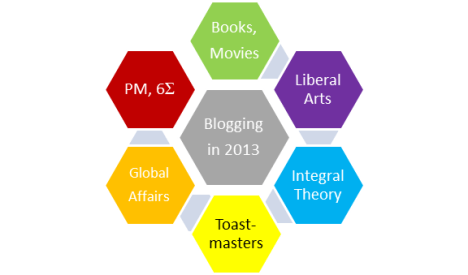
I was putting together a plan for the coming year in general about what topics to cover on my blog, and I realized that I would like to combine the approach of doing something similar to what I was doing and what Stephen Fry suggested. Besides writing on the technical subjects of project management and Six Sigma, I want to write on the opposite side of my brain and include more about the liberal arts subjects I missed studying as an undergraduate to become an engineer.

I’ve already written about the first three areas listed below heavily in 2012, and plan to expand my posts to include more on the last three areas in 2013.

Area Examples
1. Project Management, Six Sigma PMBOK Guide 5th edition detailed summary,

Six Sigma Green Belt contents summary

2. Global Affairs Webinars by Economist Intelligence Unit on global hot spots, World Economic Forum Global Risks Survey, Global Trends 2030 Report
3. Toastmasters

(public speaking, leadership)

Topics related to public speaking and leadership from various speeches, conferences and contests in Toastmasters International
4. Integral Theory Core Integral Theory course, review of SES and other classics by Ken Wilber
5. Liberal Arts Teaching Company courses on history of literature, religion, philosophy, and US History
6. Books, Movies Develop reading program and do more book reviews and occasional movie reviews

Occasionally, another topic will come up like the topic of exercise, or some other topic that relates to me personally, but I hope the mix will go from narrower to a wider range as 2013 progresses.

Part of my reason for expanding my blog posts is not just because I am interested in those areas, but in those “test posts” I have done by putting sample posts on the subject online on my blog, I have gotten positive feedback in the form of those who have gone and read them.

Another reason for writing the posts is make me a better writer, but in a blog format that allows illustrations, charts, tables, and sometimes even maps to illustrate my point. It will be just about three months when I come up on my first year of blogging and I intend to keep busy producing content that is not only for my own use and enjoyment, but which will hopefully be useful (and enjoyable) for others as well.