One Size Does NOT Fit All–Empowering Women Executives


At the Society for Information Management Women conference held on Thursday, May 5th in Chicago, IL, one of the keynote speakers Suzanne Bates, CEO of Bates Communications, described efforts of many companies to empower their women executives and how these efforts fail despite good intentions because they take a “one size fits all” approach.

I had the opportunity to attend the conference, although I am not a woman nor in information management, because of the good fortune I had to represent our Project Management Institute’s Chicagoland chapter as one of the sponsors of the event.

So I gave about the chapter during the network breaks, but was able to attend the keynote speaker presentations, including the one by Suzanne Bates.

First of all, some statistics on women executives.   Although women represent 47% of the labor force, and 44% of all MBAs earned are by women, only 14-15% of executives are women.    Companies have long recognized the need to diversify their work force, and have done various activities to encourage women to become executives or develop their career once they are executives.

But, according to Suzanne Bates, one of the activities they try to do is to send ALL women on workshops, for example, to increase their confidence.   This sometimes backfires–but why?    Because if you study the trait of “confidence”, and to statistical studies of the performance reviews of men and women, you find the startling conclusion that men are not, as a group, more confident than women.   Women, on the other hand, if they are feeling a lack of self-confidence, tend to express this more to colleagues, whereas men who are feeling this way tend to bottle up these feelings inside.   So the PERCEPTION is that women are less confident, but that is not the REALITY of the situation.

In order to tease out reality from perception, Suzanne Bates created a set of metrics for “executive presence” that fall into one of three categories:

  1. Character–qualities of the leaders as a person that are fundamental to his or her identity and ive us reason to trust him or her:   Authenticity, Integrity, Concern, Restraint, Humility
  2. Substance–cultivated qualities of mature leadership that inspire commitment, inform action, and lead to above-and-beyond effort:  Practical Wisdom, Confidence, Composure, Resonance, Vision
  3. Style–Overt-skill-based patterns of communicative leadership that build motivation and shape and sustain performance:  Appearance, Intentionality, Inclusiveness, Interactivity.

In measuring these traits among male and female executives, the surprising result was that more significant difference among women than between men and women executives taken as a group.    By just telling women to “be more confident”, we are not teaching women the specific skills they need to succeed, by focusing on the strengths among the above traits they already have, and developing a plan to shore up their weaknesses.

By doing an “executive presence” skills assessment, and then following up with external coaching and internal mentoring, women can increase the skills they need to both be and be perceived to be strong executives who earn the respect of their teams, their colleagues, and their direct reports.

In the end, Suzanne Bate concluded that women, it turns out, are not ‘broken’ and do not therefore need to be fixed to succeed in the corporate culture. It is the corporate culture itself that needs to be fixed, by allowing both men and women executives a chance to improve their specific executive presence skills they need to focus on to succeed.

I was so impressed with the talk that I am making sure I send a copy of her book “All the Leader You Can Be” to my fellow directors at the Chicagoland chapter of the Project Management Plan to see how we can implement its contents to diversity our leadership at our chapter!

District 30 Toastmasters South Division Action Plan


At last Saturday’s Spring Conference for District 30 Chicagoland of Toastmasters International, I was elected to be the South Division Director.

In an earlier post, I talked about the best ways to prepare for being a Division Director, but now that my desire has become a reality, I need to put down my action plan for making sure that I am both effective (doing the right thing) and efficient (doing things right) in the Division Director position.   These are all to be accomplished in the month of May and June, the bulk of the plan being done this month.

We had a surprise handed to us at the South Division because of another area that was added in the week before the Spring Conference making the South Division have a total of 7 areas, as opposed to the other divisions which have only 6 areas at most.

1.  Select Area Directors–S51 through S55 already selected

1.1  Select Area Director for S56

1.2  Select Area Director for S57

2.   Interview Outgoing Area Directors for SWOT analysis of Areas

3.   Interview Incoming Area Directors for skills, personality assessment (Myers/Briggs)

4.  Submit Area Director list to incoming District Director for approval

5.   Setup South Division folder on Google Drive or Office 365, create subfolders for each area

5.1  Give access to each Area Director to South Division folder

6.   Get District calendar deadlines from incoming District Director

7.   Setup planning retreat in May for Incoming Area Directors and Outgoing Area Directors

7.1   Decide date, venue based on availability of Area Directors

7.2   Create or buy planning materials (markers, post-it notes, etc.) for planning retreat

8.    Ask Area Directors to get assistant(s) for position

This is a living document–I intend to let my Assistant Division Director review it, and then we’ll start putting deadlines on it by this Friday, 5/6/2016.


District 30 Toastmasters Diversification Plan


I came to District 30 Toastmasters here in the Chicagoland area back in the summer of 2013.   It’s coming on three years now, and in that time, I had in the back of my mind a plan to increase the diversity of Toastmasters within the District, but did not felt I could act on it until I became a Distinguished Toastmaster (DTM).    This is because it is a sweeping vision, and I didn’t feel that people would take me seriously enough to consider it until I had some solid Toastmaster credentials after my name.

Last Saturday night, I was sitting at the ceremonial dinner held before the DTM induction ceremony  when I sat next to someone who reminded me inadvertently of my plan.   It was as if the universe was saying, “you know how you told yourself you would put this off until you became a DTM?   Well, you’re just about to become a DTM, so here’s a little reminder!”

That person was Tadeo Speiser, an Hispanic-American whose family came here from Ecuador.   We talked about my interest in learning Spanish and other foreign languages, and how Toastmasters could become a vehicle for increasing at the same time the multilingual and multicultural character of the District.   He invited me to the Hispano-Americano Toastmasters Club this Saturday, May 7th, to talk to the club about this topic.

Toastmasters Diversification Plan

  1. Increase the number of Hispanic-Americans who participate in Toastmasters Clubs throughout District 30.
  2. Support the multilingual clubs like the Hispano-Americano Toastmasters Club, the Francophone Toastmasters Club, and the Polyglot Toastmasters Club (for German).
  3. Explore the creation of additional multilingual clubs involving the immigrant communities from Poland, China, or other large immigrant populations in the Chicagoland area.
  4. Make English as a Second Language (ESL) resources available to clubs throughout the District 30 Chicagoland area to help those members who are trying to improve their English ability.
  5. Explore the creation of an ESL Toastmasters Club.

To use the language of project management, this is a portfolio-level plan.   I had approached a project manager I respect regarding this as a potential High Performance Leadership (HPL) Project, and he correctly pointed out that this is way to big for such a project.  An HPL project can take months, but this plan would take at least two years to implement.

However, the journey of a thousand miles begins with one step, and the first step is to write down the plan and put it out to the public, because this will spur me on to take action on not have it just remain a dream.

My next step will be to present this at the Hispano-Americano Toastmasters Club this Saturday.   As a Division Director, I will interacting with District-level leadership who will have good recommendations on how to go about implementing this plan.

For example, Charles Brooks, an African-American who was a District Governor about a decade or so ago, had the idea of diversifying District 30 so that it better served the African-American community.   Now the clubs that he has seeded throughout the South Side of Chicago, such as the Wrightwood-Ashburn Overachievers (WAO) club, have become powerhouses in their own right not just in the South Division, but in the District at large.   I am sure to take a lot of cues from him on how he accomplished this.

Of course, I have to develop connections to the Hispanic-American community in Chicagoland, and that is why I welcomed my interaction with Tadeo Speiser.   I look forward to seeing him again and the rest of the members of the Hispano-Americano Toastmasters Club this Saturday!

Multilingual Language Learning Plan–May 2016


In March, I went to a local bookstore and got Benny Lewis’ book Fluent in 3 Months.   One of his first recommendations for learning multiple languages at the same time is to make concrete goals for each of the languages you intend to focus on.

So I wrote down a multilingual learning plan, which I intend to review every month.    The purpose of today’s post is to review the plan for April 2016 and improve upon it in drawing up a plan for the month of May.

  1. Multilingual language goals–Long-term

I am fluent in five foreign languages if you measure that fluency in terms of B1 level or higher on the Common European Language Framework.

So for those five languages, I have put my goal to become one level higher by 2017.

For the languages I have been studying but which I have not achieved fluency, I am also putting my goal to become one level higher by 2017.

For those languages I have not studied before, but which I want to study in 2016, I’m putting the target as BEGINNER (A1).

Level Goal Language
C2–Mastery
C1–Advanced Japanese, French
B2—Upper Intermediate Chinese, German, Spanish
B1–Intermediate Italian, Portuguese
A2–Elementary Arabic
A1–Beginner Korean, Dutch, Hindi, Irish, Vietnamese

Although I put all languages on my level goal list, certain languages have higher priority level, which translates into studying frequency.   Also, although my ultimate goal is to speak with native speakers, my intermediate goal  is to use textbooks in order to prepare for proficiency tests.

2.  Multilingual goals–method, priority level

Language Goal (Test/Textbook) Priority
Japanese JLPT N2, Tobira High
French DALF C1/C2 Medium
Chinese HSK 4, eChineseLearning (online lessons) High
German ZDfB (B2) Medium
Spanish DELE B2, AP Spanish Medium
Italian Italian Now Medium
Portuguese Portugues Actual Medium
Arabic Mastering Arabic, Rosetta Stone 3 Low
Korean Integrated Korean Beginning 1 Low
Dutch Living Language Beginner Low
Hindi Beginning Hindi, Rosetta Stone 1 Low
Irish Living Language Essential Low
Vietnamese Elementary Vietnamese Low

3.   Multilingual goals–April 2016 (review)

Here were my goals for the past month..

Language Goal (Test/Textbook)
Japanese Kanji Kentei review level 9–still working on level 9!!
French Start review of Foreign Service Institute French course level 1, units 1 and 2–still on unit 1
Chinese–DONE 2x/week Skype lesson with eChineseLearning, HSK 4 listening comprehension test #2 prep
German Duolingo (complete entire skill tree)–completed up to level 6 out of 8
Spanish Start review of Foreign Service Institute Spanish course level 1, units 1 and 2 (only completed unit 1)
Italian NONE
Portuguese NONE
Arabic Mastering Arabic ch. 2, 3–only completed ch. 1
Korean Integrated Korean Beginning 1 (reading Hangul)–haven’t completed Hangul
Dutch NONE
Hindi NONE
Irish NONE
Vietnamese NONE

Well, I can tell you I didn’t accomplish very many language goals in April.   I did complete my three-month course of language learning at eChineseLearning, but the other goals I only partially completed.

But here’s why I’m putting these goals on my blog–because my failure to achieve them is public, it makes me want to rededicate myself to the goals of May.

Let’s see what I accomplish in the month of May!

Language Goal (Test/Textbook)
Japanese Kanji review level 9 (grade school level 2)
French Duolingo (refresh skill tree)–start DALF training (C1/C2)
Chinese Intermediate Spoken Chinese Unit 1
German Duolingo (complete entire skill tree)
Spanish Duolingo (refresh skill tree)–start AP Spanish (C1)
Italian Start Italian Now
Portuguese Start Portuguese Grammar
Arabic Mastering Arabic ch. 2
Korean Integrated Korean Beginning 1 (reading Hangul)
Dutch None
Hindi Beginning Hindi (reading Hindi script)
Irish Living Language Essential ch. 1
Vietnamese Elementary Vietnamese Pronunciation Guide

Here’s how I will improve my language plan for May.

a.  High-priority languages–after completing a three month Skype course in Chinese, I need review of some basic conversational patterns.   I got a textbook Intermediate Spoken Chinese from Tuttle Publishing which does exactly that.   What I like is that the conversations are recorded so that you can take the part of one person in the dialog at a time to really see if you can speak Chinese not just correctly, but at a conversational pace.

For Japanese, I found that the first step of the  review I can do for the JLPT N2 level exam is to review the Kanji and vocabulary for levels N5, N4, and N3.  In turn, the way to do this is to go through the elementary school Kanji grades 1 through 6, which means in terms of the Kanji Kentei (the Japanese Kanji Proficiency test aimed at native Japanese) to review levels 10 through 5.   This month I reviewed level 9 (grade school 2) by going all of the readings in a workbook and putting them on flash cards.   However, each grade there are more and more Kanji so, although I could finish all the level 10 Kanji in a month in March, I wasn’t able to do the same for the level 9 Kanji in April.    I’m practicing my Japanese listening skills by watching the NHK historical drama Ryomaden on Drama Fever.

b.  Medium-priority languages–I finished the skill trees for Spanish and French on Duolingo and am reviewing those languages now by listening to the Foreign Service Institute’s courses for Spanish and French.

I’m starting the 7th level of the German skill tree.   I aim to be done by the month of June.  It works well to concentrate on completing one skill tree at a time while periodically reviewing the ones I’ve already completed.    So I’ll complete the German skill tree before I start on Italian and Portuguese.

c. Low-priority languages–I was WAY too ambitious by listing all of the languages.   I started Arabic using a great textbook Mastering Arabic Vol. 1, but need to continue with Chapter 2.    I found that textbook is way better than the one I had been using before.   Korean and Hindi have different writing systems which I need to master before studying the languages in more depth.

d. Metalanguage–I found that Benny Lewis’ book Fluent in 3 Months was a great motivator for my language studies.  I’ve decided to get an online subscription to his Fluent in 3 Months website in order to go into more depth the principles that were in his book.   The first section is on Language Hacking, using tips and tricks to accelerate my language study of any language I’m studying

Let’s see what I accomplish in the month of May!

Which Way Did They Go? I’m Their Leader!


At the District 30 (Chicagoland) Toastmasters Spring Conference, the keynote speaker was Jana Barnhill, a past International President of Toastmasters.    In the past, we have had speakers who were champions of the World Championship of Public Speaking.    At this conference, we had somebody who was a champion of leadership at Toastmasters International.

In her talk “Which Way Did They Go?  I’m Their Leader”, Jana Barnhill gave some apropos advice which I definitely took to heart since I had earlier in the day been elected to the position of Division Governor which starts on July 1st.

  • Lead by Example–if you get in the trenches and work hard with your team, they will be willing to work hard for you
  • Everyone must know what is expected of them–you need to give them the locations of the gates they must go through, but you can allow them to figure out how to get to those gates
  • Know as much about the organization’s policies and procedures as possible–when you can answer a question from your team without having to say, “let me get back to you on that”, you will gain authority in their eyes
  • Seek advice wherever available–on the other hand, if you DON’T have the answer to a question, admit you don’t know and find out!
  • Achievers must be recognized–don’t take the achievements of your team for granted
  • Show respect to everyone–you were there once yourself, and so you need to extend your courtesy to those who may be asking something that to you is obvious
  • Be positive–“yes, you can” should be your motto
  • Have a sounding board–if you ARE negative, however, don’t be negative in front of your team, have a PRIVATE sounding board, preferably somebody outside the organization who doesn’t know the other personalities involved:   this will make them more objective when you listen to their complaints
  • Stay focused–there are so many demands on you and your team, keep reminding them what the focus is so it doesn’t get lost in all the noise
  • The person in charge takes full responsibility for any failures , but …
  • Full credit for success goes to the team!

What I liked about Jena Barnhill was, when I went to ask her a question after a talk, I didn’t get the feeling I was talking to a Past International President of Toastmasters.   She didn’t come across as a celebrity or royalty, but as just a more experienced leader in Toastmasters that anyone could go to for help or advice.    I am more confident of my ability to enter the Division Director position because I intend to follow her advice she gave at our Spring Conference!

District 30 Toastmasters Conference–Day Two


For those who are in Toastmasters in the Chicagoland area, there is an event happening today and tomorrow which I personally call “Disneyland for Toastmasters” called the Spring Conference.

The Spring Conference takes place on Friday  evening and all day Saturday evening, 4/29 and 4/30, respectively.

The reason why we are doing the conference in one and a half days is because there is too much going on to have it in a single day.

Here’s what’s on the menu for the conference program today:

  • Achiever’s Breakfast
  • Opening Ceremony/Parade of Banners
  • Area Director Recruiting Station
  • Workshop by Past International President Jana Barnhill (Keynote Speaker)
  • New Member Orientation
  • Business Meeting/District Leader Elections
  • Club Awards Ceremony
  • International Speech Contest
  • Dinner keynote speech:   Soar for Your Success by Jana Barnhill
  • Distinguished Toastmaster installation ceremony

The highlights of today were;

  • Getting my Triple Crown award at the Achiever’s Breakfast, an award for getting three educational awards from Toastmasters in a single year.   I got the Leadership in Excellence award, the Advanced Leadership Silver award, and the Distinguished Toastmasters Award all in the same year, which qualified me for the Triple Crown award as well.
  • I enjoyed all of the talks by Jana Barnhill on leadership, including her last dinner keynote speech on Soar for Your Success
  • At the busines meeting, I was elected Director of the South Division.
  • I sat by my fellow Windy City Professional Speakers Club member Nancy Depcik in the hallway as she awaited her turn as the last speaker out of nine in the International Speech Contest.   I told her stories to get her mind off of the impending contest, which she said helped her relax and stay focused rather than worrying about the applause, laughs, or other reactions the other speakers were getting.   Finally, at dinner I found out at the announcements for the winners that Nancy Depcek came first in the District and is going on to Washington for the World Championship of Public Speaking.
  • I got my DTM medallion in a ceremony where I shook the hand of every person in District 30 who has a DTM award already, welcoming me into the family as it were.

It was a great experience, I think I’ll be processing what went on to do for months to come!


District 30 Toastmasters Spring Conference 2016–Day One


For those who are in Toastmasters in the Chicagoland area, there is an event happening today and tomorrow which I personally call “Disneyland for Toastmasters” called the Spring Conference.

The Spring Conference takes place on Friday  evening and all day Saturday evening, 4/29 and 4/30, respectively.

The reason why we are doing the conference in one and a half days is because there is too much going on to have it in a single day.

Here’s what’s on the menu for the conference program tonight (Friday).

  • Table Topics Speech Contest
  • Explanation of the new Revitalized Education Program
  • Comedy Tonight with Dobie Maxwell
  • Talent Show

I helped at registration so I missed some of the events tonight, but tomorrow I plan to be on early registration (up to 7 AM) so I can enjoy the rest of tomorrow’s program, which plans to have the following

  • Opening Ceremony/Parade of Banners
  • Area Director Recruiting Station
  • Workshop by Past International President Jana Barnhill (Keynote Speaker)
  • New Member Orientation
  • Business Meeting/District Leader Elections
  • Club Awards Ceremony
  • International Speech Contest
  • Dinner keynote speech:   Soar for Your Success by Jana Barnhill
  • Distinguished Toastmaster installation ceremony

I will probably have a lot more to report on tomorrow–tonight I’m going back down to the hotel main floor to watch the rest of the Table Topics and have some drinks with fellow Toastmasters afterwards.   That’s why this time I got a hotel room at the conference, so I could socialize without having to leave early for the hour drive home.

It’s a Toastmaster holiday and I want to enjoy every moment that I can!


Toastmasters Division Director Position–5 Ways to Prepare Yourself for Success


Tomorrow at the District 30 Toastmasters Spring Conference, I am throwing the proverbial hat in the ring and running for Division Director position of the South Division.

Actually, I threw my hat in the ring months ago, but tomorrow is the election, because the Division Director is an elected position, as opposed to the Area Director position, which is an appointed one.

I have been preparing for this position for quite some time, and I wanted to pass on my ideas on how to prepare yourself for success as a Division Director for those considering the position.

  1. Be an Area Director–since you will be directing all of the Area Directors in your Division, you need to know from their perspective what they will need to be doing in their roles.
  2. Be an Asst. Division Director–all this past year, I have assisted the current Division Director in order to find out what the Division Director position entails.   I have attended all of the District Executive Committee or DEC meetings, I have assisted with all of the Area and Division level Speech Contests, and helped with other areas such as running the Division makeup training for club officers who have not attended  the District-level Toastmasters Leadership Institute.   Besides learning how to do the job, I have gotten to know the people at the District level of leadership.    I will go into the Division Director position hitting the ground running because I already know and have worked together all of the people I will be dealing with.
  3. Recruit an Asst. Division Director–I hope I have been helpful to the Division Director, but I knew that going into the Division Director is still a daunting task even if I have already practiced it a year as an Assistant myself, so I was sure to recruit an Asst. Division Director who will help me with the planning of all the events in the Toastmasters year.   He is a fellow project manager and understands the need for good planning.
  4. Recruit and interview the potential Area Directors–you can’t choose the Area Directors, you can only recommend them to be chosen by the incoming District Director.   However, the selection process by the incoming District Director can be made easier if you yourself gather information on the Area Directors, including: a) their previous leadership experience at the club level, b) their ability to use computers, which is crucial in doing some of the tasks they must accomplish, and c) what they want to get out of the position in terms of leadership growth.   In between the lines, the interview should be an opportunity for you to judge what kind of a fit this person will have with you and the rest of the team.
  5. Have a pre-planning retreat with your Area Directors–the Asst. Division Director are planning to have a planning retreat with all of the Area Directors in the month of May BEFORE the regular training takes place.   This will give us a chance to present to the Area Directors what the requirements and benchmarks they will have to clear from the District perspective.   And then, rather than say, “you should start doing your Club Visit reports in July”, we will put the District calendar including all relevant deadlines on a whiteboard and ask the Area Directors to help us put together a plan of when they have to get things done.   As far planning is concerned, if they are just shown it, they won’t own it.   They have to participate in the planning if they are to buy into why they have to complete certain tasks.

This will not guarantee success as a Division Director, but it will greatly put the odds in your favor.   These are just suggestions, and anyone who is a Toastmaster who either has been a Division Director or who is planning on being one is welcome to give me feedback on other tips for success.

To the best of success in the 2016-2017 Toastmasters year which starts July 1st, 2016!

The Fourth Industrial Revolution and Network Capital


Klaus Schwab, the Founder and Executive Chairman of the World Economic Forum wrote an article for Foreign Affairs magazine on January 14th of this year entitled:  “The Fourth Industrial Revolution:  what it means, how to respond”.   In this post, I will discuss his article, the article “This is the business model needed to master the Fourth Industrial Revolution” by Knowledge@Wharton, and the book “Collective Disruption” by Michael Docherty.

What is the fourth industrial revolution?

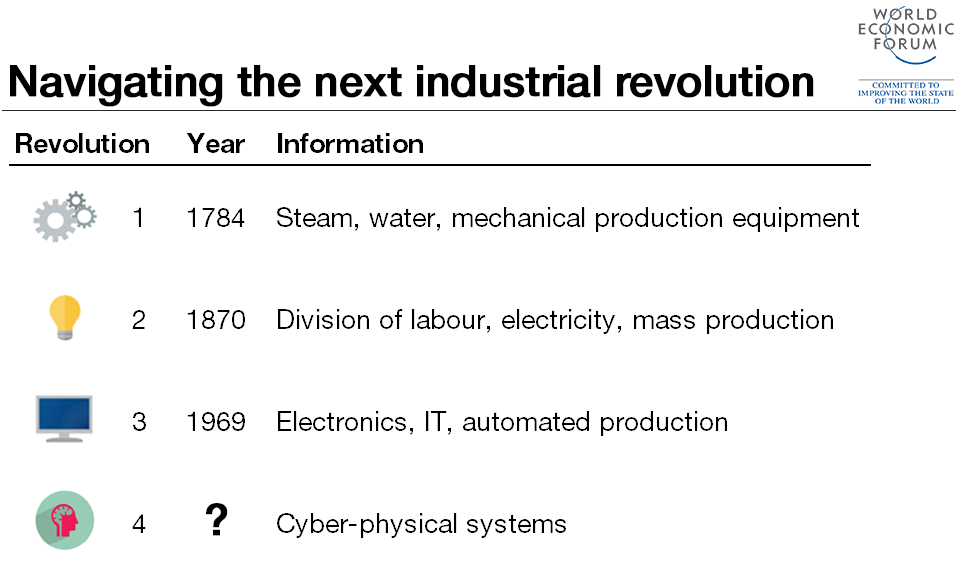
The first industrial revolution harnessed the power of steam to production and ushered in the age of mechanized factories.   The second industrial revolution harnessed the power of electricity to create mass production.   The third industrial revolution harnessed the power of electronics and information technology to automate production.

The fourth industrial revolution will take the power of digital  technology and combine it with physical and biological systems.   Here’s a chart summarizing these four industrial revolutions, taken from Klaus Schwab’s article, which can be found at

https://www.weforum.org/agenda/2016/01/the-fourth-industrial-revolution-what-it-means-and-how-to-respond

Some of the technologies represented by the Fourth Industrial Revolution are:

  • artificial intelligence and robotics
  • the Internet of Things
  • autonomous vehicles
  • 3-D printing
  • nanotechnology
  • biotechnology
  • materials science
  • energy storage, and
  • quantum computing.

Here’s an example of just one of these categories, energy storage.   I attended a TEDx talk given at IIT by Dr. John Katsoudas talked about how nano-liquid can be the breakthrough that is needed to jump-start the market for purely electric vehicles.    At present, electric vehicles suffer the problem of limited range due to the limited ability of the current state of technology to store energy in its batteries.  By taking nanoparticles and incorporating them in a conductive fluid, the resulting nano-fluid has an energy storage capacity that outstrips the current state of battery technology, thus making a battery that could create an electric vehicle with a range rivaling that of current gasoline vehicles.   This could be the bridge to a purely electric-vehicle market.

Klaus Schwab contends that the technologies listed above that comprise the Fourth Industrial Revolution are having a major impact on businesses on the supply side, by agile competitors disrupting existing supply chains, and on the demand side, by growing consumer engagement forcing new ways to design, market and deliver products.

In general, the four main effects are on

  • customer expectations
  • product enhancement
  • collaborative innovation, and
  • organizational forms.

Let me discuss the third of these four main effects, on collaborative innovation.   In the article on the business model needed for the Fourth Industrial Revolution, there are four types of capital needed:

  1. Physical capital
  2. Human capital
  3. Intellectual capital
  4. Network capital

Although the third industrial revolution involved the first three types of capital, it is fourth type of capital, network capital, which is the new type of capital required to succeed in the Fourth Industrial Revolution.

For an example of a model which attempts to build that network capital, I refer you to the book “Collective Disruption:   How Corporations and Start-Ups can Co-Create Transformative New Businesses” by Michael Docherty.   Large companies can avoid falling behind in the Fourth Industrial Revolution by partnering with entrepreneurs and start-ups to create a network he calls an “innovation ecosystem” to help companies create not just new products but also entirely new lines of business.

As a Project Director for the Leadership Forum 2016 event being held at the Project Management Institute’s Chicagoland chapter, I am organizing a forum to be held on May 20th, 2016 where we are inviting over 150 executives to discuss Michael Docherty’s book.

  • Why big companies are being left behind in the new hyperfast innovation game
  • How an innovation ecosystem can help companies create not just new products but also entirely new lines of business
  • How the entrepreneurial skills of lean startups can (and can’t) be applied in the corporate environment
  • How a co-innovation strategy—with entrepreneurs and corporations—yields new business creation faster and at a lower risk
  • New approaches to business incubation that leverage the best of entrepreneurial and corporate skills in prove-out and scale-up
  • What skills are needed to manage this co-creation process for the profitability and success of all involved

The forum is called Strategy for Innovation:  The PM Advantage because those projects created through the process of collective disruption will require project managers who are able to speak in the traditional project management “language” that big companies are used to, and the newer language of “agile” project management which is what start-up companies are more conversant with.    This issue is so important that we are having the Chair of the Board of PMI Global, Antonio Nieto-Rodriguez, to come and speak about it.

Our forum is designed to get the conversation going, as the first step in making Chicago not a bystander, but an enthusiastic participant in the forefront of the Fourth Industrial Revolution.


10 Reasons to attend District 30 Toastmasters Spring Conference 2016


Ten (10) top Reasons to Attend the Spring Conference 2016


District 30 Toastmasters covers the Chicagoland area (the city and surrounding suburbs) and here is the official list of the top 10 reasons for attending, according to the District 30 website.

10. Hospitality of the Skokie Holiday Inn–rather than stay late Friday night and get up early Saturday morning, stay at the Holiday Inn and be able to RELAX and enjoy the event!

9. Comedian Dobie Maxwell–showing how a professional entertainer gets the crowd to laugh

8. District 30 Toastmasters Got Talent Show–I tried to enter this event, but it was so popular, that the entry list was closed weeks beforehand.   Better luck in the Fall!

7. Network and have F-U-N!–I see all the people I’ve come to know over the past half-year, and I get to meet a lot of new ones.

6. Awesome Educational Sessions–learning how to be a better speechwriter?   How do use improvisational techniques in your speeches?    Do you want to learn how to do a High Performance Leadership Project?   Do you want to learn how to become a professional speaker?  Come to the educational sessions and find out!

5. Table Topics and International Speech Contest–these contests started back in January at the club level.    For those of us who have been behind the scenes running Area and/or Division Contests, it is thrilling to see people who have improved their club level speech when going to the area level, and then who have improved their area level speech when going to the division level.    Now the division finalists need to improve one more time to go to the district competition.    So it like seeing your child go from Little League to the World Series!

4. To SOAR For Your Success!–get inspired by the examples of speakers and leaders to finish the rest of the Toastmaster year in style.

3. Proudly Carry the Club Banner in the Parade of Banners–strut your stuff for your club!

2. Hear Keynote Speaker Jana Barnhill, DTM, PDG, AS, PID, PIP–her Toastmaster pedigree is longer than her name.   One of the pioneering women of Toastmasters will distill for us the experience she has gained and give us advice on how to be better leaders.

1. To Share Your Own Uniqueness–each person has their personality, and each club does as well.   Meet the individuals who have taken their membership and made it into a thing of beauty by adding their own personality to the mix!

I would add an additional reason for going to the Spring Conference, and that is because I am running for a Division Director position and am going to be giving my “stump speech” at the Business Meeting.    In addition, the business meeting will discuss many important topics, such as how District 30 will split into two during the coming year:   one district will be downtown Chicago and the South Suburbs, and one district will be all of the surrounding suburbs except the South Suburbs.    It’s not a punishment, it’s a reward as a result of the constant growth that the District 30 Chicagoland has displayed in the past few years.   It has reached the “magic” number of 240 clubs, which according to our parent organization Toastmasters International, is where a district needs to consider splitting in order to create districts that are manageable.

It will be a two-day Toastmasters version of Disneyland, in my opinion, and I look forward to enjoying every moment.   One of the main reasons why is ANOTHER reason for going to the Spring Conference, namely, to get presented with a medallion in recognition of the fact that after 5 years in Toastmasters, I am finally going to achieve the highest level of personal achievement, namely, the Distinguished Toastmaster award!    At first when I joined I thought becoming a DTM was like going to the top of Mount Everest.   No, I realize now that it is in reality just base camp.    There’s a whole mountain range awaiting for me, as Jana Barnhill, PIP (Past International President) can attest to!