5th Edition PMBOK® Guide–Step 6: Memorizing Inputs & Outputs (Integration Management Part 1)


1. Introduction

In this next series of posts on memorizing the processes, we move on to the final step 6, which is memorizing the INPUTS & OUTPUTS associated with each of the 47 processes.   In order to breakdown the memorization into more bite-size chunks, I am breaking down the processes in the 10 knowledge areas into 2 or 3 posts each.


2.  Review of Processes, Tools & Techniques in Integration Knowledge Area

Process Name Tools & Techniques Inputs Outputs
4.1 Develop Project Charter 1. Expert judgment

2. Facilitation techniques

1.  Project statement of work (SOW)

2.  Business case

3.  Agreements

4.  EEFs

5.  OPAs

1. Project  Charter
4.2 Develop Project Management Plan 1. Expert judgment

2. Facilitation techniques

1.  Project charter

2.  Outputs from other processes

3.  EEFs

4.  OPAs.

2. Project Management Plan

3.  Outputs of Integration Knowledge Area

Let’s go backwards and start with the Outputs first–they are usually more obvious than the inputs.

a.  Project charter (4.1 Develop Project Charter)

Okay, it should be fairly obvious that the output of the “4.1 Develop Project Charter) process is going to be the “Project charter”.    The project charter is the document issued by the project initiator or sponsor that formally authorizes the project.  It documents business needs, assumptions, constraints, and the customer’s needs and high-level requirements.    These collectively can be considered the “high-level boundaries of the project.”

b.  Project management plan (4.2 Develop Project Management Plan)

Likewise, it should be fairly obvious that the output of the “4.2 Develop Project Management Plan” is going to be the “Project Management Plan.”   It consists of

  • all of the management plans from all the other 9 knowledge areas
  • the 3 project baselines (scope, schedule, and cost baselines)
  • subsidiary management plans (requirements management plan, process improvement plan, change management plan, configuration management plan

It is the detailed description of how the plan will be carried through the execution and monitoring & controlling process groups to the end of the project.

4.  Inputs of Integration Knowledge Plan

Okay, now that the outputs are clear from the names of the processes, let’s see if we can look at the inputs for each process.

a.  Project Statement of Work (SOW) (4.1 Develop Project Charter)

The Project Statement of Work, sometimes referred to as an SOW, is the “seed” of the project, and it contains a high-level description of the products or services to be delivered by the project.

b.  Business Case (4.1 Develop Project Charter)

There should be some sort of business need for the product or service, a demand that might be created by one or more of the following factors:

  • Market demand
  • Organizational need
  • Customer request
  • Technological advance
  • Legal or regulatory requirement
  • Social need

The business case ties together the product together with the business need (to show that there is a market for the project) and a cost-benefit analysis (to show that the benefits will outweigh the costs) to show that the results of the project will be aligned with the strategic plan of the company.

c.  Agreements

If the organization is to produce a product for an external customer, than a contract, memorandum of understanding (MOU), or other written agreement is an input to this process.

d.  Environmental Enterprise Factors or EEFs (4.1 Develop Project Charter)

  • Government or industry standards
  • Organizational culture and structure
  • Marketplace conditions

These give the environment in which the project takes place.

e.  Organizational Process Assets or OPAs (4.1 Develop Project Charter)

  • Organizational standard processes, policies, and process definitions
  • Templates (for project charter template)
  • Historical information and lessons learned database

These give the documentation on which the project processes are based.

f.   Project Charter (4.2 Develop Project Management Plan)

This is a typical pattern, where the output of one process (4.1 Develop Project Charter) becomes the input to the next process in the sequence (4.2 Develop Project management Plan)

g.  Outputs from other processes (4.2 Develop Project Management Plan)

Since the Project Management Plan is really not one single plan, but an coordination of all the other management plans throughout the 9 other knowledge areas, it makes sense that one of the inputs is going to be … all the other management plans.  That’s what this input stands for.

h.  Environmental Enterprise Factors or EEFs (4.2 Develop Project Management Plan)

  • Government or industry standards
  • Project management body of knowledge for application area
  • Project management information system (e.g., Microsoft Project, Primavera)
  • Organizational culture
  • Infrastructure
  • Personnel administration

These give the environment in which the project takes place, either those external to the organization (the first two) or those internal to the organization (the last four).

i.  Organizational Process Assets or OPAs (4.1 Develop Project Management Plan)

  • Standardized guidelines, work instructions, proposal evaluation criteria, and performance measurement criteria
  • Project management plan template
  • Change control procedures
  • Project files from previous projects
  • Historical information and lessons learned knowledge base
  • Configuration management knowledge base

These give the documentation on which the project processes are based.   Since the Integration Knowledge Area is where all the changes to the project are managed, the subsidiary plans from the change management plan (change control procedures) and the configuration management plan (configuration management knowledge base) are inputs to this process.

With the inputs and outputs, it is harder to actively memorize them, in the sense of being able to recall a list of them given the name of any particular process.    It is sufficient for the purpose of the PMP certification exam, however, to be able to recognize them passively, so that given a list of 4 possibilities, you can pick the one that most likely applies to any given process.   In order to do this, understanding the purpose of the process, plus the tools & techniques used in this process, should be sufficient.

The next post will cover the next two processes in the Integration Knowledge Area, 4.3 Direct and Manage Project Work and 4.4 Monitor and Control Project Work.

Integral Theory and Project Management–Tenet #12


This series of posts take the Ken Wilber’s introduction to Integral Theory called A Brief History of Everything and discusses the 12 main tenets concerning the concept of a holon and how they can be applied to the field of project management.   This is the last post in the series, and it covers tenet #12.

1.  Recap–definition of a holon, and tenets #1-11

A holon is an entity which consists of components, and yet is itself a component of a larger whole.

Tenet #1. Reality as a whole is not composed of things or processes, but of holons.

Holons must be considered from the standpoint of interacting with other holons on the same level, and with holons at higher levels (of which the holon is just a part) and lower levels (which comprise the parts of the holon).

Tenet #2 Holons display four fundamental capacities: The horizontal capacities of self-preservation, self-adaptation, and the vertical capacities of self-transcendence and self-dissolution.

Holons follow the dual rules of evolution when it comes to holons at the same level:    survival of the fittest (self-preservation) and survival of the fitting (self-adaptation).    Holons have the property of being able to evolve to the next highest level (self-transcendence), and they can also “devolve” into their component parts (self-dissolution).

Tenet #3 Holons emerge

As mentioned in Tenet #2, holons have the property of self-transcendence or evolution to the next highest level.    This is not just a higher degree of organization, but also involves emergent properties or differences in kind from the level below.

Tenet #4 Holons emerge holarchically

Holons, as seen above, are units that are both wholes containing parts and parts of larger wholes.   This kind of nested or concentric linking of holons reminiscent of the Russian matroshka dolls is considered a holarchy.    In contrast, we see in an organizational chart the traditional notion where parts are linked vertically to the levels above them (the notion of hierarchy), and horizontally to the units at the same level (the notion of a heterarchy).

Tenet #5  Each emergent holon transcends but includes its predecessor(s)

When a higher level of holons emerges, it incorporates the holons from a lower level but adds emergent properties.  A cell contains molecules, but is an entity which is capable of reproduction, where a property that goes above and beyond what a mere collection of molecules could do on its own.

Tenet #6  The lower sets the possibilities of the higher; the higher sets the probabilities of the lower.

Tenet #5  tells us that the higher level of holon has emergent properties which go above and beyond the lower level.  However, tenet #6 says that the higher level cannot ignore the lower level, and it there is bound to a certain extent by the possibilities set by the holons of the lower level.  However, the higher level also affects the lower level in that, the order imposed by the higher level of holons will influence the patterns in which the lower levels interact.

Tenet #7–The number of levels which a hierarchy comprises determines whether it is “shallow” or “deep”; and the number of holons on any given level we shall call its “span.”

Tenet #8  Each successive level of evolution produces GREATER depth and LESS span

This tenet follows from tenet #7 if you think about the definition of “depth” and “span” of a concentrically organized system of a holarchy.   Ken Wilber makes this point because if you look at the concentric diagrams of any holarchy, the circle containing the highest level of organization is going to be on the outside, and the visual impact is that it has greater “span” in terms of area.    He is simply emphasizing the fact that span refers to the number of holons at the same level; the reason why the circle is so large is so that it can encompass the lower levels inside of it.    The fact that the largest circle, representing the holon at the highest level, has several circles within it actually means that it has the greatest depth because it includes the most levels or holons (represented by the nested series of circles inside of it).

Tenet #9  Destroy any type of holon, and you will destroy all of the holons above it and none of the holons below it.

The lower level of holon, while having less depth than the higher level (based on tenets #7 and #8), is nonetheless more fundamental for precisely the reason mentioned in the tenet.   If you get rid of the lower level of holon, you are in fact getting rid of the very components of the higher level.

Thus the higher level is more significant, in terms of adding coordination and direction to the lower level of holons, but the lower level of holons are more fundamental to the enterprise, because without them, there would BE no higher level of holons.   In terms of project management It is very important to remember as a project manager, that despite the significance of all that you do as a manager of the project, and despite the fact that the project charter and your authority has to be sponsored by management, without the team members you would not have a project at all.   They are truly fundamental to the project’s success; that is why you must take care of the members of your team.

This tenet is, therefore, a lesson in humility and a warning against humiliation of any the members of your team for having made mistakes.    Failure is to be seen as an opportunity to learn, not to be cast in terms of blame or moral failing.    By understanding that the team member is more fundamental to the project than you are as the project manager, the more likely you will treat that team member with the respect that he or she deserves.     Once you do so, you will be surprised at how much more engaged that team member will be in the success of the project.

Tenet #10–Holarchies coevolve

Recall that a holon is an entity which is both a whole and a part of a larger whole, and a holarchy is that concentric nesting of holons at higher levels.    What does “coevolve” mean?    An individual holon exists in an environment, and it evolves to fit into the environment.   When the environment changes, the holon must also change in order to maintain its fitness.

What does tenet #10 mean in the context of project management?    Every project manager exists in a system of best practice regarding project management which is codified by the Project Management Institute into the Project Management Body of Knowledge or PMBOK®.   In order to survive in the fast-changing world of project management, the project manager must evolve as well through training, which is the whole point of the PDU system of continuing education.

Another example of the principle espoused in tenet #10 that “holarchies co-evolve (with their environments)” is the fact that companies in a certain application area need to evolve as the industry in that application area evolves.    The rapid growth of agile methodology in products involving IT development is a great example of this.    The recognition of the growing importance in the IT industry of agile methodology has meant that PMI is developing a new, separate category of certification called PMI-ACP or PMI-Agile Certified Practitioner to meet this demand for agile methodology.

Tenet #11–The micro is in relational exchange with the macro at all levels of its depth.

The first step in understanding this tenet is to figure out what “micro” and “macro” refer to when talking about a holon.    Each holon, say a person on a team, exists in a network of relationships with other holons at the same level of structural organization, in this case, other team members.    The “micro” referred to in the tenet means the “individual holon” and the “macro” refers to the “network of relationships with others holons at the same level of structural organization.”   Okay, each team member exists in a network of relationships with other team members.   So what?   Well, it should be obvious to a project manager that it is necessary for a successful project for the team members to have good relationships with each other, right?   So far, so good.

Where this tenet comes into play, is the insight that team members also exist in a network of relationships at higher levels of structural organization with the company–they are also members of certain functional departments, and they are also members of the organization as a whole as managed by upper management.     To maintain the success of a project, it is of course necessary to foster good relationships between team members, but it is not sufficient.   You must also foster good relationships between department members, and between members in relationship to upper management.

2.  Tenet #12–Evolution has directionality

Evolution is marked by creative emergence of novel properties, increasing depth  and greater consciousness, according to Ken Wilber.   That is why evolution tends in the following directions, which are related:

a.   Increasing complexity–emergence of new levels of holons which create new structures within the holon itself (between the various levels in the holon) and between holons at the same level.

b.  Increasing differentiation/integration–the structures between holons at the same level is the “differentiation”, whereas the structures between the levels of the holon is the “integration”

c.  Increasing organization/structuration–this is the consequence of increasing complexity (the “new structures” mentioned in paragraph a above).

d.  Increasing relative autonomy–this is the greater capacity for self-preservation in the midst of fluctuations in the environment

e.  Increasing telos (purpose)–the deep structure of a holon (the structures between the levels of the holon) acts an attractor for the actualization of the holon (the interaction between the holon and its environment).

The Project Management Office is something which many organizations aspire to create within their organization.   This is considered the ultimate step in “evolution” of project management within the organization.    However, because it is the holon or entity at the “top” level of organization of projects, its evolution must be solidly built up from the holons at the lower levels (project team members, project, program, portfolio).    There must be a coordination between holons at each level, and the different levels of the holon, so that the project manager coordinates the project team members, the program manager coordinates the projects, etc.    Although there is increasing complexity, Ken Wilber says that at the functional level there should be a simplification.    The Project Management Office therefore has to be guided by a mission statement or some other organizing set of principles so that if there are conflicting directions within the PMO, they can be ranked and then resolved by reference to this set of principles.

If this mission statement then harnesses the forces of the organization, the PMO can be a source of innovation, rather than a source of bureaucratic inertia that holds that innovation back.   This is what this tenet means to me, that the organization try to evolve a healthy set of relationships of these lower levels (between project team member and project manager, between project manager and program manager, between project manager and upper management) BEFORE the next step of evolution, the Project Management Office is attempted.    The PMO must be evolved, rather than imposed upon an existing organization structure, or it will not work organically (between the various levels of project management) as it was meant to.

This is the last of the posts on the twelve tenets of Integral Theory, showing how they can be applied to project management.   It has been a learning exercise for me to see how Integral Theory can be applied to any field of knowledge, including that of project management.    It holds together a lot of piecemeal observations I have made about project management in one single framework, and for that reason, it is a worthwhile tool.    I hope it generates new ideas not just for me, but for those who have read this series of posts.

Harvest of Empire–The Untold Story of Latinos in America


This is a post on the documentary Harvest of Empire: the Untold Story of Latinos in America, that was presented at the Unitarian Universalist Church of Park Forest, Illinois on Saturday, October 26th.

The movie was based on the book of the same name written by Juan Gonzalez, the co-host with Amy Goodman of the Democracy Now program.    The documentary showed  7 separate stories of migration of Latinos from the Caribbean, Mexico, and Central America to the United States.     The first four stories listed deal with the consequences of the United States’ covert actions to install dictatorships in formerly democratic countries.    The last three deal with the territorial expansion of the United States into territory formerly held originally by Spain, but then by the republics which rebelled against Spain like the United States rebelled against Britain.

1.   Dominican Republic

Rafael Trujillo was the dictator of the Dominican Republic who ruled with an iron fist from 1927-1961.   When he was assassinated in May 1961, there was a period of instability which lasted for four years.    When Juan Bosch won the elections were held in December 1962, his leftist policies led to a right-wing military coup led by Colonel Elias Wessin.   The rebellion against the coup ushered in a period of U.S. military intervention from 1965-66.    True democracy was not restored until 1998.

2.  Guatemala

After World War II, Guatemala had free, democratic elections, but in 1951, Jacobo Arbenz Guzman adopted a major land reform policy, which led to a military coup in 1954 orchestrated by the CIA.   A bloody civil war ensued for the next few decades which only ended in 1996.

3.  Nicaragua

Nicaragua suffered for 43 years under the hereditary dictatorship of the Somoza family.   This ended in July 1979, when the Sandinistas took power and then won in general elections in 1984 which were accepted by the Carter administration, which tried to work with the new government.    However, the following Reagan administration, after first floating the idea of military intervention which garnered widespread opposition in the United States, decided that “two wrongs make a right” in the infamous Iran-Contra scandal, where he negotiated with the Iranian government to supply them with weapons to fight against Saddam Hussein in Iraq in return for the funding of a paramilitary group called the Contras whose mission was to overthrow the Sandinistas.

Only recent years have brought some measure of economic growth and political stability.

4.  El Salvador

In 1979, a coup d’etat brought Napoleon Duarte out of exile, and this started a period of brutal oppression through so-called “death squads” or paramilitary groups that were designed to spread any leftist insurrection.    When Archbishop Oscar Romero started criticizing the policies of the government, he was assassinated.    The conflict in El Salvador spilled over into neighboring Honduras, threatening to engulf the entire region into the conflict.   Only the economic reforms of 1990s have brought some measure of stability to the country.

In the above four countries, political turmoil aided and abetted by the United States led to the overthrow of democratic governments.   These were replaced by authoritarian regimes that created such a nightmare of brutality that many people ended up not immigrating to the United States as a matter of seeking a better economic opportunity, but rather fleeing for their very lives.

And yet the number of applications for immigration that were accepted on the basis of “political asylum” were abysmally low, usually less than 5%.    The immigration of these groups were birthed from an atmosphere of national trauma, in the middle of which those who made it to the United States now confronted a country that was indifferent to their plight.

In the case of the following three countries, the expansion of the United States into territory that was originally claimed by Spain and later by the Latin American Republicans which they gave birth to, meant that as opposed to other immigrant groups which came to the United States, these groups had the borders of the United States and its empire come to them.

The irony is that, at times of a labor shortage such as during World War II in the other states, the immigrant populations created a safety valve which helped stabilize the economy in the United States during times of expansion.    However, during times of economic reversal, like the one we are experiencing now, there is great political pressure to put up barriers to legal immigration, pressure which is encouraged by a “divide and conquer” strategy of having the economically disadvantaged fight against either other rather than cooperating with each other to change the economic equation more in their favor.

5.  Puerto Rico

Being an unincorporated territory of the United States, Puerto Rico has enjoyed a “grey” status of neither state, nor separate country, but somewhere in between.    You can technically speak only of “migration” of Puerto Ricans to the United States, since they are already citizens.

6.  Cuba

Alone of all the other political upheavals in the Caribbean, this was a leftist revolution which was NOT able to reversed.   This time the immigration came from relatively well-to-do Cubans who were fleeing the communist regime.    They set up in Miami, Florida, and a once sensecent city has turned into one of the most vibrant Latino towns in the United States.

7.  Mexico

Mexico has the most ambiguous status, since many of those who were of Mexican heritage were here BEFORE the settlers came in from the East.    So the phrase that many nativists use,  “go back where you came from”, has a uniquely ironic ring for many Mexicans.    They are the largest immigrant group of all of those that come from Latin America.

Taken together, these groups and others from Latin America form the fastest-growing minority, and the present-day status of LA, where whites are the minority, is what will happen in the future in the U.S.  by the year 2050.    For someone like me, who believes in the strength that of this multi-cultural, multi-ethnic to assimilate new gropus, this is not a negative future to be feared but an opportunity to be welcomed.    We in this country have so many connections through immigration with so many countries in the world, that we have a unique window into the culture of the world that should be celebrated.

However, the demographic trend towards a larger Latino population in the United States has caused a lot of resistance in the Republican party, which currently is on the record of opposing immigration reform.    It is a measure of the rightward shift in this country that the accommodation of Latinos in Texas was something that was supported by George Bush, but was treated as anathema by Republican candidates for the Presidency in 2012.

The solutions to this potential inter-ethnic conflict in the United States between the growing minority of Latinos and the rest of the country are “radical,” according to the capsule summary by Kenneth Maxwell of Foreign Affairs referenced below

http://www.foreignaffairs.com/articles/56082/kenneth-maxwell/harvest-of-empire-a-history-of-latinos-in-america

These include three positive measures

  • complete labor mobility between the United States and Mexico to end the “predatory” market in cheap Mexican labor;
  • recognition of minority language rights;
  • investment in U.S. cities and public schools;

and three measures to put an end to

  • U.S. militarism,
  • Puerto Rico’s colonial status, and
  • the blockade of Cuba.

The Trans-Pacific Partnership now being discussed in secret between Washington and other trade partners is like “NAFTA on steroids” and goes in the complete other direction of complete capital mobility.     Juan Gonzalez makes the point that it is not only in the interest of Latinos to have these policies mentioned above implemented, but also in the interest of the Anglos as well.

I agree, and my own family history having connections with Honduras (my uncle lived there for many years in the 1960s) I find that this story of Latinos is also, indirectly, my story as well, and one which needs to be told to EVERYBODY.   I intend to get Juan Gonzalez’ book and study this in more detail.   I’m glad the church put on this film to tell the story to a sympathetic audience.    But it takes more than empathy, which is based on a commonality of feeling; it also takes a definite thinking component of understanding to realize what the immigrants from Latin America have gone through, so that we can see them as neighbors who have much to teach us, and as allies in our struggle for a better economic future for all Americans, no matter what country they have come from.

5th Edition PMBOK® Guide–Step 5: Memorizing Tools & Techniques (Stakeholder Knowledge Area)


1. Introduction

This series of posts assumes that you have already memorized the names of the 47 project management processes, and you are ready to go on to the task of memorizing the tools & techniques.    This post covers chapter 13 of the 5th Edition PMBOK® Guide, the Stakeholder Knowledge Area.

2.  Stakeholder Management Processes

Here is a list of the 4 procurement management processes, together with a brief description and a list of the tools & techniques used in those processes.

Process Number & Name Process Description Tools & Techniques
13.1 Identify Stakeholders Identifies people, groups or organizations that could be impacted by the outcome of a project; analyzes and documents information about their interest and potential impact on project success. 1. Stakeholder analysis

2. Expert judgment

3. Analysis

13.2 Plan Stakeholder Management Develops appropriate management strategies to effectively engage stakeholders. 1. Expert judgment

2.  Meetings

3. Analytical techniques

13.3 Manage Stakeholder Engagement Communicates and works with stakeholders to meet their needs/expectations, address issues, and foster appropriate stakeholder engagement. 1.  Communication skills

2.  Interpersonal skills

3.  Management skills

13.4 Control Stakeholder Engagement Monitors overall project stakeholder relationships and adjusts strategies and plans for engaging stakeholders. 1.  Information management systems

2.  Expert judgment

3. Meetings

3.   Stakeholder Management Tools & Techniques

Here is a closer look at the tools & techniques used in the stakeholder management processes.

a.  Stakeholder Analysis (13.1 Identify Stakeholders)

Systematically gathers and identifies information to determine which stakeholder’s interests should be taken into account during the project.

b.  Expert judgment (13.1 Identity Stakeholders, 13.2 Plan Stakeholder Management, 13.4 Control Stakeholder Engagement)

The judgment of those with expertise in the stakeholders on the project, in particular, senior management, functional unit managers, and project managers who have worked on previous projects.

c. Meetings (13.2 Plan Stakeholder Management, 13.4 Control Stakeholder Management)

Used to define the required engagement levels of all stakeholders on the project.

d.  Analysis, analytical techniques (13.1 Identify Stakeholders, 13.2 Plan Stakeholder Management)

The current engagement level of the stakeholders is compared to the desired engagement level.

e.  Communication skills (13.3 Manage Stakeholder Engagement)

The methods of communication identified in the communications management plan are used for each stakeholder.

f.  Interpersonal skills (13.3 Manage Stakeholder Engagement)

Used to manage stakeholder’s expectations.

g.  Management skills (13.3 Manage Stakeholder Engagement)

Used to coordinate and harmonize the group toward accomplishing the project objectives.

h.  Information management systems (13.3 Manage Stakeholder Engagement)

Used to capture information on project progress and distribute it to stakeholders as set forth in the communications management plan.

“Stakeholder analysis” is a technique used in 13.1 Identify Stakeholders to a) identify who the stakeholders are and b) to determine their general interest and impact on the project.   This is a preliminary analysis in the initiating process group done to determine the general strategy of how to deal with the stakeholder:   Manage closely, keep satisfied, keep informed, or monitor (listed from greater to lesser level of engagement).   “Analysis” and “analytical techniques” are more specific in that they are used to determine the desired level of engagement with each stakeholder.    “Expert judgment” is used to determine the actual  level of engagement, and the purpose of all of the tools & techniques with the word “skills” such as communication skills, interpersonal skills, and management skills, are used to try to bring the actual level of engagement in line with the desired level of engagement.

4.  Conclusion

This is the last of the knowledge areas, and once you understand the basic concept of the processes, to determine the actual level of engagement and bring it in line with the desired level, the tools & techniques are pretty easy to understand.

This concludes stage 5 of memorizing the processes.   Next Monday I will start on the final step, which is memorizing the inputs and outputs.   This is kind of a misnomer, because you will not be expected to actively remember each of the inputs and outputs for any given process, but you should be able to passively recognize from a list of inputs and outputs, which one is the one that pertains to that given process, given the tools & techniques that go with it.    It is a longer, more involved set of posts, because of the sheer number of inputs & outputs involved, so each knowledge area will be covered in 2 or more posts.


5th Edition PMBOK® Guide—Step 5: Memorizing Tools & Techniques (Procurement Management Knowledge Area)


1. Introduction

This series of posts assumes that you have already memorized the names of the 47 project management processes, and you are ready to go on to the task of memorizing the tools & techniques.    This post covers chapter 12 of the 5th Edition PMBOK® Guide, the Procurement Knowledge Area.


2.  Procurement Management Processes

Here is a list of the 4 procurement management processes, together with a brief description and a list of the tools & techniques used in those processes.

Process 

Number & Name

Process Description Tools & Techniques
12.1 Plan Procurements Documents project purchasing decisions, specifies the approach to procurement, identifies potential sellers. 1. Make-or-buy analysis

2. Expert judgment

3. Market research

4. Meetings

12.2 Conduct Procurements Obtains seller responses, selects a seller, awards a contract. 1. Bidder conferences

2. Proposal evaluation techniques

3. Independent estimates

4. Expert judgment

5. Advertising

6. Analytical techniques

7. Procurement negotiations

12.3 Administer Procurements Manages procurement relationships, monitors contract performance, makes changes and corrections as appropriate 1. Contract change control system

2. Procurement performance reviews

3. Inspections and audits

4. Performance reporting

5. Payment systems

6. Claims administration

7. Records management system

12.4 Close Procurements Completes each project procurement. 1. Procurement audits

2. Negotiated settlements

3. Records management system

3.   Procurement Management Tools & Techniques

Here is a closer look at the tools & techniques used in the procurement management processes.

a.  Make-or-buy analysis (12.1 Plan Procurement Management)

This decides whether a particular part of the project can be accomplished by the project team or should be purchased from outside sources.   After all, if no procurements are needed and the entire project can be done by the project team, then there is no need for procurements management.    This knowledge area is then the only truly optional knowledge area in that there are some projects for which it is not needed.

b.  Expert judgment, meetings (12.1 Plan Procurement Management, 12.2 Conduct Procurements)

By now, you should be familiar with the fact that when you doing a planning process, you are doing knowledge gathering to develop the management plan.    That’s where expert judgment comes in, by asking the people who either are expert at a certain subject matter area, in this case procurement management, or who are expert regarding procurement management with similar projects in the past.

In this case “meetings” can refer to meetings of the project team to develop the management plan, but it can also include meetings with potential bidders to exchange information, a process which is continued in the 12.2 Conduct Procurements process.

c.  Market research (12.1 Plan Procurement Management)

This is an examination of the capabilities of vendors within the industry in general, and specific vendors that would be possible candidates for vendors on this specific project.

d.  Bidder conference (12.2 Conduct Procurements)

These are meetings between the buyer and all prospective sellers prior to the submittal of a bid or a proposal.   The purpose is to ensure that all prospective sellers have an understanding of the procurement requirements before they submit their bid.

e.  Proposal evaluation techniques (12.2 Conduct Procurements)

This is the formal evaluation review process when bids are received, based on criteria that developed during the 12.1 Plan Procurement process.

f.   Independent estimates (12.2 Conduct Procurements)

One tool for evaluating the bids when they are received from prospective sellers, is to have an independent estimate of the costs of doing the work involved with the procurement.    This will give a “ballpark” figure against which to evaluate the various bids.

h.  Advertising (12.2 Conduct Procurements)

Existing lists of potential sellers can be expanded through advertisements in appropriate newspapers or specialty trade publications.

i.   Analytical techniques (12.2 Conduct Procurements)

These are ways of analyzing the vendor’s capabilities to do the work, often on the basis of past performance of that vendor on previous procurements,

j.   Procurement negotiations (12.2 Conduct Procurements, 12. 4 Close Procurements)

These negotiations are for working out the terms of the procurement agreement with sellers selected in the bidding process, in order to finalize the procurement contract.

k.  Contract change control system (12.3 Control Procurements)

This is the process by which the procurement may be modified by mutual agreement of the buyer and seller.    This contract change control system is incorporated into the integrated change control system for the project at large.

l.  Procurement performance reviews (12.3 Control Procurements)

This is a structured review of the seller’s progress during the course of the procurement to make sure that the work is progressing as per the terms of the procurement contract.

m.  Inspections and audits (12.3 Control Procurements)

These may be required by the buyer to verify compliance of the seller’s work processes and the quality of the deliverables.    The difference between this and the “procurement performance reviews” described in paragraph l above is that the procurement performance reviews may be passed passively on information supplied by the seller; the inspections and audits are more active methods of monitoring progress that are conducted by the buyer, either by the buyer’s own procurement personnel or done by independent personnel agreed upon by both parties.

n.  Performance reporting (12.3 Control Procurements)

This is ongoing reporting of the work done by the seller as compared to the agreement requirements.   It is the most passive form of monitoring of compliance in that it is simply information that is supplied on a regular basis to the buyer.    This may form the basis of the buyer’s structured procurement performance review as described in paragraph l above.

o.  Payment systems (12.3 Control Procurements)

This is the accounts payable system of the buyer, which is coordinated with the certification of satisfactory work done in accordance with the procurement contract.

p.  Claims administration (12.3 Control Procurements)

If a change is suggested in the contract control change system referred to above in paragraph k, but the change cannot be mutually agreed upon by the buyer and seller, or compensation for the change cannot be agreed upon, then this contested change becomes a “claim, dispute, or appeal” that must be resolved through an agreed upon mechanism, either through negotiations between the parties themselves or through an alternative dispute resolution (ADR) process.

q.  Records administration system (12.3 Control Procurements, 12.4 Close Procurements)

This is the management of contract and procurement documentation and records, and the system contains an archive of contract documents and correspondence.

r.  Procurement audits (12.4 Close Procurements)

This is a structured review of the procurement process at the completion of the procurement.    It differs from the “inspections and audits” referred to in paragraph m above in that it is contingent upon the satisfactory completion of the procurement contract.   The purpose is for contribution to a “lessons learned” document for future procurements.

The procurement tools and techniques to be used should be relatively straightforward as to which process they belong to; there are only a few which belong to multiple processes (such as the records administration system, used for both monitoring & controlling, and for closing the procurement).

Some of these tools & techniques will be used with most types of procurements, such as the bidder conference, whereas some tools & techniques offer a range of options for the company to choose from (such as performance reporting, inspections and audits, and structured performance reviews).

The next post will be on the LAST chapter of the 5th Edition PMBOK® Guide, namely, the 13th chapter on Stakeholder Management.   This knowledge area has been added in the 5th Edition, as an outgrowth of the Communications Knowledge area that goes beyond simply communicating with stakeholders, and actively engages them during the course of the project.

5th Edition PMBOK® Guide—Step 5: Memorizing Tools & Techniques (Risk Management Knowledge Area)


1. Introduction

This series of posts assumes that you have already memorized the names of the 47 project management processes, and you are ready to go on to the task of memorizing the tools & techniques.    This post covers chapter 11 of the 5th Edition PMBOK® Guide, the Risk Knowledge Area.

2.  Risk Management Processes

Here’s a description of the six processes that are included in the Risk Management Knowledge Area, together with a listing of the Tools & Techniques used in those processes.

Process Number & Name Process Description Tools & Techniques
11.1  Plan Risk Management Defines how to conduct risk management activities on the project. 1.  Analytical techniques

2.  Expert judgment

3.  Meetings

11.2  Identify Risks Determines what risks may impact the project and documents their characteristics. 1.  Documentation reviews

2.  Information gathering techniques

3.  Checklist analysis

4.  Assumptions analysis

5.  Diagramming techniques

6.  SWOT Analysis

7.  Expert judgment

11.3  Perform Qualitative Risk Analysis Prioritizes risks for further analysis or action by assessing their probability of occurrence and impact. 1.  Risk probability and impact assessment

2.  Probability and impact matrix

3.  Risk data quality assessment

4.  Risk categorization

5.  Risk urgency assessment

6.  Expert judgment

11.4  Perform Quantitative Risk Analysis Numerically analyzes the effect of risks on overall project objectives. 1.  Data gathering and representation techniques

2.  Quantitative risk analysis and modeling techniques

3.  Expert judgment

11.5  Plan Risk Responses Develops options and actions to enhance opportunities and reduce threats to project objectives. 1.  Strategies for negative risks or threats

2.  Strategies for positive risks or opportunities

3.  Contingent response strategies

4.  Expert judgment

11.6  Control Risks Implements risk response plans, tracks identified risks, monitors residual risks, identifies new risks, and evaluates risk process effectiveness throughout the project. 1.  Risk reassessment

2.  Risk audits

3.  Variance and trend analysis

4.  Technical performance measurement

5.  Reserve analysis

6.  Meetings

3.   Risk Management Tools & Techniques
Here’s a description of the various tools & techniques used in the risk management processes.   Since there are 6 processes, with several tools & techniques that are unique to each process, it is quite a long list.
a.   Analytical techniques, meetings (11.1 Plan Risk Management)
These are all tools & techniques used in the planning process, particularly when creating management plans.  Analytical techniques are used to define the overall risk management approach on the project.   Expert judgment is used to obtain specialized or in-depth knowledge from those who have experience either in a subject area or on some aspect of the current project due to having worked on similar ones in the past.  The meetings are used not only for brainstorming, but also for obtaining buy-in from the entire project team.
b.  Expert judgment (11.1 Plan Risk Management, 11.2 Identify Risks, 11.3 Perform Qualitative Risk Analysis, 11.4 Perform Quantitative Risk Analysis, 11.5 Plan Risk Responses)
Expert judgment is also used not just to develop the risk management approach, but in identifying risks. analyzing them both qualitatively and quantitatively, and coming up with risk responses.

c.  Documentation reviews, Information gathering techniques, checklist analysis (11.2  Identify Risks) “Documentation reviews” means a structured review of project documentation in order to identify possible risks on the project. Information gathering techniques include

  • Brainstorming–generated by a group under the leadership of a facilitator
  • Delphi techniques–reaches a consensus through the use of a questionnaire given anonymously to a group of experts
  • Interviewing–one-on-one interviews of subject matter experts, experienced project participants, or stakeholders

“Checklist analysis” are risk identification checklists developed based on historical information regarding the industry and application area involved in a project. c.  Assumptions analysis, diagramming techniques, SWOT analysis “Assumptions analysis” explores the validity of assumptions as they apply to the project. Diagramming techniques include

  • Cause and effect diagrams–also known as “fishbone” or “ishikawa” diagrams, used to identify causes of risks
  • System or process flow charts–shows how elements of a system or process interrelate; used to identify the mechanism of causation of a problem
  • Influence diagrams–graphical representations of situations showing causal influences, time ordering of events, and other relationships among variables and outcomes

SWOT analysis stands for the analysis of “Strengths-Weaknesses-Opportunities-Threats”, and is used to identify risks that come from within an organization and those that come from without. All of these techniques are used in the identification of risks as they not only identify risks but characterize what parts of the project they would effect.

d.  Risk probability and impact assessment, probability and impact matrix (11.3 Perform Qualitative Risk Analysis)

These tools are used to identify the a) probability of each risk of occurring, and b) its potential impact on the project.   At this stage, qualitative labels such as low/medium/high, or ranking on a scale from 1-10 are used to give a ranking along each dimensions for a given risk.   These two dimensions are then combined in a probability and impact matrix, which is used to give a risk rating to risks in order to prioritize them, and to give a general strategic response to that risk depending on where they fall in that matrix.

e.   Risk data quality assessment (11.3 Perform Qualitative Risk Analysis)

This assesses the accuracy of the data on the risks because low-quality risk data may be of little use to the project, and even worse, may harm the project due to inaccuracy of the data on which the risks were categorized.

f,   Risk categorization (11.3 Perform Qualitative Risk Analysis)

In preparing a risk to be put on the risk register, many features of the risk need to be understood, such as:

  • sources of risk (using Risk Breakdown Structure)
  • area of the project affected (using Work Breakdown Structure)

g.  Risk urgency assessment (11.3 Perform Qualitative Risk Analysis)

This assesses at which stage of the project the risk may be triggered.    Those risks that may be triggered at an earlier stage of the project have more urgency, as these near-term risks will need to have risk responses in place sooner than those risks which may occur later on in the project.   Some organizations combine not just the two factors of probability and impact, but they add a third factor of urgency to get an overall risk rating in order to prioritize risks.

h.  Data gathering and representation techniques (11.4 Perform Quantitative Risk Analysis)

When you have tools that have the word “Data” or “Quantitative” in them, you know you are dealing with 11.4 Perform Quantitative Risks Analysis).   Data gathering techniques regarding quantitative risk analysis include

  • Interviewing–draws on historical experience with similar projects in the past to quantity the probability and impact of risks on project objectives
  • Probability distributions–used in modeling and simulation techniques

i.  Quantitative Risk Analysis and Modeling Techniques (11.4 Perform Quantitative Risk Analysis)

These includes such techniques as

  • Sensitivity analysis–determines which risks have the most potential impact on a project
  • Expected monetary value (EMV) analysis–quantifies the potential impact on a project by taking the dollar value of the impact of a risk if it occurs and weighting it (multiplying it) by the probability of that risk occurring
  • Modeling and simulation–Monte Carlo technique is when a project model (showing assumptions which affect the risk) is simulated many times to get the average impact of the risks over the course of the entire project

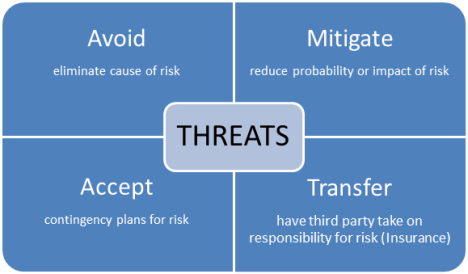
j.  Strategies for negative risks (11.5 Plan Risk Responses)

Based on the results of the probability and impact matrix done in the Perform Quantitative Risk Analysis process, these are the general risk response strategies for dealing with negative risks.

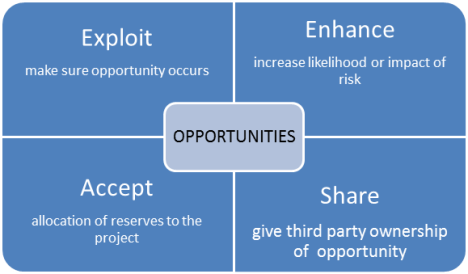
k.  Strategies for positive risks or opportunities (11.5 Plan Risk Responses)

Based on the results of the probability and impact matrix done in the Perform Quantitative Risk Analysis process, these are the general risk response strategies for dealing with positive risks.

k.  Contingent response strategies (11.5 Plan Risk Responses)

Some responses may be triggered only if certain events occur, and under certain predefined conditions.  Risk responses that are identified in this way are called contingency plans.

l.  Risk reasessment (11.6 Control Risks)

At various points on the project, it is a good idea to do a risk reassessment, which includes doing the following:

  • identification of new risks
  • reassessment of current risks (i.e., have the probability and/or potential impact changed)
  • closing of risks that are outdated (because the events that would have triggered them did not occur)

m.  Risk Audits (11.6 Control Risks)

Rather than a reassessment of the risks, which is done in the the “risk reassessment” technique described in paragraph l above, risk audits examine the effectiveness of risk responses, as well as the effectiveness of the risk management process as a whole.

n.  Variance and Trend Analysis (11.6 Control Risks)

These types of analysis compare the planned results to the actual results.    If the risk management plan may include predefined levels of variance at which various actions must be taken, either corrective action or preventive action.

o.  Technical Performance Measurement (11.6 Control Risks)

As opposed to measurement of the scope, time or cost baseline, which is done in Variance and Trend Analysis (see paragraph n above), Technical Performance Measurement compares technical performance measures such as number of defects, transaction times, delivery times, etc.

p.   Reserve analysis (11.6 Control Risks)

If risks do occur, then the funds for risk responses come from contingency reserves if the risks are on the risk register.   If they are not planned risks (i.e., risks that are on the risk register), then ad hoc risk responses called “workarounds” must be developed and these come not from contingency reserves, which are under control of the project manager, but from management reserves, which as the name implies are under control of management that sponsored the project, and not under the direct control of the project manager. Once the risk responses are completed, the remaining contingency reserves are analyzed to see if they are adequate for the remainder of the project of if they need to be increased, in which case it should be reported to management.    If risk responses are not utilized because certain risks do not occur, then the excess in contingency reserves should also be reported to management, because this excess no longer being needed on the project, might be utilized for other projects in the organization.

4.  Conclusion

Risk management contains a wide variety of tools, but because the processes are relatively distinct in character, there are very few tools & techniques which are used on multiple processes (expert judgment, meetings for example are the only ones that come to mind).    In addition, for any given tool & technique, it should be fairly obvious which process it is associated with.   The real test of your knowledge will be for your to be able to think of at least 3 tools and/or techniques for each of the six processes.

The next post will be on the Tools & Techniques associated with the processes of chapter 12 of 5th Edition PMBOK® Guide, that covering the Procurement Management knowledge area.

5th Edition PMBOK® Guide—Step 5: Memorizing Tools & Techniques (Communications Knowledge Area)


1. Introduction

This series of posts assumes that you have already memorized the names of the 47 project management processes, and you are ready to go on to the task of memorizing the tools & techniques.    This post covers chapter 10 of the 5th Edition PMBOK® Guide, the Communications Knowledge Area.

2.   Communications Knowledge Area Processes

Here’s a description of the three processes that are included in the Communications  Knowledge Area, together with a listing of the Tools & Techniques used in those processes.


Process
Number & Name
Process Description Tools & Techniques
10.1  Plan Communications Management Develops an appropriate and plan for project communications based on stakeholder’s information needs and requirements, and available organization assets. 1.  Communication requirements analysis

2.  Communication technology

3.  Communication models

4.  Communication methods

5.  Meetings

10.2  Manage Communications Creates, collects, distributes, stores, retrieves project information in accordance with the communications management plan. 1.  Communication technology

2.  Communication models

3.  Communication methods

4.  Information management systems

5.  Performance reporting

10.3.  Control Communications Monitors and controls communications throughout the entire project life cycle to ensure information needs of the project stakeholders are being met. 1.  Information management systems

2.  Expert judgment

3.  Meetings


3.  Communications Knowledge Area Tools & Techniques

Here’s a closer look at the tools & techniques used in the communications knowledge area.   Many of these are used in multiple processes.

a.  Communications requirements analysis (10.1 Plan Communication Management)

This determines the information needs of the project stakeholders.

b.  Communication technology (10.1 Plan Communication Management, 10.2 Manage Communications)

Various factors are considered in choosing the communication technology to be used on a project:

  • Urgency of the need for the information
  • Availability of technology
  • Ease of use
  • Project environment
  • Sensitivity and/or confidentiality of the information

c.  Communication models (10.1 Plan Communication Management, 10.2 Manage Communications)

The basic steps of a communication model are

  • Encode
  • Transmit message
  • Decode
  • Acknowledge
  • Feedback/response

d.  Communication methods (10.1 Plan Communication Management, 10.2 Manage Communications)

The basic communication methods are

  • Interactive communications (for a multidirectional exchange of information):   meetings, conference calls, videoconferencing, etc.
  • Push communications (send to specific recipients who need to receive the information):  letters, memos, reports, e-mails, etc.
  • Pull communications (for large amounts of information to be accessed by recipients as needed):  intranet sites, e-learning, etc.

e.  Expert judgment, meetings (10.1 Plan Communication Management, 10.3 Control Communications)

These are used in planning to make sure the various detailed aspects of the communication management plan are put into place.    During monitoring & controlling of communications, used to resolve problems, make decisions, and suggest changes to the project and/or communications management plan

f.  Information management systems (10.2 Manage Communications, 10.3 Control Communications)

This is a tool, not a technique, used to facilitate the other techniques and manage

  • Hard-copy documents
  • Electronic communications
  • Electronic project management tools (Microsoft Project, Primavera, etc.)

g.  Performance reporting (10.2 Manage Communications)

This is the collection and distribution of performance information to tell the various interested stakeholders how the project is going.

This set of tools & techniques is relatively straightforward in terms of understanding why they are used with communications, because most of them even have the word “communications” in them.    The only caveat is that some of them are used for more than process.

The next post will cover the tools & techniques of the next chapter, chapter 11 of the 5th Edition PMBOK® Guide, that of the Risk Management knowledge area.


5th Edition PMBOK® Guide—Step 5: Memorizing Tools & Techniques (Human Resources Knowledge Area)


1. Introduction

This series of posts assumes that you have already memorized the names of the 47 project management processes, and you are ready to go on to the task of memorizing the tools & techniques.    This post covers chapter 9 of the 5th Edition PMBOK® Guide, the Human Resources Knowledge Area.

2.  Human Resources Processes

Here’s a description of the four processes that are included in the Human Resources Knowledge Area, together with a listing of the Tools & Techniques used in those processes.

Process Number & Name Process Description Tools & Techniques
9.1 Plan Human Resources Development Identifies and documents project roles, responsibilities, and reporting relationships; creates a staffing management plan 1.  Organization charts and position descriptions 2.  Networking 3.  Organizational Theory 4.  Expert judgment 5.  Meetings
9.2  Acquire Project Team Confirms human resource availability and obtains the team necessary to complete project activities. 1.  Pre-assignment 2.  Negotiation 3.  Acquisition 4.  Virtual Teams 5.  Multi-criteria decision analysis
9.3  Develop Project Team Improves competencies, team member interaction, and overall team environment to enhance project performance. 1.  Interpersonal skills 2.  Training 3.  Team-building activities 4.  Ground rules 5.  Colocation 6.  Recognition and awards 7.  Personnel assessment tools
9.4  Manage Project Team Tracks team member performance, provides feedback, resolves issues, and manages changes to optimize project performance. 1.  Observation and conversation 2.  Project performance appraisals 3.  Conflict management 4.  Interpersonal skills
3.   Human Resources Tools & Techniques
Here is a closer look at the tools & techniques used in the various processes in the Human Resources Management Area.   The tools & techniques are pretty distinct for most of the processes, so it should be relatively easy, if you are given a certain tool & technique, to be able to guess which process it goes with.
a.  Organization charts and positional descriptions (9.1 Plan Human Resources Management)
These are not the organizational charts and position descriptions for the organization, but for the project itself.
b.  Networking  (9.1 Plan Human Resources Management)
The PMBOK likes to use the trendy language of “human resource assets”, but I just mentally erase that jargon and replace it with the word “people”.   Networking is formal and informal interaction with others, and is one of the ways that can be used to assess who would be best to work on the project.
c.  Organizational Theory  (9.1 Plan Human Resources Management)
Organizational theory exists in order that the project manager can choose a flexible leadership style that changes as the team’s maturity level changes.
d.  Expert judgment  (9.1 Plan Human Resources Management)
In this case, the expert judgment is that of people who have experience with human resources management.
e.  Meetings  (9.1 Plan Human Resources Management)
Any time you have a management plan you need meetings to engage the entire project team in the planning.   This is not just to brainstorm in order to come up with effective solutions to problems, but also to get buy-in from the entire team at the beginning of the project since they are all involved in its planning.
f.   Pre-assignment (9.2 Acquire Project Team)
A project may be approved with the express intent that certain people are designated to be involved on the project team in order to do jobs that they are particularly suited for.
g.  Negotiation (9.2 Acquire Project Team)
For project managers in a matrix organization, where they do not have the authority to acquire project team members on their own, but must do so through functional managers of various departments, negotiation may be needed to obtain those project team members.   Project managers may have to “borrow” team members who are currently working on other projects.
h.  Acquisition (9.2 Acquire Project Team)
Temporary or contract workers may be needed to be acquired to assist the organization for the duration of the project.
i.  Virtual Teams (9.2 Acquire Project Team)
Team members may be acquired from other branches of the organization in different locations around the world to form a “virtual team”.    Special care in communication planning must be taken into account for these virtual teams.
j.  Multi-criteria decision analysis (9.2 Acquire Project Team)
This is similar to the criteria used to choose a supplier, but in this case it is the company that has a choice of potential team members rather than suppliers.    These criteria are developed in order to choose the best person for a particular job or position on the team.
k.  Interpersonal skills (9.3 Develop Project Team, 9.4 Manage Project Team)
These are the so-called “soft skills” of communication skills, and emotional intelligence, which tend to be underrated when it comes to their importance on a project.    They are used in developing the team through the four stages of development (forming, storming, norming, and performing), and once the team reaches that final stage of performing, they are used for maintaining the team at that level until the project is done.
l.  Training (9.3 Develop Project Team)
These are all activities that enhance the technical skills and competencies of the project team members.
m.  Team-Building Activities (9.3 Develop Project Team)
These are activities that help individual team members work together effectively and successfully go through the various stages of development of a team (forming, storming, norming, and performing).
n.  Ground Rules (9.3 Develop Project Team)
The discussion of ground rules decrease misunderstandings, especially when it comes to interactions at team meetings.
o.  Colocation (9.3 Develop Project Team)
Colocation is the opposite of a virtual team, it is a team which is in the same physical location.   This can be done on a temporary basis to bring team members into a situation where they have more face-to-face contact than they normally would; even a team meeting is a form of colocation.
p.  Recognition and rewards (9.3 Develop Project Team)
This is to motivate team members to give their best efforts for the project, and should be given throughout the project life cycle and not just the end.
q.  Personnel assessment tools (9.3 Develop Project Team)
These tools are for giving insight into the strengths and weaknesses of the team members so that the project manager can make a productive team where the strengths of some members in any given area compensates for the weaknesses of others.
r.  Observation and conversation (9.4 Manage Project Team)
Never underestimate the power of these seemingly ordinary tools for a project manager to stay in touch with the attitudes of the team members.
s.  Project Performance Appraisals (9.4 Manage Project Team)
It is important for project team members to get feedback from the project manager so that can know specifically what they are doing right and what they need to improve upon.    This can also be time for the project manager to get feedback from the project team members regarding any issues they have regarding the project or other team members that may need to get resolved.
t.  Conflict Management (9.4 Manage Project Team)
Ground rules are designed to minimize conflict on a project, but they cannot eliminate it.   A project manager needs to be able to look at the conflict situation from the perspective of all sides of the conflict in order to facilitate a resolution.
These tools & techniques are fairly clear given the subject matter of dealing with human resources, also known as people.    One of the problems I have with the phrase “human resources” is the reduction of people to commodities or things.   When a company does this and dehumanizes their employees, it is done with the idea of short-term efficiency in mind, but it always, ALWAYS leads to loss of long-term effectiveness as employees no longer for feel that they, or their ideas, matter.   This is why these tools are, as I mentioned above, underrated in terms of their importance.
The next chapter deals with chapter 10 of the 5th Edition of the PMBOK Guide, and that is the chapter on Communications Management.

Integral Theory and Project Management–Tenet #11


This series of posts take the Ken Wilber’s introduction to Integral Theory called A Brief History of Everything and discusses the 12 main tenets concerning the concept of a holon and how they can be applied to the field of project management.  I have been posting one tenet a week on Sundays; this post covers tenet #11.

1.  Recap–definition of a holon, and tenets #1-10

A holon is an entity which consists of components, and yet is itself a component of a larger whole.

Tenet #1. Reality as a whole is not composed of things or processes, but of holons.

Holons must be considered from the standpoint of interacting with other holons on the same level, and with holons at higher levels (of which the holon is just a part) and lower levels (which comprise the parts of the holon).

Tenet #2 Holons display four fundamental capacities: The horizontal capacities of self-preservation, self-adaptation, and the vertical capacities of self-transcendence and self-dissolution.

Holons follow the dual rules of evolution when it comes to holons at the same level:    survival of the fittest (self-preservation) and survival of the fitting (self-adaptation).    Holons have the property of being able to evolve to the next highest level (self-transcendence), and they can also “devolve” into their component parts (self-dissolution).

Tenet #3 Holons emerge

As mentioned in Tenet #2, holons have the property of self-transcendence or evolution to the next highest level.    This is not just a higher degree of organization, but also involves emergent properties or differences in kind from the level below.

Tenet #4 Holons emerge holarchically

Holons, as seen above, are units that are both wholes containing parts and parts of larger wholes.   This kind of nested or concentric linking of holons reminiscent of the Russian matroshka dolls is considered a holarchy.    In contrast, we see in an organizational chart the traditional notion where parts are linked vertically to the levels above them (the notion of hierarchy), and horizontally to the units at the same level (the notion of a heterarchy).

Tenet #5  Each emergent holon transcends but includes its predecessor(s)

When a higher level of holons emerges, it incorporates the holons from a lower level but adds emergent properties.  A cell contains molecules, but is an entity which is capable of reproduction, where a property that goes above and beyond what a mere collection of molecules could do on its own.

Tenet #6  The lower sets the possibilities of the higher; the higher sets the probabilities of the lower.

Tenet #5  tells us that the higher level of holon has emergent properties which go above and beyond the lower level.  However, tenet #6 says that the higher level cannot ignore the lower level, and it there is bound to a certain extent by the possibilities set by the holons of the lower level.  However, the higher level also affects the lower level in that, the order imposed by the higher level of holons will influence the patterns in which the lower levels interact.

Tenet #7–The number of levels which a hierarchy comprises determines whether it is “shallow” or “deep”; and the number of holons on any given level we shall call its “span.”

Tenet #8  Each successive level of evolution produces GREATER depth and LESS span

This tenet follows from tenet #7 if you think about the definition of “depth” and “span” of a concentrically organized system of a holarchy.   Ken Wilber makes this point because if you look at the concentric diagrams of any holarchy, the circle containing the highest level of organization is going to be on the outside, and the visual impact is that it has greater “span” in terms of area.    He is simply emphasizing the fact that span refers to the number of holons at the same level; the reason why the circle is so large is so that it can encompass the lower levels inside of it.    The fact that the largest circle, representing the holon at the highest level, has several circles within it actually means that it has the greatest depth because it includes the most levels or holons (represented by the nested series of circles inside of it).

Tenet #9  Destroy any type of holon, and you will destroy all of the holons above it and none of the holons below it.

The lower level of holon, while having less depth than the higher level (based on tenets #7 and #8), is nonetheless more fundamental for precisely the reason mentioned in the tenet.   If you get rid of the lower level of holon, you are in fact getting rid of the very components of the higher level.

Thus the higher level is more significant, in terms of adding coordination and direction to the lower level of holons, but the lower level of holons are more fundamental to the enterprise, because without them, there would BE no higher level of holons.   In terms of project management It is very important to remember as a project manager, that despite the significance of all that you do as a manager of the project, and despite the fact that the project charter and your authority has to be sponsored by management, without the team members you would not have a project at all.   They are truly fundamental to the project’s success; that is why you must take care of the members of your team.

This tenet is, therefore, a lesson in humility and a warning against humiliation of any the members of your team for having made mistakes.    Failure is to be seen as an opportunity to learn, not to be cast in terms of blame or moral failing.    By understanding that the team member is more fundamental to the project than you are as the project manager, the more likely you will treat that team member with the respect that he or she deserves.     Once you do so, you will be surprised at how much more engaged that team member will be in the success of the project.

Tenet #10–Holarchies coevolve

Recall that a holon is an entity which is both a whole and a part of a larger whole, and a holarchy is that concentric nesting of holons at higher levels.    What does “coevolve” mean?    An individual holon exists in an environment, and it evolves to fit into the environment.   When the environment changes, the holon must also change in order to maintain its fitness.

What does tenet #10 mean in the context of project management?    Every project manager exists in a system of best practice regarding project management which is codified by the Project Management Institute into the Project Management Body of Knowledge or PMBOK®.   In order to survive in the fast-changing world of project management, the project manager must evolve as well through training, which is the whole point of the PDU system of continuing education.

Another example of the principle espoused in tenet #10 that “holarchies co-evolve (with their environments)” is the fact that companies in a certain application area need to evolve as the industry in that application area evolves.    The rapid growth of agile methodology in products involving IT development is a great example of this.    The recognition of the growing importance in the IT industry of agile methodology has meant that PMI is developing a new, separate category of certification called PMI-ACP or PMI-Agile Certified Practitioner to meet this demand for agile methodology.

2.   Tenet #11–The micro is in relational exchange with the macro at all levels of its depth.

The first step in understanding this tenet is to figure out what “micro” and “macro” refer to when talking about a holon.    Each holon, say a person on a team, exists in a network of relationships with other holons at the same level of structural organization, in this case, other team members.    The “micro” referred to in the tenet means the “individual holon” and the “macro” refers to the “network of relationships with others holons at the same level of structural organization.”   Okay, each team member exists in a network of relationships with other team members.   So what?   Well, it should be obvious to a project manager that it is necessary for a successful project for the team members to have good relationships with each other, right?   So far, so good.

Where this tenet comes into play, is the insight that team members also exist in a network of relationships at higher levels of structural organization with the company–they are also members of certain functional departments, and they are also members of the organization as a whole as managed by upper management.     To maintain the success of a project, it is of course necessary to foster good relationships between team members, but it is not sufficient.   You must also foster good relationships between department members, and between members in relationship to upper management.

Let me give you an example of a situation involving project management when that was not the case.    A blogger friend of mine named Driftglass worked in IT on a software project.    The project was split into phases.    The first one was writing the programming code in modules, which were then integrated, tested, and then released as the final software package.    His group was involved in integrating the programming code modules.    Management gave an incentive to any group that finished their part of the project earlier than the deadline, thus in their eyes, saving the company money in terms of paying for man-hours.     The programmers got the job done early, which in their eyes made them heroes, and they looked forward to their incentive.    The integration people like Driftglass, however, noticed that their work was so error-laden, that they ended up having to fix a lot more bugs than they had counted on, so they took MORE time than had been scheduled.   Management started giving them a lot of negative attention for costing the company money.   Driftglass tried to explain that they were saddled with an error-laden set of programming modules, but management thought they were just “making excuses.”

On the next project, the incentive scheme worked to exacerbate the already existing problems.    Eager to earn even more money, the programmers decided to churn out their product even faster, which naturally was laden with even MORE errors, which the integration team now had to cope with.    Now each individual team member on the programming and integration phases of the project were working well together.    But the management needed to realize that the level of departments, their incentive scheme was breaking down the relationship between the programmers and those responsible for integration of the modules.    The company kept getting rid of members of Driftglass’ team whom management thought were the locus of the problem, but as each new person kept coming across the exact same problem, it finally dawned on them that maybe that wasn’t where the problem was.    By that time the company was facing not only morale problems but financial problems as well.    If they had worked on the coordination of teams between phases, and not just the teams working on each phase, they would have had better productivity from all workers on the project.

Here’s another example.   In an article on July 11, 2013, Mina Kines wrote an article for Business Week outlining the difficulties that Sears was having after Eddie Lampert, a hedge fund billionaire who is the chairman of the company, splintered the company into 30 or so units which all now had to compete for resources.    The idea is that capitalism = competition, and the more competition between units of the company, the healthier they will become.    Well, companies exist in a network of relationships to other companies in an atmosphere of competition, but even there there will be some frameworks of cooperation that benefit each company.    Taking this “nature red in tooth and claw” caricature of the way the world works and applying it internally to the company, however, has had the effect of putting Sears in a “death spiral.”   This is because employees of the company, rather than spending time, energy, and resources trying to make the company stronger so that it can compete with other companies (at the same level as the company), they end up spending most of that energy fighting employees of other units over meager company resources.    There’s any fight left for the competition after they’ve been exhausted fighting each other, to put it bluntly.

The relationships between units has been allowed to deteriorate, and thus the company’s overall relationship with the market is deteriorating as well.

Thus, a project manager needs to foster cooperation between team members, but also between departments which often have differing or even competing interests at stake when it comes to the solution of a problem.    And the members must foster a relationship with the upper management so that their needs (having to justify the return on investment, etc., to stockholders) are taken into account.     Only by fostering relationships at each and every level of interaction inside a company can the company truly be made successful.   And that is the point of this tenet.

The last post next Sunday is the twelve and final tenet of Integral Theory, and will conclude this series of posts on the relationship between Integral Theory and Project Management.

How to Run a Successful Toastmasters Division Speech Contest–10 Lessons Learned


A.   Introduction–why create a “lessons learned” document?

As the Assistant Area Governor, I was called upon by our division governor Lee Jones for the South Division Fall Speech Contest in District 30 (Chicagoland) of Toastmasters International.

I put on the Club Speech Contest at my home club, Homewood-Flossmoor Toastmasters Club, and assisted the Area Governor to put on our Area Speech Contest, so helping the Division Governor put on the Division Speech Contest was the next step.   I observed some things that worked well in all three levels of contest, and I wanted to write those things down that I would like to do again in the future when I help run the speech contests next Spring.    Some things, however, didn’t go smoothly and I would like to an opportunity to create a “lessons learned” document that will also help me know what to avoid in next Spring’s Contest.

That’s why I’m writing this post.   I’m writing it from the point of view of the contest chair, the one organizing the contest.

B.   Lessons Learned

1.    Start on time

District 30 is the Chicagoland area, and after having lived in Los Angeles, one of the big risk factors for any event is traffic.   An accident on the so-called “freeway” can add a half-hour to your trip or worse.    So if there is an event that you need to plan for, add a contingency factor in terms of time to your trip.    For example, according to the map application on my iPhone, it would take 1 hour to get from my home in Homewood (southern suburb of Chicago) up to the contest site in Broadview (near north suburb of Chicago).    I started half an hour early, and I’m glad I did.    Road construction caused a delay when I got off the freeway, but even so I got there 15 minutes early, and was able to help set up.   If I started one hour before the event like the map application recommended, I would have been 15 minutes late.   

2.  Back-up test speaker

The contest ended up starting slightly later than planned due to the fact that the first contest was the evaluation contest, and the test speaker for that contest was delayed in … you guessed it, traffic.    You should have a back-up test speaker in case the test speaker is severely delayed or cannot make it to a family emergency, etc.    And ALWAYS have all of your contest participants and contest staff (judges, timers, counters, Sergeant At Arms, Toastmaster, and contest chair) on your telephone contact list so you can contact them to get an estimated time of arrival if they are running late.

3.  Back-up contest staff

You normally need the following staff for the contest.

  • 1 Toastmaster
  • 1 chief judge
  • 1 Sergeant-At-Arms
  • 5 judges and a tiebreaking judge for the area contest, 7 judges and a tiebreaking judge for the division contest
  • 3 counters
  • 2 timers

What happens if all those who volunteered to work on the contest don’t show up?    The crucial role is that of the Toastmaster, followed by the Chief Judge.    Those are difficult to back up.   You can ask any visiting Area Governors to be judges, because normally they are encouraged to have training as judges, so they can help at each other’s Area Contests.  The ones that can be substituted at the last minute from the audience are Sergeant-At-Arms, counters, and timers.    I’ve been tapped for all three roles when the person who was supposed to be doing that role didn’t show up.   

4.   Certificates of Participation

There are two sets of certificates of participation, one for the contestants and one for the contest staff.    The certificates of participation can be given to the contestants in the post-contest “interview” section of the contest event.   However, rather than giving the certificates of participation to the staff as part of the event, to save time it is best to put the certificate of participation with their printed on it together with all the paperwork that role requires in an envelope prepared for the contest that has the name of the role written on the outside.    When a person, say the counter for the contest, arrives at the contest site, you just give them the packet.   There!  You’ve already given them a vote of appreciation for having shown up and done their role.    It is also convenient to have a little envelope for the contest staff to take home their certificates of participation once their paperwork has been turned in to the chief judge or contest chair.   And it doesn’t take any time away from the contest event by having to announce the giving of the certificate of participation to each and every contest staff participant at the event itself.   

5.   Award Trophies and Award Certificates

If you have dignitaries from the Toastmasters organization (one contestant acknowledged them ironically as “Toastmasters royalty”), then having them help you hand out the award trophies is a nice touch to the contest and makes the winners feel that much more appreciated.    Now the award certificates won’t have the pre-printed names on them like the certificates of appreciation for the ones doing the contest staff roles, because obviously you don’t know who is going to win before the contest.   But one elegant solution that our Division Governor Lee Jones came up with is to have a sheet of pre-printed labels with each contestant’s name on it, double-checked for spelling accuracy.   

As a counter, I just had to peel off the winner’s names, and stick them on the award certificates, and voila, we were done!

6.   Congratulate the “Non-Winners”

This is not a procedural issue, as much as a psychological one.   When I entered my first contest, I put so much effort into my speech and, although I won in the Area Contest, I didn’t even get third place in the Division Contest.   I was so disappointed, and I resolved never again to enter a speech contest.    Then one of the people at the contest came up to me and encouraged me, saying that the speech was a good one, they enjoyed it, and that I really had talent and should consider joining the contest next year.    On the way home, I was already picking out the subject of next year’s speech, and I caught myself and had to laugh at myself.    Wow, if I’m picking out the subject of the speech for next year’s contest on the way home from the last contest, that means I’m definitely hooked on these contests!    And then I realized that just half an hour before, before I had received that encouragement, I had vowed never to enter a contest again.   Now I vowed to make sure that I encouraged those who tried their hardest in the contest only to “lose” that, in my eyes they were winners for having entered the contest.  

7.  Instructions for Judges

At the various contests, judge’s ballots have been disqualified for the following reasons:

  • Ballot not signed
  • Ballot not filled out completely (third place winner left off and only the first and second place winner listed)
  • More than one name put on the ballot in a single line (judge thought first-place was a tie and listed two people)

The first mistake of not signing the ballot can be corrected by having the chief judge instruct the judges at the judges briefing to sign their ballots right then and there.    One other great idea from Lee Jones is to have them pre-fold or bend their ballot so that the bottom portion is easy to separate after they have made their decision. 

Make sure the chief judge tells the judges that there is no trophy for the third-place winner, but there is an award certificate, so they need to make sure that they list the first, second, AND third-place winners on the ballot.    In the statistically unlikely event that they have a tie between two people, they must make a decision and put one person’s name on the ballot, and then put the other person’s name as the next-highest place winner.    There is a mechanism if the total from ALL judges forms a tie (that is why there is a tie-breaking judge), but there is no mechanism for a tie from any INDIVIDUAL judge.    

8.   Toastmasters Announcement of Contestants

One of the problems about announcing Contestants is that once the Toastmaster says, “and now our next contestant is … JOHN DOE”, everybody applauds, and if the Toastmaster then goes on to say the title, repeats the title, and then repeats the person’s name while everybody is applauding, nobody can hear the speech title.    This is especially true if the contestant is coming from the back, and then once they get up to the lectern, they think there is going to be an additional introduction as they were briefed in the contestant’s briefing, and so they are not sure whether they should go ahead with their speech or not.    Contestants have enough on their mind without worrying about whether the Toastmaster has given the correct signal or not to the judges.   

So in the next contest, the contestants will be told that they will be standing to the side or the back, and the Toastmaster will say, “and now the next contestant,” and GESTURE to the person to approach the lectern.    Then he or she can applaud, leading the audience to follow suit.   Once the applause has died down and the person is AT the lectern, the Toastmaster can THEN say the person’s name, the speech title, repeat the speech title, and then the person’s name.    That will allow the audience to acknowledge the speaker with applause without it interfering with the opening “ritual” of the speech which is there for the judges, timers, and the speaker to know when the speech actually begins.

9.   Contestant’s Speech Set-Up

Some people give a speech with props or with an accompanying PowerPoint presentation.    The contestant should not do the set-up for the speech.   This should be done by the Sergeant-at-Arms.   This is because if the person gets up and starts setting up the props, this may be interpreted by the judges and/or timers to be part of the speech.    This is because a speech technically starts with the “first definite verbal or nonverbal communication with the audience.”    Having the Sergeant-At-Arms do the set-up takes away any ambiguity.   Also, the contestant can focus on doing the speech, and not getting the logistics right regarding the props.  

10.   Toastmasters are the Masters of Ceremony, not the Ceremony itself

It is has been said that there are three stages of becoming an effective Toastmaster.    The first is when you are afraid to get on stage.   That’s the initial “butterflies” that people feel about public speaking that they are there to conquer at Toastmasters.    The second stage is when you afraid to get OFF stage.    This is when you are bursting in confidence and now see any public speaking event as an opportunity rather than a threat.    The point here is:    at a contest, it’s not about you, it’s about the contestants.    I have seen Toastmasters at Contests, not here in Chicago, but back in California, that were so intent on entertaining the audience that they made jokes and comedy routines that while making the audience laugh, also made the contest drag on too long and also put more emphasis on the audience paying attention to them rather than paying attention to the contestants.

So the third stage of being a Toastmaster is when you know when to get on stage, but also know when it is time to get off stage.    I can truly say that the Toastmaster for last night’s Division Contest, had reached this stage.   She was enthusiastic at the beginning, kept things going in an effective but cheerful manner throughout, and made the contestants feel as relaxed as they could be under the circumstances.    I intend to watch the video of the contest not just to watch the speeches again, but also to watch the Toastmaster, because that’s how I want to conduct myself as Toastmaster when I get to be the MC for a Division level contest.

These are my observations on what seemed to work well and what needed work in order for the contest to be even better the next time around.    Toastmasters is an organization devoted to self-improvement, and that includes their speech contests!