Six Sigma Green Belt–Management Tool #5: Matrix Diagrams


The matrix diagram is used to show relationships between a single set of factors or between 2 or more sets of factors. It differs from the prioritization matrix in that the prioritization matrix tries to quantify the ranking among the factors. The matrix diagram gives a qualified relationship between the factors, denoting the relationship with symbols like + for a positive relationship or a – for a negative relationships.

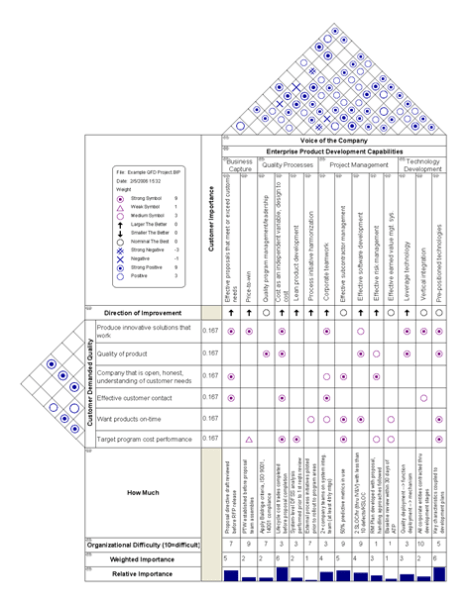
An example of this can be found in the House of Quality tool that demonstrates the method of Quality Function Deployment (this image is taken from Wikipedia).


Notice the “roof” of the house which contains the relationships between the various design features proposed for this product development. If two factors influence each other positively, there is a circle, with a dot in the circle for a strong positive influence. On the other hand, if there is an X, that means there is a negative influence between the factors. If the influence between the factor is weak, there is a triangle. This is, of course, a single example; other companies may use other symbols to represent similar types of relationships.

By the way, you may notice that in the “basement” of the House of Quality model, there is a list of weighting factors underneath each design feature which demonstrates an example of the prioritization matrix that was talked about in the last post.

In fact, you can convert a matrix diagram into a prioritization by taking each of the symbols for strong, medium, or weak relationships (both positive and negative) and assigning them a weighting factor from 0 to 9 and then adding up the various values for the symbols.

Finally, the website http://www.syque.com/quality_tools/toolbook/Matrix/how.htm gives the following examples of the different types of matrices that can be used to compare a set of factors (L-type matrix), two sets of factors (T or X-type matrix), or even three sets of factors (C-type or Y-type) in a three-dimensional matrix.

The matrix diagram is therefore used to chart the complex interrelationships between various one, two, or three sets of factors. It is used to focus on the complicated details of a particular aspect of a problem that has been previously identified and broken down using some of the other tools mentioned in previous posts in this series.

Six Sigma Green Belt–Management Tool #4: Prioritization Matrices


The prioritization matrix is also called the criteria matrix and is a tool used to help in the decision-making process. It can be used when deciding which Six Sigma projects to work on, in deciding which design features are Critical to Quality, or in making a decision with regards to any set of criteria such as the frequency, severity, and difficulty of dealing with a set of risks.

Step Description
1. Develop Criteria These are the dimensions which you will use to analyze the various options. They should be listed on a row at the top of the matrix.
2. Determine Options What are the various options under consideration? They should be listed on a column to the left of the matrix.
3. Develop Weighting Each criteria should be assigned a numerical weight from 1 to 10, or some other similar scale.
4. Score Each Option Take each option and go across the list of each criteria, giving them a weighting from 1 to 10 based on the scale you developed in step 3. Each row should have the various weightings for each particular option across the various criteria.
5. Add up Columns Take the total scores for each column and each row. Sum up the columns and rows (check: they should be equal).
5. Rank Options Let’s say the total comes to 100. Then divide the total for each row by the total for the entire matrix, which will then give you a decimal ranking from 0.00 to 1.00 for each option. Rank each options with the highest decimal ranking at the top, and going downwards from there.

Or you can simply list the rankings on a numerical basis without the decimal conversion; it’s your choice.

6. Discuss Results Discuss the results of the exercise and make a decision based on the option with the highest score.

This tool is used only after the various options are clearly known, so it is best to be done after some other brainstorming tools are performed to identify them.

Constitutional Crisis in #Egypt continues


Below is summary of my understanding of the continuing constitutional crisis unfolding in Egypt. I am indebted to Juan Cole’s at Informed Comment, Esam Al-Amin’s article in Counterpunch, and the Egyptian blogger Big Pharoah for his on-the-scene observations.

1. Recap–What is the Crisis all about?

On Thursday, November 22nd, Egyptian President Morsi set out a series of 7 decrees which effectively gave him more unprecedented political power. Although the aim of his power was to assert greater control over political holdovers from the Mubarak regime, the heavy-handed way that Morsi went about his grab for power has sparked a series of protests in Egypt, even from groups who opposed the Mubarak regime.

Here are the 7 decrees listed; the decrees in red are the ones that are causing the most backlash among various groups.

Decree

Significance

1. Officials in Mubarak regime who resorted to violence against protestors will be investigated and retried. This is a demand from Egyptian masses, so Morsi appears to be pacifying opposition from the Left.
2. Suits brought in the Courts against Morsi’s executive orders are hereby dismissed. Morsi is trying to prevent the Courts from dissolving the parliament like it did to the one elected in Fall 2011.
3. Public prosecutor will be appointed by the judiciary for 4 years. Preventing public prosecutor from aligning with members of former Mubarak regime.
4. Constituent Assembly has 2 more months to finish drafting constitution. Deadline moves from the end of December 2012 to end of February 2013.
5. No Court may dissolve the Constituent Assembly or the upper house of Parliament. Leftists are concerned that Morsi plans to reinstate the Muslim Brotherhood-dominated parliament.
6. President may take any steps to preserve national security. Secularists and leftists are concerned at how broad and vague these unspecified powers are. Similar decrees have been used by dictators in the past to consolidate power.
7. This decree will be published in Official Gazette. Makes it official.

2. What are the groups that are lining up for and against Morsi’s regime?

This is a three-way power struggle, with Morsi trying to control on the right the military council or SCAF as well as those elements of the judiciary that are remnants of the Mubarrak regime, and on the left the various secular and leftists movements as well as the Coptic Christians who are nervous about the hard-wiring of Shariah law into the proposed constitution. Morsi’s decrees 1 and 3 above were aimed at placating the revolutionary movements that had helped overthrow the old regime. However, decrees 2, 4, and 6 ended up creating a backlash from the other direction.

What it seems to come down to is the following: Is Morsi’s regime going to simply replace the Mubarrak regime and replicate its corruption, but with the added feature of Egypt becoming a theocracy like Iran rather than a democracy? Or is it going to truly open up Egypt towards becoming a pluralistic democracy? The decrees made many on the left fear that Egypt was sliding towards the former than the latter.

3. Boiling Point

The Islamists and the secularists had competing demonstrations, which finally led to the confrontation of both groups on December 5th in front of the Presidential Palace, where six deaths and hundreds of injuries resulted.  This led to recent negotiations where Morsi has apparently agreed to back down or rescind decree 6 (granting unlimited powers) and limiting the power of decree 2 (ability to override the judiciary). However, he still is insisting that the constitution drafted by the Muslim Brotherhood is “fast-tracked” for a vote on December 15th.

For more detailed analysis, I urge you to visit Esam Al-Amin’s article in Counterpunch: http://www.counterpunch.org/2012/12/07/in-egypt-when-democracy-is-not-an-option/

4. What is the role of the United States in this crisis?

The Egyptian blogger Big Pharoah says the low-key reaction from the Obama administration seems to give tacit approval to Morsi as the legitimate alternative to the Mubarak regime. You can contrast this to the US government’s protests against the actions in Syria, which is not a client state of the US.

5.  What is the next step in the crisis?

The next step is the vote on the constitution which is scheduled for December 15th (this coming Saturday). Many leftists or liberals have called for a boycott of the election, but in the opinion of Prof. Juan Cole at Informed Comment, that would ensure the success of the constitution. He understands their concerns that the rushing of the constitution to a vote does not allow people in Egypt to have a proper national debate. However, if a coalition of liberals, leftists, and Muslim centrist defeat the constitution in the vote on December 15th, this would definitely allow a proper national debate.

We’ll see what happens on December 15th!

Six Sigma Green Belt–Management Tool #3: Interrelationship or Relations Diagram


The Relations Diagram, also known as an Interrelationship Diagram (or Digraph), is a brainstorming tool for exploring the cause-and-effect relationship between a series of ideas of facts.

Here’s how it works (the methodology is similar to that of Management Tool #1: Affinity Diagrams):

Step Description
1. Identify Problem Define your problem or identify a general theme. Example: why has customer satisfaction rate been declining?
2. Collect facts/ideas List the relevant facts, data, or ideas, opinions regarding the subject and put these on the post-in notes or index cards. Post these on a noteboard or blackboard.
3. Create groups Notice which of these notes or cards are related to each other similar and arrange them according to patterns based on those cohesive groups.
4. Identify Groupings Label each group of similar notes or cards with a label for each group. These could be aspects of the problem under consideration.
5. Identify Relationships Identify cause-and-effect relationships between various ideas or facts. Draw an arrow if one idea, effect, or fact is caused by another, with the arrow going from the cause to the effect.
5. Analyze Results Look at the number of arrows leading into and the number of arrows leading out of each idea. Those that have the most arrows going out are causes, and those that have the most arrows going in are effects.
6. Share Results Share the results with the stakeholders at large.

The results should show the natural links that emerge among the various issues or presented, and will help the team discover root causes of the problem defined at the beginning.

It is sometimes used in conjunction with the affinity diagram, or sometimes with the results of the causes identified by the Ishikawa or fishbone diagram.

Six Sigma Green Belt–Management Tool #2: Tree Diagram


A tree diagram is used to communicate logical relationships between critical events (such as with failure tree analysis) or specific objectives (decision tree analysis). One event may cause another, and that new event may cause a series of others, so you have a hierarchical relationship that resembles the branching of a tree.

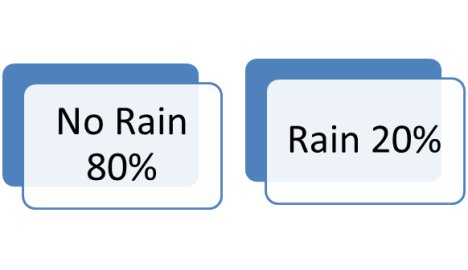
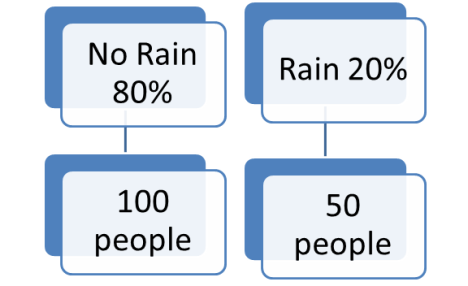
Let’s say you are putting on a company picnic, and you pick a weekend date for it. You are holding a raffle for charity that costs $5 per ticket and you want to calculate how much money you think you will make on the raffle. You have to have some allowance for if it rains. Let’s say the long-term weather forecast is for it to have an 80% chance of clear skies or scattered clouds, and 20% chance of rain. If you are trying to forecast how much money you will make, then you have to account for both probabilities, whether it will rain or not rain.

Now if it is does not rain, your past experience tells you that there will be 100 people that show up. If it does rain, again your past experience tells you only half the people will show up, giving you only 50 people that will come to the event.

In either case, your past experience tells you that each person on average buys 2 tickets that cost $5 each, so each person spends $10 on the raffle on average.

Now what is the expected payout for the event? In the case of “No rain”, there will be 100 people X $10 spent per person or $1000. In the case of “Rain”, there will be 50 people X $10 spent per person or $500. However since the probability of “No rain” is 80%, and the probability of “Rain is” is 20%, the expected payout will be on average

(Probability of “No rain”) X (Payout of “No rain”) +

(Probability of “Rain”) X (Payout of “Rain”) = (80% X $1000) + (20% X $500) = $800 + $100 = $900.

It can be used in decision making, where the decision tree consists of 3 types of nodes:-

 1. Decision nodes – commonly represented by squares

2. Chance nodes – represented by circles

3. End nodes – represented by triangles

 In the example above, whether it rains or not rains would be represented in squares, the probabilities of 80% and 20% would be represented by the circles that lead from these squares, and the end result we’ve listed above ($800 payout for “No rain” and $100 payout for “Rain”) would be represented by triangles at the end of the branches.

 It can be used in fault tree analysis, where instead of decisions, you have critical events that occur in the failure of the part. Each of these will have events that cause these failures, and these events will have their causes and so on, where eventually you get to the root causes.

 In project management, breaking down a project into activities through the work breakdown structure could also be considered an example of a tree diagram.

 In conclusion, tree diagrams can help visualize logical, hierarchical relationships between events, objectives, or tasks. In certain applications, it helps identify the probabilities of the various outcomes, which helps in the calculation of the relative contribution each “branch” makes.

Six Sigma Green Belt—Management Tool #1: Affinity Diagrams


In the next week, I would like to discuss the 7 management tools that are used in conjunction with the DMAIC methodology in the course of managing a Six Sigma project. The first is that of affinity diagrams. I am indebted to the Project Management Hut (http://www.pmhut.com) for their lucid explanation.

1. What is an affinity diagram?
It is a brainstorming tool, developed by Jiro Kawakita in the 1960s, which is why it is sometimes referred to as the “KJ Method” (in Japanese, last names are listed first).

It is a way of taking a series of facts, ideas, or data on a certain general theme and organizing it into groups of clusters. It can be the first step towards a cause-and-effect analysis using an Ishikawa or fishbone diagram.

2. How does it work?

You get the various stakeholders who are involved on a problem to get together. You buy a lot of variously colored post-it notes or 3×5 cards which are the “atoms” of facts or ideas that you are going to assemble into the various groupings.

Here’s the steps you take:

Step Description
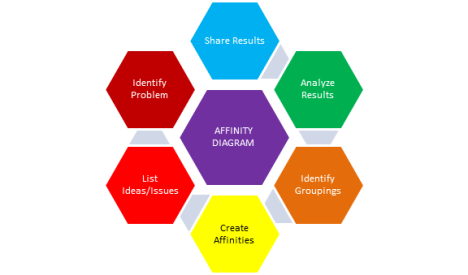
1. Identify Problem Define your problem or identify a general theme. Example: why has customer satisfaction rate been declining?
2. List ideas/issues List the relevant facts, data, ideas, opinions regarding the subject and put these on the post-in notes or index cards. Post these on a noteboard or blackboard.
3. Create affinities Notice which of these notes or cards are similar and arrange them according to patterns based on those affinities.
4. Identify Groupings Label each group of similar notes or cards with a label for each Affinity group. These could be aspects of the problem under consideration. Prioritize these problems that have been identified.
5. Analyze Results Look at the overall groupings created and the facts/ideas associated with each. What insights does this create with regards to the problem stated at the beginning? Does it suggest potential solutions?
6. Share Results Share the results with the stakeholders at large.

For an example of how this would work with a real-world problem, please go to the following website because I thought they did a great job showing the various steps I outlined above.

http://www.mindtools.com/pages/article/newTMC_86.htm

In conclusion, the affinity diagram or KJ method is a way of synthesizing data and allowing natural patterns to emerge, which allow you to approach the problem in a more organized and systematic way in order to create a more comprehensive solution.

Leadership Excellence Series–Team Building


1. Introduction

WIIFM. It sounds like a radio station, doesn’t it?  “I’m talking to here at station W-I-I-F-M … in Cincinnati” (sings a la “WKRP in Cincinnati” theme).  But what it stands for is”What’s in it for me?”   This is the powerful force of self-interest.  How do you go from a group of self-interested individuals to a team that works coherently as if a single unit? That’s the subject of my presentation for today.

For those who were not here at my talk last week, this is the second presentation from the Leadership Excellence Series, which are given by those who are going for an advanced leadership award. The purpose of this series is to provide the speaker with an opportunity to do research on one of 10 possible topics related to leadership, and to present those results to the other members of the club so that they can hopefully benefit as well.

The topic I have chosen is that of Team Building, and let me start by restating my opening question. Team Building—what’s in it for the company? Greater Creativity, Greater Productivity, in other words, greater effectiveness and greater efficiency.

What’s in it for the Leader? More time on strategic planning, preventing problems, and coaching and mentoring. Less time on meetings, babysitting, and dealing with problems.

As a general principle, the most effective thing you can do with your power as a leader is to let it go. This may seem counterintuitive to you, but it is vital to do as a leader. Where does the power go? To the members of the team. You see, your success of a leader depends upon the ability to share power with others and let them direct their own work.

According to the PMBOK®, there are four stages of team development, which were described by psychologist Bruce Tuckman as the alliterative quartet of Forming, Storming, Norming, and Performing. Let’s take these stages one by one.

2. Forming

It’s important to take three sets of skills into account when forming a team. There are problem solving or technical skills, attitudinal skills, and there are people skills In other words, you ask yourself the three basic questions about each potential team member: “can that person do the job?”, “is the person willing to do the job?”, and “does he or she play well with others on the job?”

Leaders sometimes overlook the importance of getting a variety of types of people on a team. This has its drawbacks in the form of potential conflict, but if this conflict can be managed, it is the best way to bring a variety of perspectives on a problem and therefore increase the probability of finding a solution.

One tool for creating a team that has different but complementary types on it is the Myers-Briggs assessment. The original developers of the personality inventory were Katharine Cook Briggs and her daughter Isabel Briggs Myers.  They were psychologist who studied extensively the work of Karl Jung, and created their assessment system during World War II.  They were assisting women who who were entering the industrial workforce for the first time to identify the sort of war-time jobs  they would be most comfortable and effective with based on their psychological assessment.

There are four basic types of psychological preference in the Myers-Briggs assessment system, the first of which is probably the most familiar to you all, that of being an extrovert vs an introvert. Does your mind get stimulation in the external world of behavior, action, people, and things, or the internal world of ideas and reflection. Extroverts draw energy from action: they act, and then reflect. To rebuild their energy, extroverts need breaks from time spent in reflection. Introverts expend energy through action: they reflect, and then they act. To rebuild their energy, introverts need quiet time alone, away from activity.

How do we gather information? Sensing and intuition are the two contrasting preferences here. Individuals who prefer sensing are more likely to trust information that is in the present, tangible, and concrete: for them, the meaning is in the data. On the other hand, those who prefer intuition tend to trust information that is more abstract or theoretical, For them, the meaning is in the underlying theory and principles which are manifested in the data.

How do we make decisions? Those who prefer thinking tend to decide things from a more detached standpoint, matching a given set of rules. Those who prefer feeling tend to come to decisions by empathizing with the situation, looking at it ‘from the inside’ and achieving, on balance, the greatest harmony, consensus and fit, considering the needs of the people involved. Thinkers care about the truth, feelers care about being tactful.

How do people cope with change? Those with the judging function like matters to be settled; those with the perceiving function are more comfortable with keeping options open.

Dimension

Type

Attitude E = extrovert (energy from action) I = introvert (energy from reflection)
Perception S = sensing (prefers data) N = intuition (prefers theory)
Judging T = thinking (seeks truth) F = feeling (seeks tact)
Lifestyle J = judging (prefers closure) P = perception (prefers openness)

It is important to balance your team so that you don’t have all introverts, or all extroverts on a team, for example.   You can have the potential members of your team take the Myers-Briggs assessment online, and make sure you let them know what your type is to make them feel at more ease at revealing their own psychological type.

Having a mix of types is important, but it can lead to the next stage, which is storming.

3. Storming

This refers to the beginning of a team’s meeting together when there is both brainstorming and storming in the sense of potential conflict. The fact that you have mixed types of people is an opportunity to approach a problem from different perspectives, but it can also create potential for misunderstanding. A T or Thinker sees an F or Feeler as illogical, whereas the F sees the T as cold-blooded, emotionless. Think of the conflict between McCoy and Spock on Star Trek. It takes a leader like Kirk who is both their boss and the personal friend of both, to rise above the conflict and see the partial truth that both of them contribute to the conversation.

In practical terms, when a team meets, it must do the following:

  • review goals
  • establish parameters or scope
  • develop a plan
  • assign roles and responsibilities and
  • establish measurements or metrics.

These ground rules are important, because in order to solve a problem there has to be team trust. According to Tom Rieger, who wrote the book: Breaking the Fear Barrier, wrote on the three processes that destroy trust within a team and an organization.

a) The first is parochialism, seeing the problem and the team through the lens of your particular functional area or silo. It’s the “versus” mentality. The sales team vs. the technical team, the software engineers vs. the hardware engineers, and the lawyers vs. everybody else. This creates an unwillingness to see the point of view of the others on the team, and more time is spent fighting others on the team than is spent on fighting against the problem.

b) The second is territorialism, which is about control over what is inside your area and its resources. This is where people refuse to share power, and in this informational age, information is power. When I was at a Japanese company, we used to have a saying that the Japanese informed the Americans on their staff about policy on a need-to-know basis, meaning that if they were Americans, they didn’t need to know. By holding information closely and not sharing it, some Japanese managers gathered power to themselves, but at the expense of mistakes made because the frontline people did not have access to the information that they needed.

c) The third process can destroy trust on a team is empire building, which is the organizational equivalent of scope creep, where one person starts to encroach upon the roles and responsibilities of others on the team. Sometimes this is done with the best of motives, but if people go beyond their role, the leader has to inform that person that their intention may be honorable, but their taking over of someone else’s role or responsibility is not acceptable. This is why setting grounds rules about roles and responsibilities at the beginning of the team’s meeting is essential.

Once the barriers of fear or mistrust have been broken down, the team can now be open enough to each other to effective to able to brainstorm. This open mode means willingness to take risks, and willingness to change. You must never accept the response, “well, we’ve always done it this way!”

4.  Norming to Performing:  The Leader’s Changing Role

In the progress from norming to performing, which is the journey from proposing solutions to actually carrying them out, a leader’s role will change. At first you will supervise people closely, and assist with problem solving. However, you should get to the point where you tell your team members: “don’t come to me with a problem. Come to me with a problem and a potential solution, preferably a menu of potential solutions from which a decision will be chosen.” Eventually, the problems will be solved by members of the team so that you can focus on preventive measures. You now become a coach and mentor for the members of the team, encouraging them to work things out on their own. And when there are small wins along the way, and hopefully a big win at the end when the project is successful, you can then be the recognizer, the one that brings to everybody’s attention the efforts made by members on your team.

And that is what a successful leader is: one who fosters success in the various team members. In closing, to paraphrase from the Beatles, in the end, the leadership you take … is equal to the leadership you make … in all the members of your team.

Leadership Excellence Series–Motivating People


Once you complete your Competent Leader Award at Toastmasters International, the next step in the leadership track is the Advanced Leader Bronze or ALB award. To get this award, you need to practice those leadership skills you learned doing the various roles in the club meetings by becoming a club officer.

In addition, you need to study leadership skills and present them to the club in the form of two presentations from the Leadership Excellence Series. The following is the first of two presentations I completed towards the Advanced Leader Bronze or ALB award. The talk was geared towards the topic of project management, since the club I belong to OC Project Masters is a club specifically for Project Managers.

I will relate some of the theories of motivation, explain how to use the psychology of personality types to choose the right motivation, and to follow some simple rules for when and how to apply that motivation.

Theories of motivation are part of the Human Resource knowledge area those that are covered as part of the Project Management Body of Knowledge or PMBOK. Just a word of caution: these are not listed in the PMBOK Guide, but if you study for the PMP exam, you must study these theories of motivation as part of the Human Resources Management knowledge area. That is why they are included in any of the well-known PMP exam prep textbooks, like Andy Crowe’s or Rita Mulcahy’s.

Being a good project manager is motivating your team. Our sixth President of the United States, John Quincy Adams, once said “If your actions inspire others to dream more, to learn more, do more and become more, you are a leader.” How do you get people to dream more and learn more so that they will do more and make your project successful?

To discuss this, I will first present theories of what is it that truly motivates people, and then discuss how as a leader you can provide this motivation.

Theories of Motivation

There are several theories of motivation mentioned in the PMBOK, but I think they can all related to the most elaborate theory, that of Abraham Maslow.

His hierarchy of needs expresses that people have a certain priority of needs or motivations. The needs of one level need to be fulfilled before the person is motivated to attend to the higher level of needs. The bottom level is physiological needs. If a person’s basic physical survival is assured by getting food, water, oxygen, sleep, etc., then the person seeks the needs of the next level, that of safety or security.

Examples here include employment, healthy, family, and property. If those are fulfilled, the social needs are at the next level, and these include the need for friendship, colleagues, and sexual and emotional relationships.

If these needs are fulfilled and you are a member of a society or group, then you need self-esteem, or the respect of others. You can have a relationship with others without being respected by them. This respect can come from achievements that are recognized by the group.

And finally, if you do have confidence or self-esteem, you are free to grow and develop, or what is called self-actualization. You want to learn new things and solve problems; you are free to express yourself.

When we get a raise, we are being motivated at the level of physical needs. When we get a promotion, we are motivated by the level of self-esteem or earned respect. But the highest form of motivation is when we are not motivated by others, but by our own desire to grow and develop our skills. In reality, you cannot fulfill people’s needs at this level, you can only fulfill them up to here. From here on, people have to motivate themselves, but you can at least but them in a good position to be able to do so.

Douglas McGregor—Theory X and Theory Y

Let’s go through some of the other theories of motivation. Douglas McGregor at the MIT Sloan School of Management said that there are two kinds of ways of dealing with team members.

You can use management Theory X, which assumes that people need supervision and need to be pushed into doing something. Theory Y on the other hand is where you assume employees are self-motivated and you just need to motivate them so that they pull themselves towards the goal.

If you’ll notice, Theory Y acknowledges this top layer of self-actualization needs, where Theory X assumes that people are just interested in satisfying their more immediate needs, either physical or social.

Herzberg—Dual Factors (external/internal)

The psychologist Frederick Herzberg postulated that people were motivated negatively by external factors such as the work environment. If you have a negative work environment, it will affect your performance. Therefore it is necessary to have a good external work environment in order to perform well. But it is not sufficient for good performance. That is, if the environment is poor, people will perform poorly. But if the environment is a healthy one, they may or not perform well. What guarantees good performance in a worker is not an external factor, but an internal one.

Again, you can relate this to Maslow’s hierarchy of needs because the external factors are the ones lower down in priority. Once these are fulfilled, people need something else, an internal motivation, in order to thrive in the workplace.

McClelland—Acquired Needs

Finally, another psychologist named David McClelland developed his own theory of needs, Acquired Needs which said that people are motivated by different things, namely achievement, affiliation, or power. Achievement-oriented people work best when they have challenging goals. Affiliation-oriented people work best when they work together with others in a team. Power-oriented people work best when they are organizing and influencing others.

But if you look at Maslow’s hierarchy of needs, you can see how this maps really well onto the top 3 categories. Those who have social needs will be more affiliation-oriented. Those who have needs for respect by others may be power-oriented because they want to influence others. However, self-actualizing people will be achievement-oriented, because the ones that are in competition with are not others, but themselves.

Review of Maslow model

The one superior feature I see in the Maslow model is that, in reality, it subsumes the categories that the others have developed. But also, it is fluid and dynamic, meaning that a person can, depending on their external and internal circumstances, change their needs and therefore their basis for motivation. The other theories I mentioned tend to put people into categories that are perceived to be static, and people are in reality not static at all.

So all the theories agree on this point, which is that internal motivational factors are superior to external ones. But since people are different, and have different needs and motivations, how do you know what will work for each person?

Matching team members skills and personality types to the job

That’s where your powers of observation come into play. Let me bring a system of recognizing different personality types to your attention, called Myers-Briggs.

It was developed by Katherine Briggs and her daughter Isabel Myers in 1942, and was used in World War II to test women who were working for the first time in munitions factories and other jobs outside the home to know what type of work they would be most suited for.

Myers-Briggs: Extrovert vs. Introvert

There are four dimensions in the Myers-Briggs assessment, but I will relate just one which should be familiar to everybody: Extroverted vs. Introverted. This basically determines how you focus your attention and gather your energy.
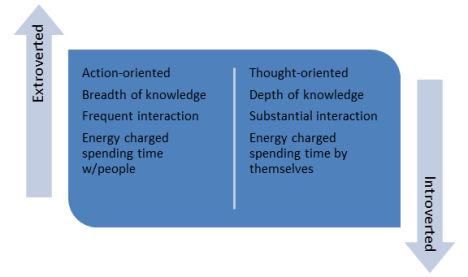
On one episode of Star Trek, for example, Captain Kirk thinks he is going to punish Scotty by telling him he can’t go on short leave. Scotty is delighted because he is says that will give him some time to catch up on his reading of technical journals. It was not perceived by him as a punishment, but as a reward, because Kirk and Scotty have opposite personality types.

So find out what your team members skills are but also what their personality type is, so that you can match your motivation to his or hers.

Reward properly

As a leader, you must reward people in such a way to motivate them to exhibit positive behavior and stop negative or undesirable behavior. Now what this behavior is depends on the context, but does it help further the project towards completion or not?

  1. Recognize them immediately or as soon as possible after the achievement, to encourage repetition of the behavior.
  2. Reward behavior that you want that is better than the standard. You can recognize or acknowledge behavior that meets the standard, but a reward should be something extra given for extra effort.
  3. Address undesirable behavior. This is crucial and controversial, because if you do not address that behavior, others on the team that do perform well will become discouraged. However, criticizing someone’s behavior in front of others may decrease their motivation, so I find it best to talk to that person individually so that issues of esteem with regard to the group do not show up. One way to address people’s concerns about others on a team is to have an issue log. This lets the person know that their concern is being addressed.
  4. Eliminate obstacles. If there is something in the environment, and not let’s say another person, who is causing a problem for a team, do what you can to eliminate that impediment.

 I think the best way to get a feel for this in Toastmasters is to pay attention to how you do your evaluations. There’s a lot that goes into an evaluation that is directly applicable to being skilled at motivating others to improve.

 So in retrospect, recognizing that different people have different motivations based on their individual needs and personality types will help you recognize what to use as motivation. You also need to learn when and how to use that motivation to both increase positive behavior and reduce negative behavior of a team member.

So with that, I hope I’ve motivated you all to improve not just in Toastmasters, but as a leader of your project team.

Sex, Ecology, Spirituality—Concepts of Hierarchy, Heterarchy, Holarchy


This is the second post which summarizes the ideas presented in the first chapter “The Web of Life” of Sex, Ecology, Spirituality, the philosophical work by Ken Wilber that inspired Lana Wachowski, the co-director with her brother Andy of such films as The Matrix Trilogy, V for Vendetta, and Cloud Atlas. I read an article in the New York Review of Books that reminded me that Lana Wachowski has been influenced by the philosopher Ken Wilber. Ken Wilber stands in relationship to Lana Wachowski as her philosophical muse in the same way that Joseph Campbell was to George Lucas, who based Star Wars on the “monomyth” described in The Hero of A Thousand Faces. I was inspired by this connection as mentioned in the NY Review of Books to start reading the book, and decided to take some notes of some key passages as I go through it.

1. Summary of the The Web of Life and the Great Chain of Being

Before I summarize the three concepts mentioned in the title of the post, let me situate how they fit into the narrative of the chapter. As mentioned in the last post, the first half of the chapter describes the modern ecological meme of the “Web of Life”, and how it is related to its philosophical forerunner in the Middle Ages called the Great Chain of Being.

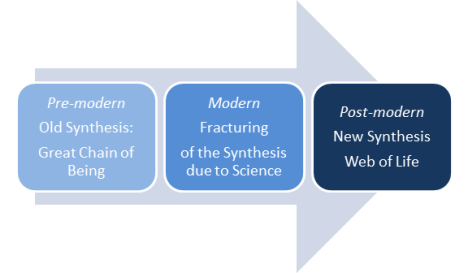
The intellectual history of this relationship shows three main overall stages, the medieval or pre-modern synthesis of the Great Chain of Being, the break-up of that synthesis with the rise of modern science, and the new synthesis that emerged during the latter part of the 20th century under the general meme of The Web of Life.

2. The Concept of Hierarchy falls on Politically Correct times

Many of the systems theorists that were responsible to contributing to the “new synthesis” mentioned above (where physical systems or the physiosphere also participates in “evolution” along with living systems or the biosphere) use the concept of hierarchy.

To illustrate their use of this concept, let me give an example from the “old synthesis”, the Great Chain of Being.

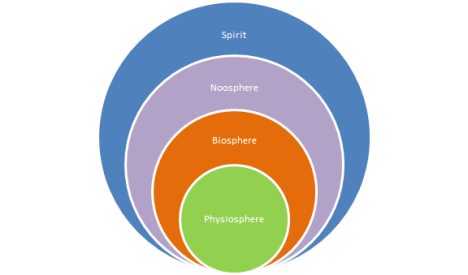
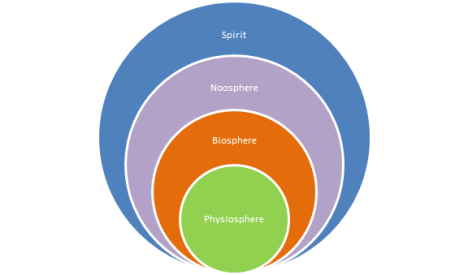
If you will notice the concentric circles, it’s not really a Chain of Being, as it is a Nest of Being. That is because the properties that are in the physiosphere are also in the biosphere, but the biosphere has emergent properties such as reproduction that are not in the physiosphere. This was recognized by Aristotle by his concepts of

  • plants possessing a “vegetative soul”, which meant they were capable of reproduction and growth,
  • animals possessing a vegetative soul plus a “sensitive soul” which meant they were also capable of mobility and sensation, and
  • humans possessing a vegetative soul, a sensitive soul, and a “rational soul” which meant they were also capable of thought and behavior

However, hierarchy became what I can refer to as “politically incorrect” in some academic circles because it seemed to imply the “higher” level did not transcend the “lower” level, but rather it somehow oppressed it. To give an example from literature, Harold Bloom, the celebrated literary critic and author of The Western Canon, said that many literary academics decried the very idea of their being a list of the “best books of Western Literature” because they implied that it was a tool of social and economic oppression, having been written by DWEMs (Dead White European Males) who were among the class of people that have historically carried out this oppression. He referred to this school of thought as part of the politically correct movement he calls “The School of Resentment”.

3. Heterarchy—an alternative to Hierarchy

The champions of The School of Resentment posit an egalitarian or “equalitarian” view where at best, more women and minority writers are included in The Western Canon, or better, if the Western Canon were gotten rid of altogether. Lewis Carroll satirized this egalitarian view with his character of the Dodo who declared after announcing a competition: “Everybody has won, and all must have prizes.”

The philosophical problem according to Ken Wilber is that there is a difference between a natural hierarchy, where the higher levels occur naturally because of the evolution of emergent properties, and the pathological case of a “dominator hierarchy”, where the higher level tries to oppress the lower level. By trying to get rid of all hierarchies, the normal or healthy ones as well as the unhealthy or pathological ones, the egalitarians are throwing the baby out with the bathwater. Their alternative is that of heterarchy, which is governance by the group, with essentially no leaders.

Ken Wilber says that a group that consists of parts, but no whole that encompasses them, is really what he calls a “heap”, because there is really no connection between the parts. Indeed, according to the documentary the Century of the Self by Adam Curtis, the communes of the 1960s that tried to live a strictly egalitarian lifestyle with no leaders all fell apart within a few years after their founding.

4. Hierarchy = Holarchy

Since each circle in the Great Chain of Being (except the physiosphere) has a circle or part within it, each can be considered a whole. But each can also be considered parts of larger wholes. This nested series of circles where each circle is both a part and a whole is an example of what Arthur Koesler termed a holon. In reality, the hierarchy that is healthy is actually a holarchy, a term that Ken Wilber coins.

If the parts overcome and destroy the whole, then this is a pathology of heterarchy. If the whole overcomes and destroys the parts within it, then this is a pathology of hierarchy. But a truly well-functioning system will allow for the growth of both the parts and the whole.

The Great Chain of Being and the Web of Life are two philosophical memes which represent a holarchy, and I believe that’s why he presented them in this first chapter before he presented the details of his theory of holons, which is presented in the next chapter.

Sex, Ecology, Spirituality—The Great Chain of Being


After watching the movie Cloud Atlas, directed by Lana and Andy Wachowski and Tom Tykwer, I read an article in the New York Review of Books that reminded me that Lana Wachowski has been influenced by the philosopher Ken Wilber. Ken Wilber stands in relationship to Lana Wachowski as her philosophical muse in the same way that Joseph Campbell was to George Lucas, who based Star Wars on the “monomyth” described in The Hero of A Thousand Faces. In the case of Ken Wilber, his philosophical work that inspired Lana was Sex, Ecology, Spirituality. I was inspired by this connection as mentioned in the NY Review of Books to start reading the book, and decided to take some notes of some key passages as I go through it.

1. Introduction—The Web of Life and the Great Chain of Being

The first chapter deals with the modern ecological meme of the “Web of Life”, and how it is related to its philosophical forerunner in the Middle Ages called the Great Chain of Being.

What was the theory of the Great Chain of Being? There were 3 essential elements.

1.


All phenomena in the material world (physiosphere), the living world of plants and animals (biosphere), and the world of the mind (noosphere) are manifestations of Spirit, and it is woven within each of them.


2.


There are “no gaps” in nature, because everything is interwoven by being part of Spirit, the “continuum of being”.


3. There are gradations within the different worlds contained in Spirit, since some emergent properties exist in some that don’t appear in others (the physiosphere cannot reproduce, the biosphere cannot create language, etc.).

2. The Breakup of the Great Chain of Being—part 1

This occurred with the rise of modern science when the physiosphere of material world was seen not as infused with Spirit, but rather like a machine, one whose movements could be explained through the new laws of physics being developed by Galileo, Newton, and others.

However, there are two types of phenomena within the material world, one where time plays no fundamental role, which is described by classical mechanics, and one where “time’s arrow” is essential, which is described by thermodynamics. So not only was the physiosphere detached from Spirit, but the material world was now a machine, a machine that according to thermodynamics was winding down.

3. The Great Chain of Being becomes The Web of Life

With the work of Alfred Wallace and Charles Darwin on evolution through natural selection in the biosphere, there was a return to the 2nd idea of the Great Chain of Being, that there was a continuity of life in its various forms, one that would become the modern meme of the Web of Life in the science of ecology.

4. The Great Chain of Being becomes Unchained

Although the plenum of the Great Chain of Being was considered timeless, the theory of natural selection was added the idea of the possibility of the creation of new species that evolved from the old ones, sometimes with even greater complexity. The biosphere now had a direction, and it was winding up, not down like the physiosphere.

This sense that the biosphere and physiosphere had somehow parted ways was very disconcerting to scientists in the 18th and 19th centuries. There was also an attempt by some to separate the mind (noosphere) from the natural world, particularly in the works of Descartes. So the three realms that were together in the Great Chain of Being were now separated from each other.

5. Early Attempts at Unification

The attempts to re-unify these now separated realms of existence took several forms. The first was to reduce mind and body to matter (the materialists such as Hobbes, La Mettrie). The second was to elevate matter and bodies to the status of mind (the phenomenalism of Berkeley). There were other theories as well, but none were convincing as a way to close the gap between these worlds.

6. Reunification

Ken Wilber maintains that the sciences of complexity (systems theory, chaos theory, nonequilibrium thermodynamics) show that when purely material processes become very chaotic and far from equilibrium, they tend to escape that chaos by transforming into higher and more structured orders.

Thus these sciences show that the physical world, like the natural world, has a tendency over time to “wind up” as well. Evolutionary systems theory shows that the same patterns apply to the physiosphere, the biosphere, and the noosphere, so a unified worldview is now a possibility once again.

7. Conclusion

This portion of chapter 1 of Sex, Ecology, Spirituality called The Web of Life shows the evolution of the fracturing of the medieval worldview and the reestablishment of what is essentially the same unified worldview but with the language of modern science rather than that of faith.